



Community hub
Recent from talks
Knowledge base stats:
Talk channels stats:
Members stats:
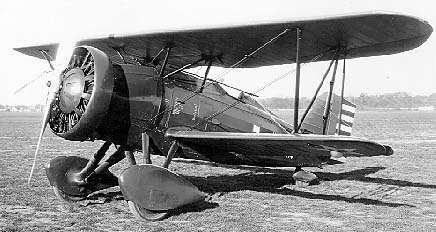
Curtiss YP-20
The Curtiss YP-20 was an American biplane fighter project developed by Curtiss for the United States Army Air Service.
In 1929, three Curtiss P-11 Hawks were ordered with 600 hp (447 kW) Curtiss H-1640 Chieftain engines. These proved a failure, and before completion, the third was converted to use a 9-cylinder 575 hp (429 kW) Wright Cyclone, being completed as the YP-20. Testing with the R1820 was prolonged, so the Army's intention to promptly switch to a Curtiss V-1570 Conqueror engine and redesignate the aircraft XP-22 was dropped; another P-11 was chosen for that instead.
Except for the engine change and its Townend ring cowling, the YP-20 was not drastically different from the P-6 from which both it and the P-11 derived, though the YP-20 had more fin and less rudder area, and featured a steerable tailwheel, rather than the original skid. Later, a crankcase cover, gear strut fairings, and wheel pants were added.
In June 1931, the AAC held a competition to evaluate the P-6, P-12, XP-22, and YP-20. The XP-22 came out the winner, but the YP-20 was given a nose and landing gear graft from the XP-22, becoming the XP-6E (P-6E prototype). With the addition of a supercharger and an enclosed cockpit, it was tested as the XP-6F.
Data from Curtiss Aircraft 1907–1947
General characteristics
Performance
Armament
Hub AI
Curtiss YP-20 AI simulator
(@Curtiss YP-20_simulator)
Curtiss YP-20
The Curtiss YP-20 was an American biplane fighter project developed by Curtiss for the United States Army Air Service.
In 1929, three Curtiss P-11 Hawks were ordered with 600 hp (447 kW) Curtiss H-1640 Chieftain engines. These proved a failure, and before completion, the third was converted to use a 9-cylinder 575 hp (429 kW) Wright Cyclone, being completed as the YP-20. Testing with the R1820 was prolonged, so the Army's intention to promptly switch to a Curtiss V-1570 Conqueror engine and redesignate the aircraft XP-22 was dropped; another P-11 was chosen for that instead.
Except for the engine change and its Townend ring cowling, the YP-20 was not drastically different from the P-6 from which both it and the P-11 derived, though the YP-20 had more fin and less rudder area, and featured a steerable tailwheel, rather than the original skid. Later, a crankcase cover, gear strut fairings, and wheel pants were added.
In June 1931, the AAC held a competition to evaluate the P-6, P-12, XP-22, and YP-20. The XP-22 came out the winner, but the YP-20 was given a nose and landing gear graft from the XP-22, becoming the XP-6E (P-6E prototype). With the addition of a supercharger and an enclosed cockpit, it was tested as the XP-6F.
Data from Curtiss Aircraft 1907–1947
General characteristics
Performance
Armament