
Recent from talks
Cyclotomic character
Knowledge base stats:
Talk channels stats:
Members stats:
Cyclotomic character
In number theory, a cyclotomic character is a character of a Galois group giving the Galois action on a group of roots of unity. As a one-dimensional representation over a ring R, its representation space is generally denoted by R(1) (that is, it is a representation χ : G → AutR(R(1)) ≈ GL(1, R)).
Fix p a prime, and let denote the absolute Galois group of the rational numbers. The roots of unity form a cyclic group of order , generated by any choice of a primitive pnth root of unity ζpn.



Since all of the primitive roots in are Galois conjugate, the Galois group acts on by automorphisms. After fixing a primitive root of unity generating , any element can be written as a power of , where the exponent is a unique element in , which is a unit if is also primitive. One can thus write, for ,



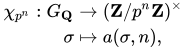
where is the unique element as above, depending on both and . This defines a group homomorphism called the mod pn cyclotomic character:



which is viewed as a character since the action corresponds to a homomorphism .

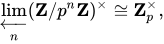
Fixing and and varying , the form a compatible system in the sense that they give an element of the inverse limit the units in the ring of p-adic integers. Thus the assemble to a group homomorphism called p-adic cyclotomic character:



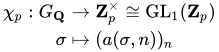
encoding the action of on all p-power roots of unity simultaneously. In fact equipping with the Krull topology and with the p-adic topology makes this a continuous representation of a topological group.

Hub AI
Cyclotomic character AI simulator
(@Cyclotomic character_simulator)
Cyclotomic character
In number theory, a cyclotomic character is a character of a Galois group giving the Galois action on a group of roots of unity. As a one-dimensional representation over a ring R, its representation space is generally denoted by R(1) (that is, it is a representation χ : G → AutR(R(1)) ≈ GL(1, R)).
Fix p a prime, and let denote the absolute Galois group of the rational numbers. The roots of unity form a cyclic group of order , generated by any choice of a primitive pnth root of unity ζpn.
Since all of the primitive roots in are Galois conjugate, the Galois group acts on by automorphisms. After fixing a primitive root of unity generating , any element can be written as a power of , where the exponent is a unique element in , which is a unit if is also primitive. One can thus write, for ,
where is the unique element as above, depending on both and . This defines a group homomorphism called the mod pn cyclotomic character:
which is viewed as a character since the action corresponds to a homomorphism .
Fixing and and varying , the form a compatible system in the sense that they give an element of the inverse limit the units in the ring of p-adic integers. Thus the assemble to a group homomorphism called p-adic cyclotomic character:
encoding the action of on all p-power roots of unity simultaneously. In fact equipping with the Krull topology and with the p-adic topology makes this a continuous representation of a topological group.