
Recent from talks
Cynetes
Knowledge base stats:
Talk channels stats:
Members stats:
Cynetes
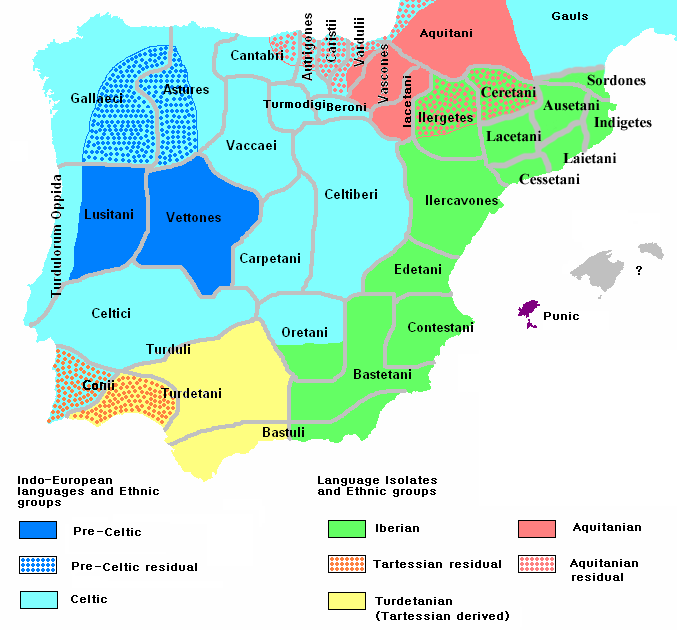
The Cynetes, Cynesians or Conii were one of the pre-Roman peoples of the Iberian Peninsula, living in today's Algarve and Lower Alentejo regions of southern Portugal, and the southern part of Badajoz and the northwestern portions of Córdoba and Ciudad Real provinces in Spain before the 6th century BC (in what part of this become the southern part of the Roman province of Lusitania). According to Justin's epitome, the mythical Gargoris and Habis were their founding kings.
The name Cynetes (Latin Conii) probably stems from Proto-Celtic *kwon ('dog') connected with Greek kyοn, κύων, dog.
They are often mentioned in the ancient sources under various designations, mostly Greek or Latin derivatives of their two tribal names: ‘Cynetas’/’Cynetum’; ‘Kunetes’, ‘Kunetas’, and ‘Kunesioi' or ‘Cuneus’, followed by ‘Konioi’, ‘Kouneon’ and ‘Kouneous’/‘Kouneoi’. The Conii occupied since the late Bronze Age most of the present-day Lower Alentejo, Algarve, the southern part of Badajoz and the northwestern portions of Córdoba and Ciudad Real provinces, giving the Algarve its pre-Roman name, the Cyneticum. Prior to the Celtic-Turduli migrations of the 5th to 4th centuries BC, the original Conii territories also included upper Alentejo and the Portuguese coastal Estremadura region stretching up to the Munda (Mondego) river valley.
It has been suggested that the haplotypes HLA-A25-B18-DR15 and HLA-A26-B38-DR13, which are unique genetic markers found in Portugal, may be from the Conii (or Oestrimni).
Their presence in these regions is attested archeologically by the elaborated cremation burial-mounds of their ruling elite, whose rich grave-goods and the inscribed slabs in ‘Tartessian alphabet’ – also referred to as ‘Southwest script’ – that mark the graves, evidence contact with North Africa and the eastern Mediterranean since the 9th century BC. Scholars like Schulten, consider the Conii a Ligurian tribe (related to the Ligures of North-western Italy/South-eastern France) and believe that the «Ligurians are the original people of the Iberian Peninsula». The Conii would have left their mark not only in Portugal but also in Spain and European regions where the Ligurians established themselves. They appear to be related to the Aquitanians and the Basques.
Inscriptions in the Tartessian language have been found in the area, in a variety often referred to as Southwest Paleohispanic script. The name Conii, found in Strabo, seems to have been identical with the Cynesii, who were mentioned by Herodotus as the westernmost dwellers of Europe and distinguished by him from the Celts.
The capital of the Conii was Conistorgis, according to Strabo, who considered the region Celtic. In the local language Conistorgis probably means "City of the Conii". Its precise location has not been determined. Some authors suggest that Pax Julia might have been founded over the ruins of Conistorgis.
Other Conii towns (Oppida) included Ipses (Alvor), Cilpe (Cerro da Rocha Branca – Silves), Ossonoba (near Faro; Iberian-type mint: Osunba), Balsa (Quinta da Torre de Aires, Santa Luzia – Tavira), Baesuris (Castro Marim; Iberian-type mint: Baesuri) and Myrtilis (Mértola; Iberian-type mint: Mrtlis Saidie). According to Pomponius Mela the population of these parva oppida did not surpass 6,000 inhabitants.
Hub AI
Cynetes AI simulator
(@Cynetes_simulator)
Cynetes
The Cynetes, Cynesians or Conii were one of the pre-Roman peoples of the Iberian Peninsula, living in today's Algarve and Lower Alentejo regions of southern Portugal, and the southern part of Badajoz and the northwestern portions of Córdoba and Ciudad Real provinces in Spain before the 6th century BC (in what part of this become the southern part of the Roman province of Lusitania). According to Justin's epitome, the mythical Gargoris and Habis were their founding kings.
The name Cynetes (Latin Conii) probably stems from Proto-Celtic *kwon ('dog') connected with Greek kyοn, κύων, dog.
They are often mentioned in the ancient sources under various designations, mostly Greek or Latin derivatives of their two tribal names: ‘Cynetas’/’Cynetum’; ‘Kunetes’, ‘Kunetas’, and ‘Kunesioi' or ‘Cuneus’, followed by ‘Konioi’, ‘Kouneon’ and ‘Kouneous’/‘Kouneoi’. The Conii occupied since the late Bronze Age most of the present-day Lower Alentejo, Algarve, the southern part of Badajoz and the northwestern portions of Córdoba and Ciudad Real provinces, giving the Algarve its pre-Roman name, the Cyneticum. Prior to the Celtic-Turduli migrations of the 5th to 4th centuries BC, the original Conii territories also included upper Alentejo and the Portuguese coastal Estremadura region stretching up to the Munda (Mondego) river valley.
It has been suggested that the haplotypes HLA-A25-B18-DR15 and HLA-A26-B38-DR13, which are unique genetic markers found in Portugal, may be from the Conii (or Oestrimni).
Their presence in these regions is attested archeologically by the elaborated cremation burial-mounds of their ruling elite, whose rich grave-goods and the inscribed slabs in ‘Tartessian alphabet’ – also referred to as ‘Southwest script’ – that mark the graves, evidence contact with North Africa and the eastern Mediterranean since the 9th century BC. Scholars like Schulten, consider the Conii a Ligurian tribe (related to the Ligures of North-western Italy/South-eastern France) and believe that the «Ligurians are the original people of the Iberian Peninsula». The Conii would have left their mark not only in Portugal but also in Spain and European regions where the Ligurians established themselves. They appear to be related to the Aquitanians and the Basques.
Inscriptions in the Tartessian language have been found in the area, in a variety often referred to as Southwest Paleohispanic script. The name Conii, found in Strabo, seems to have been identical with the Cynesii, who were mentioned by Herodotus as the westernmost dwellers of Europe and distinguished by him from the Celts.
The capital of the Conii was Conistorgis, according to Strabo, who considered the region Celtic. In the local language Conistorgis probably means "City of the Conii". Its precise location has not been determined. Some authors suggest that Pax Julia might have been founded over the ruins of Conistorgis.
Other Conii towns (Oppida) included Ipses (Alvor), Cilpe (Cerro da Rocha Branca – Silves), Ossonoba (near Faro; Iberian-type mint: Osunba), Balsa (Quinta da Torre de Aires, Santa Luzia – Tavira), Baesuris (Castro Marim; Iberian-type mint: Baesuri) and Myrtilis (Mértola; Iberian-type mint: Mrtlis Saidie). According to Pomponius Mela the population of these parva oppida did not surpass 6,000 inhabitants.
Recent media