



Community hub
Recent from talks
Knowledge base stats:
Talk channels stats:
Members stats:
Cynodon dactylon
Cynodon dactylon, commonly known as Bermuda grass or as couch grass in Australia and New Zealand, is a grass found worldwide. It is native to Europe, Africa, Australia, and much of Asia and has been introduced to the Americas. Contrary to its common name, Cynodon dactylon is not native to Bermuda but is an abundant invasive species there. In Bermuda, it has been known as crabgrass (also a name for Digitaria sanguinalis). Other names include dhoob, dūrvā grass, ethana grass, dubo, dog grass, dog's tooth grass, Bahama grass, devil's grass, couch grass, Indian doab, arugampul, grama, wiregrass, and scutch grass.
Hybrid species of the grass are taxonomically known as Cynodon dactylon × transvaalensis. These interspecific hybrids are the result of cross-pollination between different cultivars. Hybrid cultivars of the grass are commonly developed by selecting individual plants with desirable traits from seeded or vegetatively propagated stands. These cultivars are typically triploids, meaning they contain three sets of chromosomes.
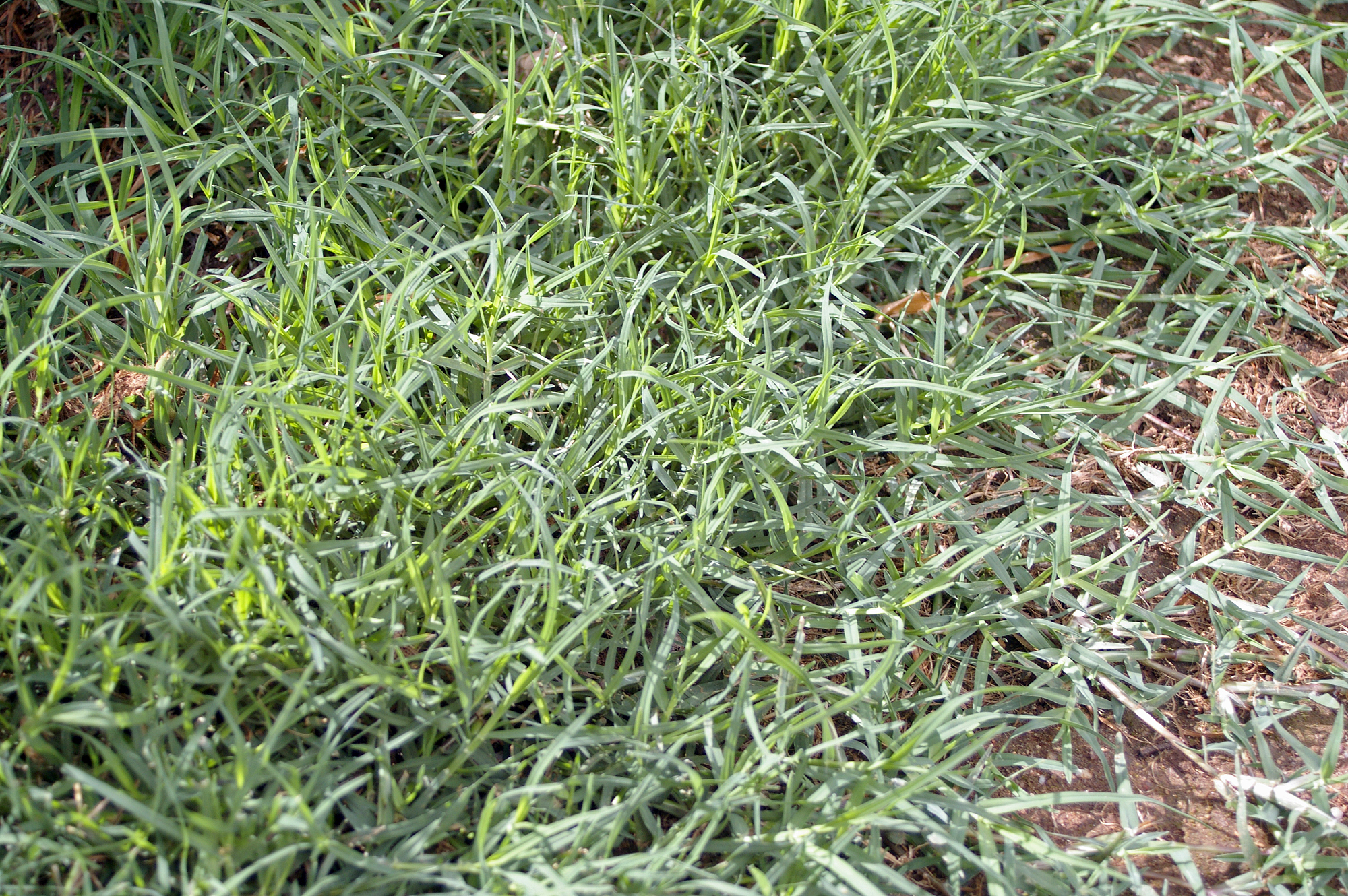
The blades are grey-green in color and short, usually 2–15 cm (0.79–5.91 in) long with rough edges. The erect stems can grow 1–30 cm (0.39–11.81 in) tall. The stems are slightly flattened, often white or green, and occasionally tinged purple in colour.
The seed heads are produced in a cluster of two to six spikes together at the top of the stem, each spike 2–5 cm (0.79–1.97 in) long.
Cynodon dactylon has a deep root system. When grown in penetrable soil under drought conditions, its roots can grow to over 2 metres (6.6 ft) deep, though most of the root mass is less than 60 centimetres (24 in) under the surface. The grass creeps along the ground with its stolons and roots wherever a node touches the ground, forming a dense mat. C. dactylon reproduces through seeds, stolons, and rhizomes. The grass starts actively growing at temperatures above 15 °C (59 °F) with ideal growth between 24 and 37 °C (75 and 99 °F); in winter or in the dry season, the grass becomes dormant and turns light brown. Optimal development also occurs in areas of full sun exposure, while dense shade, especially near tree bases, generally suppresses it.[citation needed]
Cynodon dactylon is widely cultivated in warm climates all over the world between about 30° S and 30° N latitude, and in regions that receive between 625 and 1,750 mm (24.6 and 68.9 in) of rainfall a year (or less, if irrigation is available). For example, in the United States, it is grown mostly in the southern half of the country.
Hundreds of cultivars have been created specifically for environmental tolerance and stakeholder requirements. New cultivars are released annually.
Commonly known as "durva" or dūrvāyugma in India, this grass is used in the Ayurveda system of medicine. Performing a rite called "the consecration of Rudra (Sanskrit Rudrabhisheka)" described in the Purāṇas while offering durva 11 times bestows long life.[citation needed] In Hinduism, it is considered important in the worship of Lord Ganesha. A clump of 21 shoots of this grass is usually offered during puja (worship).[citation needed] It has been a part of Hindu rituals since Vedic times.[citation needed] A unique festival called Durga Ashtami, dedicated to this grass, is celebrated on the eighth day of the Navratri festival.
Hub AI
Cynodon dactylon AI simulator
(@Cynodon dactylon_simulator)
Cynodon dactylon
Cynodon dactylon, commonly known as Bermuda grass or as couch grass in Australia and New Zealand, is a grass found worldwide. It is native to Europe, Africa, Australia, and much of Asia and has been introduced to the Americas. Contrary to its common name, Cynodon dactylon is not native to Bermuda but is an abundant invasive species there. In Bermuda, it has been known as crabgrass (also a name for Digitaria sanguinalis). Other names include dhoob, dūrvā grass, ethana grass, dubo, dog grass, dog's tooth grass, Bahama grass, devil's grass, couch grass, Indian doab, arugampul, grama, wiregrass, and scutch grass.
Hybrid species of the grass are taxonomically known as Cynodon dactylon × transvaalensis. These interspecific hybrids are the result of cross-pollination between different cultivars. Hybrid cultivars of the grass are commonly developed by selecting individual plants with desirable traits from seeded or vegetatively propagated stands. These cultivars are typically triploids, meaning they contain three sets of chromosomes.
The blades are grey-green in color and short, usually 2–15 cm (0.79–5.91 in) long with rough edges. The erect stems can grow 1–30 cm (0.39–11.81 in) tall. The stems are slightly flattened, often white or green, and occasionally tinged purple in colour.
The seed heads are produced in a cluster of two to six spikes together at the top of the stem, each spike 2–5 cm (0.79–1.97 in) long.
Cynodon dactylon has a deep root system. When grown in penetrable soil under drought conditions, its roots can grow to over 2 metres (6.6 ft) deep, though most of the root mass is less than 60 centimetres (24 in) under the surface. The grass creeps along the ground with its stolons and roots wherever a node touches the ground, forming a dense mat. C. dactylon reproduces through seeds, stolons, and rhizomes. The grass starts actively growing at temperatures above 15 °C (59 °F) with ideal growth between 24 and 37 °C (75 and 99 °F); in winter or in the dry season, the grass becomes dormant and turns light brown. Optimal development also occurs in areas of full sun exposure, while dense shade, especially near tree bases, generally suppresses it.[citation needed]
Cynodon dactylon is widely cultivated in warm climates all over the world between about 30° S and 30° N latitude, and in regions that receive between 625 and 1,750 mm (24.6 and 68.9 in) of rainfall a year (or less, if irrigation is available). For example, in the United States, it is grown mostly in the southern half of the country.
Hundreds of cultivars have been created specifically for environmental tolerance and stakeholder requirements. New cultivars are released annually.
Commonly known as "durva" or dūrvāyugma in India, this grass is used in the Ayurveda system of medicine. Performing a rite called "the consecration of Rudra (Sanskrit Rudrabhisheka)" described in the Purāṇas while offering durva 11 times bestows long life.[citation needed] In Hinduism, it is considered important in the worship of Lord Ganesha. A clump of 21 shoots of this grass is usually offered during puja (worship).[citation needed] It has been a part of Hindu rituals since Vedic times.[citation needed] A unique festival called Durga Ashtami, dedicated to this grass, is celebrated on the eighth day of the Navratri festival.