Hubbry Logo
CyprinodontiformesCyprinodontiformesMain
Open search
Cyprinodontiformes
Community hub
Cyprinodontiformes
logo
8 pages, 0 posts
0 subscribers
Be the first to start a discussion here.
Cyprinodontiformes
Cyprinodontiformes
from Wikipedia

Cyprinodontiformes
Temporal range: Late Paleocene–recent
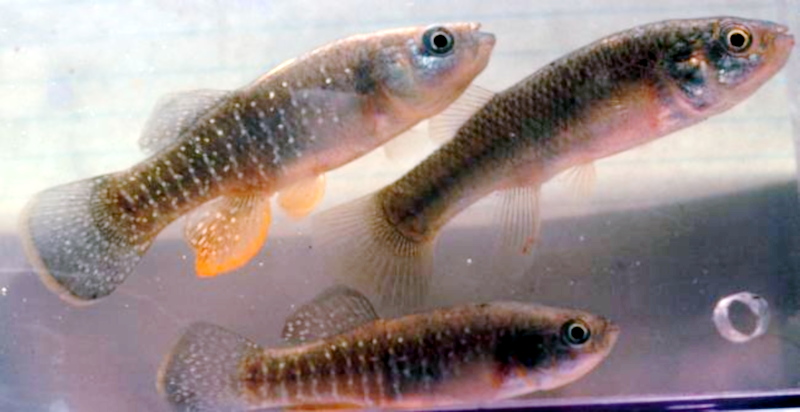
Mummichog (Fundulus heteroclitus heteroclitus)
Female (top right) and two males
Scientific classification Edit this classification
Kingdom: Animalia
Phylum: Chordata
Class: Actinopterygii
Clade: Ovalentaria
Order: Cyprinodontiformes
L. S. Berg, 1940
Type species
Cyprinodon variegatus
Lacépède, 1803
Suborders

Aplocheiloidei
Cyprinodontoidei

Synonyms

Microcyprini Regan, 1909

Cyprinodontiformes /ˌsɪprɪnˈdɒntɪfɔːrmz/ is an order of ray-finned fish, comprising mostly small, freshwater fish.[1] Many popular aquarium fish, such as killifish and live-bearers, are included. They are closely related to the Atheriniformes and are occasionally included with them. A colloquial term for the order as a whole is toothcarps, though they are not actually close relatives of the true carps – the latter belong to the superorder Ostariophysi, while the toothcarps are Acanthopterygii.

The families of Cyprinodontiformes can be informally divided into three groups based on reproductive strategy: viviparous and ovoviviparous (all species give live birth), and oviparous (all species are egg-laying). The live-bearing groups differ in whether the young are carried to term within (ovoviviparous) or without (viviparous) an enclosing eggshell. Phylogenetically however, one of the two suborders – the Aplocheiloidei – contains oviparous species exclusively, as do two of the four superfamilies of the other suborder (the Cyprinodontoidea and Valencioidea of the Cyprinodontoidei). Vivipary and ovovivipary have evolved independently from oviparous ancestors, the latter possibly twice.

The oldest fossil record of the group is the extinct ?Cyprinodon primulus, a nomen vanum known from isolated fossil scales from the Late Paleocene of Argentina. Its exact taxonomic identity is uncertain, although it is generally considered to at least be a true cyprinodontiform.[2][3]

Description

[edit]
Fundulopanchax scheeli, a killifish of the family Nothobranchiidae.

Some members of this order are notable for inhabiting extreme environments, such as saline or very warm waters, heavily polluted waters, rain water pools devoid of minerals and made acidic by decaying vegetation, or isolated situations where no other types of fish occur.

They are typically carnivores, and often live near the surface, where the oxygen-rich water compensates for environmental disadvantages. Scheel (1968) observed the gut contents were invariably ants, others have reported insects, worms and aquatic crustaceans. Aquarium specimens are invariably seen eating protozoans from the water column and the surfaces of leaves, however these are not apparent as stomach contents. Many members of the family Cyprinodontidae (the pupfishes) eat plant material as well and some have adapted to a diet very high in algae to the point where one, the Flagfish also known as American flagfish, is a renowned algae eater in the aquarium, in spite of belonging to an order of fishes that do not generally consume any plant material. In addition, killifish derive some of the carotenoids and other chemicals required to make their body pigments from pollen grains on the surface of and in the gut of insects they eat from the surface of the water; this can be simulated in culture by the use of special color enhancing foods that contain these compounds.

Although the Cyprinodontiformes are a diverse group, most species contained within are small to medium-sized fish, with small mouths, large eyes, a single dorsal fin, and a rounded caudal fin. The largest species is the cuatro ojos (Anableps dowei), which measures 34 cm (13 in)[4] in length, while the smallest, the least killifish (Heterandria formosa), is just 8 mm (0.31 in) long as an adult.[5]

Systematics

[edit]

Based on Eschmeyer's Catalog of Fishes (2025):[6]

Guppy, a live-bearer of the Poeciliidae

CYPRINODONTIFORMES

The family Aplocheilidae has been expanded by some authorities to include all the killifishes with three subfamilies, Aplocheilinae, Cynolebiinae and Nothobranchiinae,[8] but this is not the classification adopted in the 5th Edition of Fishes of the World.[9]

Phylogeny

[edit]

Based on:[7][10]

Cyprinodontiformes

References

[edit]
Revisions and contributorsEdit on WikipediaRead on Wikipedia
from Grokipedia
Cyprinodontiformes is an order of ray-finned fishes (class ) comprising approximately 1,500 (as of 2025) across 16 families, including well-known groups such as killifishes, pupfishes, toothcarps, and . These predominantly small fishes, typically measuring 2–15 cm in length, are characterized by diagnostic features such as a symmetrical caudal fin supported by a single epural, a low-set pectoral with a scalelike postcleithrum, pitted scales on the body, and marked with often brightly colored males. The order exhibits high morphological and ecological diversity, with adapted to a range of reproductive strategies from egg-laying () to live-bearing (), and many are popular in the aquarium trade due to their vibrant colors and hardiness. Taxonomically, Cyprinodontiformes belongs to the superorder Atherinomorpha and is divided into two monophyletic suborders: Aplocheiloidei (encompassing families like Aplocheilidae and Nothobranchiidae from the , and Rivulidae from the ) and Cyprinodontoidei (including New World families such as , Goodeidae, and Cyprinodontidae). The 16 recognized families are Anablepidae, Aphaniidae, Aplocheilidae, Cubanichthyidae, Cyprinodontidae, Fluviphylacidae, Fundulidae, Goodeidae, Nothobranchiidae, Orestiidae, Pantanodontidae, , Procatopodidae, Profundulidae, Rivulidae, and Valenciidae, with the highest species diversity in Rivulidae (~520 species) and (~280 species) (as of 2025). Phylogenetic studies using molecular data, such as anchored hybrid enrichment, have confirmed the of the order and resolved familial relationships, highlighting its evolutionary divergence around 45 million years ago alongside the sister order . Cyprinodontiformes are globally distributed, with centers of diversity in the Neotropics (especially ), sub-Saharan Africa, and parts of and , inhabiting freshwater rivers, lakes, swamps, and temporary pools, as well as brackish estuaries and some coastal marine environments. Many species thrive in challenging habitats, including ephemeral wetlands with seasonal drying, hypersaline lagoons, and low-oxygen waters, showcasing physiological adaptations like air-breathing in certain amphibious forms and tolerance to wide salinity ranges. Ecologically, they play key roles as predators of insects and , serving as mosquito control agents in some regions (e.g., species), while facing threats from habitat loss, , and , leading to numerous endangered taxa. The order's record dates to the Early Tertiary, underscoring its ancient lineage within atherinomorph fishes.

Introduction and Description

Physical Characteristics

Cyprinodontiformes encompass a diverse array of small to medium-sized ray-finned fishes, with body lengths ranging from about 3.5 cm in the least (Heterandria formosa) to 32 cm in the largest species, such as the (Anableps anableps). Diagnostic features include a symmetrical caudal fin supported by a single epural, a low-set pectoral with a scalelike postcleithrum, pitted scales on the body, pelvic fins in an abdominal position or reduced/absent, and a reduced lateral line system primarily cephalic. These fishes generally feature a slender to moderately compressed body, small mouths suited for capturing small prey like and , and prominent large eyes that enhance vision in dim or low-light environments, as well as for surface-oriented species that forage at the water-air interface. The skin is covered by scales, which are smooth and rounded, providing flexibility in varied aquatic habitats. The mouth position is typically terminal or slightly superior, often oblique and protrusible to facilitate feeding on surface or mid-water resources, with some surface-dwelling taxa exhibiting upturned mouths for accessing at the water surface. Fin structures are characteristic of the order, featuring soft-rayed fins that mostly lack spines (though rare spines occur in some taxa)—a trait distinguishing them from many other percomorph fishes—and a single soft-rayed positioned posteriorly, along with a rounded or truncate caudal that aids in maneuverability in shallow or vegetated waters. In viviparous families like and Goodeidae, males possess a specialized known as the gonopodium, formed by elongation and modification of the anal fin rays, which enables . Many species demonstrate remarkable physiological adaptations for conditions, tolerating salinities from freshwater to hypersaline environments through enhanced , including the proliferation of chloride cells in the gills that actively secrete excess salts.

Habitat and Distribution

Cyprinodontiformes exhibit a broad global distribution, primarily concentrated in tropical and temperate regions of the , including North, Central, and , as well as the , encompassing (including ), the Mediterranean basin, , the , and parts of southern such as . In the , they are prevalent from the through the Neotropics to southern , while in the , species are found from the and eastward to the and the . This distribution reflects their Gondwanan origins, with vicariance and dispersal events shaping current patterns across freshwater and coastal systems. Most species are predominantly freshwater inhabitants, favoring shallow, vegetated waters such as marshes, ponds, and slow-moving with abundant aquatic for cover and foraging. Many occupy temporary or ephemeral habitats, including seasonal pools and floodplains that dry periodically; for instance, annual killifishes of the family Nothobranchiidae thrive in rain-filled savanna pools in , completing their life cycles before habitats desiccate. species, such as those in the families Cyprinodontidae and , extend into brackish and hypersaline environments, including estuaries, salt marshes, and even isolated hypersaline springs. They demonstrate remarkable tolerance for extreme conditions, inhabiting hot springs (e.g., Cyprinodon pupfishes in geothermal pools exceeding 40°C), acidic swamps in tropical regions, and polluted urban where is degraded by anthropogenic inputs. Vertically, Cyprinodontiformes are typically found in surface to mid-water layers of shallow habitats, rarely exceeding depths of 10 m, with a preference for oxygen-rich waters. Certain species tolerate a wide range of 10–40°C, with some enduring extremes from near-freezing to over 45°C, and salinities from 0 to 100 ppt or higher. These adaptations enable occupancy of marginal ecosystems, from high-altitude Andean lakes to desert oases.

Systematics and Taxonomy

Historical Classification

The classification of Cyprinodontiformes traces back to the 19th century, when early ichthyologists began grouping small, tooth-bearing fishes based on shared morphological features such as cycloid scales, dorsal fin position, and fin ray counts. Pierre Bleeker contributed significantly in 1859 by proposing the suborder Aplocheiloidei within the broader atherinoid fishes, encompassing oviparous species with adhesive eggs, exemplified by genera like Aplocheilus, and emphasizing scale patterns and fin structures as diagnostic traits. This suborder highlighted distinctions from other silversides (Atheriniformes) through reproductive modes, setting the stage for later separations. By the early 20th century, debates intensified over whether these fishes should remain subsumed under or warrant independent status, driven by differences in reproduction— in many and forms versus in groups like —and morphological variations in structure and arches. George S. Myers advanced this in by formally establishing the Rivulidae for Neotropical rivulines, characterized by life cycles and specific scale coverings, while proposing suborders Aplocheiloidei and Cyprinodontoidei to organize oviparous cyprinodontids into subfamilies like Fundulinae and Rivulinae based on orbital rim attachment and morphology. These efforts underscored reproductive strategies as key separators from , though some classifications still embedded them within broader atherinomorph groups. The order Cyprinodontiformes was formally established by Lev S. Berg in 1940, who renamed the earlier Microcyprini and recognized it as distinct from , initially comprising fewer families focused on oviparous Cyprinodontoidea (e.g., Cyprinodontidae) and viviparous Poeciloidea (e.g., , Goodeidae), with classifications relying on fin ray counts, scale cycloidy, and patterns. This framework consolidated pre-1940 proposals but retained ambiguities in family boundaries due to overlapping traits. In the mid-20th century, revisions emphasized reproductive dichotomies, with J. J. Hoedeman's 1961 work proposing subfamilies within Rivulidae based on squamation and cephalic sensory pores, contributing to consolidations that recognized 5 to 8 families by the 1970s, such as Profundulidae (established with Hoedeman and Bronner in 1951) for Central American forms distinguished by live-bearing and scale patterns. These changes highlighted in aplocheiloids versus in poecilioids as central to taxonomic stability, though ongoing morphological analyses revealed variability in traits like head scalation.

Current Taxonomy

The current taxonomy of Cyprinodontiformes recognizes the order as comprising two suborders: Aplocheiloidei, which includes oviparous species in three families (Aplocheilidae, Nothobranchiidae, and Rivulidae), and Cyprinodontoidei, which encompasses species with mixed reproductive modes across thirteen families (Anablepidae, Aphaniidae, Cubanichthyidae, Cyprinodontidae, Fluviphylacidae, Fundulidae, Goodeidae, Orestiidae, Pantanodontidae, , Procatopodidae, Profundulidae, and Valenciidae). This division reflects phylogenetic analyses emphasizing reproductive strategies and morphological traits, with Aplocheiloidei primarily featuring annual killifishes adapted to temporary waters. As of the 2025 editions of authoritative , Cyprinodontiformes is classified into 16 families total, a structure established through revisions between 2018 and 2022 that recognized Cubanichthyidae and Orestiidae as distinct families based on molecular and morphological evidence. Subfamilies are recognized within several families, such as () in and Cynolebiinae (pearl killifishes) in Rivulidae, providing finer resolution for genera with diverse ecologies. Ongoing taxonomic debates include the of Rivulidae and the potential amalgamation of Aphaniidae and Valenciidae, informed by genomic and highlighting the need for further integrative studies. These classifications draw from Eschmeyer's Catalog of Fishes (2025 edition) and Huber's Killi-Data (2025), which serve as primary references for ichthyological and updates.

Phylogeny and Evolution

Phylogenetic analyses of Cyprinodontiformes reveal two primary suborders: Aplocheiloidei, positioned as the basal group comprising oviparous ancestors including families like Rivulidae, Nothobranchiidae, and Aplocheilidae, and the more derived Cyprinodontoidei, which encompasses 13 families and exhibits greater diversification. Within Cyprinodontoidei, key clades include Poeciliidae sister to Anablepidae and Fluviphylacidae, and Goodeidae sister to Profundulidae, with Pantanodontidae emerging as the earliest diverging lineage among cyprinodontoids. These relationships were established through molecular studies, such as Helmstetter et al. (2016), which utilized mitochondrial DNA sequences (e.g., CYTB, COX1, ND1, ND2, 12S-rRNA, 16S-rRNA) and nuclear genes in a Bayesian inference framework to construct a time-calibrated tree, highlighting rate shifts in diversification. Similarly, Piller et al. (2022) employed anchored hybrid enrichment across ~244 loci to confirm the monophyly of the order and refine interfamily relationships, resolving previous uncertainties like the placement of Cubanichthyidae and Orestiidae. Viviparity has evolved independently at least five times within Cyprinodontoidei, notably in and Goodeidae, driving elevated speciation rates up to five times the background level in viviparous lineages compared to oviparous ones. This reproductive innovation contributed to bursts of diversification, with viviparous clades showing approximately twofold higher net diversification rates. The crown age of Cyprinodontiformes is estimated at around 70 million years ago (Mya) in the , based on genomic analyses calibrated with data. The fossil record of Cyprinodontiformes begins in the Late Paleocene of , with dubious ?Procatopodidae-like forms represented by isolated scales of the nomen vanum Cyprinodon? primulus from the Maíz Gordo Formation, dated to approximately 60 Mya. A major radiation occurred during the Eocene, coinciding with and the fragmentation of , which facilitated adaptive radiations in isolated freshwater and brackish habitats across , , and . Multigene phylogenies support continent-scale radiations within the order, linking diversification patterns to vicariance events. Evolutionary adaptations in Cyprinodontiformes, such as salinity tolerance in Aphaniidae allowing in fluctuating coastal environments and annual life cycles in Rivulidae enabling survival in temporary pools amid climate variations, arose in response to post-Eocene paleoclimatic shifts and habitat isolation. These traits underscore the order's resilience and role in filling ecological niches vacated by mass extinction events. The divergence of Cyprinodontiformes from its sister group within Atherinomorpha is estimated around 71 Mya, near the origin of the superorder.

Diversity

Families and Subfamilies

Cyprinodontiformes encompasses a diverse array of families, primarily distinguished by reproductive strategies, preferences, and geographic distributions, with many exhibiting adaptations to temporary or extreme environments. The order is broadly divided into suborders Aplocheiloidei and Cyprinodontoidei, grouping and lineages, respectively, based on phylogenetic analyses. Aplocheilidae comprise Old World killifishes, oviparous fishes characterized by small to medium body sizes and adaptations to freshwater streams and ponds, with a distribution centered in , , and . Key genera include Aplocheilus and Pachypanchax, featuring distinct fin structures and typical of the order. These fishes are non-annual, depositing adhesive eggs on substrates such as . Nothobranchiidae represent African annual killifishes, renowned for their substrate-spawning behavior in temporary pools and wetlands south of the Desert. Prominent genera such as Nothobranchius and Epiplatys exhibit diapausing eggs that survive dry periods, enabling rapid colonization of ephemeral habitats across continental . Their distinguishing features include vibrant male coloration and a short lifespan synchronized with seasonal flooding. Rivulidae, the largest family of Neotropical killifishes, inhabit diverse freshwater systems from seasonal pools to permanent rivers across Central and . This family includes over 30 genera, exemplified by Rivulus (non-annual forms in stable waters) and Cynolebias (annual species in temporary habitats), with many showing despite . The subfamily Cynolebiinae is notable for its annual members adapted to seasonal pools, featuring drought-resistant eggs buried in substrates. Anablepidae, known as four-eyed fishes and , are viviparous species with unique divided eyes adapted for simultaneous vision above and below the water surface. Distributed in freshwater and brackish habitats from southern to northern , key genera include Anableps, Jenynsia, and Oxyzygonectes. Cubanichthyidae consist of small oviparous pupfishes endemic to freshwater habitats in western , represented by the single genus Cubanichthys with a few species adapted to karstic systems and showing limited morphological variation. Fluviphylacidae, the American lampeyes, are tiny oviparous fishes inhabiting blackwater streams and floodplain forests of the , , and Essequibo basins in . The genus Fluviphylax features translucent bodies and large eyes, with species depositing eggs among vegetation. Cyprinodontidae, commonly known as pupfishes, are oviparous species often dwelling in harsh, arid environments like springs and hypersaline waters. Distributed from the through the to northern , key genera include Cyprinodon (adaptable to varying salinities). Subfamilies such as Cyprinodontinae dominate lowland, niches. Orestiidae, Andean pupfishes, are oviparous highland species endemic to lakes, rivers, and springs in the Andean from to , with the genus Orestias featuring specialized gill structures for low-oxygen conditions and tolerance to salinity variations. Approximately 50 species occur, many in . Poeciliidae, the livebearers, are viviparous fishes with internal fertilization, widespread in freshwater and brackish habitats from the to , and introduced elsewhere. Genera like (including guppies with polymorphic traits) and (mosquitofishes used in biocontrol) feature gonopodia in males for sperm transfer. The subfamily Poeciliinae is distinguished by gonopodial thrusting during , promoting and diverse mating behaviors. Goodeidae, endemic to central and adjacent areas, exhibit advanced matrotrophic where embryos receive nutrients from maternal tissues via trophotaeniae. This family occupies highland rivers and lakes, with genera such as Goodea and Xenotoca displaying split fins in males as a primitive . Their distribution is restricted to the Mesa Central, reflecting Gondwanan origins with specialized . Pantanodontidae, spine killifishes, are small oviparous African with elongated spines in males, inhabiting coastal swamps, lagoons, and freshwater streams in . Key genera include Pantanodon and the extinct Malagasy Malagodon, noted for their basal position in cyprinodontoid phylogeny. Procatopodidae, African lampeyes, comprise over 100 small oviparous killifishes distributed across sub-Saharan African freshwater systems, including rivers, lakes, and swamps. Genera such as Aplocheilichthys, Lacustricola, and Procatopus feature large reflective eyes and adhesive eggs laid on substrates. Fundulidae, North American topminnows, are oviparous inhabitants of coastal plains, estuaries, and freshwater streams from southeastern to . Genera including Fundulus and are , tolerating wide ranges, and often surface-oriented feeders. They spawn eggs that adhere to vegetation, adapting to temperate and subtropical lowlands. Aphaniidae, small oviparous killifishes of the , primarily occupy Mediterranean brackish lagoons, coastal streams, and hypersaline pools in , the , and southwestern . Key genera like Aphanius feature and tolerance to extreme salinities, with eggs laid on substrates in shallow waters. This family underscores cyprinodontiform resilience in fragmented, arid-margin ecosystems. Valenciidae, European toothcarps, are small oviparous fishes restricted to coastal wetlands and streams in the western Mediterranean Basin, including southeastern , , and . The genus Valencia includes critically endangered species with adhesive eggs and marked .

Number of Species and Genera

Cyprinodontiformes exhibits significant , comprising approximately 1,500 distributed across 16 families and around 150 genera as documented in taxonomic compilations as of 2025. Among these, the family Rivulidae holds the highest with about 490 , primarily annual killifishes adapted to temporary wetlands in , while follows with roughly 280 , including well-known livebearers such as guppies and mollies that thrive in diverse freshwater and brackish habitats. This distribution underscores the order's dominance in tropical and subtropical ecosystems, where families like Nothobranchiidae contribute additional diversity through African annual killifishes. Endemism within Cyprinodontiformes is particularly pronounced in isolated aquatic systems, reflecting adaptive radiations in fragmented habitats. Similarly, the Andean genus Orestias encompasses approximately 50 species, many endemic to high-altitude lakes like , where they occupy unique niches in saline and freshwater environments amid the plateau. Recent taxonomic studies have further expanded recognized diversity, including the description of new genera within Rivulidae based on 2024 molecular analyses that revealed previously overlooked lineages in Neotropical floodplains. Geographically, diversity hotspots are concentrated in the Neotropics, accounting for about 60% of all , driven by extensive radiations in South American river basins and coastal wetlands. The Afrotropics host around 25% of the order's , mainly in Nothobranchiidae across seasonal pools in , while representation in the Palearctic remains low, limited to a few eurytopic in Mediterranean and regions. Current trends indicate ongoing increases in recognized counts, largely attributable to molecular phylogenies that delineate cryptic diversity, as seen in a 2024 study revising Fundulidae relationships and proposing splits within North American topminnow complexes.

Biology and Ecology

Reproduction

Cyprinodontiformes exhibit a remarkable diversity of reproductive strategies, ranging from to advanced forms of , adaptations that reflect their occupation of varied and often ephemeral aquatic environments. , the ancestral condition, involves where females scatter eggs over substrates or, in some cases, aerially onto vegetation; this is prevalent in families such as Cyprinodontidae and Rivulidae. In annual species of Rivulidae and Nothobranchiidae, eggs enter stages (I, II, or III) to endure seasonal droughts, with development resuming upon rehydration during wet periods, enabling survival in temporary pools. Ovoviviparity and true represent derived modes, with live birth of offspring. Internal fertilization is common throughout the order, particularly in livebearing families like Poeciliidae where ovoviviparity occurs. In ovoviviparous species, such as those in (e.g., guppies and mollies), embryos develop internally nourished solely by reserves, while true in Goodeidae involves matrotrophy, where maternal tissues provide nutrients via a placental-like structure to support extended embryonic growth. Males in livebearing lineages possess a gonopodium, a specialized formed from modified anal rays, facilitating internal sperm transfer; this structure has evolved convergently multiple times across the order. Clutch or brood sizes typically range from 10 to 300 offspring per reproductive event, varying with and environmental conditions; for instance, oviparous annual killifishes produce smaller daily clutches over their short lifespan, while release broods at intervals. Annual complete their post-hatching lifecycle in 3 to 9 months, driven by rapid maturation to exploit brief wet seasons. is pronounced, with males often displaying brighter coloration and elongated fins to attract mates, contrasting with larger, plainer females optimized for egg or embryo production. Breeding is triggered by environmental cues, such as rains that fill temporary habitats and stimulate spawning in annual species, while populations in stable aquatic systems (e.g., some ) reproduce year-round. Livebearing has evolved independently five times within the order, highlighting the order's evolutionary lability in reproductive modes.

Diet and Feeding

Cyprinodontiformes exhibit a range of dietary preferences, predominantly carnivorous or omnivorous, consuming , crustaceans, worms, , and algae. Many species, particularly those in the families and Cyprinodontidae, forage opportunistically on small aquatic invertebrates such as cladocerans and insect larvae, reflecting their adaptation to diverse freshwater and brackish habitats. For instance, the (Gambusia holbrooki) specializes in surface-feeding on mosquito larvae, with adults capable of consuming up to 100 larvae per day, a trait that has been exploited for biological . Specialized diets occur within the order, including herbivory in certain cyprinodontids like the American flagfish (Jordanella floridae), which primarily grazes on and using scraping behaviors facilitated by their trophic apparatus. Annual killifishes, such as Cynopoecilus fulgens in the Rivulidae, display seasonal shifts in prey selection, favoring cladocerans during wet periods but adapting to available resources like and smaller as pools begin to recede. Foraging typically involves ram-suction mechanisms, where species generate suction to capture prey from the or substrate, often with upturned mouths enabling efficient surface interception. In trophic ecology, Cyprinodontiformes occupy mid-level predator roles in food webs, controlling populations while some, like pupfishes in the Goodeidae, act as primary consumers by grazing , thereby influencing . Their feeding activities contribute to nutrient cycling in temporary wetlands, as they transport and recycle and other elements through consumption and , supporting dynamics in ephemeral environments.

Behavior and Adaptations

Species within Cyprinodontiformes exhibit diverse social behaviors adapted to their habitats, ranging from schooling in open-water environments to more solitary lifestyles in ephemeral pools. In families like , such as guppies (Poecilia reticulata), individuals form cohesive schools as an anti-predator strategy, particularly in low-predation upstream sites where schooling is less pronounced but still present compared to high-predation downstream areas. In contrast, annual in Rivulidae, inhabiting temporary wetlands, tend toward solitary or small-group behaviors, with individuals showing increased boldness when isolated, reflecting adaptations to unpredictable, resource-limited conditions. Males across several families display aggressive territoriality during the breeding season to secure spawning sites; for instance, in pupfishes (Cyprinodon spp.), territorial males defend areas with topographic complexity, engaging in chases and displays to deter rivals. Courtship often involves stereotypical displays, such as fin flaring and sigmoid body undulations in , where males spread unpaired fins to attract females and assert dominance. Physiological adaptations in Cyprinodontiformes enable survival in extreme environments, including , hypoxia, and rapid life cycles. Eggs of Rivulidae , such as those in the genus Austrofundulus, resist through diapause II, a developmental at the 38- to 42-somite stage that allows embryos to withstand prolonged dry periods in buried sediments until rehydration. This stage confers exceptional tolerance to stressors like anoxia and , far exceeding that of other embryonic phases. For hypoxia, some Anablepidae, like , exhibit surface-oriented behaviors and can survive brief emersions out of water, facilitating access to atmospheric oxygen in low-dissolved-oxygen habitats. Short-lived , particularly in Nothobranchiidae like Nothobranchius furzeri, demonstrate rapid growth rates, reaching in as little as 14 days to complete their life cycle within the brief . Migratory patterns in Cyprinodontiformes are generally limited, with most species showing sedentariness suited to stable or temporary local habitats, though some undertake short upstream movements for spawning. For example, in floodplain-associated species, adults may migrate downstream post-spawning while juveniles move upstream to nursery areas during flood pulses. In polluted urban habitats, populations like urban Fundulus heteroclitus have evolved tolerance to contaminants such as polycyclic aromatic hydrocarbons, with potential color adaptations enhancing against darkened substrates from industrial runoff.

Human Interactions

Economic and Cultural Importance

Cyprinodontiformes species play a significant role in the global aquarium , particularly through popular livebearer and genera that are selectively bred for vibrant color variants and ease of care. Guppies (Poecilia reticulata), mollies ( spp.), platies (Xiphophorus maculatus), and swordtails (Xiphophorus hellerii) from the family dominate freshwater ornamental markets due to their reproductive efficiency and adaptability to captive conditions, while various (e.g., Fundulus and Aphyosemion spp.) appeal to hobbyists for their diverse patterns and behaviors. These species are primarily aquacultured in regions like , , and using recirculating systems, contributing to the trade's scale where over 2,000 species are exchanged annually, with freshwater forms comprising 90-96% of volume. The global ornamental trade, heavily featuring Cyprinodontiformes, reached approximately $357 million in value in 2023, supporting jobs in breeding and distribution while driving innovation in for aesthetic traits. In biocontrol efforts, the western mosquitofish (Gambusia affinis) has been widely introduced since the early 1900s to prey on larvae, notably during 1920s malaria eradication campaigns in regions like the , , and parts of and . First documented introductions occurred in 1905 by ichthyologist Alvin Seale in , followed by global dissemination through organizations like the , establishing G. affinis populations in over 100 countries for integrated vector management. However, these introductions have sparked ecological controversy due to the species' invasive potential, including predation on native and competition with endemic fishes, leading to mixed assessments of its net benefits in modern conservation contexts. Culturally, Cyprinodontiformes hold value in indigenous Andean communities through like Orestias spp., which have been integral to local fisheries and diets from archaeological contexts dating back to the Late Formative period (ca. 500 BCE), providing a nutrient-rich protein source amid high-altitude challenges. Archaeological evidence from the central shows O. agassii as a key dietary component for early inhabitants, reflecting sustained reliance on these endemic killifishes for subsistence before the dominance of introduced . Additionally, certain Cyprinodontiformes, including goodeids and pupfishes, function as minor food fishes in localized and artisanal fisheries across and the , supplementing diets in arid or saline environments.

Conservation Status

The conservation status of Cyprinodontiformes species varies widely, but a significant proportion face threats from human activities, with habitat loss due to wetland drainage, pollution, invasive species, and being primary drivers. According to the , many species in this order are categorized as threatened, including numerous critically endangered forms across families like Cyprinodontidae and Goodeidae. For instance, the Valencia toothcarp (Valencia hispanica) is classified as vulnerable due to severe habitat degradation in coastal wetlands from and water extraction. Similarly, in the Goodeidae family, nine of 35 Mexican species are critically endangered, largely from and groundwater . Annual killifishes, particularly in genera like Nothobranchius and Rivulidae, are especially vulnerable, with 72% of 94 assessed Nothobranchius species falling into threatened categories (critically endangered, endangered, or vulnerable) owing to ephemeral destruction and altered rainy seasons from . These species' dependence on seasonal flooding makes them highly sensitive to shifts in patterns, exacerbating risks in and ; recent assessments as of 2025 have added new critically endangered species, such as Nothobranchius sylvaticus. Overcollection for the aquarium trade further endangers rare Rivulidae species, where unregulated harvesting depletes small populations in isolated habitats. Conservation efforts include programs, habitat restoration, and legal protections. Successful recoveries have occurred for pupfishes (Cyprinodon spp.), such as the , through establishment of refugia in controlled desert environments to bolster wild populations against drought and predation. Some species, like certain , have been subject to Appendix II listings to regulate , though many have been delisted following population improvements. In the , ongoing initiatives for Orestias spp. involve community-based habitat restoration to combat mining pollution and water diversion, with projects in assessing status and implementing protections as of 2024. Approximately 50 protected areas worldwide, including wetlands and reserves, safeguard Cyprinodontiformes hotspots, supporting recovery through enforced habitat management. Recent updates (2024–2025) highlight ongoing declines in some taxa due to climate impacts.

References

Add your contribution
Related Hubs
User Avatar
No comments yet.