
Recent from talks
Cytokine
Knowledge base stats:
Talk channels stats:
Members stats:
Cytokine
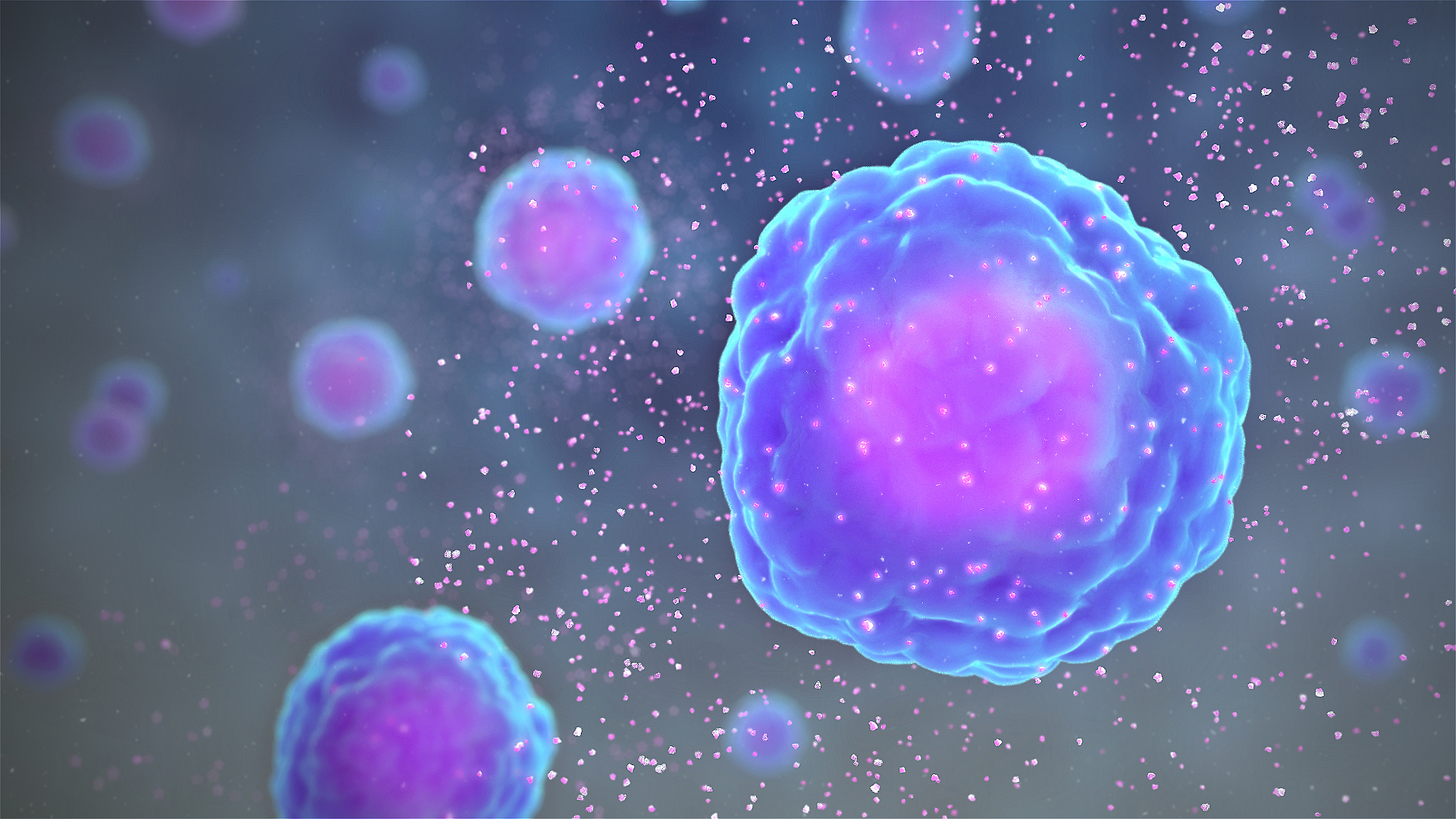
Cytokines (/ˈsaɪtəkaɪn/) are a broad and loose category of small proteins (~5–25 kDa) important in cell signaling. Cytokines are produced by a broad range of cells, including immune cells, as well as endothelial cells, fibroblasts, and various types of connective tissue cells. A single cytokine may be produced by more than one type of cell.
Cytokines are usually too large to cross cell membranes and enter cells. They typically function by interacting with specific cytokine receptors on the surface of target cells. Cytokines include chemokines, interferons, interleukins, lymphokines, and tumour necrosis factors, but generally not hormones or growth factors (despite some overlap in the terminology).
Cytokines are especially important in the immune system, including in immune responses and inflammation. Cytokines modulate the balance between humoral and cell-based immune responses, and they regulate the maturation, growth, and responsiveness of particular cell populations. Some cytokines enhance or inhibit the action of other cytokines in complex ways. Cytokines are generally released in lower concentrations than hormones. Immune cytokines released by one cell can send signals to the same cell (autocrine signaling), nearby cells (paracrine signaling), and other cells throughout the body (endocrine signaling).
The word comes from the ancient Greek language: cyto, from Greek κύτος, kytos, 'cavity, cell' + kines, from Greek κίνησις, kinēsis, 'movement'.
Cytokines have been classed as lymphokines, interleukins, and chemokines, based on their presumed cell of secretion, function, or target of action. Because cytokines are characterised by considerable redundancy and pleiotropism, such distinctions, allowing for exceptions, are obsolete.
Structural homogeneity has been able to partially distinguish between cytokines that do not demonstrate a considerable degree of redundancy so that they can be classified into four types:
A classification that proves more useful in clinical and experimental practice outside of structural biology divides immunological cytokines into those that enhance cellular immune responses, type 1 (TNFα, IFN-γ, etc.), and those that enhance antibody responses, type 2 (TGF-β, IL-4, IL-10, IL-13, etc.).
A key focus of interest has been that cytokines in one of these two sub-sets tend to inhibit the effects of those in the other. Dysregulation of this tendency is under intensive study for its possible role in the pathogenesis of autoimmune disorders.
Hub AI
Cytokine AI simulator
(@Cytokine_simulator)
Cytokine
Cytokines (/ˈsaɪtəkaɪn/) are a broad and loose category of small proteins (~5–25 kDa) important in cell signaling. Cytokines are produced by a broad range of cells, including immune cells, as well as endothelial cells, fibroblasts, and various types of connective tissue cells. A single cytokine may be produced by more than one type of cell.
Cytokines are usually too large to cross cell membranes and enter cells. They typically function by interacting with specific cytokine receptors on the surface of target cells. Cytokines include chemokines, interferons, interleukins, lymphokines, and tumour necrosis factors, but generally not hormones or growth factors (despite some overlap in the terminology).
Cytokines are especially important in the immune system, including in immune responses and inflammation. Cytokines modulate the balance between humoral and cell-based immune responses, and they regulate the maturation, growth, and responsiveness of particular cell populations. Some cytokines enhance or inhibit the action of other cytokines in complex ways. Cytokines are generally released in lower concentrations than hormones. Immune cytokines released by one cell can send signals to the same cell (autocrine signaling), nearby cells (paracrine signaling), and other cells throughout the body (endocrine signaling).
The word comes from the ancient Greek language: cyto, from Greek κύτος, kytos, 'cavity, cell' + kines, from Greek κίνησις, kinēsis, 'movement'.
Cytokines have been classed as lymphokines, interleukins, and chemokines, based on their presumed cell of secretion, function, or target of action. Because cytokines are characterised by considerable redundancy and pleiotropism, such distinctions, allowing for exceptions, are obsolete.
Structural homogeneity has been able to partially distinguish between cytokines that do not demonstrate a considerable degree of redundancy so that they can be classified into four types:
A classification that proves more useful in clinical and experimental practice outside of structural biology divides immunological cytokines into those that enhance cellular immune responses, type 1 (TNFα, IFN-γ, etc.), and those that enhance antibody responses, type 2 (TGF-β, IL-4, IL-10, IL-13, etc.).
A key focus of interest has been that cytokines in one of these two sub-sets tend to inhibit the effects of those in the other. Dysregulation of this tendency is under intensive study for its possible role in the pathogenesis of autoimmune disorders.
Recent media