
Recent from talks
Czech koruna
Knowledge base stats:
Talk channels stats:
Members stats:
Czech koruna
The koruna, or crown (sign: Kč; code: CZK, Czech: koruna česká), has been the currency of the Czech Republic since 1993. The koruna is one of the European Union's eight currencies, and the Czech Republic is legally bound to adopt the euro in the future.
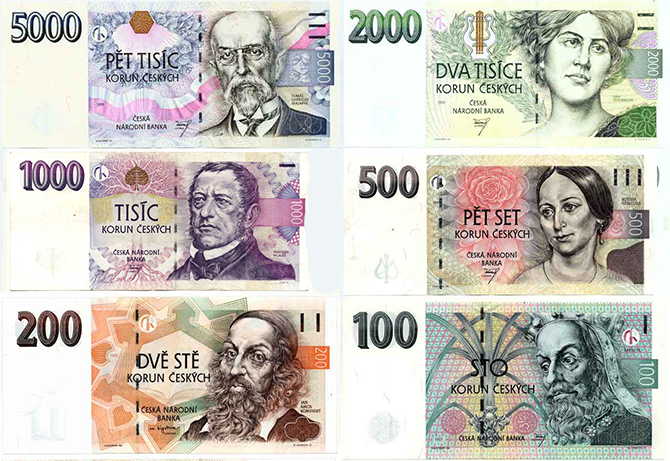
The official name in Czech is koruna česká (plural koruny české, though the zero-suffixed genitive plural form korun českých is used on banknotes and coins of value 5 Kč or higher). The ISO 4217 code is CZK and the local acronym is Kč, which is placed after the numeric value (e.g., "50 Kč") or sometimes before it (as is seen on the 10-koruna coin). One crown is made up of 100 hellers (abbreviated as "h", official name in Czech: singular: haléř, nominative plural: haléře, genitive plural: haléřů – used with numbers higher or equal to 5 – e.g. 3 haléře, 8 haléřů), but hellers have now been withdrawn from circulation, and the smallest unit of physical currency is 1 Kč.
In 1892, the Austro-Hungarian krone replaced the gulden at the rate of two kronen to one gulden (which is also the reason why the 10 Kč coin had been nicknamed pětka or "fiver" - and has been in use in informal conversation up until nowadays). The name was suggested by the emperor, Franz Joseph I of Austria. After Austria-Hungary dissolved in 1918, Czechoslovakia was the only successor state to retain the name of its imperial-era currency. During the Second World War, the currency on the occupied Czech territory was artificially weakened. The Czechoslovak crown was restored after the war. It underwent a highly controversial monetary reform in 1953.
The Czech koruna replaced the Czechoslovak koruna in 1993 after the dissolution of Czechoslovakia. It first consisted of overstamped 20 Kčs, 50 Kčs, 100 Kčs, 500 Kčs, and 1,000 Kčs banknotes, and a new series was properly introduced in 1993.
In November 2013, the Czech National Bank (ČNB) intervened to weaken the exchange rate of the koruna through a monetary stimulus to stop the currency from excessive strengthening. This was meant to support the Czech economy, mainly focused on export, but people were unhappy about this step because it was set up before Christmas, which led to raising the prices of imported goods. In late 2016, the ČNB stated that the return to conventional monetary policy was planned for mid-2017. After higher-than-expected inflation and other figures, the national bank removed the cap at a special monetary meeting on April 6, 2017. The koruna avoided significant volatility and City Index Group stated: "If you want to drop a currency peg, then the ČNB can show you how to do it".
The Czech Republic planned to adopt the euro in 2010, but its government suspended that plan indefinitely in 2005. Although the country is economically well positioned to adopt the euro, there is considerable opposition to the move within the Czech Republic. According to a survey conducted in April 2014, only 16% of the Czech population was in favour of replacing the koruna with the euro. As reported by an April 2018 survey by CVVM (Public Opinion Research Center), this value remained at nearly identical levels between 2014-18, with only 20% of the Czech population above 15 years old supporting euro adoption.
The coins of the Czech koruna increase in size and weight with value.
In 1993, coins were introduced in denominations of 10, 20 and 50 haléřů (h), 1 Kč, 2 Kč, 5 Kč, 10 Kč, 20 Kč and 50 Kč. The 10 h and 20 h coins were taken out of circulation by 31 October 2003 and the 50 h coins by 31 August 2008 due to their diminishing purchasing power and circulation. However, financial amounts are still written with the accuracy of 1-haléř (CZK 0.01); prices in retail shops are usually multiples of CZK 0.10. When cash transactions are made, the amount is rounded to the nearest integer.
Hub AI
Czech koruna AI simulator
(@Czech koruna_simulator)
Czech koruna
The koruna, or crown (sign: Kč; code: CZK, Czech: koruna česká), has been the currency of the Czech Republic since 1993. The koruna is one of the European Union's eight currencies, and the Czech Republic is legally bound to adopt the euro in the future.
The official name in Czech is koruna česká (plural koruny české, though the zero-suffixed genitive plural form korun českých is used on banknotes and coins of value 5 Kč or higher). The ISO 4217 code is CZK and the local acronym is Kč, which is placed after the numeric value (e.g., "50 Kč") or sometimes before it (as is seen on the 10-koruna coin). One crown is made up of 100 hellers (abbreviated as "h", official name in Czech: singular: haléř, nominative plural: haléře, genitive plural: haléřů – used with numbers higher or equal to 5 – e.g. 3 haléře, 8 haléřů), but hellers have now been withdrawn from circulation, and the smallest unit of physical currency is 1 Kč.
In 1892, the Austro-Hungarian krone replaced the gulden at the rate of two kronen to one gulden (which is also the reason why the 10 Kč coin had been nicknamed pětka or "fiver" - and has been in use in informal conversation up until nowadays). The name was suggested by the emperor, Franz Joseph I of Austria. After Austria-Hungary dissolved in 1918, Czechoslovakia was the only successor state to retain the name of its imperial-era currency. During the Second World War, the currency on the occupied Czech territory was artificially weakened. The Czechoslovak crown was restored after the war. It underwent a highly controversial monetary reform in 1953.
The Czech koruna replaced the Czechoslovak koruna in 1993 after the dissolution of Czechoslovakia. It first consisted of overstamped 20 Kčs, 50 Kčs, 100 Kčs, 500 Kčs, and 1,000 Kčs banknotes, and a new series was properly introduced in 1993.
In November 2013, the Czech National Bank (ČNB) intervened to weaken the exchange rate of the koruna through a monetary stimulus to stop the currency from excessive strengthening. This was meant to support the Czech economy, mainly focused on export, but people were unhappy about this step because it was set up before Christmas, which led to raising the prices of imported goods. In late 2016, the ČNB stated that the return to conventional monetary policy was planned for mid-2017. After higher-than-expected inflation and other figures, the national bank removed the cap at a special monetary meeting on April 6, 2017. The koruna avoided significant volatility and City Index Group stated: "If you want to drop a currency peg, then the ČNB can show you how to do it".
The Czech Republic planned to adopt the euro in 2010, but its government suspended that plan indefinitely in 2005. Although the country is economically well positioned to adopt the euro, there is considerable opposition to the move within the Czech Republic. According to a survey conducted in April 2014, only 16% of the Czech population was in favour of replacing the koruna with the euro. As reported by an April 2018 survey by CVVM (Public Opinion Research Center), this value remained at nearly identical levels between 2014-18, with only 20% of the Czech population above 15 years old supporting euro adoption.
The coins of the Czech koruna increase in size and weight with value.
In 1993, coins were introduced in denominations of 10, 20 and 50 haléřů (h), 1 Kč, 2 Kč, 5 Kč, 10 Kč, 20 Kč and 50 Kč. The 10 h and 20 h coins were taken out of circulation by 31 October 2003 and the 50 h coins by 31 August 2008 due to their diminishing purchasing power and circulation. However, financial amounts are still written with the accuracy of 1-haléř (CZK 0.01); prices in retail shops are usually multiples of CZK 0.10. When cash transactions are made, the amount is rounded to the nearest integer.
Recent media