


Community hub
Recent from talks
Contribute something
Nothing was collected or created yet.
DB Class 120
View on Wikipedia | This article needs additional citations for verification. (June 2025) |
| Deutsche Bundesbahn Baureihe 120 | |||||||||||||||||||||||||
|---|---|---|---|---|---|---|---|---|---|---|---|---|---|---|---|---|---|---|---|---|---|---|---|---|---|
 120 105-2 with an InterCity from Berlin to Cologne, 2013. | |||||||||||||||||||||||||
| |||||||||||||||||||||||||
| |||||||||||||||||||||||||
| |||||||||||||||||||||||||
| |||||||||||||||||||||||||
The DB Baureihe 120 is a class of electric locomotives operated by DB Fernverkehr in Germany. In November 2023, the last locomotives of this series were decommissioned by Deutsche Bahn. A few were sold to private railway companies and are operational.
Background and design
[edit]The locomotives' prototypes, delivered in 1979 (Mark 120.0), were one of the first electric locomotives with three-phase motors controlled by thyristor-based power electronics. This principle, mainly devised by the German branch of Swiss-based Brown, Boveri & Cie lay the foundation for all current electric and diesel-electric rail engines. For this, the Mark 120 is often acclaimed as milestone in locomotive technology. They were based on experiments made in the 1970s with diesel-electric test platforms (Mark DE 2500/ DB Mark 202). In Norway, a new four-axle Locomotive, Mark El-17, was launched during 1983 with top speeds up to 93 miles per hour (150 km/h).
The design was intended to be the first truly universal locomotive, capable of pulling fast passenger trains as well as heavy freight trains. While the electric equipment exceeded expectations, the mechanical part suffered from its lightweight construction necessitated by the heavy electronics of the time.
After extensive tests, a series of 60 locomotives (Mark 120.1) were ordered in 1984 and delivered in 1986–1988. Original plans to build up to 2,000 machines were ultimately ended by German reunification and the politically driven decision to support the economy in the former DDR by procuring the DR 243 (DB BR 143) instead. The 120s went to DB Fernverkehr, the other divisions of Deutsche Bahn ordered locomotives that featured technologies from the 120, but were not direct successors. However, the class 120 locomotive formed the foundation for the power cars of the German high-speed trains ICE 1 and ICE 2
Technical data
[edit]| 120.0 | 120.1 | |
|---|---|---|
| General | ||
| Operator | DB | => |
| Manufacturing year | 1979-19xx | 1986–1988 |
| Number of manuf. | 5 | 60 |
| Supplier mechanical part | Henschel, Krauss Maffei, Krupp | => |
| Supplier electrical part | BBC, Siemens, AEG | => |
| Axle arr | Bo-Bo | => |
| Weight | 84.0 t (82.7 long tons; 92.6 short tons) | => |
| Axle load | 21.0 t (20.7 long tons; 23.1 short tons) | => |
| Max tractive eff | 340 kN (76,000 lbf) | 340 kN (76,000 lbf) |
| Max speed | 280 km/h (170 mph) | 200 km/h (120 mph) |
| Body | ||
| Length | 19,200 mm (63 ft 0 in) | => |
| Bogie distance | 10,200 mm (33 ft 6 in) | => |
| Height over pantograph | 4,375 mm (14 ft 4.2 in) | => |
| Body width | 3,000 mm (9 ft 10 in) | => |
| Coupling | buffers and chain | => |
| Surface | smooth steel sheet | => |
| Colour | wine-red beige | red, white |
| Bogies | ||
| Track width | 1,435 mm (4 ft 8+1⁄2 in) standard gauge | => |
| Wheel base | 2,800 mm (9 ft 2 in) | => |
| Wheel diameter, new | 1,250 mm (49.21 in) | => |
| Primary suspension | coil | => |
| Secondary suspension | coil | => |
| Brake | shoe, rheostatic, regenerative | shoe, regenerative |
| Bogie Weight | 15.96 t (15.71 long tons; 17.59 short tons) | => |
| Min hor radius | 100 m (328 ft) | => |
| Electrical equipment | ||
| Catenary voltage | 15 kV | => |
| Catenary frequency | 162⁄3 Hz | => |
| Max cont power | 4.4 MW (5,900 hp) | => |
| Traction motor | QD646 | BQg 4843 |
| Max power trainheating | 900 kW (1,200 hp) | => |
Gallery
[edit]-
 120 143 in Dresden
 -
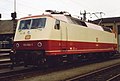 120 002 in Würzburg 1984
 -
 DB-AG BR 120 (DB Systemtechnik), Summer 2006 in Dresden Main Station
 -
 120 134 arrives at Köln Hbf
 -
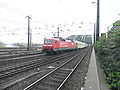 120 502 leaves Köln Hbf on a Bahntechnik train.


References
[edit]- ^ a b c Duffy, Michael C. (2003). Electric railways 1880-1990. Institution of Engineering and Technology. p. 345. ISBN 978-0-85296-805-5.
External links
[edit]
Classes of German electric locomotives | ||
|---|---|---|
| Current class numbering |  | |
| Pre-1968 class numbering | ||
| DR classes | ||
| Older DR classes | ||
DB Class 120
View on GrokipediaHistory and Development
Prototypes and Testing (1979–1986)
In March 1977, the Deutsche Bundesbahn placed an order for five prototype electric locomotives of class 120 (numbered 120 001 to 120 005) to evaluate three-phase asynchronous motor technology for mainline use.[1] These prototypes were constructed by Krauss-Maffei for the mechanical components, with electrical systems provided by a consortium including BBC and AEG/Telefunken. The first prototype, 120 001, was delivered in late 1979, followed by the others in 1980, marking the initial implementation of thyristor-controlled inverters driving asynchronous traction motors in a production-oriented locomotive design.[1][4] Initial testing commenced on the DB network in 1979, focusing on freight and passenger services to assess reliability, traction performance, and electrical system stability under operational conditions. The prototypes accumulated extensive mileage through regular service trials, validating the asynchronous motors' torque-speed characteristics that provided superior starting torque and efficiency across variable speeds compared to DC commutator motors, which suffer from brush wear and higher maintenance needs.[5] Early evaluations confirmed reduced energy consumption, with the three-phase drive enabling precise vector control for optimized power delivery without mechanical gear changes.[6] Key milestones included iterative refinements to address initial challenges such as inverter control stability and motor cooling under sustained high loads, resolved through engineering modifications during the test phase. By 1984, the prototypes had undergone high-speed trials reaching up to 200 km/h, demonstrating dynamic stability and regenerative braking efficacy. These outcomes empirically supported the technology's advantages in efficiency and durability, paving the way for the series production decision in 1984.[7][8]Production Order and Series Build (1987–1988)
In 1984, after four years of extensive prototype testing, the Deutsche Bundesbahn placed an order for 60 series production locomotives designated as Class 120.1, numbered 120 101 to 120 160.[9][10] This decision was driven by empirical data from the prototypes demonstrating the viability of three-phase asynchronous traction for high-performance, versatile electric locomotives, enabling the DB to advance fleet modernization amid growing demands for faster and more efficient rail services.[11] Manufacturing responsibilities were distributed among a consortium of established firms, with Krauss-Maffei handling final assembly, mechanical components sourced from Henschel and Krupp, and electrical systems from BBC, AEG, and Siemens.[12][13] Production occurred between 1987 and 1989, incorporating refinements from prototype feedback to enhance overall reliability, including optimized traction control and reduced mechanical wear rates observed during high-mileage trials.[14] The first series unit, 120 103, was formally handed over to the DB on January 13, 1987.[15] Subsequent deliveries followed incrementally, with locomotives entering operational service by late 1987. This series build represented the world's inaugural mass production of electric locomotives using three-phase drive technology, validating the shift from traditional DC systems to asynchronous AC motors for superior efficiency and maintenance economics.[1][16]Design and Technical Features
Propulsion and Electrical Systems
The DB Class 120 draws electrical power from the standard German railway electrification system at 15 kV, 16.7 Hz alternating current via a pantograph connected to the overhead catenary. This single-phase AC input is fed into two main transformers, stepping down the voltage before rectification by line-commutated thyristor bridges to produce a stable intermediate DC link voltage of approximately 2.4 kV. The DC link serves as a buffer, enabling independent control of power conversion stages and facilitating energy recovery during braking. From the DC link, four pulse-width modulated (PWM) inverters, utilizing gate turn-off (GTO) thyristors, generate variable-voltage, variable-frequency three-phase AC output tailored to the four frame-mounted asynchronous traction motors—one inverter per motor bogie pair, with parallel connection of the two motors per bogie. This configuration allows precise regulation of motor slip, optimizing torque delivery from standstill (high slip for maximum starting tractive effort of 340 kN) to high speeds up to 200 km/h (low slip for efficiency). The asynchronous motors, rated at 1,400 kW each for a total continuous power of 5,600 kW, operate without brushes or commutators, relying on induced rotor currents for propulsion, which inherently reduces mechanical wear and electrical losses compared to DC series motors. The three-phase asynchronous drive yields measurable efficiency improvements, with operational trials demonstrating 20–30% lower specific energy consumption relative to contemporary DC-equipped locomotives like the DB Class 103, attributable to motor efficiencies exceeding 90% across partial loads, enhanced regenerative braking recovering up to 30% of braking energy, and elimination of commutator-related arcing and maintenance. These gains stem from the physics of induction motors, where stator fields induce rotor currents without physical contacts, minimizing I²R losses and enabling field weakening for sustained high-speed performance without overspeeding risks. Early prototypes incorporated fault-tolerant features, such as redundant inverter controls and the ability to isolate a failed inverter, allowing operation at reduced power (e.g., three motors) to maintain service reliability during trials from 1979 onward.Mechanical Construction and Aerodynamics
The DB Baureihe 120 employs a welded steel underframe constructed from profiles clad in sheet metal panels, with external cladding approximately 2 mm thick and internal panels around 1.5 mm thick, reinforced by ribbed steel elements for structural rigidity under high-speed loads.[17] This material choice prioritizes durability and load-bearing capacity over weight savings, enabling the locomotive to withstand dynamic forces at speeds up to 200 km/h while maintaining a total service weight of about 84 tonnes. The running gear consists of two rigid pivotless bogies in Bo'Bo' configuration, each with two powered axles and frame-hung traction motors connected via cardan shafts.[18] Primary suspension utilizes conical rubber-metal springs to isolate axle vibrations, while secondary suspension employs steel coil springs positioned 330 mm apart to dampen oscillations and ensure tracking stability, informed by empirical vibration measurements from prototype testing conducted between 1979 and 1986. These elements collectively mitigate hunting oscillations and provide the necessary compliance for curve negotiation and high-speed ride quality without compromising adhesion. Aerodynamic considerations influenced the cab and body profiling, with prototypes such as 120 005 undergoing modifications including a rounded fiberglass roof hood, lowered front edge above the lower headlamps, sealed buffer beam gaps via panels, and added underbody skirts to minimize drag coefficients during wind tunnel evaluations.[19] Although cost constraints prevented full adoption in series production—retaining a more angular, boxy cab form—these tests validated streamlined contours that reduced air resistance, contributing to efficient operation at 200 km/h by lowering energy demands from aerodynamic drag, which constitutes a significant portion of total resistance at such velocities. The braking apparatus integrates mechanical shoe brakes as a fail-safe with electric regenerative and rheostatic modes, supported by multi-stage controls and wheel-slide detection sensors to optimize adhesion under varying conditions. Safety enhancements, derived from prototype feedback, include laminated safety glass windshields (approximately 15 mm thick) and toughened side windows (about 5 mm), alongside the inherent crash energy absorption of the steel body structure.[17] Air reservoirs totaling 800 liters at 10 bar pressure supply the pneumatic components, ensuring reliable actuation across friction and dynamic braking phases.Specifications
Power and Performance Data
The DB Class 120 locomotive delivers a one-hour power rating of 5,600 kW from its four three-phase asynchronous traction motors, enabling high acceleration for mixed passenger and freight duties.[20][21] Its continuous power rating stands at 4,400 kW, reflecting thermal limits under sustained load with forced ventilation cooling.[20][21] The design prioritizes adhesion-limited starting traction, with a maximum starting tractive effort of 340 kN on units 120 101–136, reduced to 290 kN on later builds due to gear ratio adjustments for higher sustained speeds.[20][22]| Parameter | Value | Notes |
|---|---|---|
| One-hour power rating | 5,600 kW | At 1,500 V DC or 15 kV 16⅔ Hz AC; per-motor output 1,400 kW.[20][21] |
| Continuous power rating | 4,400 kW | Per-motor output 1,100 kW; limited by motor winding temperature rise.[20][21] |
| Top design speed | 200 km/h | Gear ratio optimized post-prototype testing; prototypes initially limited to 160 km/h.[20][22] |
| Starting tractive effort | 340 kN (early units); 290 kN (later units) | Adhesion coefficient ~0.25–0.30 under dry conditions; hollow-shaft cardan drive.[20][22] |
| Power-to-weight ratio | 66.6 kW/t | Based on 84 t service weight; supports rapid acceleration, e.g., prototypes achieved 0–200 km/h in ~16 s unladen during tests.[20][23] |
Dimensions and Capacities
The DB Class 120 electric locomotive has a length over buffers of 19.20 meters, providing a compact profile relative to its power output for versatile routing on standard gauge tracks.[22][25] Its body width measures 2.978 meters, and height reaches 4.631 meters, accommodating the single-arm pantographs required for 15 kV 16.7 Hz AC overhead contact line operation.[26] The Bo'Bo' wheel arrangement distributes the service weight of 84 tonnes evenly across four powered axles, yielding an axle load of 21 tonnes, which complies with load limits on the majority of Deutsche Bahn's mainline infrastructure without necessitating track reinforcements.[27]| Dimension/Capacity | Value | Notes |
|---|---|---|
| Length over buffers | 19.20 m | Standard configuration across prototypes and series units.[28] |
| Width | 2.978 m | Body width excluding mirrors or protrusions.[26] |
| Height | 4.631 m | Including pantograph stowed; roof height optimized for European clearance profiles.[2] |
| Service weight | 84 t | Empty weight in operational trim, excluding any towed vehicles.[22][18] |
| Axle load | 21 t | Uniform distribution; suitable for lines rated up to 22.5 t/axle.[27] |