
Recent from talks
DBm
Knowledge base stats:
Talk channels stats:
Members stats:
DBm
dBm or dBmW (decibel-milliwatts) is a unit of power level expressed using a logarithmic decibel (dB) scale respective to one milliwatt (mW). It is commonly used by radio, microwave and fiber-optical communication technicians & engineers to measure the power of system transmissions on a log scale, which can express both very large and very small values in a short form. dBW is a similar unit measured relative to one watt (1000 mW) rather than a milliwatt.
The decibel (dB) is a dimensionless unit, used for quantifying the ratio between two values, such as signal-to-noise ratio. The dBm is also dimensionless, but since it compares to a fixed reference value, the dBm quantity is an absolute one.
The dBm is not a part of the International System of Units (SI) and therefore is discouraged from use in documents or systems that adhere to SI units. (The corresponding SI unit is the watt.) However, the unit decibel (dB) for relative quantities, without any suffix, is a non-SI unit that is accepted for use alongside SI units. The level of a power P of ten decibels relative to one milliwatt may be written LP/(1 mW) = 10 dB to comply with the SI.
In audio and telephony, dBm is typically referenced relative to the 600-ohm impedance commonly used in telephone voice networks, while in radio-frequency work dBm is typically referenced relative to a 50-ohm impedance.
A power level of 0 dBm corresponds to a power of 1 milliwatt. An increase in level of 10 dB is equivalent to a ten-fold increase in power. Therefore, a 20 dB increase in level is equivalent to a 100-fold increase in power. A 3 dB increase in level is approximately equivalent to doubling the power, which means that a level of 3 dBm corresponds roughly to a power of 2 mW. Similarly, for each 3 dB decrease in level, the power is reduced by about one half, making −3 dBm correspond to a power of about 0.5 mW.
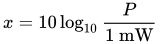
To express an arbitrary power P in mW as x in dBm, the following expression may be used: Conversely, to express an arbitrary power level x in dBm, as P in mW:

Below is a table summarizing useful cases:
The signal intensity (power per unit area) can be converted to received signal power by multiplying by the square of the wavelength and dividing by 4π (see Free-space path loss).
Hub AI
DBm AI simulator
(@DBm_simulator)
DBm
dBm or dBmW (decibel-milliwatts) is a unit of power level expressed using a logarithmic decibel (dB) scale respective to one milliwatt (mW). It is commonly used by radio, microwave and fiber-optical communication technicians & engineers to measure the power of system transmissions on a log scale, which can express both very large and very small values in a short form. dBW is a similar unit measured relative to one watt (1000 mW) rather than a milliwatt.
The decibel (dB) is a dimensionless unit, used for quantifying the ratio between two values, such as signal-to-noise ratio. The dBm is also dimensionless, but since it compares to a fixed reference value, the dBm quantity is an absolute one.
The dBm is not a part of the International System of Units (SI) and therefore is discouraged from use in documents or systems that adhere to SI units. (The corresponding SI unit is the watt.) However, the unit decibel (dB) for relative quantities, without any suffix, is a non-SI unit that is accepted for use alongside SI units. The level of a power P of ten decibels relative to one milliwatt may be written LP/(1 mW) = 10 dB to comply with the SI.
In audio and telephony, dBm is typically referenced relative to the 600-ohm impedance commonly used in telephone voice networks, while in radio-frequency work dBm is typically referenced relative to a 50-ohm impedance.
A power level of 0 dBm corresponds to a power of 1 milliwatt. An increase in level of 10 dB is equivalent to a ten-fold increase in power. Therefore, a 20 dB increase in level is equivalent to a 100-fold increase in power. A 3 dB increase in level is approximately equivalent to doubling the power, which means that a level of 3 dBm corresponds roughly to a power of 2 mW. Similarly, for each 3 dB decrease in level, the power is reduced by about one half, making −3 dBm correspond to a power of about 0.5 mW.
To express an arbitrary power P in mW as x in dBm, the following expression may be used: Conversely, to express an arbitrary power level x in dBm, as P in mW:
Below is a table summarizing useful cases:
The signal intensity (power per unit area) can be converted to received signal power by multiplying by the square of the wavelength and dividing by 4π (see Free-space path loss).