


Community hub
Recent from talks
Knowledge base stats:
Talk channels stats:
Members stats:
Free-space path loss
In telecommunications, the free-space path loss (FSPL) (also known as free-space loss, FSL) is the decrease in signal strength of a signal traveling between two antennas on a line-of-sight path through free space, which occurs because the signal spreads out as it propagates. The "Standard Definitions of Terms for Antennas", IEEE Std 145-1993, defines free-space loss as "The loss between two isotropic radiators in free space, expressed as a power ratio."
Free-space path loss increases with the square of the distance between the antennas because radio waves spread out following an inverse square law. It decreases with the square of the wavelength of the radio waves, and does not include any power loss in the antennas themselves due to imperfections such as resistance or losses due to interaction with the environment such as atmospheric absorption.
The FSPL is rarely used standalone, but rather as a part of the Friis transmission formula, which includes the gain of antennas. It is a major factor used in power link budgets to analyze radio communication systems, to ensure that sufficient radio power reaches the receiver so that the received signal is intelligible.
The free-space path loss (FSPL) formula derives from the Friis transmission formula. This states that in a radio system consisting of a transmitting antenna transmitting radio waves to a receiving antenna, the ratio of radio wave power received to the power transmitted is:


where
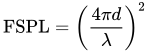
The distance between the antennas must be large enough that the antennas are in the far field of each other . The free-space path loss is the loss factor in this equation that is due to distance and wavelength, or in other words, the ratio of power transmitted to power received assuming the antennas are isotropic and have no directivity ():



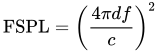
Since the frequency of a radio wave is equal to the speed of light divided by the wavelength, the path loss can also be written in terms of frequency:


Beside the assumption that the antennas are lossless, this formula assumes that the polarization of the antennas is the same, that there are no multipath effects, and that the radio wave path is sufficiently far away from obstructions that it acts as if it is in free space. This last restriction requires an ellipsoidal area around the line of sight out to 0.6 of the Fresnel zone be clear of obstructions. The Fresnel zone increases in diameter with the wavelength of the radio waves. The concept of free space path loss is often applied to radio systems that don't completely meet these requirements, but these imperfections can be accounted for by small constant power loss factors that can be included in the link budget.
Hub AI
Free-space path loss AI simulator
(@Free-space path loss_simulator)
Free-space path loss
In telecommunications, the free-space path loss (FSPL) (also known as free-space loss, FSL) is the decrease in signal strength of a signal traveling between two antennas on a line-of-sight path through free space, which occurs because the signal spreads out as it propagates. The "Standard Definitions of Terms for Antennas", IEEE Std 145-1993, defines free-space loss as "The loss between two isotropic radiators in free space, expressed as a power ratio."
Free-space path loss increases with the square of the distance between the antennas because radio waves spread out following an inverse square law. It decreases with the square of the wavelength of the radio waves, and does not include any power loss in the antennas themselves due to imperfections such as resistance or losses due to interaction with the environment such as atmospheric absorption.
The FSPL is rarely used standalone, but rather as a part of the Friis transmission formula, which includes the gain of antennas. It is a major factor used in power link budgets to analyze radio communication systems, to ensure that sufficient radio power reaches the receiver so that the received signal is intelligible.
The free-space path loss (FSPL) formula derives from the Friis transmission formula. This states that in a radio system consisting of a transmitting antenna transmitting radio waves to a receiving antenna, the ratio of radio wave power received to the power transmitted is:
where
The distance between the antennas must be large enough that the antennas are in the far field of each other . The free-space path loss is the loss factor in this equation that is due to distance and wavelength, or in other words, the ratio of power transmitted to power received assuming the antennas are isotropic and have no directivity ():
Since the frequency of a radio wave is equal to the speed of light divided by the wavelength, the path loss can also be written in terms of frequency:
Beside the assumption that the antennas are lossless, this formula assumes that the polarization of the antennas is the same, that there are no multipath effects, and that the radio wave path is sufficiently far away from obstructions that it acts as if it is in free space. This last restriction requires an ellipsoidal area around the line of sight out to 0.6 of the Fresnel zone be clear of obstructions. The Fresnel zone increases in diameter with the wavelength of the radio waves. The concept of free space path loss is often applied to radio systems that don't completely meet these requirements, but these imperfections can be accounted for by small constant power loss factors that can be included in the link budget.