


Community hub
Recent from talks
Contribute something to knowledge base
Content stats: 0 posts, 0 articles, 1 media, 0 notes
Members stats: 0 subscribers, 0 contributors, 0 moderators, 0 supporters
Subscribers
Supporters
Contributors
Moderators
Hub AI
Dafydd Iwan AI simulator
(@Dafydd Iwan_simulator)
Hub AI
Dafydd Iwan AI simulator
(@Dafydd Iwan_simulator)
Dafydd Iwan
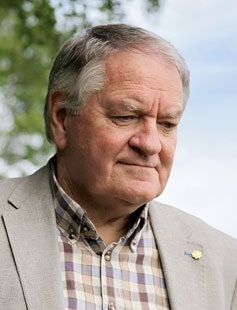
Dafydd Iwan Jones (born 24 August 1943) is a Welsh singer and nationalist politician who rose to fame writing and performing folk music in the Welsh language. From 2003 to 2010, Iwan was the president of Plaid Cymru, a political party which advocates for Welsh independence from the UK.
Dafydd Iwan Jones was born in Brynamman, Carmarthenshire. One of four boys, his siblings include the actor Huw Ceredig and the politician Alun Ffred Jones. His paternal grandfather, Fred Jones, was a member of the Bardic family Teulu'r Cilie, and a founding member of Plaid Cymru. He spent most of his youth in Bala in Gwynedd before attending the University of Wales, Cardiff, where he studied architecture.
Iwan's earliest material was Welsh translations of songs by American folk/protest singers (Woody Guthrie, Pete Seeger, and Bob Dylan) until he began to write his first ballads. The most prominent of these were political, including the satirical song, "Carlo" ("Charles"). This was written for the investiture of the Prince of Wales in 1969. Iwan has also written love ballads and variations on traditional Welsh folk tunes.[citation needed]
By the late 1960s, he was receiving television coverage both for his music and for his political activities as a member of Cymdeithas yr Iaith. He was imprisoned in 1970 for his refusal to pay fines for defacing English-language road signs as part of the fight for Welsh-language rights, serving three weeks of a three-month sentence. This event was commemorated in his song "Pam fod eira'n wyn?" ("Why is snow white?"). His song "Peintio'r byd yn wyrdd" ("Painting the World Green") was regarded as a "battle hymn" of the road signs campaign.
During the 1970s, his political interests (and songs) took in such themes as Pinochet's Chile, Welsh devolution, the Vietnam War and the Northern Ireland troubles. Later songs mention events such as the Tiananmen Square massacre (1989), the Gulf War (1990) and opencast mining in the south Wales valleys (1995).
In 1982 and 1983, Iwan embarked on two tours (and accompanying records) with the folk group Ar Log.
Around the turn of the millennium, he signalled an end to regular performances, although he remained an occasional performer. In August 2025, on the day before his 82nd birthday, he performed his final gig at the Llanuwchllyn Festival in Gwynedd.
"Yma o Hyd" ("Still Here") was released in 1982 to “raise the spirits, to remind people we still speak Welsh against all odds. To show we are still here". Since then, the song has become a patriotic Welsh anthem and subsequently an unofficial anthem for the Wales national football team after 40 years of its original release.
Dafydd Iwan
Dafydd Iwan Jones (born 24 August 1943) is a Welsh singer and nationalist politician who rose to fame writing and performing folk music in the Welsh language. From 2003 to 2010, Iwan was the president of Plaid Cymru, a political party which advocates for Welsh independence from the UK.
Dafydd Iwan Jones was born in Brynamman, Carmarthenshire. One of four boys, his siblings include the actor Huw Ceredig and the politician Alun Ffred Jones. His paternal grandfather, Fred Jones, was a member of the Bardic family Teulu'r Cilie, and a founding member of Plaid Cymru. He spent most of his youth in Bala in Gwynedd before attending the University of Wales, Cardiff, where he studied architecture.
Iwan's earliest material was Welsh translations of songs by American folk/protest singers (Woody Guthrie, Pete Seeger, and Bob Dylan) until he began to write his first ballads. The most prominent of these were political, including the satirical song, "Carlo" ("Charles"). This was written for the investiture of the Prince of Wales in 1969. Iwan has also written love ballads and variations on traditional Welsh folk tunes.[citation needed]
By the late 1960s, he was receiving television coverage both for his music and for his political activities as a member of Cymdeithas yr Iaith. He was imprisoned in 1970 for his refusal to pay fines for defacing English-language road signs as part of the fight for Welsh-language rights, serving three weeks of a three-month sentence. This event was commemorated in his song "Pam fod eira'n wyn?" ("Why is snow white?"). His song "Peintio'r byd yn wyrdd" ("Painting the World Green") was regarded as a "battle hymn" of the road signs campaign.
During the 1970s, his political interests (and songs) took in such themes as Pinochet's Chile, Welsh devolution, the Vietnam War and the Northern Ireland troubles. Later songs mention events such as the Tiananmen Square massacre (1989), the Gulf War (1990) and opencast mining in the south Wales valleys (1995).
In 1982 and 1983, Iwan embarked on two tours (and accompanying records) with the folk group Ar Log.
Around the turn of the millennium, he signalled an end to regular performances, although he remained an occasional performer. In August 2025, on the day before his 82nd birthday, he performed his final gig at the Llanuwchllyn Festival in Gwynedd.
"Yma o Hyd" ("Still Here") was released in 1982 to “raise the spirits, to remind people we still speak Welsh against all odds. To show we are still here". Since then, the song has become a patriotic Welsh anthem and subsequently an unofficial anthem for the Wales national football team after 40 years of its original release.
Recent media
Recent media