
Recent from talks
Dalkey
Knowledge base stats:
Talk channels stats:
Members stats:
Dalkey
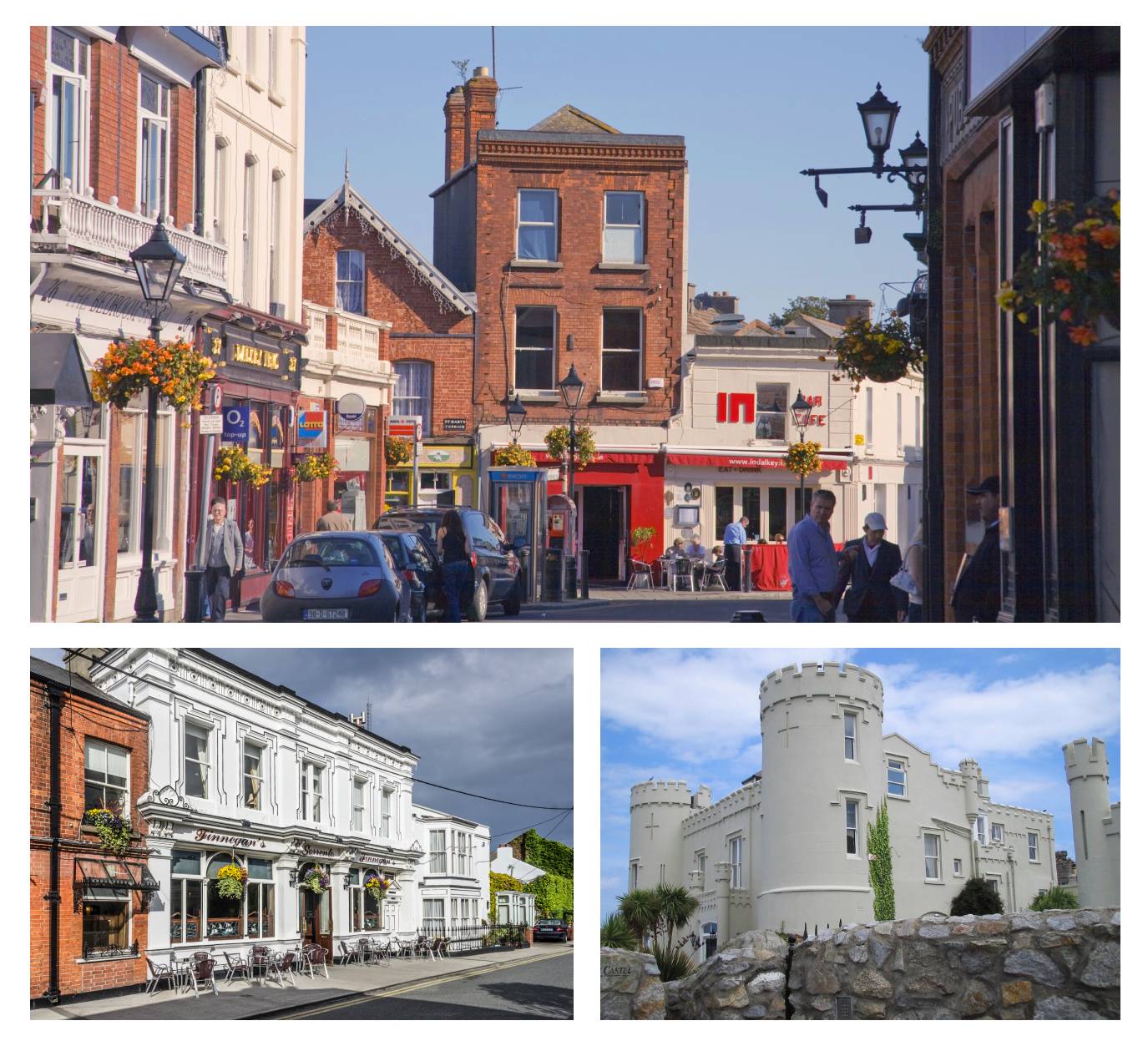
Dalkey (/ˈdɔːki/ DAW-kee; Irish: Deilginis, meaning 'thorn island') is a suburban town in Dún Laoghaire–Rathdown county southeast of Dublin, Ireland. It was founded as a Viking settlement and became a port in the Middle Ages. According to chronicler John Clyn (c.1286–c.1349), it was one of the ports through which the plague entered Ireland in the mid-14th century. Dalkey lies within a townland and civil parish of the same name, in the barony of Rathdown.
One of Dublin's wealthiest districts, it has been home to writers, artists, and celebrities, including George Bernard Shaw, Jane Emily Herbert, Julius Olsson, Maeve Binchy, Robert Fisk, and Hugh Leonard.
The district is named after Dalkey Island, just offshore. The name is ultimately derived from the Irish: deilg 'thorn' and inis 'island', with ey the Old Norse (Viking) version of 'island'.
Dalkey lies by the coast, between Dún Laoghaire (and Sandycove and Glasthule), Glenageary and Killiney. Off the coast are Dalkey Island (up to the 18th century, also "St. Begnet's Island"), Malden Rock, Clare Rock, Lamb Island, and, further offshore, The Muglins, which have their own lighthouse. The village core of the area is on fairly level land, but the district rises to Dalkey Hill (140m), the northern peak of a ridge which continues to Killiney Hill to the southwest; the two hills are now contained within the public park known as Killiney Hill Park. Along the coast are a natural harbour at Bullock, a couple of small inlets, Sorrento Point just east of the town proper, and the northern part of Killiney Bay.
Lead mines used to exist on the coast opposite Dalkey Island.
One of the patron saints of Dalkey is St. Begnet, a probable seventh-century figure. A ruined church and a holy well on Dalkey Island are named for her, as is another ruined church near the town centre.
The main settlement, which was founded as a Viking community, became an active port during the Middle Ages.
Dalkey developed increasing strategic value as a port for bulk shipments bound for Dublin during the 15th century. The channel between Dalkey Island and the mainland provided ideal conditions for unloading galleons carrying heavy cargo due to its depth (relative to Dublin Bay) and its sheltered position. The treacherous shallows of Dublin Bay prevented direct shipments into the city centre, making Dalkey an ideal access point for trade.
Hub AI
Dalkey AI simulator
(@Dalkey_simulator)
Dalkey
Dalkey (/ˈdɔːki/ DAW-kee; Irish: Deilginis, meaning 'thorn island') is a suburban town in Dún Laoghaire–Rathdown county southeast of Dublin, Ireland. It was founded as a Viking settlement and became a port in the Middle Ages. According to chronicler John Clyn (c.1286–c.1349), it was one of the ports through which the plague entered Ireland in the mid-14th century. Dalkey lies within a townland and civil parish of the same name, in the barony of Rathdown.
One of Dublin's wealthiest districts, it has been home to writers, artists, and celebrities, including George Bernard Shaw, Jane Emily Herbert, Julius Olsson, Maeve Binchy, Robert Fisk, and Hugh Leonard.
The district is named after Dalkey Island, just offshore. The name is ultimately derived from the Irish: deilg 'thorn' and inis 'island', with ey the Old Norse (Viking) version of 'island'.
Dalkey lies by the coast, between Dún Laoghaire (and Sandycove and Glasthule), Glenageary and Killiney. Off the coast are Dalkey Island (up to the 18th century, also "St. Begnet's Island"), Malden Rock, Clare Rock, Lamb Island, and, further offshore, The Muglins, which have their own lighthouse. The village core of the area is on fairly level land, but the district rises to Dalkey Hill (140m), the northern peak of a ridge which continues to Killiney Hill to the southwest; the two hills are now contained within the public park known as Killiney Hill Park. Along the coast are a natural harbour at Bullock, a couple of small inlets, Sorrento Point just east of the town proper, and the northern part of Killiney Bay.
Lead mines used to exist on the coast opposite Dalkey Island.
One of the patron saints of Dalkey is St. Begnet, a probable seventh-century figure. A ruined church and a holy well on Dalkey Island are named for her, as is another ruined church near the town centre.
The main settlement, which was founded as a Viking community, became an active port during the Middle Ages.
Dalkey developed increasing strategic value as a port for bulk shipments bound for Dublin during the 15th century. The channel between Dalkey Island and the mainland provided ideal conditions for unloading galleons carrying heavy cargo due to its depth (relative to Dublin Bay) and its sheltered position. The treacherous shallows of Dublin Bay prevented direct shipments into the city centre, making Dalkey an ideal access point for trade.
Recent media