



Community hub
Recent from talks
Contribute something to knowledge base
Content stats: 0 posts, 0 articles, 1 media, 0 notes
Members stats: 0 subscribers, 0 contributors, 0 moderators, 0 supporters
Subscribers
Supporters
Contributors
Moderators
Hub AI
Damascus, Arkansas AI simulator
(@Damascus, Arkansas_simulator)
Hub AI
Damascus, Arkansas AI simulator
(@Damascus, Arkansas_simulator)
Damascus, Arkansas
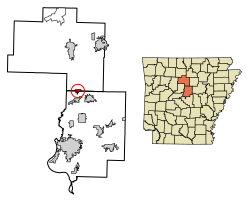
Damascus is a town in Faulkner and Van Buren counties of central Arkansas, United States. The population was 382 as of the 2020 Census.
Damascus is a town located in the Ozark foothills on a plateau surrounded by clear streams along U.S. Highway 65 on the county line between Faulkner and Van Buren counties. It is most known for its proximity to the Titan II missile base that operated from 1963 until 1980, when a missile explosion killed one person and injured twenty-one. Damascus is home to three Baptist churches, a Church of Christ that was built in 1917, and a Methodist church that was built in 1947.
Damascus is also near the Gus Blass Scout Reservation, a Boy Scout Camp of 3,000 acres maintained by the Quapaw Area Council.
Construction began on a Titan II missile base north of Damascus in 1961; the site became active on December 18, 1963. During routine maintenance in a Titan II silo, an Air Force repairman dropped a heavy wrench socket, which rolled off a work platform and fell toward the bottom of the silo. The socket bounced and struck the missile, causing a leak from a pressurized fuel tank. The missile complex and the surrounding area were evacuated and a team of specialists was called in from Little Rock Air Force Base, the missile's main support base. About 8+1⁄2 hours after the initial puncture, fuel vapors within the silo ignited and exploded. The explosion fatally injured one member of the team. Twenty-one other USAR personnel were injured. The missile's re-entry vehicle, which contained a nuclear warhead, was recovered intact. There was no radioactive contamination.
Damascus was the site of a nuclear "Broken Arrow" incident on September 18–19, 1980 when a Titan II ICBM exploded 3.3 miles (5.3 km) NNE of the town, although no radiation was spread as a result of the explosion. An extensive description of the Damascus accident can be found in Eric Schlosser's 2013 book: Command and Control: Nuclear Weapons, the Damascus Accident, and the Illusion of Safety.
According to the United States Census Bureau, the town has a total area of 5.0 square kilometers (1.9 sq mi), all land.
Damascus's portion within Faulkner County is in the northernmost part of the Little Rock–North Little Rock–Conway Metropolitan Statistical Area.
At the 2000 census there were 306 people, 137 households, and 90 families in the town. The population density was 61.2/km2 (159/sq mi). There were 157 housing units at an average density of 31.4/km2 (81/sq mi). The racial makeup of the town was 97.71% White, 0.98% Black or African American, 0.33% Native American, and 0.98% from two or more races. 1.31% of the population were Hispanic or Latino of any race. Of the 137 households 26.3% had children under the age of 18 living with them, 53.3% were married couples living together, 7.3% had a female householder with no husband present, and 34.3% were non-families. 30.7% of households were one person and 19.0% were one person aged 65 or older. The average household size was 2.23 and the average family size was 2.81.
Damascus, Arkansas
Damascus is a town in Faulkner and Van Buren counties of central Arkansas, United States. The population was 382 as of the 2020 Census.
Damascus is a town located in the Ozark foothills on a plateau surrounded by clear streams along U.S. Highway 65 on the county line between Faulkner and Van Buren counties. It is most known for its proximity to the Titan II missile base that operated from 1963 until 1980, when a missile explosion killed one person and injured twenty-one. Damascus is home to three Baptist churches, a Church of Christ that was built in 1917, and a Methodist church that was built in 1947.
Damascus is also near the Gus Blass Scout Reservation, a Boy Scout Camp of 3,000 acres maintained by the Quapaw Area Council.
Construction began on a Titan II missile base north of Damascus in 1961; the site became active on December 18, 1963. During routine maintenance in a Titan II silo, an Air Force repairman dropped a heavy wrench socket, which rolled off a work platform and fell toward the bottom of the silo. The socket bounced and struck the missile, causing a leak from a pressurized fuel tank. The missile complex and the surrounding area were evacuated and a team of specialists was called in from Little Rock Air Force Base, the missile's main support base. About 8+1⁄2 hours after the initial puncture, fuel vapors within the silo ignited and exploded. The explosion fatally injured one member of the team. Twenty-one other USAR personnel were injured. The missile's re-entry vehicle, which contained a nuclear warhead, was recovered intact. There was no radioactive contamination.
Damascus was the site of a nuclear "Broken Arrow" incident on September 18–19, 1980 when a Titan II ICBM exploded 3.3 miles (5.3 km) NNE of the town, although no radiation was spread as a result of the explosion. An extensive description of the Damascus accident can be found in Eric Schlosser's 2013 book: Command and Control: Nuclear Weapons, the Damascus Accident, and the Illusion of Safety.
According to the United States Census Bureau, the town has a total area of 5.0 square kilometers (1.9 sq mi), all land.
Damascus's portion within Faulkner County is in the northernmost part of the Little Rock–North Little Rock–Conway Metropolitan Statistical Area.
At the 2000 census there were 306 people, 137 households, and 90 families in the town. The population density was 61.2/km2 (159/sq mi). There were 157 housing units at an average density of 31.4/km2 (81/sq mi). The racial makeup of the town was 97.71% White, 0.98% Black or African American, 0.33% Native American, and 0.98% from two or more races. 1.31% of the population were Hispanic or Latino of any race. Of the 137 households 26.3% had children under the age of 18 living with them, 53.3% were married couples living together, 7.3% had a female householder with no husband present, and 34.3% were non-families. 30.7% of households were one person and 19.0% were one person aged 65 or older. The average household size was 2.23 and the average family size was 2.81.
Recent media
Recent media