



Community hub
Recent from talks
Knowledge base stats:
Talk channels stats:
Members stats:
Dance pad
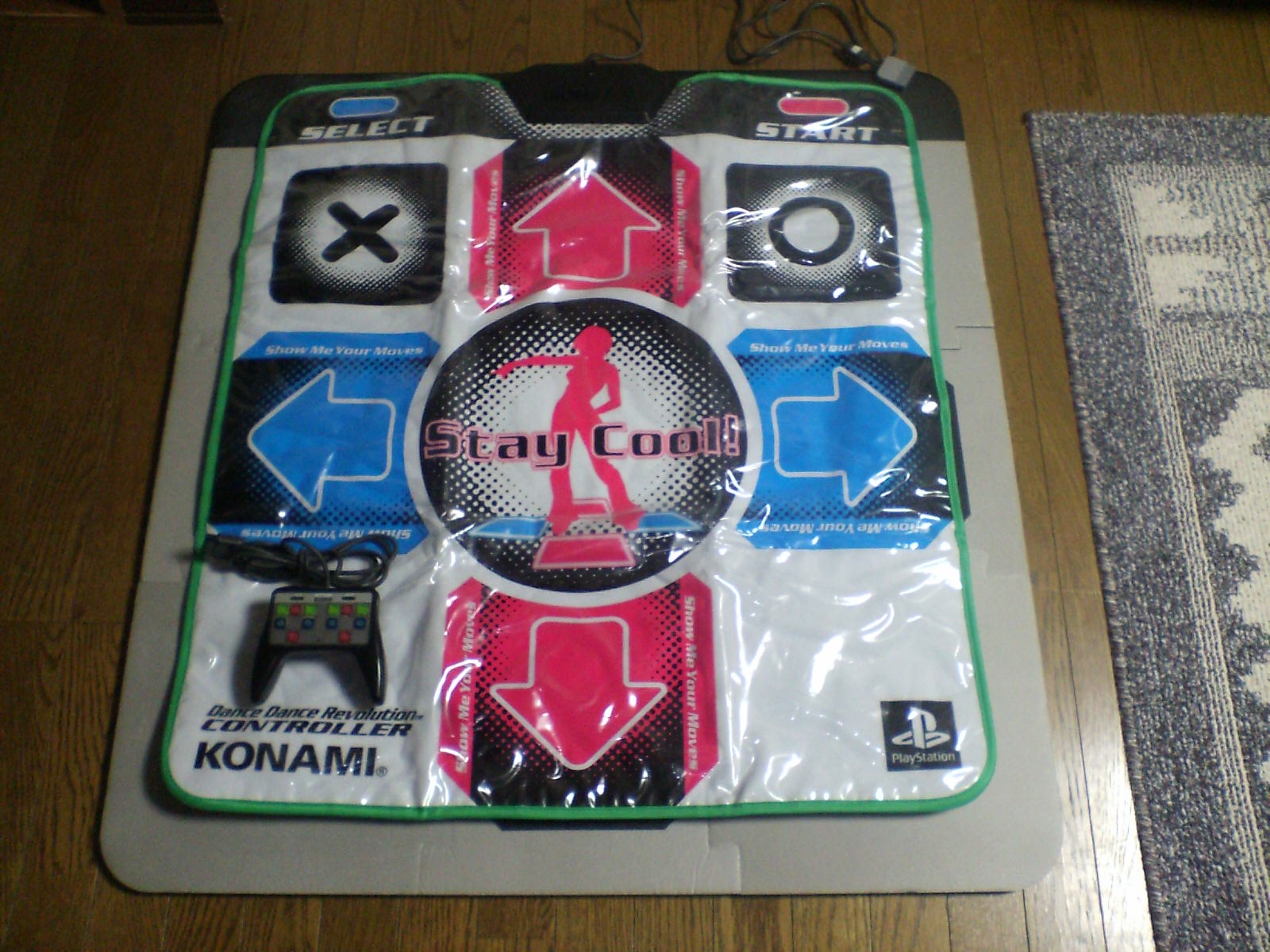
A dance pad, also known as a dance mat or dance platform, is a flat electronic game controller used for input in dance games. Most dance pads are divided into a 3×3 matrix of square panels for the player to stand on, with some or all of the panels corresponding to directions or actions within the game. Some dance pads also have extra buttons outside the main stepping area, such as "Start" and "Select". Pairs of dance pads often are joined, side by side, for certain gameplay modes.
Popular arcade games such as Dance Dance Revolution, In the Groove, Pump It Up, and StepManiaX use large steel dance platforms connected to the arcade cabinet, whereas versions for home consoles usually use smaller (often flexible) plastic pads. These home pads are specifically made for systems such as the GameCube, Wii, Dreamcast (Japan only), PlayStation, PlayStation 2 and Xbox, but can also be used in computer simulators such as StepMania through the use of special adapters.
"Soft" pads are thin and made of plastic. They generally cost $10–$20 USD. They are good for beginners to dance games or casual use, but they have a tendency to move around and wrinkle up during gameplay (unless "modded", such as by gluing or taping them to the top of a piece of plywood or the bottom of a transparent office chair mat). They are not usually durable and may wear out easily, but for light use they are quite suitable. Manufacturers of soft pads include Konami, BNSUSA, RedOctane, Intec, Mad Catz (Beat Pad), MyMyBox, Naki International, and Nintendo (Action Pad). OEM manufacturers include Topway (manufacturer of RedOctane pads), Futime, and many others.
Some soft pads contain stiff foam inserts of the dense or hard varieties to provide more stability and durability. The inserts usually ship as three or six puzzle pieces (to allow for a smaller box) which fit together using a dovetail joint and slide into the dance pad, which then zips closed around the foam. Certain brands of foam pads put raised plastic sections under the directional buttons to allow them to be more easily felt by a player's feet, so as to help keep them centered on the pad. These pads generally cost between $40 and $100.
It is also possible to modify a pad by attaching it to a hard surface and optionally covering it with clear material; this can increase pad life and keep it from slipping around.
"Hard" pads are usually constructed with metal (and sometimes wood) for durability, and usually come with a raised bar behind the player. Arcade machines use very durable metal pads that are designed for heavy use. Other hard pads can be purchased for home use with a video game system; the prices can be around US$100 to $350 ($200–$600 for double pads) - $700 to $1000+ online. Manufacturers of hard pads include DDRgame, Cobalt Flux, L-TEK, MyMyBox, Brown Box, RedOctane (ceased production as of February 2010 due to company termination) and Naki International.
Hard pads are used in all arcade versions of music games that employ dance pads, and often serve as the nec plus ultra for DIY Gamers that attempt to construct "Homebrew pads." Many Homebrew kits are ultimately instruction guides for converting soft pads into hard pads, although Homebrew hard pads often feature additional functions such as additional inputs (see below).
"Solid State" pads replace the usual mechanical switch and contact used in other hard pads. A proximity sensor is used to detect a player's steps on the pad. The advantages of a solid state design is that they do not require pressure to activate, eliminating moving parts that might break down and keeping dirt from getting into the mechanism.
Hub AI
Dance pad AI simulator
(@Dance pad_simulator)
Dance pad
A dance pad, also known as a dance mat or dance platform, is a flat electronic game controller used for input in dance games. Most dance pads are divided into a 3×3 matrix of square panels for the player to stand on, with some or all of the panels corresponding to directions or actions within the game. Some dance pads also have extra buttons outside the main stepping area, such as "Start" and "Select". Pairs of dance pads often are joined, side by side, for certain gameplay modes.
Popular arcade games such as Dance Dance Revolution, In the Groove, Pump It Up, and StepManiaX use large steel dance platforms connected to the arcade cabinet, whereas versions for home consoles usually use smaller (often flexible) plastic pads. These home pads are specifically made for systems such as the GameCube, Wii, Dreamcast (Japan only), PlayStation, PlayStation 2 and Xbox, but can also be used in computer simulators such as StepMania through the use of special adapters.
"Soft" pads are thin and made of plastic. They generally cost $10–$20 USD. They are good for beginners to dance games or casual use, but they have a tendency to move around and wrinkle up during gameplay (unless "modded", such as by gluing or taping them to the top of a piece of plywood or the bottom of a transparent office chair mat). They are not usually durable and may wear out easily, but for light use they are quite suitable. Manufacturers of soft pads include Konami, BNSUSA, RedOctane, Intec, Mad Catz (Beat Pad), MyMyBox, Naki International, and Nintendo (Action Pad). OEM manufacturers include Topway (manufacturer of RedOctane pads), Futime, and many others.
Some soft pads contain stiff foam inserts of the dense or hard varieties to provide more stability and durability. The inserts usually ship as three or six puzzle pieces (to allow for a smaller box) which fit together using a dovetail joint and slide into the dance pad, which then zips closed around the foam. Certain brands of foam pads put raised plastic sections under the directional buttons to allow them to be more easily felt by a player's feet, so as to help keep them centered on the pad. These pads generally cost between $40 and $100.
It is also possible to modify a pad by attaching it to a hard surface and optionally covering it with clear material; this can increase pad life and keep it from slipping around.
"Hard" pads are usually constructed with metal (and sometimes wood) for durability, and usually come with a raised bar behind the player. Arcade machines use very durable metal pads that are designed for heavy use. Other hard pads can be purchased for home use with a video game system; the prices can be around US$100 to $350 ($200–$600 for double pads) - $700 to $1000+ online. Manufacturers of hard pads include DDRgame, Cobalt Flux, L-TEK, MyMyBox, Brown Box, RedOctane (ceased production as of February 2010 due to company termination) and Naki International.
Hard pads are used in all arcade versions of music games that employ dance pads, and often serve as the nec plus ultra for DIY Gamers that attempt to construct "Homebrew pads." Many Homebrew kits are ultimately instruction guides for converting soft pads into hard pads, although Homebrew hard pads often feature additional functions such as additional inputs (see below).
"Solid State" pads replace the usual mechanical switch and contact used in other hard pads. A proximity sensor is used to detect a player's steps on the pad. The advantages of a solid state design is that they do not require pressure to activate, eliminating moving parts that might break down and keeping dirt from getting into the mechanism.