Recent from talks
Nothing was collected or created yet.
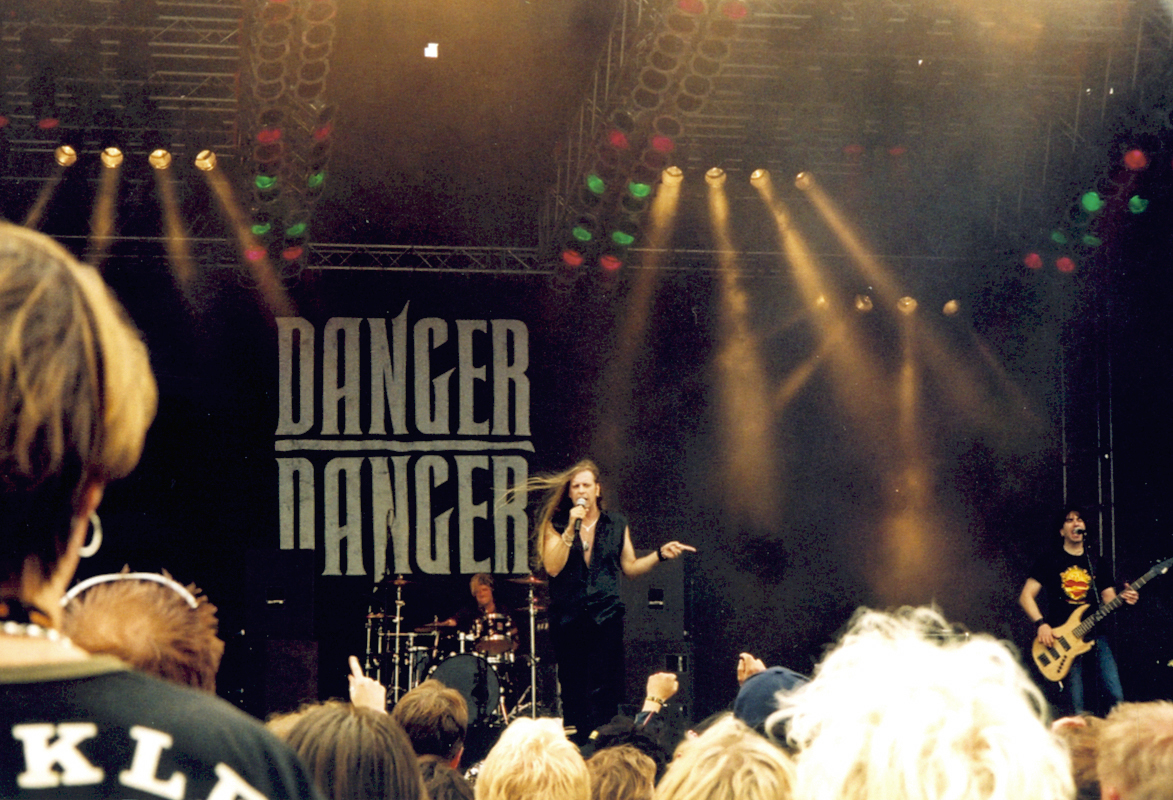
Danger Danger
View on Wikipedia
Danger Danger is an American hard rock band formed in Queens, New York, in 1986.[4]
Key Information
History
[edit]Danger Danger was formed in 1986 by former Hotshot members lead vocalist Mike Pont (joined in 1987), bassist Bruno Ravel, and drummer Steve West (joined in 1987). This lineup also featured then future Savatage and Megadeth guitarist Al Pitrelli and keyboardist Kasey Smith. Mike Pont later left the band and was replaced by Ted Poley, who previously played in the band Prophet as drummer, and sometimes lead vocalist. Somewhere during this time, they made a failed attempt at recording a demo.
They made another attempt at recording a demo and this time it landed them a recording contract with Epic Records.[4] In 1988, Pitrelli left Danger Danger.[4] Shortly after, Pont and Pitrelli reunited to form a new lineup of Hotshot. Since then, Pitrelli has played in various other bands. Pitrelli played on most of the Danger Danger compilation album Rare Cuts.
In 1988, Saraya guitarist Tony Rey joined briefly and played on part of their debut album, before returning to his previous band. Andy Timmons replaced him and played on the rest of their debut album, which was released the same year.[4] The album spawned two hits with "Naughty Naughty" and "Bang Bang", with the former gaining a spot in MTV's Headbangers Ball. The band went on tour opening for KISS, Alice Cooper, Extreme and Warrant.[5] Before Danger Danger, he was in the band Hotshot with original Danger Danger lead vocalist Mike Pont and Danger Danger bassist Bruno Ravel. After that, the band went on to record their follow-up in Fort Lauderdale, Florida, releasing Screw It! in 1991.[4] The album spawned two other hits with "Monkey Business" and "I Still Think About You" and again they went on tour with KISS. After the tour, Kasey Smith left the band and started a new project titled Shock together with friend and former Get With It drummer Michael Bellusci.[6]
In 1993 the band had finished work with their third album titled Cockroach. However, the band fired singer Poley. Subsequent lawsuits from Poley prevented the album from being released. In the meantime, Paul Laine was hired by Ravel and West as the new singer and he re-recorded the vocals for the new album. When they were about to release the album, Epic thought it was in their best interest to shelve the record. Shortly after that the band and the label parted ways. In addition, guitarist Timmons left the band to pursue a solo career. Timmons went on to play guitar on both of Kip Winger's solo albums.
Ravel and West formed their own label, Low Dice Records, and started working on a new album with Laine. They released Dawn in 1995 which featured a more somber and introspective tone. The album was partly marketed through the band's fan club, newsletter and website. The band recruited bassist Scott Brown, who had previously played with Paul Laine as a solo artist, and they went on tour again in the U.S.

The band went back in the studio and released Four the Hard Way in 1997. Former band members Andy Timmons and Kasey Smith contributed to the album, and the band went back on tour. In 2000 they released The Return of the Great Gildersleeves.
In 2001 the band made a unique move after talks with Epic, releasing Cockroach, which was supposed to be their third album, but could not be released for legal issues. The album featured two discs with two versions of the album, one with Laine on vocals and the other with Ted Poley. In 2002 the song "Naughty Naughty Christmas" was featured in the Tim Allen movie The Santa Clause 2. They followed Cockroach with Rare Cuts in 2003, a collection of unreleased and rare tracks including early demos with original member Pitrelli, now playing with Megadeth and Trans-Siberian Orchestra, that were recorded in his mother's laundry room. In 2004 Laine left the band and original singer Poley returned. However, in 2005 the band still released, Live and Nude, which was recorded in 2003 and featured Laine on vocals.
In 2008 rock and roll comic C.C. Banana recorded a song called "Ted Poley", released on the album Kiss My Ankh. The song is a parody of the Kiss song "Unholy", inspired by the story of Poley's first encounter with Kiss lead singer Paul Stanley.[7]
On September 19, 2009, the independent label Frontiers Records released Revolve, featuring the return of Poley as lead singer, as well as new member, guitarist Rob Marcello.[8] The album coincided with the 20th anniversary of their debut release for Imagine Records.
The classic lineup of Ted Poley, Bruno Ravel, Steve West, Andy Timmons, and Kasey Smith reunited in 2014 for a series of touring dates.[9][10]
Members
[edit]Current members
[edit]- Bruno Ravel – bass, backing vocals (1986–1995; 1997–present), guitar (1993–1995, 1997–2000), keyboards (1993–1995, 1998–2014, 2014–present)
- Steve West – drums, backing vocals (1987–1995; 1997–present)
- Ted Poley – lead vocals (1987–1993, 2004–present)
- Rob Marcello – guitar, backing vocals (2003–present)
- Steve Brown – guitar, backing vocals (2016–present; occasional touring guest)
Former members
[edit]- David Walls – lead vocals (1986) (repetitions only)
- Mike Rose — guitar (1986) (repetitions only)
- Joe Franco — drums (1986) (repetitions only)
- Phil Naro – lead vocals (1986-1987)
- Mike Pont – lead vocals (1987)
- Al Pitrelli – guitar, backing vocals (1987–1988)
- Tony "Bruno" Rey – guitar (1988–1989, 1997, 2000)
- Kasey Smith – keyboards, backing vocals (1987–1993, 1997–1998, 2014)
- Andy Timmons – guitar, backing vocals (1989–1993, 1997–2003, 2014)
- Paul Laine – lead vocals, guitar, keyboards (1994–1995; 1997–2004)
- Scott Brown – bass, backing vocals (1994–1995; touring member)
Timeline
[edit]
Discography
[edit]Studio albums
[edit]| Title | Release | Peak chart positions | |
|---|---|---|---|
| US | JPN [11] | ||
| Danger Danger | 1989 | 88 | — |
| Screw It! | 1991 | 123 | 67 |
| Dawn | 1995 | — | — |
| Four the Hard Way | 1997 | — | — |
| The Return of the Great Gildersleeves | 2000 | — | — |
| Cockroach | 2001 | — | — |
| Revolve | 2009 | — | 145 |
Live albums
[edit]- Down and Dirty Live EP (1990)
- Live and Nude (2005)
Compilation albums
[edit]- Rare Cuts (2003)
Singles
[edit]| Title | Release | Peak chart positions | Album | ||
|---|---|---|---|---|---|
| US | US Main |
UK [12] | |||
| "Naughty Naughty" | 1989 | — | — | — | Danger Danger |
| "Bang Bang" | 49 | 39 | — | ||
| "Don't Walk Away" | 1990 | — | — | — | |
| "Monkey Business" | 1992 | — | — | 42 | Screw It! |
| "I Still Think About You" | — | — | 46 | ||
| "Comin' Home" | — | — | 75 | ||
See also
[edit]Notes
[edit]- ^ hiatus 1995–1997
References
[edit]- ^ Ling, Dave (August 7, 2017). "Danger Danger: 'There is no motivation to record another album'". Louder. Retrieved April 28, 2025.
- ^ Prato, Greg. "Danger Danger – Artist Biography". AllMusic. Retrieved October 9, 2016.
- ^ "Danger Danger - Danger Danger (1989) - Album". Rock'n'Reviews. June 18, 2022. Retrieved April 28, 2025.
- ^ a b c d e Colin Larkin, ed. (1995). The Guinness Who's Who of Heavy Metal (Second ed.). Guinness Publishing. p. 93. ISBN 0-85112-656-1.
- ^ "2009 July 08 « Hard Rock Hideout". Hardrockhideout.com. July 8, 2009. Retrieved September 8, 2012.
- ^ "Kasey Smith – Rediff Pages". pages.rediff.com. Archived from the original on August 28, 2018. Retrieved August 28, 2018.
- ^ "KISS MY ANKH: A Tribute To Vinnie Vincent". SplitScreen Entertainment. Archived from the original on August 31, 2008. Retrieved August 31, 2008.
- ^ "2007 News Archive". MelodicRock.com. Archived from the original on January 29, 2013. Retrieved September 8, 2012.
- ^ "Danger Danger – Live At Firefest, Nottingham, Oct 26, 2014". YouTube. June 24, 2015. Archived from the original on December 12, 2021. Retrieved November 14, 2019.
- ^ "DANGER DANGER Boys will be boys LIVE Amityville L.I. USA Aug 30, 2014". YouTube. August 31, 2014. Archived from the original on December 12, 2021. Retrieved November 14, 2019.
- ^ "デンジャー・デンジャーのCDアルバムランキング、デンジャー・デンジャーのプロフィールならオリコン芸能人事典-ORICON STYLE". Oricon.co.jp. Retrieved December 29, 2013.
- ^ Roberts, David (2006). British Hit Singles & Albums (19th ed.). London: Guinness World Records Limited. p. 139. ISBN 1-904994-10-5.
External links
[edit]Danger Danger
View on GrokipediaHistory
Formation and early career (1987–1989)
Danger Danger was formed in 1987 in Queens, New York, by bassist Bruno Ravel and drummer Steve West, who had previously played together in the local new wave band Hotshot.[3] After Hotshot disbanded, Ravel and West sought to create a harder-edged rock outfit, drawing from the glam metal trends of the era.[4] The initial lineup included vocalist Mike Pont and guitarist Al Pitrelli, but Pont soon departed, prompting the band to recruit Ted Poley as lead singer after spotting him at a concert.[3] Poley, a seasoned performer from New Jersey's local scene, brought a dynamic vocal presence that aligned with the band's energetic style.[5] The lineup solidified further with the addition of guitarist Andy Timmons, who auditioned and impressed the group with his technical prowess, replacing Pitrelli who left in 1988.[6] Keyboardist Kasey Smith rounded out the core quintet, contributing to the band's pop-infused hard rock sound through layered synth elements.[1] In their early days, Danger Danger honed their material through frequent rehearsals and immersed themselves in the vibrant New York and New Jersey club circuit, performing at venues that served as breeding grounds for the East Coast hair metal scene.[3] These local shows helped build a grassroots following, with the band occasionally opening for major acts like Bon Jovi, exposing them to larger audiences and refining their high-energy live performances.[3] By late 1987, the band's demos caught the attention of A&R representatives, leading to a signing with Epic Records' newly launched Imagine imprint as its inaugural act in 1988.[1] Under producer Lance Quinn, they entered recording sessions for their self-titled debut album at studios including The Warehouse in Philadelphia.[4] A key milestone was the tracking of "Naughty Naughty," an early single that showcased their hook-driven, party-rock vibe and began generating buzz through limited local radio airplay on East Coast stations prior to the full album release.[3] This period marked the transition from club regulars to label-backed prospects, setting the stage for their breakthrough while maintaining roots in the regional rock community.[5]Breakthrough and major label success (1989–1993)
In 1989, Danger Danger achieved their breakthrough with the release of their self-titled debut album on Epic Records, which captured the high-energy glam metal sound prevalent in the late 1980s hair metal scene. Produced by Lance Quinn, the album featured standout tracks including the playful "Naughty Naughty" and the anthemic "Bang Bang," the latter of which peaked at No. 49 on the Billboard Hot 100 and No. 39 on the Mainstream Rock chart. The record climbed to No. 88 on the Billboard 200, reflecting solid initial commercial success driven by Epic's promotional efforts, including music videos that received rotation on MTV's Headbangers Ball.[7][8][3][9] The band's visibility surged through extensive touring, opening for prominent acts such as Alice Cooper on his Trash tour and KISS, which exposed them to larger audiences and solidified their live reputation for high-octane performances. Epic Records supported this phase with strategic marketing, emphasizing the band's charismatic stage presence and catchy hooks to build a dedicated fanbase, particularly in the United States where arena rock crowds embraced their party-oriented style. In Japan, early international traction emerged, with the album's melodic hooks resonating in the local hard rock market, laying the groundwork for future tours and releases tailored to Asian audiences.[3][10] By 1991, amid the shifting musical landscape toward grunge, Danger Danger released their sophomore album Screw It!, which maintained their signature blend of humor-infused hard rock but faced a tougher reception. The record, produced by band members Steve West and Bruno Ravel, peaked at No. 123 on the Billboard 200, hampered by the industry's pivot away from glam metal. Singles like "Love Gonna Make Me" and the power ballad "I Still Think About You"—the latter reaching No. 46 on the UK Singles Chart—highlighted the album's radio-friendly moments, though domestic airplay was limited. Epic's promotion continued with video releases and additional U.S. tours, fostering steady fan growth despite broader genre challenges, while Japanese interest remained strong, evidenced by acoustic performances and import sales.[11][12]Challenges and independent releases (1994–2000)
Following the modest commercial performance of their 1991 album Screw It!, which peaked at number 123 on the Billboard 200 amid the rising dominance of grunge and alternative rock, Danger Danger parted ways with Epic Records in 1993. This departure came after the band recorded their third album, Cockroach, for the label, but legal disputes and internal tensions led to the shelving of the project and the firing of lead vocalist Ted Poley.[1][13] To continue, the band recruited Canadian vocalist Paul Laine as Poley's replacement in late 1993, who re-recorded vocals for Cockroach—though it would not see release until 2001 due to ongoing litigation with Sony.[1] Facing significant financial hardships and a shrinking market for glam metal in the U.S., Danger Danger formed their independent label, Low Dice Records, in 1995 and issued their first self-released album, Dawn.[1] This record adopted a darker, grunge-influenced hard rock sound, with introspective lyrics mirroring the band's struggles, and was primarily distributed in Japan, where they maintained a loyal audience that supported limited regional touring.[14][15] By 1997–1998, the band rebounded creatively with Four the Hard Way, self-released via Low Dice in Japan (September 1997) and the U.S. (May 1998), featuring six new originals, four re-recorded tracks from the unreleased Cockroach, and one cover.[16] Produced by bassist Bruno Ravel, guitarist Steve West, and Laine, the album marked a return to their melodic hard rock style and garnered strong fan acclaim despite minimal promotion.[17] Touring remained constrained by budget issues, focusing on sporadic club shows and Japanese dates, as the group navigated ongoing economic challenges without major label backing.[1] In 2000, Danger Danger capped the decade with The Return of the Great Gildersleeves, another Low Dice release that blended high-energy rockers and ballads, earning critical praise for revitalizing their sound and solidifying their cult status among hard rock enthusiasts.[1] Throughout this era, the core members Ravel, West, and Laine persisted, with keyboardist Kasey Smith contributing to recordings, while guitar duties were handled primarily by Ravel with guest appearances; broader lineup stability was tested by the industry's shifts.[1][18]Reunion efforts and modern era (2001–present)
In 2004, after an eleven-year absence, original vocalist Ted Poley rejoined Danger Danger, marking a significant reunion effort for the band.[19] The reunited lineup's first performance took place at the Sweden Rock Festival in front of 25,000 attendees, signaling a resurgence in live activity.[19] Poley's return also led to the release of the live album Live and Nude in 2005, which captured recordings from earlier shows featuring his vocals alongside the core rhythm section of bassist Bruno Ravel and drummer Steve West. The band's momentum continued into the late 2000s with the studio album Revolve, released on September 18, 2009, via Frontiers Records, featuring Poley on lead vocals, Ravel on bass and production, and guitarist Rob Marcello.[20] This release coincided with a series of reunion tours emphasizing the classic lineup, including appearances at major events like Rocklahoma in Pryor, Oklahoma, on July 10, 2009, and multiple U.S. club and festival dates throughout 2009 and 2010.[21] These tours highlighted fan demand for the original sound, with setlists drawing heavily from early hits while incorporating tracks from Revolve.[22] By 2014, Danger Danger achieved a full original lineup reunion for touring purposes, bringing together Poley, Ravel, West, guitarist Andy Timmons, and keyboardist Kasey Smith for select dates, the first such configuration in over two decades.[23] Former vocalist Paul Laine, who had fronted the band from 1993 to 2004, did not rejoin this effort but maintained ties through collaborative projects like The Defiants, formed in 2016 with Ravel and Marcello.[24] Poley remained the primary vocalist thereafter, solidifying his role in the band's ongoing activities. Entering the 2020s, Danger Danger sustained a touring resurgence through appearances on specialized events, including the Monsters of Rock Cruise in 2019, where they shared stages with acts like Tesla and Queensrÿche.[25] The COVID-19 pandemic disrupted plans in 2020, leading to cancellations and postponements of live shows amid global restrictions, though the band managed early-year performances such as one in Wantagh, New York, on February 23, 2020.[26] Post-pandemic recovery saw resumed U.S. festival and club dates, including slots at events like the M3 Rock Festival in May 2025 and intimate venues such as the Rainbow Bar & Grill in Hollywood on September 1, 2024.[27] As of 2025, Danger Danger operates independently without major label backing, relying on fan-driven interest to fuel sporadic tours and merchandise sales centered on their catalog, including Revolve.[28] No large-scale anniversary tour has been announced for the band's 1987 formation milestone, though Poley continues to perform core material at rock festivals and has expressed openness to further reunions in interviews.[29] This era reflects a stabilized, nostalgia-oriented presence in the hard rock scene, with emphasis on live preservation of their 1980s sound rather than new recordings.[30]Musical style and influences
Core sound and genre classification
Danger Danger is primarily classified as a glam metal band, often encompassed under the hair metal or pop-metal subgenres of hard rock, characterized by its high-energy riffs, anthemic choruses, and infectious pop hooks that epitomized late-1980s arena rock.[6] This style emerged prominently on their 1989 self-titled debut album, blending fist-pumping energy with a polished, radio-ready accessibility that aligned with the era's MTV-driven hard rock scene.[4] The band's core sound revolves around signature elements that define its party-hearty vibe, including Ted Poley's soaring and charismatic lead vocals, which anchor massive sing-along choruses in tracks like "Naughty Naughty" and "Bang Bang."[4] Keyboardist Kasey Smith's contributions add melodic flourishes and synth-driven layers, enhancing the pop-rock soul beneath the glam exterior, while guitarist Andy Timmons delivers virtuosic, glitzy solos that provide dynamic flair without overwhelming the hooks.[4] Lyrical themes focus on upbeat party anthems, romantic escapades, and playful rebellion, steering clear of deeper social commentary in favor of lighthearted, hedonistic escapism.[1] Early production emphasized a big 1980s arena rock aesthetic, featuring reverb-laden mixes, gang vocals, and a bright sheen crafted by producers like Lance Quinn to suit major-label releases on Epic Records.[4] Following lineup changes and the shift to independent labels after 1993, such as with the 1995 album Dawn, the sound evolved to a rawer, grittier tone that reflected darker, more introspective moods while retaining melodic hard rock foundations.[19] Compared to contemporaries, Danger Danger's approach is more melodic and polished than the chaotic aggression of Guns N' Roses, sharing Mötley Crüe's hedonistic party ethos but with a sleeker pop-metal edge akin to Poison, Ratt, or Warrant.[6][4]Key influences and evolution
Danger Danger's musical influences drew heavily from 1970s hard rock acts such as Aerosmith and Kiss, which shaped their energetic riffs and theatrical elements, as noted by bassist Bruno Ravel in a 2005 interview where he cited these bands alongside Led Zeppelin and Van Halen as formative inspirations.[31] The band also absorbed elements from the New Wave of British Heavy Metal, particularly Def Leppard's anthemic structures and production polish, evident in their hook-driven songwriting.[4] Additionally, pop rock influences from Journey and Bon Jovi contributed to their melodic sensibilities and radio-friendly choruses, blending accessibility with rock edge.[32][31] During their 1989–1991 polished glam phase, Danger Danger refined a high-energy, synth-infused hard rock sound on albums like their self-titled debut and Screw It!, emphasizing party anthems and glossy production that captured the late-1980s hair metal aesthetic while incorporating Cheap Trick's punchy hooks.[4][33] Following vocalist Ted Poley's departure in 1993, the band's 1994–2000 era marked a shift toward independent releases, with Cockroach (recorded 1993, released 2001) and Four the Hard Way (1998) adopting a grittier, more straightforward hard rock approach amid the post-grunge landscape, reducing glam excesses in favor of rawer AOR elements and re-recorded tracks from unreleased material.[34][35] This adaptation reflected broader industry changes, allowing the band to sustain a core fanbase through melodic hard rock without fully abandoning their roots.[1] In the 2000s revival, Danger Danger blended original compositions with modern production techniques, as seen in their 2009 album Revolve, which incorporated cleaner mixes and contemporary rock elements like refined songwriting and upbeat rhythms while maintaining their signature party vibe.[20] Post-reunion efforts, including Poley's return in 2004, emphasized a fusion of classic hard rock with updated sonic clarity, evolving toward a timeless melodic style that appealed to both longtime followers and newer audiences through live performances heavy on 1980s staples.[36] By the 2020s, this trajectory continued with a focus on classic rock fusion in touring sets, incorporating covers and polished originals to bridge eras, though new studio output remained sparse.[37]Band members
Current members
The current lineup of Danger Danger, as of November 2025, consists of the following members, reflecting the core group that has been stable since 2004 following Ted Poley's return and Rob Marcello's inclusion on guitar.- Ted Poley – lead vocals (1987–1993, 2004–present): Original frontman who rejoined the band in 2004 after an 11-year hiatus, contributing to subsequent releases and tours.[1]
- Bruno Ravel – bass, keyboards, backing vocals (1987–present): Founding member who has handled multiple instrumental roles, including synthesizer and piano on recent recordings, while serving as a primary songwriter.[1][19][38]
- Rob Marcello – lead guitar, backing vocals (2003–present): Joined in the early 2000s and has been a consistent presence, contributing to albums like Revolve (2009).[39][38]
- Steve West – drums, backing vocals (1987–present): Founding member and primary lyricist, maintaining a continuous role throughout the band's history.[1][19]
Former members
Ted Poley served as the lead vocalist for Danger Danger from the band's formation in 1987 until 1993, when he was fired shortly after completing vocals for the album Cockroach, reportedly due to financial disputes and label pressures amid the band's legal issues with Sony.[3] He pursued a solo career and other projects, including fronting Bone Machine in the 1990s, before rejoining Danger Danger in 2004 for reunion tours and recordings.[30] Paul Laine replaced Poley as lead vocalist in 1994, recording vocals for the reissued Cockroach and contributing to subsequent albums including Dawn (1995) and Four the Hard Way (1997), during a tenure that lasted approximately ten years until his departure in 2004 to pursue solo work and later form The Defiants with bassist Bruno Ravel.[1][24] Laine made occasional guest appearances with the band between 2009 and 2013.[41] Kasey Smith was the band's keyboardist from 1987 to around 1991, appearing on the debut album Danger Danger (1989) and Screw It! (1991), but left following the latter's tour as the group's sound shifted toward a heavier guitar emphasis that diminished the role of keyboards.[1][42] Prior to Ted Poley's arrival, the band briefly featured vocalist Mike Pont during its early formation in 1987, who departed before the official lineup solidified.[43]Timeline
| Year/Period | Vocals | Guitar | Keyboards | Bass | Drums |
|---|---|---|---|---|---|
| 1987 | Mike Pont [44] | Al Pitrelli [44] | Kasey Smith [44] | Bruno Ravel [44] | Steve West [44] |
| Late 1987 | Ted Poley joins, replaces Pont [4] | Al Pitrelli | Kasey Smith | Bruno Ravel | Steve West |
| 1988–1989 | Ted Poley | Andy Timmons joins, replaces Pitrelli [45] | Kasey Smith | Bruno Ravel | Steve West |
| 1989–1993 | Ted Poley | Andy Timmons | Kasey Smith (until 1992) [44] | Bruno Ravel | Steve West |
| 1993–1994 | Paul Laine joins, replaces Poley [1] | Andy Timmons | (Various/session) | Bruno Ravel | Steve West |
| 1995–2003 | Paul Laine | Andy Timmons (until 2003) [45] | (Various) | Bruno Ravel (Scott Brown temporary 1995–1996) [44]; Kelly Nickels (brief) [45] | Steve West |
| 2003–2004 | Paul Laine | Rob Marcello joins, replaces Timmons [44] | (Various) | Bruno Ravel | Steve West |
| 2004–present | Ted Poley rejoins, replaces Laine [1] | Rob Marcello | Kasey Smith (1997–2000, 2014) [44]; Andy Timmons (guest appearances 2014) [44] | Bruno Ravel | Steve West |
Discography
Studio albums
Danger Danger's self-titled debut studio album was released on June 27, 1989, by Epic Records. It showcased the band's high-energy glam metal sound, featuring standout tracks like "Naughty Naughty" and "Bang Bang," which helped propel the album to moderate commercial success through extensive touring with acts like Kiss and Alice Cooper.[1] The follow-up, Screw It!, arrived on October 1, 1991, also via Epic Records. This release expanded on their party-rock formula with hits such as "Monkey Business" and the power ballad "I Still Think About You," supporting tours in Europe alongside Kiss and a headlining stint in Japan.[1] After parting ways with Epic, the band issued Dawn on June 5, 1995, through the independent label Low Dice Records. Marked by a more introspective and somber tone amid personal and legal challenges, it highlighted Bruno Ravel's multi-instrumental contributions on guitar and bass.[1] Four the Hard Way followed in 1998 on Low Dice Records, embracing a return to the group's melodic hard rock roots and earning positive critical reception for its polished production and energetic tracks.[1] In 2000, The Return of the Great Gildersleeves was released independently, further cementing the band's enduring appeal in the hard rock scene with its blend of classic influences and modern edge.[1] Cockroach, recorded as early as 1993 but delayed by contractual disputes, emerged in 2001 as a two-disc set on Low Dice Records in partnership with Sony Music. It uniquely presented vocals by both former singer Paul Laine on the first disc and returning vocalist Ted Poley on the second, offering fans dual perspectives on the material.[1] The 2009 album Revolve, issued by Frontiers Records, commemorated the 20th anniversary of the band's debut and featured the reunion of original frontman Ted Poley alongside core members Bruno Ravel and Steve West. It debuted on the Swedish Top 100 albums chart, signaling a revitalized phase for the group.[20][1]Live albums
Danger Danger has released two official live recordings, capturing the band's high-energy performances during key periods of their career. The band's first live release, Down and Dirty Live!, is a five-track EP issued in 1990 by Epic Records as a promotional item during their tour supporting the debut album. Recorded live in 1990, it showcases the original lineup's raw stage presence with extended versions of fan favorites like "Boys Will Be Boys" (6:30) and "Bang Bang" (5:03), an original instrumental "Groove or Die" (5:38), "Naughty Naughty" (6:26), and a cover of Rick Derringer's "Rock 'n' Roll Hoochie Koo" (4:15). The EP highlights the group's glam metal roots and crowd interaction, though specific venue details remain undocumented in official releases.[47][48] Their sole full-length live album, Live and Nude, arrived in 2005 via MTM Music, recorded during the 2003 tour with vocalist Paul Laine, bassist Bruno Ravel, drummer Steve West, and guitarist Rob Marcello (replacing Andy Timmons). Spanning 13 tracks and over 70 minutes, it draws from later studio efforts like Dawn and The Return of the Great Gildersleeves, opening with high-octane renditions of "Beat the Bullet" and "Grind," alongside classics such as "Under the Gun," "Don't Walk Away," and "Bang Bang." Produced and mixed at Soundcheckers Studios in New York, the album emphasizes the band's matured hard rock sound with added keyboards for depth, earning praise for its faithful reproduction of their live dynamics without overdubs. No specific venues are credited, but it reflects tours across Europe and the U.S.[49][50][51]| Title | Release Year | Format | Label | Key Features |
|---|---|---|---|---|
| Down and Dirty Live! | 1990 | EP (5 tracks, 28:02) | Epic Records | Promotional tour recording; includes covers and instrumentals; original lineup. |
| Live and Nude | 2005 | Album (13 tracks, 71:00) | MTM Music | Full concert capture from 2003 tour; post-reunion era with Laine; mixes classics and newer material. |
Compilation albums
Danger Danger's compilation albums primarily consist of retrospective collections featuring rare recordings, demos, and alternate takes from their early career, released after their major-label tenure with Epic Records ended. These releases cater to dedicated fans seeking unreleased material from the band's formative years in the late 1980s and early 1990s.[52][53] Rare Cuts (2003, Low Dice Records) is the band's primary official compilation, compiling 11 tracks recorded between 1986 and 1991 across various sessions, including outtakes from their debut and Screw It! eras at studios like The Hit Factory in New York and Wisseloord Studios in the Netherlands. Produced by band members Bruno Ravel and Steve West, it includes alternate versions and B-sides such as "Lovin' A Girl Like You (Could Be Bad For My Health)," "Bang Bang," "Feels Like Love," and "Don't Blame It On Love," highlighting the group's glam metal sound with high-energy riffs and hooks. Released independently amid a resurgence of interest in 1980s hard rock, it serves as a fan-oriented archive rather than a traditional greatest hits package, emphasizing material not found on their studio albums.[52][53][54] In the 2020s, unofficial and bootleg compilations have emerged to fill gaps in official releases, such as Demos & Rarities (1987-91) (2020, Loudworks), a 15-track collection of early demos and live recordings featuring covers like Alice Cooper's "No More Mr. Nice Guy" alongside originals such as "Temptation" and "Hold On Maria." Drawn from the band's pre-debut lineup experiments, including sessions with vocalist Phil Naro, it provides insight into their development but lacks official band endorsement. No major anniversary compilations were issued by the band in this decade, though reissues of core albums with bonus tracks appeared in Japan during the 2010s.[55][56]Singles and EPs
Danger Danger's singles output primarily consisted of promotional and commercial releases tied to their early Epic Records era, with limited chart success on rock radio formats. The band's debut single, "Naughty Naughty," was released in 1989 to promote their self-titled album.[57] Later that year, the double A-side single "Under My Skin" / "Saturday Nite" followed, serving as additional promotion for the same album, though it did not achieve notable chart placement.[18] The 1991 album Screw It! yielded two further singles: the power ballad "I Still Think About You," which became one of the band's enduring radio staples.[58] These releases highlighted the band's glam metal sound during the tail end of the hair metal boom, with "I Still Think About You" gaining traction through MTV airplay and live performances. In the band's independent phase after the mid-1990s, singles became more sporadic, often as digital downloads or limited promo items. Post-2010 examples include tracks like "F.U.$." from the 2011 album Revolve, released as a digital single to support touring. Regarding EPs, Danger Danger's output was modest, focusing on promotional and live formats. Early efforts included demo tapes circulated in the late 1980s prior to their major-label deal, featuring rough versions of songs like "Naughty Naughty." Japanese market releases featured specialized singles packs, such as the 1990 four-track promotional CD EP Rock America, which included live recordings for international promotion.[59]| Single/EP | Year | Label | Peak Chart Position | Notes |
|---|---|---|---|---|
| "Naughty Naughty" | 1989 | Epic | - | Lead single from debut album; promotional CD and vinyl formats. |
| "Under My Skin" / "Saturday Nite" | 1989 | Epic | - | Double A-side promo single. |
| "I Still Think About You" | 1991 | Epic | - | Ballad single with video; CD single with B-sides like "Rock America." |
| Rock America (Promo EP) | 1990 | Epic (Japan) | - | 4-track live promo for Japanese market. |
