


Community hub
Recent from talks
Contribute something to knowledge base
Content stats: 0 posts, 0 articles, 1 media, 0 notes
Members stats: 0 subscribers, 0 contributors, 0 moderators, 0 supporters
Subscribers
Supporters
Contributors
Moderators
Danilo Di Luca
Danilo Di Luca (born 2 January 1976) is a former Italian professional road racing cyclist, best known for winning the 2007 Giro d'Italia, but also for several positive doping tests, the last of which resulting in a lifetime ban from the sport.
Di Luca is also one of six riders to have won each of the three Ardennes classics; he won the Amstel Gold Race and La Flèche Wallonne in 2005, and Liège–Bastogne–Liège in 2007. During his career, Di Luca rode for the Riso Scotti, Cantina Tollo–Acqua & Sapone, Saeco, Liquigas, LPR Brakes–Farnese Vini, Team Katusha, Acqua & Sapone and Vini Fantini–Selle Italia squads.
Di Luca's career was also dogged by numerous infractions, involving three suspensions in relation to doping. In 2007, Di Luca was suspended for three months towards the end of the season, for visiting previously banned doctor Carlo Santuccione, which later escalated into the Oil for Drugs case. In 2009, at the Giro d'Italia, Di Luca tested positive on two occasions for CERA, and was given a backdated – to July 2009 – two-year ban in February 2010, which was later reduced to nine months. His third positive test came just before the 2013 Giro d'Italia, when he tested positive for erythropoietin (EPO) in an out-of-competition test. Di Luca expressed surprise at the test results, but he was given a lifetime ban in December 2013.
Danilo Di Luca wrote his autobiography Bestie da Vittoria, which means "Beasts for victories". Such book is also a denunciation of the use of doping substances among cyclists and the use of anti-doping controls as a way to manipulate competition results.
Born in Spoltore, province of Pescara, Di Luca began his professional career in 1998 in the Riso Scotti team. He showed talent by winning the under-23 version of the Giro D'Italia. His first pro win was in 1999, when, moving to Cantina Tollo-Alexia Alluminio, he won the first stage of the Giro d'Abruzzo. He remained in the team taking wins in 2001 such as the fourth stage of the Giro d'Italia and the Giro di Lombardia. Then, he transferred to Saeco-Longoni Sport.
During his time at Saeco-Longoni he lost the Vuelta al País Vasco on the last stage, a mountain time trial in which Andreas Klöden took the lead and the win. Combined with injuries and lack of confidence of the team directors, his performance suffered. In 2004 Italian officials investigated Di Luca for doping. Cyclingnews.com said: "Di Luca was recorded in several phone conversations with Eddy Mazzoleni in which he allegedly talked about doping products, the investigation led to Di Luca's non-participation in the 2004 Tour de France."
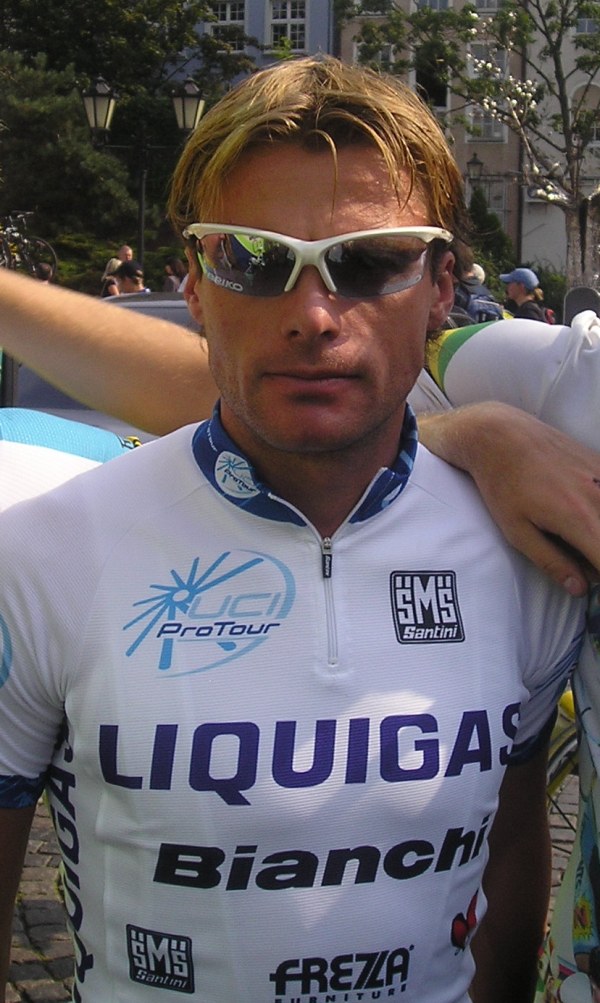
In 2005, Di Luca switched to Liquigas–Bianchi, with Mario Cipollini, Dario Cioni, Stefano Garzelli and Magnus Bäckstedt. He led the team for the spring classics. His first victory came in the first stage of the UCI ProTour race Vuelta al País Vasco, which he won overall after defeating Aitor Osa in the final time trial. He won the Amstel Gold Race and La Flèche Wallonne, taking the ProTour leader's white jersey.
Di Luca was seen as suited to races lasting only a few days. His success in the 2005 Giro d'Italia came as a surprise. Here he won two stages and finished fourth. He finished fifth in the Tour de Pologne. With a fourth in the 2005 Züri-Metzgete, he became 2005 UCI ProTour champion.
Danilo Di Luca
Danilo Di Luca (born 2 January 1976) is a former Italian professional road racing cyclist, best known for winning the 2007 Giro d'Italia, but also for several positive doping tests, the last of which resulting in a lifetime ban from the sport.
Di Luca is also one of six riders to have won each of the three Ardennes classics; he won the Amstel Gold Race and La Flèche Wallonne in 2005, and Liège–Bastogne–Liège in 2007. During his career, Di Luca rode for the Riso Scotti, Cantina Tollo–Acqua & Sapone, Saeco, Liquigas, LPR Brakes–Farnese Vini, Team Katusha, Acqua & Sapone and Vini Fantini–Selle Italia squads.
Di Luca's career was also dogged by numerous infractions, involving three suspensions in relation to doping. In 2007, Di Luca was suspended for three months towards the end of the season, for visiting previously banned doctor Carlo Santuccione, which later escalated into the Oil for Drugs case. In 2009, at the Giro d'Italia, Di Luca tested positive on two occasions for CERA, and was given a backdated – to July 2009 – two-year ban in February 2010, which was later reduced to nine months. His third positive test came just before the 2013 Giro d'Italia, when he tested positive for erythropoietin (EPO) in an out-of-competition test. Di Luca expressed surprise at the test results, but he was given a lifetime ban in December 2013.
Danilo Di Luca wrote his autobiography Bestie da Vittoria, which means "Beasts for victories". Such book is also a denunciation of the use of doping substances among cyclists and the use of anti-doping controls as a way to manipulate competition results.
Born in Spoltore, province of Pescara, Di Luca began his professional career in 1998 in the Riso Scotti team. He showed talent by winning the under-23 version of the Giro D'Italia. His first pro win was in 1999, when, moving to Cantina Tollo-Alexia Alluminio, he won the first stage of the Giro d'Abruzzo. He remained in the team taking wins in 2001 such as the fourth stage of the Giro d'Italia and the Giro di Lombardia. Then, he transferred to Saeco-Longoni Sport.
During his time at Saeco-Longoni he lost the Vuelta al País Vasco on the last stage, a mountain time trial in which Andreas Klöden took the lead and the win. Combined with injuries and lack of confidence of the team directors, his performance suffered. In 2004 Italian officials investigated Di Luca for doping. Cyclingnews.com said: "Di Luca was recorded in several phone conversations with Eddy Mazzoleni in which he allegedly talked about doping products, the investigation led to Di Luca's non-participation in the 2004 Tour de France."
In 2005, Di Luca switched to Liquigas–Bianchi, with Mario Cipollini, Dario Cioni, Stefano Garzelli and Magnus Bäckstedt. He led the team for the spring classics. His first victory came in the first stage of the UCI ProTour race Vuelta al País Vasco, which he won overall after defeating Aitor Osa in the final time trial. He won the Amstel Gold Race and La Flèche Wallonne, taking the ProTour leader's white jersey.
Di Luca was seen as suited to races lasting only a few days. His success in the 2005 Giro d'Italia came as a surprise. Here he won two stages and finished fourth. He finished fifth in the Tour de Pologne. With a fourth in the 2005 Züri-Metzgete, he became 2005 UCI ProTour champion.
Recent media
Recent media