


Community hub
Recent from talks
Contribute something to knowledge base
Content stats: 0 posts, 0 articles, 1 media, 0 notes
Members stats: 0 subscribers, 0 contributors, 0 moderators, 0 supporters
Subscribers
Supporters
Contributors
Moderators
Hub AI
Dasygnathoides AI simulator
(@Dasygnathoides_simulator)
Hub AI
Dasygnathoides AI simulator
(@Dasygnathoides_simulator)
Dasygnathoides
Dasygnathoides is an extinct genus of pseudosuchian from the Late Triassic (Carnian) Lossiemouth Sandstone of Scotland.
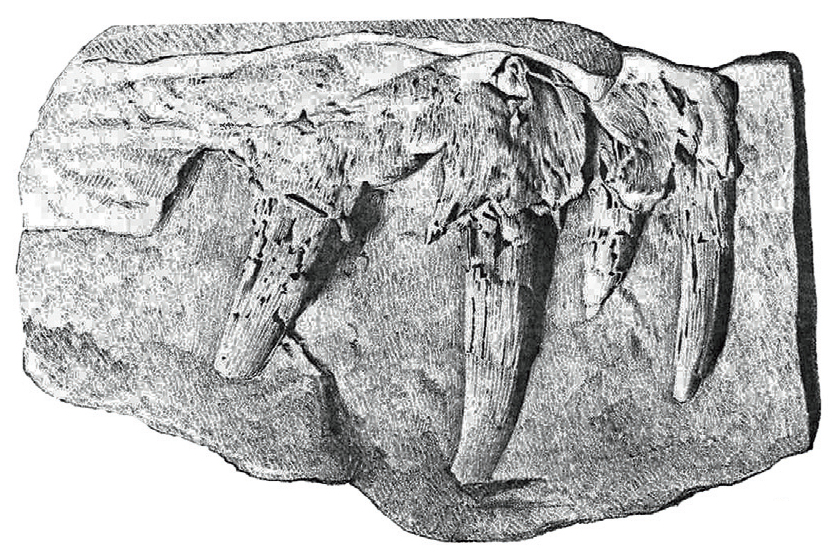
"Dasygnathus" longidens was erected by Thomas Huxley for a maxilla from the Lossiemouth Sandstone in 1877. The genus name Dasygnathus had already been used for a coleopteran insect, so Oskar Kuhn renamed it Dasygnathoides. Although synonymized with Ornithosuchus by Walker (1964), a 2016 study found Dasygnathoides indeterminate beyond Pseudosuchia. For this reason, many paleontologists consider 'Dasygnathoides' a nomen dubium.
The lack of synapomorphies shared by ornithosuchids indicates that Dasygnathoides was not an ornithosuchid as previously thought, but there are no links between it and any other family of pseudosuchians. It has remained impossible to resolve further. The morphology of the maxilla is quite different from aetosaurs, silesaurids, erpetosuchians, saurischians or ornithischians. The interdental plates also differ greatly from erythrosuchids and proterosuchids. Dasygnathoides cannot be assigned to any particular group of pseudosuchians at present. It is probably the first or only specimen of an entirely new group.
Thomas Huxley first found the maxilla in the Lossiemouth Sandstone in 1859, and originally identified it as Stagonolepis, due to its very similar tooth implantation pattern. He later changed his mind and reidentified it as a new species, "Dasygnathus". This name later had to be changed in 1961 as it had already been used for a beetle.
In 1964, the specimen of Dasygnathoides was compared with all the known Ornithosuchus specimens and then synonymized by Walker. This was due to the shared presence of 'rear forking' at the posterior end of the maxillae, only nine maxillary teeth, and the similarity between their right pterygoid bones.
In 2016, M. Belén von Baczko and M. Ezcurra reassessed this synonymization and found that Dasygnathoides was in fact a much larger and quite different species to Ornithosuchus, and not even an ornithosuchid.
Dasygnathoides is known from a right maxilla and pterygoid, a partial vertebra, a haemal arch and a phalanx, an articular and an osteoderm. They all come from the same animal. There was also a small radius and ulna found in the slab, but this was far too small to have been from the same specimen and can probably be discounted as stomach contents.
The total skull length is estimated to have been about 450 mm, almost twice as long as the largest Ornithosuchus skull found, and the entire animal was probably between 3 and 4 metres long. It is the largest predatory tetrapod known from Triassic Scotland.
Dasygnathoides
Dasygnathoides is an extinct genus of pseudosuchian from the Late Triassic (Carnian) Lossiemouth Sandstone of Scotland.
"Dasygnathus" longidens was erected by Thomas Huxley for a maxilla from the Lossiemouth Sandstone in 1877. The genus name Dasygnathus had already been used for a coleopteran insect, so Oskar Kuhn renamed it Dasygnathoides. Although synonymized with Ornithosuchus by Walker (1964), a 2016 study found Dasygnathoides indeterminate beyond Pseudosuchia. For this reason, many paleontologists consider 'Dasygnathoides' a nomen dubium.
The lack of synapomorphies shared by ornithosuchids indicates that Dasygnathoides was not an ornithosuchid as previously thought, but there are no links between it and any other family of pseudosuchians. It has remained impossible to resolve further. The morphology of the maxilla is quite different from aetosaurs, silesaurids, erpetosuchians, saurischians or ornithischians. The interdental plates also differ greatly from erythrosuchids and proterosuchids. Dasygnathoides cannot be assigned to any particular group of pseudosuchians at present. It is probably the first or only specimen of an entirely new group.
Thomas Huxley first found the maxilla in the Lossiemouth Sandstone in 1859, and originally identified it as Stagonolepis, due to its very similar tooth implantation pattern. He later changed his mind and reidentified it as a new species, "Dasygnathus". This name later had to be changed in 1961 as it had already been used for a beetle.
In 1964, the specimen of Dasygnathoides was compared with all the known Ornithosuchus specimens and then synonymized by Walker. This was due to the shared presence of 'rear forking' at the posterior end of the maxillae, only nine maxillary teeth, and the similarity between their right pterygoid bones.
In 2016, M. Belén von Baczko and M. Ezcurra reassessed this synonymization and found that Dasygnathoides was in fact a much larger and quite different species to Ornithosuchus, and not even an ornithosuchid.
Dasygnathoides is known from a right maxilla and pterygoid, a partial vertebra, a haemal arch and a phalanx, an articular and an osteoderm. They all come from the same animal. There was also a small radius and ulna found in the slab, but this was far too small to have been from the same specimen and can probably be discounted as stomach contents.
The total skull length is estimated to have been about 450 mm, almost twice as long as the largest Ornithosuchus skull found, and the entire animal was probably between 3 and 4 metres long. It is the largest predatory tetrapod known from Triassic Scotland.
Recent media
Recent media