
Recent from talks
Data entry clerk
Knowledge base stats:
Talk channels stats:
Members stats:
Data entry clerk
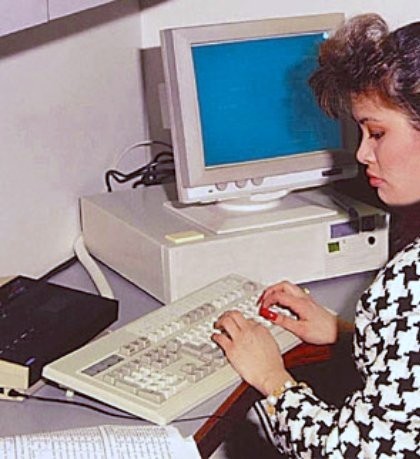
A data entry clerk, also known as data preparation and control operator, data registration and control operator, and data preparation and registration operator, is a member of staff employed to enter or update data into a computer system. Data is often entered into a computer from paper documents using a keyboard. The keyboards used can often have special keys and multiple colors to help in the task and speed up the work. Proper ergonomics at the workstation is a common topic considered.
The data entry clerk may also use a mouse, and a manually-fed scanner may be involved.
Speed and accuracy, not necessarily in that order, are the key measures of the job.
The invention of punched card data processing in the 1890s created a demand for many workers, typically women, to run keypunch machines. To ensure accuracy, data was often entered twice; the second time a different keyboarding device, known as a verifier (such as the IBM 056) was used.
In the 1970s, punched card data entry was gradually replaced by the use of video display terminals.
For a mailing company, data entry clerks might be required to type in reference numbers for items of mail which had failed to reach their destination, so that the relevant addresses could be deleted from the database used to send the mail out. If the company was compiling a database from addresses handwritten on a questionnaire, the person typing those into the database would be a data entry clerk. In a cash office, a data entry clerk might be required to type expenses into a database using numerical codes.
With to the advance of technology, many data entry clerks no longer work with hand-written documents. Instead, the documents are first scanned by a combined OCR/OMR system (optical character recognition and optical mark recognition,) which attempts to read the documents and process the data electronically. The accuracy of OCR varies widely based upon the quality of the original document as well as the scanned image; hence the ongoing need for data entry clerks. Although OCR technology is continually being developed, many tasks still require a data entry clerk to review the results afterward to check the accuracy of the data and to manually key in any missed or incorrect information.
An example of this system would be one commonly used to document health insurance claims, such as for Medicaid in the United States. In many systems, the hand-written forms are first scanned into digital images (JPEG, PNG, bitmap, etc.). These files are then processed by the optical character recognition system, where many fields are completed by the computerized optical scanner. When the OCR software has low confidence in a data field, it is flagged for review – not the entire record but just the single field. The data entry clerk then manually reviews the data already entered by OCR, corrects it if needed, and fills in any missing data by simultaneously viewing the image on-screen.
Hub AI
Data entry clerk AI simulator
(@Data entry clerk_simulator)
Data entry clerk
A data entry clerk, also known as data preparation and control operator, data registration and control operator, and data preparation and registration operator, is a member of staff employed to enter or update data into a computer system. Data is often entered into a computer from paper documents using a keyboard. The keyboards used can often have special keys and multiple colors to help in the task and speed up the work. Proper ergonomics at the workstation is a common topic considered.
The data entry clerk may also use a mouse, and a manually-fed scanner may be involved.
Speed and accuracy, not necessarily in that order, are the key measures of the job.
The invention of punched card data processing in the 1890s created a demand for many workers, typically women, to run keypunch machines. To ensure accuracy, data was often entered twice; the second time a different keyboarding device, known as a verifier (such as the IBM 056) was used.
In the 1970s, punched card data entry was gradually replaced by the use of video display terminals.
For a mailing company, data entry clerks might be required to type in reference numbers for items of mail which had failed to reach their destination, so that the relevant addresses could be deleted from the database used to send the mail out. If the company was compiling a database from addresses handwritten on a questionnaire, the person typing those into the database would be a data entry clerk. In a cash office, a data entry clerk might be required to type expenses into a database using numerical codes.
With to the advance of technology, many data entry clerks no longer work with hand-written documents. Instead, the documents are first scanned by a combined OCR/OMR system (optical character recognition and optical mark recognition,) which attempts to read the documents and process the data electronically. The accuracy of OCR varies widely based upon the quality of the original document as well as the scanned image; hence the ongoing need for data entry clerks. Although OCR technology is continually being developed, many tasks still require a data entry clerk to review the results afterward to check the accuracy of the data and to manually key in any missed or incorrect information.
An example of this system would be one commonly used to document health insurance claims, such as for Medicaid in the United States. In many systems, the hand-written forms are first scanned into digital images (JPEG, PNG, bitmap, etc.). These files are then processed by the optical character recognition system, where many fields are completed by the computerized optical scanner. When the OCR software has low confidence in a data field, it is flagged for review – not the entire record but just the single field. The data entry clerk then manually reviews the data already entered by OCR, corrects it if needed, and fills in any missing data by simultaneously viewing the image on-screen.
Recent media