
Recent from talks
De Havilland Dragon Rapide
Knowledge base stats:
Talk channels stats:
Members stats:
De Havilland Dragon Rapide
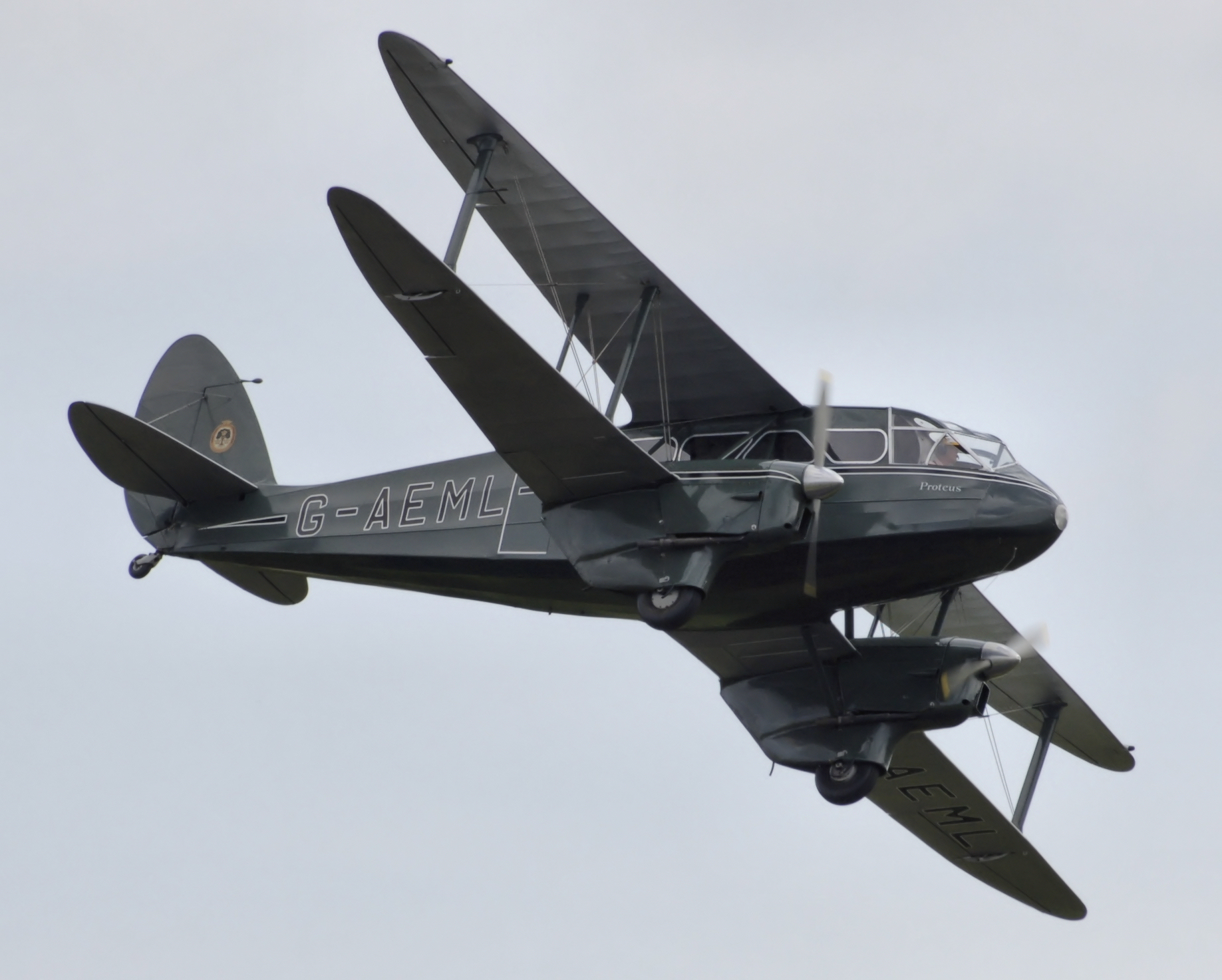
The de Havilland DH.89 Dragon Rapide is a 1930s short-haul biplane airliner developed and produced by British aircraft company de Havilland. Capable of accommodating 6–8 passengers, it proved an economical and durable craft with its strong lightweight plywood construction.
Developed during the early 1930s, the Dragon Rapide was essentially a smaller, twin-engined version of the four-engined DH.86 Express, and shared a number of common features, such as its tapered wings, streamlined fairings and Gipsy Six engines. First named the "Dragon Six", the type was marketed as "Dragon Rapide" and later simply known as the "Rapide". Upon its introduction in summer 1934, it proved to be a popular aircraft with airlines and private civil operators alike, attaining considerable foreign sales in addition to its domestic use.
Upon the outbreak of the Second World War, many of the civil Rapides were pressed into service with the Royal Air Force (RAF) and Royal Navy. Referred to in military service by the name de Havilland Dominie, the type was employed for radio and navigation training, passenger transport and communications missions. British training aircraft had names with educational associations, and dominie is a Scots term for a school teacher.
Hundreds of Dominies were also constructed during the war. Other Rapides continued to be operated by British airlines throughout the war under the auspices of the Associated Airways Joint Committee (AAJC). Postwar, many military aircraft were returned to civilian service. Shortly after the end of the Second World War, de Havilland introduced a Dragon Rapide replacement, the de Havilland Dove.
During summer 1933, the de Havilland aircraft company commenced work upon an aircraft to meet an Australian requirement, producing a four-engined faster passenger aircraft capable of seating ten passengers, the DH.86 Dragon Express. An important feature of the DH.86 was the newly developed and powerful Gipsy Six engine, a six-cylinder variant of the four cylinder Gipsy Major engine. The DH.86 would serve as the a key starting point for the later DH.89.
During late 1933, a team at de Havilland, led by aircraft designer Arthur Ernest Hagg, began working on a new design, intended to be a faster and more comfortable successor to the earlier DH.84 Dragon. The new aircraft was, in effect, a twin-engined, scaled-down version of the four-engined DH.86 Express. It shared many common features with the earlier DH.86 Express, including its tapered wings, streamlined fairings and fuselage, as well as the same Gipsy Six engines. However, the DH.89 demonstrated none of the operational vices of the Express.
On 17 April 1934, the prototype conducted its maiden flight at Hatfield Aerodrome, Hertfordshire. Flown by senior de Havilland test pilot H.S. Broad, it was powered by a pair of 200 horsepower (150 kW) Gypsy Six engines. Even prior to the prototype's first flight, plans to proceed with serial production of DH.89 had already received the go-ahead from management. During May 1934, airworthiness trials commenced at RAF Martlesham Heath using the prototype; during one such flight, upon attaining a speed of roughly 175 miles per hour (282 km/h), the tip of the aircraft's nose buckled. In response to this event, a maximum permissible speed of 160 mph (260 km/h) was implemented for all DH89s. Upon the conclusion of trials, the prototype was sold.
By November 1934, series production of the Rapide had reached full swing. Originally referred to as the "Dragon Six", the aircraft was first marketed as the "Dragon Rapide", although the type later came to be popularly referred to as simply the "Rapide". Prior to the outbreak of the Second World War, 205 aircraft were manufactured for airlines and other private owners all around the world. The Rapide is perhaps the most successful British-built short-haul commercial passenger aircraft to be produced during the 1930s.
Hub AI
De Havilland Dragon Rapide AI simulator
(@De Havilland Dragon Rapide_simulator)
De Havilland Dragon Rapide
The de Havilland DH.89 Dragon Rapide is a 1930s short-haul biplane airliner developed and produced by British aircraft company de Havilland. Capable of accommodating 6–8 passengers, it proved an economical and durable craft with its strong lightweight plywood construction.
Developed during the early 1930s, the Dragon Rapide was essentially a smaller, twin-engined version of the four-engined DH.86 Express, and shared a number of common features, such as its tapered wings, streamlined fairings and Gipsy Six engines. First named the "Dragon Six", the type was marketed as "Dragon Rapide" and later simply known as the "Rapide". Upon its introduction in summer 1934, it proved to be a popular aircraft with airlines and private civil operators alike, attaining considerable foreign sales in addition to its domestic use.
Upon the outbreak of the Second World War, many of the civil Rapides were pressed into service with the Royal Air Force (RAF) and Royal Navy. Referred to in military service by the name de Havilland Dominie, the type was employed for radio and navigation training, passenger transport and communications missions. British training aircraft had names with educational associations, and dominie is a Scots term for a school teacher.
Hundreds of Dominies were also constructed during the war. Other Rapides continued to be operated by British airlines throughout the war under the auspices of the Associated Airways Joint Committee (AAJC). Postwar, many military aircraft were returned to civilian service. Shortly after the end of the Second World War, de Havilland introduced a Dragon Rapide replacement, the de Havilland Dove.
During summer 1933, the de Havilland aircraft company commenced work upon an aircraft to meet an Australian requirement, producing a four-engined faster passenger aircraft capable of seating ten passengers, the DH.86 Dragon Express. An important feature of the DH.86 was the newly developed and powerful Gipsy Six engine, a six-cylinder variant of the four cylinder Gipsy Major engine. The DH.86 would serve as the a key starting point for the later DH.89.
During late 1933, a team at de Havilland, led by aircraft designer Arthur Ernest Hagg, began working on a new design, intended to be a faster and more comfortable successor to the earlier DH.84 Dragon. The new aircraft was, in effect, a twin-engined, scaled-down version of the four-engined DH.86 Express. It shared many common features with the earlier DH.86 Express, including its tapered wings, streamlined fairings and fuselage, as well as the same Gipsy Six engines. However, the DH.89 demonstrated none of the operational vices of the Express.
On 17 April 1934, the prototype conducted its maiden flight at Hatfield Aerodrome, Hertfordshire. Flown by senior de Havilland test pilot H.S. Broad, it was powered by a pair of 200 horsepower (150 kW) Gypsy Six engines. Even prior to the prototype's first flight, plans to proceed with serial production of DH.89 had already received the go-ahead from management. During May 1934, airworthiness trials commenced at RAF Martlesham Heath using the prototype; during one such flight, upon attaining a speed of roughly 175 miles per hour (282 km/h), the tip of the aircraft's nose buckled. In response to this event, a maximum permissible speed of 160 mph (260 km/h) was implemented for all DH89s. Upon the conclusion of trials, the prototype was sold.
By November 1934, series production of the Rapide had reached full swing. Originally referred to as the "Dragon Six", the aircraft was first marketed as the "Dragon Rapide", although the type later came to be popularly referred to as simply the "Rapide". Prior to the outbreak of the Second World War, 205 aircraft were manufactured for airlines and other private owners all around the world. The Rapide is perhaps the most successful British-built short-haul commercial passenger aircraft to be produced during the 1930s.
Recent media