



Community hub
Recent from talks
Knowledge base stats:
Talk channels stats:
Members stats:
Deforestation in Brazil
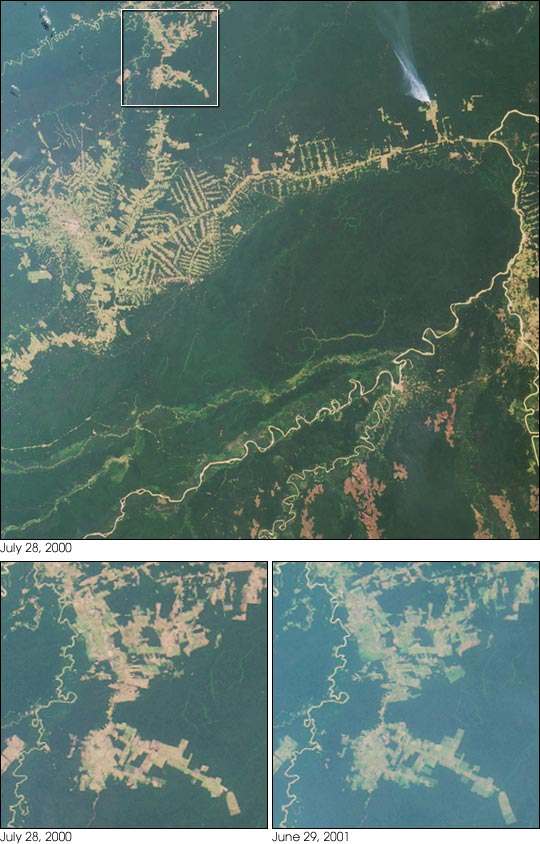
Brazil once had the highest deforestation rate in the world, and recent data still shows high rates of deforestation. Between 2001 and 2023, Brazil lost 68.9 Mha of tree cover (13% of its total tree cover lost since 2000), and in 2022, Brazilian forest loss accounted for 43% of global deforestation. In 2005, Brazil still had the largest area of forest removed annually. Since 1970, over 700,000 square kilometres (270,000 sq mi) of the Amazon rainforest have been destroyed. In 2001, the Amazon was approximately 5,400,000 square kilometres (2,100,000 sq mi), which is only 87% of the Amazon's original size. According to official data, about 729,000 km² have already been deforested in the Amazon biome, which corresponds to 17% of the total. 300,000 km² have been deforested in the last 20 years.
Rainforests have decreased in size primarily due to deforestation. Between May 2000 and August 2006, Brazil lost nearly 150,000 square kilometres (58,000 sq mi) of forest, an area larger than Greece. According to the Living Planet Report 2010, deforestation continues at an alarming rate. At the Convention on Biological Diversity's 9th Conference, 67 ministers signed up to help achieve zero net deforestation by 2020. Due to deforestation the Amazon was a net emitter of greenhouse gas in the 2010s.
The effects include "severe financial losses, social setbacks, and biodiversity loss". Economic losses due to deforestation in Brazil could reach around 317 billion dollars per year, approximately 7 times higher in comparison to the cost of all commodities produced through deforestation. In 2023 the World Bank, published a report named: "A Balancing Act for Brazil's Amazonian States: An Economic Memorandum" proposing non-deforestation based economic program in the region of the Amazon rainforest.
The deforestation of the Atlantic forest, or Mata Atlântica, dates back to Portuguese colonization and the subsequent rapid development of urban centers. Before human-modification, the forest covered around 17% of Brazil's area. Unlike the Amazon, which has only faced extreme deforestation in recent years, the Atlantic Forest has been a long-lasting target for land development, speculation, and agricultural endeavors. Starting during the sixteenth century, the forest began facing pressure due to the unsustainable development of coffee, sugarcane, brazilwood, and cattle in the region.
In the 1940s Brazil began a program of national development in the Amazon Basin. President Getúlio Vargas declared emphatically that:
The Amazon, in the impact of our will and labor, will cease to be a simple chapter in the world, and made equivalent to other great rivers, shall become a chapter in the history of human civilization. Everything which has up to now been done in Amazonas, whether in agriculture or extractive industry... must be transformed into rational exploitation.
— Getúlio Vargas
Before the 1960s, much of the forest remained intact due to restrictions on access to the Amazon beyond partial clearing along the river banks. The poor soil made plantation-based agriculture unprofitable. The key point in deforestation of the Amazon came when colonists established farms in the forest in the 1960s. They farmed based on crop cultivation and used the slash and burn method. The colonists were unable to successfully manage their fields and the crops due to weed invasion and loss of soil fertility. Soils in the Amazon are productive for only a very short period of time after the land is cleared, so farmers there must constantly move and clear more and more land.
Hub AI
Deforestation in Brazil AI simulator
(@Deforestation in Brazil_simulator)
Deforestation in Brazil
Brazil once had the highest deforestation rate in the world, and recent data still shows high rates of deforestation. Between 2001 and 2023, Brazil lost 68.9 Mha of tree cover (13% of its total tree cover lost since 2000), and in 2022, Brazilian forest loss accounted for 43% of global deforestation. In 2005, Brazil still had the largest area of forest removed annually. Since 1970, over 700,000 square kilometres (270,000 sq mi) of the Amazon rainforest have been destroyed. In 2001, the Amazon was approximately 5,400,000 square kilometres (2,100,000 sq mi), which is only 87% of the Amazon's original size. According to official data, about 729,000 km² have already been deforested in the Amazon biome, which corresponds to 17% of the total. 300,000 km² have been deforested in the last 20 years.
Rainforests have decreased in size primarily due to deforestation. Between May 2000 and August 2006, Brazil lost nearly 150,000 square kilometres (58,000 sq mi) of forest, an area larger than Greece. According to the Living Planet Report 2010, deforestation continues at an alarming rate. At the Convention on Biological Diversity's 9th Conference, 67 ministers signed up to help achieve zero net deforestation by 2020. Due to deforestation the Amazon was a net emitter of greenhouse gas in the 2010s.
The effects include "severe financial losses, social setbacks, and biodiversity loss". Economic losses due to deforestation in Brazil could reach around 317 billion dollars per year, approximately 7 times higher in comparison to the cost of all commodities produced through deforestation. In 2023 the World Bank, published a report named: "A Balancing Act for Brazil's Amazonian States: An Economic Memorandum" proposing non-deforestation based economic program in the region of the Amazon rainforest.
The deforestation of the Atlantic forest, or Mata Atlântica, dates back to Portuguese colonization and the subsequent rapid development of urban centers. Before human-modification, the forest covered around 17% of Brazil's area. Unlike the Amazon, which has only faced extreme deforestation in recent years, the Atlantic Forest has been a long-lasting target for land development, speculation, and agricultural endeavors. Starting during the sixteenth century, the forest began facing pressure due to the unsustainable development of coffee, sugarcane, brazilwood, and cattle in the region.
In the 1940s Brazil began a program of national development in the Amazon Basin. President Getúlio Vargas declared emphatically that:
The Amazon, in the impact of our will and labor, will cease to be a simple chapter in the world, and made equivalent to other great rivers, shall become a chapter in the history of human civilization. Everything which has up to now been done in Amazonas, whether in agriculture or extractive industry... must be transformed into rational exploitation.
— Getúlio Vargas
Before the 1960s, much of the forest remained intact due to restrictions on access to the Amazon beyond partial clearing along the river banks. The poor soil made plantation-based agriculture unprofitable. The key point in deforestation of the Amazon came when colonists established farms in the forest in the 1960s. They farmed based on crop cultivation and used the slash and burn method. The colonists were unable to successfully manage their fields and the crops due to weed invasion and loss of soil fertility. Soils in the Amazon are productive for only a very short period of time after the land is cleared, so farmers there must constantly move and clear more and more land.