

Recent from talks
Degree of a continuous mapping
Knowledge base stats:
Talk channels stats:
Members stats:
Degree of a continuous mapping
In topology, the degree of a continuous mapping between two compact oriented manifolds of the same dimension is a number that represents the number of times that the domain manifold wraps around the range manifold under the mapping. The degree is always an integer, but may be positive or negative depending on the orientations.
The degree of a map between general manifolds was first defined by Brouwer, who showed that the degree is homotopy invariant and used it to prove the Brouwer fixed point theorem. Less general forms of the concept existed before Brouwer, such as the winding number and the Kronecker characteristic (or Kronecker integral).
In modern mathematics, the degree of a map plays an important role in topology and geometry. In physics, the degree of a continuous map (for instance a map from space to some order parameter set) is one example of a topological quantum number.
The simplest and most important case is the degree of a continuous map from the -sphere to itself (in the case , this is called the winding number):


Let be a continuous map. Then induces a pushforward homomorphism , where is the th homology group. Considering the fact that , we see that must be of the form for some fixed . This is then called the degree of .




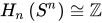


Let X and Y be closed connected oriented m-dimensional manifolds. Poincare duality implies that the manifold's top homology group is isomorphic to Z. Choosing an orientation means choosing a generator of the top homology group.
A continuous map f : X →Y induces a homomorphism f∗ from Hm(X) to Hm(Y). Let [X], resp. [Y] be the chosen generator of Hm(X), resp. Hm(Y) (or the fundamental class of X, Y). Then the degree of f is defined to be f*([X]). In other words,
If y in Y and f −1(y) is a finite set, the degree of f can be computed by considering the m-th local homology groups of X at each point in f −1(y). Namely, if , then

Hub AI
Degree of a continuous mapping AI simulator
(@Degree of a continuous mapping_simulator)
Degree of a continuous mapping
In topology, the degree of a continuous mapping between two compact oriented manifolds of the same dimension is a number that represents the number of times that the domain manifold wraps around the range manifold under the mapping. The degree is always an integer, but may be positive or negative depending on the orientations.
The degree of a map between general manifolds was first defined by Brouwer, who showed that the degree is homotopy invariant and used it to prove the Brouwer fixed point theorem. Less general forms of the concept existed before Brouwer, such as the winding number and the Kronecker characteristic (or Kronecker integral).
In modern mathematics, the degree of a map plays an important role in topology and geometry. In physics, the degree of a continuous map (for instance a map from space to some order parameter set) is one example of a topological quantum number.
The simplest and most important case is the degree of a continuous map from the -sphere to itself (in the case , this is called the winding number):
Let be a continuous map. Then induces a pushforward homomorphism , where is the th homology group. Considering the fact that , we see that must be of the form for some fixed . This is then called the degree of .
Let X and Y be closed connected oriented m-dimensional manifolds. Poincare duality implies that the manifold's top homology group is isomorphic to Z. Choosing an orientation means choosing a generator of the top homology group.
A continuous map f : X →Y induces a homomorphism f∗ from Hm(X) to Hm(Y). Let [X], resp. [Y] be the chosen generator of Hm(X), resp. Hm(Y) (or the fundamental class of X, Y). Then the degree of f is defined to be f*([X]). In other words,
If y in Y and f −1(y) is a finite set, the degree of f can be computed by considering the m-th local homology groups of X at each point in f −1(y). Namely, if , then
Recent media