Hubbry Logo
Winding numberWinding numberMain
Open search
Winding number
Community hub
Winding number
logo
8 pages, 0 posts
0 subscribers
Be the first to start a discussion here.
Winding number
Winding number
from Wikipedia
This curve has winding number two around the point p.

In mathematics, the winding number or winding index of a closed curve in the plane around a given point is an integer representing the total number of times that the curve travels counterclockwise around the point, i.e., the curve's number of turns. For certain open plane curves, the number of turns may be a non-integer. The winding number depends on the orientation of the curve, and it is negative if the curve travels around the point clockwise.

Winding numbers are fundamental objects of study in algebraic topology, and they play an important role in vector calculus, complex analysis, geometric topology, differential geometry, and physics (such as in string theory).

Intuitive description

[edit]
An object traveling along the red curve makes two counterclockwise turns around the person at the origin.

Suppose we are given a closed, oriented curve in the xy plane. We can imagine the curve as the path of motion of some object, with the orientation indicating the direction in which the object moves. Then the winding number of the curve is equal to the total number of counterclockwise turns that the object makes around the origin.

When counting the total number of turns, counterclockwise motion counts as positive, while clockwise motion counts as negative. For example, if the object first circles the origin four times counterclockwise, and then circles the origin once clockwise, then the total winding number of the curve is three.

Using this scheme, a curve that does not travel around the origin at all has winding number zero, while a curve that travels clockwise around the origin has negative winding number. Therefore, the winding number of a curve may be any integer. The following pictures show curves with winding numbers between −2 and 3:

              
−2 −1 0
              
1 2 3

Formal definition

[edit]

Let be a continuous closed path on the plane minus one point. The winding number of around is the integer

where is the path written in polar coordinates, i.e. the lifted path through the covering map

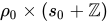
The winding number is well defined because of the existence and uniqueness of the lifted path (given the starting point in the covering space) and because all the fibers of are of the form (so the above expression does not depend on the choice of the starting point). It is an integer because the path is closed.

Alternative definitions

[edit]

Winding number is often defined in different ways in various parts of mathematics. All of the definitions below are equivalent to the one given above:

Alexander numbering

[edit]

A simple combinatorial rule for defining the winding number was proposed by August Ferdinand Möbius in 1865[1] and again independently by James Waddell Alexander II in 1928.[2] Any curve partitions the plane into several connected regions, one of which is unbounded. The winding numbers of the curve around two points in the same region are equal. The winding number around (any point in) the unbounded region is zero. Finally, the winding numbers for any two adjacent regions differ by exactly 1; the region with the larger winding number appears on the left side of the curve (with respect to motion down the curve).

Differential geometry

[edit]

In differential geometry, parametric equations are usually assumed to be differentiable (or at least piecewise differentiable). In this case, the polar coordinate θ is related to the rectangular coordinates x and y by the equation:

Which is found by differentiating the following definition for θ:
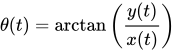
By the fundamental theorem of calculus, the total change in θ is equal to the integral of . We can therefore express the winding number of a differentiable curve as a line integral:

The one-form (defined on the complement of the origin) is closed but not exact, and it generates the first de Rham cohomology group of the punctured plane. In particular, if ω is any closed differentiable one-form defined on the complement of the origin, then the integral of ω along closed loops gives a multiple of the winding number.

Complex analysis

[edit]

Winding numbers play a very important role throughout complex analysis (cf. the statement of the residue theorem). In the context of complex analysis, the winding number of a closed curve in the complex plane can be expressed in terms of the complex coordinate z = x + iy. Specifically, if we write z = re, then

and therefore

As is a closed curve, the total change in is zero, and thus the integral of is equal to multiplied by the total change in . Therefore, the winding number of closed path about the origin is given by the expression[3]

More generally, if is a closed curve parameterized by , the winding number of about , also known as the index of with respect to , is defined for complex as[4]

This is a special case of the famous Cauchy integral formula.

Some of the basic properties of the winding number in the complex plane are given by the following theorem:[5]

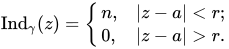
Theorem. Let be a closed path and let be the set complement of the image of , that is, . Then the index of with respect to ,is (i) integer-valued, i.e., for all ; (ii) constant over each component (i.e., maximal connected subset) of ; and (iii) zero if is in the unbounded component of .

As an immediate corollary, this theorem gives the winding number of a circular path about a point . As expected, the winding number counts the number of (counterclockwise) loops makes around :

Corollary. If is the path defined by , then

Topology

[edit]

In topology, the winding number is an alternate term for the degree of a continuous mapping. In physics, winding numbers are frequently called topological quantum numbers. In both cases, the same concept applies.

The above example of a curve winding around a point has a simple topological interpretation. The complement of a point in the plane is homotopy equivalent to the circle, such that maps from the circle to itself are really all that need to be considered. It can be shown that each such map can be continuously deformed to (is homotopic to) one of the standard maps , where multiplication in the circle is defined by identifying it with the complex unit circle. The set of homotopy classes of maps from a circle to a topological space form a group, which is called the first homotopy group or fundamental group of that space. The fundamental group of the circle is the group of the integers, Z; and the winding number of a complex curve is just its homotopy class.

Maps from the 3-sphere to itself are also classified by an integer which is also called the winding number or sometimes Pontryagin index.

Turning number

[edit]
This curve has total curvature 6π, turning number 3, though it only has winding number 2 about p.

One can also consider the winding number of the path with respect to the tangent of the path itself. As a path followed through time, this would be the winding number with respect to the origin of the velocity vector. In this case the example illustrated at the beginning of this article has a winding number of 3, because the small loop is counted.

This is only defined for immersed paths (i.e., for differentiable paths with nowhere vanishing derivatives), and is the degree of the tangential Gauss map.

This is called the turning number, rotation number,[6] rotation index[7] or index of the curve, and can be computed as the total curvature divided by 2π.

Polygons

[edit]

In polygons, the turning number is referred to as the polygon density. For convex polygons, and more generally simple polygons (not self-intersecting), the density is 1, by the Jordan curve theorem. By contrast, for a regular star polygon {p/q}, the density is q.

Space curves

[edit]

Turning number cannot be defined for space curves as degree requires matching dimensions. However, for locally convex, closed space curves, one can define tangent turning sign as , where is the turning number of the stereographic projection of its tangent indicatrix. Its two values correspond to the two non-degenerate homotopy classes of locally convex curves.[8][9]

Winding number and Heisenberg ferromagnet equations

[edit]

The winding number is closely related with the (2 + 1)-dimensional continuous Heisenberg ferromagnet equations and its integrable extensions: the Ishimori equation etc. Solutions of the last equations are classified by the winding number or topological charge (topological invariant and/or topological quantum number).

Applications

[edit]
Visualization of Dan Sunday's winding number algorithm. A winding number of 0 means the point is outside the polygon; other values indicate the point is inside the polygon

Point in polygon

[edit]

A point's winding number with respect to a polygon can be used to solve the point in polygon (PIP) problem – that is, it can be used to determine if the point is inside the polygon or not.

Generally, the ray casting algorithm is a better alternative to the PIP problem as it does not require trigonometric functions, contrary to the winding number algorithm. Nevertheless, the winding number algorithm can be sped up so that it too, does not require calculations involving trigonometric functions.[10] The sped-up version of the algorithm, also known as Sunday's algorithm, is recommended in cases where non-simple polygons should also be accounted for.

See also

[edit]

References

[edit]
[edit]
Revisions and contributorsEdit on WikipediaRead on Wikipedia
from Grokipedia
In mathematics, particularly in the fields of and , the winding number of a closed around a point in the plane is an that quantifies the net number of times the curve encircles the point, with positive values indicating counterclockwise orientation and negative values indicating clockwise orientation. For a point not lying on the curve, this measure captures the topological linking between the curve and the point, serving as a invariant that remains unchanged under continuous deformations of the curve that do not pass through the point. Formally, for a smooth closed curve CC parameterized by c(t)=(x(t),y(t))c(t) = (x(t), y(t)) for t[0,T]t \in [0, T] with c(0)=c(T)c(0) = c(T), and a point pCp \notin C, the winding number W(p,C)W(p, C) can be computed as the total change in the polar angle subtended by the curve at pp, divided by 2π2\pi:
W(p,C)=12π0Ty(t)x˙(t)+x(t)y˙(t)x(t)2+y(t)2dt,W(p, C) = \frac{1}{2\pi} \int_0^T \frac{ -y(t) \dot{x}(t) + x(t) \dot{y}(t) }{ x(t)^2 + y(t)^2 } \, dt ,
where the coordinates are relative to pp, and the result is always an integer. In the context of complex analysis, for a closed curve γ\gamma in the complex plane and a point z0γz_0 \notin \gamma, the winding number n(γ,z0)n(\gamma, z_0) is equivalently given by the contour integral
n(γ,z0)=12πiγdzzz0,n(\gamma, z_0) = \frac{1}{2\pi i} \int_\gamma \frac{dz}{z - z_0} ,
which counts the oriented revolutions of γ\gamma around z0z_0.
Key properties of the winding number include its additivity under concatenation of curves, where W(p,C1C2)=W(p,C1)+W(p,C2)W(p, C_1 \cdot C_2) = W(p, C_1) + W(p, C_2), and its role as a complete invariant for homotopy classes of curves in the punctured plane. For a simple closed curve, such as the boundary of a Jordan domain, the winding number is +1+1 or 1-1 for points in the bounded interior component (depending on orientation) and 00 for points in the unbounded exterior component, underpinning the Jordan curve theorem. In complex analysis, it features prominently in the argument principle, which equates the winding number of the image curve f(γ)f(\gamma) around the origin to the number of zeros minus poles of an analytic function ff inside γ\gamma, enabling proofs of theorems like the fundamental theorem of algebra. These attributes make the winding number a versatile tool in algebraic topology, geometric analysis, and computational geometry.

Introduction

Intuitive Description

The winding number of a closed in the plane around a given point quantifies the net number of complete loops the curve makes around that point, where counterclockwise encirclements count as positive and clockwise ones as negative. This integer value captures the overall "twisting" or encircling behavior of the curve relative to the point, providing a simple measure of its topological enclosure without requiring advanced . For instance, if the point lies outside the curve entirely, the winding number is zero, indicating no net encirclement. Consider basic examples to build : a traced counterclockwise around the point yields a winding number of 1, as it completes one full positive loop. In contrast, tracing the same clockwise gives -. A figure-eight shaped , which crosses itself and forms two opposing loops around a central point, results in a net winding number of 0, since the counterclockwise loop (+1) cancels the clockwise one (-). For more complex self-intersecting , the winding number sums the contributions from each relevant loop, yielding the algebraic total rather than an absolute count. An everyday helps visualize this: imagine walking your on a through a park with a tall at its center. If the dog darts around the tree while you continue your path, the number of times the leash wraps around the trunk—netting positive for one direction and negative for the other—mirrors the winding number, as the leash's total revolutions remain invariant regardless of minor path variations, as long as the tree stays enclosed similarly. Diagrams often illustrate this by plotting the angle from the fixed point to positions along the curve as it travels; the total angular sweep, divided by 2π2\pi, reveals the winding number through the number of full rotations accumulated. This angle-tracking approach underscores the rotational intuition behind the concept.

Historical Overview

The concept of the winding number originated in 19th-century through Augustin-Louis Cauchy's foundational work on contour integrals. In his 1825 publication of the integral theorem, Cauchy established that the integral of a over a closed contour depends on the singularities enclosed, implicitly incorporating ideas of how paths encircle points in the . This was further developed in Cauchy's , which quantifies the number of inside a contour via the total change in argument along the path, a measure directly analogous to the winding number as the net encirclements divided by 2π2\pi. In the early 20th century, the winding number gained more explicit formalization through refinements in . Édouard Goursat's 1900 proof of Cauchy's theorem, published without reliance on residues or continuity of the derivative, highlighted the theorem's dependence on path and the vanishing of integrals over contractible paths, concepts tied to zero winding numbers. This proof emphasized the topological independence of integrals from the specific contour shape, provided no singularities are enclosed, laying groundwork for viewing winding as a invariant. In parallel, the topological perspective emerged with Poincaré's introduction of the in the early 1900s, where the winding number represents the generator of π₁ of the punctured plane or . The adoption of the winding number in accelerated in with Heinz Hopf's contributions to degree theory and fibrations. Hopf's 1931 work on the topological invariant for maps between spheres introduced the Hopf invariant, linking winding-like measures to classes and fundamental groups, particularly for circles and higher-dimensional analogs. Post-World War II expansions in further integrated the winding number into through works like Witold Hurewicz's development of higher groups (1935) and the (1940s), which relate and homology groups in low dimensions, encompassing invariants such as the winding number. A comprehensive survey of these evolutions across , , and appears in John Roe's 2015 monograph, which traces the winding number's role from classical theorems to modern invariants. Recent developments have extended discrete versions of winding numbers to , particularly for handling noisy or imperfect data. The 2023 SIGGRAPH paper by Feng, Gillespie, and Crane introduces an algorithm for computing winding numbers on discrete surfaces with topological errors, enabling robust point-in-polygon tests and signed distance approximations in practical applications.

Definitions and Formulations

Basic Formal Definition

The winding number of a closed γ:[0,1]R2{p}\gamma: [0,1] \to \mathbb{R}^2 \setminus \{p\} around a point pγ([0,1])p \notin \gamma([0,1]) is defined as n(γ,p)=12πγd[θ](/page/Theta),n(\gamma, p) = \frac{1}{2\pi} \int_{\gamma} d[\theta](/page/Theta), where θ\theta denotes the angle that the vector from pp to points on γ\gamma makes with a fixed reference direction, and the represents the total variation in θ\theta as one traverses γ\gamma. This measures the net number of revolutions the curve makes around pp in the counterclockwise direction. By translating coordinates so that pp maps to the origin $0 \in \mathbb{C}$, the definition admits an equivalent complex-analytic form n(γ,0)=12πiγdzz,n(\gamma, 0) = \frac{1}{2\pi i} \int_{\gamma} \frac{dz}{z}, valid for γ\gamma parametrized as a closed path in C{0}\mathbb{C} \setminus \{0\}. The winding number is integer-valued: to see this, consider the continuous argument function θ:[0,1]R\theta: [0,1] \to \mathbb{R} along γ\gamma such that θ(t)\theta(t) is the angle of γ(t)p\gamma(t) - p, normalized so the map teiθ(t)t \mapsto e^{i \theta(t)} traces a loop in S1S^1. Since γ\gamma is closed, θ(1)θ(0)(mod2π)\theta(1) \equiv \theta(0) \pmod{2\pi}, so the total change Δθ=θ(1)θ(0)\Delta \theta = \theta(1) - \theta(0) is a multiple of 2π2\pi, yielding n(γ,p)=Δθ/(2π)Zn(\gamma, p) = \Delta \theta / (2\pi) \in \mathbb{Z}. Key properties include additivity under concatenation of curves, n(γ1γ2,p)=n(γ1,p)+n(γ2,p)n(\gamma_1 \cdot \gamma_2, p) = n(\gamma_1, p) + n(\gamma_2, p), and vanishing if γ\gamma is contractible in R2{p}\mathbb{R}^2 \setminus \{p\} (hence n(γ,p)=0n(\gamma, p) = 0 whenever pp lies outside the region "enclosed" by γ\gamma in a homotopical sense). The winding number is undefined if pγ([0,1])p \in \gamma([0,1]), but extends continuously to zero in such limiting cases where the curve avoids pp but approaches it without enclosing it. For example, consider the unit circle γ(t)=e2πit\gamma(t) = e^{2\pi i t} for t[0,1]t \in [0,1] around p=0p = 0. Here, θ(t)=2πt\theta(t) = 2\pi t, so Δθ=2π\Delta \theta = 2\pi and n(γ,0)=1n(\gamma, 0) = 1; the complex integral form confirms this as 12πiγdzz=1\frac{1}{2\pi i} \int_{\gamma} \frac{dz}{z} = 1 by direct parametrization.

In Complex Analysis

In complex analysis, the winding number provides a key tool for analyzing the behavior of meromorphic functions along closed contours. For a meromorphic function ff and a closed contour γ\gamma in the complex plane such that af(γ)a \notin f(\gamma), the winding number n(fγ,a)n(f \circ \gamma, a) of fγf \circ \gamma around the point aa is defined by the contour integral n(fγ,a)=12πiγf(z)f(z)adz.n(f \circ \gamma, a) = \frac{1}{2\pi i} \int_\gamma \frac{f'(z)}{f(z) - a} \, dz. This formula arises from the change in the argument of f(z)af(z) - a as zz traverses γ\gamma, divided by 2π2\pi, and it counts the net number of times f(γ)f(\gamma) encircles aa in the positive direction. The argument principle extends this concept to relate the winding number directly to the of ff inside γ\gamma. Specifically, if ff is meromorphic in a domain containing γ\gamma and its interior, with no zeros or poles on γ\gamma, then 12πiγf(z)f(z)dz=NfPf,\frac{1}{2\pi i} \int_\gamma \frac{f'(z)}{f(z)} \, dz = N_f - P_f, where NfN_f is the number of zeros of ff inside γ\gamma (counted with multiplicity) and PfP_f is the number of poles (also with multiplicity). Thus, the winding number n(fγ,0)n(f \circ \gamma, 0) equals the difference between the number of zeros and poles of ff enclosed by γ\gamma. This is fundamental for locating without explicit solving. The winding number also underpins Cauchy's integral theorem in its generalized form. For a holomorphic function hh in a simply connected domain, the integral γh(z)dz=0\int_\gamma h(z) \, dz = 0 if γ\gamma is homologous to zero in the domain, meaning the winding number of γ\gamma around any singularity of hh (though hh has none) is zero. More broadly, if hh is holomorphic inside and on γ\gamma with no singularities enclosed, the winding number condition ensures the integral vanishes, highlighting how the absence of encircled singularities implies path independence of integrals. Rouché's theorem leverages the winding number to compare the zero structures of two functions. If ff and gg are holomorphic inside and on a simple closed contour γ\gamma, and g(z)<f(z)|g(z)| < |f(z)| for all zγz \in \gamma, then ff and f+gf + g have the same number of zeros inside γ\gamma (counted with multiplicity). This follows because the winding numbers n(fγ,0)n(f \circ \gamma, 0) and n((f+g)γ,0)n((f + g) \circ \gamma, 0) coincide, as g/fg/f maps γ\gamma into the unit disk, deforming the image without crossing zero.

In Algebraic Topology

In algebraic topology, the winding number of a closed oriented curve γ:S1R2{p}\gamma: S^1 \to \mathbb{R}^2 \setminus \{p\} around a point pp is defined as the homotopy class of the associated map γ~:S1S1\tilde{\gamma}: S^1 \to S^1 obtained by normalizing the vector from pp to points on the curve, i.e., γ~(t)=γ(t)pγ(t)p\tilde{\gamma}(t) = \frac{\gamma(t) - p}{|\gamma(t) - p|}. This class lies in the set of homotopy classes [S1,S1][S^1, S^1], which is isomorphic to Z\mathbb{Z}, where the integer representative corresponds to the degree of γ~\tilde{\gamma}. The fundamental group π1(S1)\pi_1(S^1) is isomorphic to Z\mathbb{Z}, generated by the class of the standard loop that traverses the circle once counterclockwise. For loops based at a point on S1S^1, the induced homomorphism on π1\pi_1 sends the generator to nn times the generator of Z\mathbb{Z}, where nn is the winding number, making it a complete invariant for homotopy classes of based loops in the circle. In the plane complement R2{p}\mathbb{R}^2 \setminus \{p\}, which is homotopy equivalent to S1S^1, loops based away from the curve map similarly to integers via this isomorphism. The winding number is a homotopy invariant: if two loops γ0\gamma_0 and γ1\gamma_1 are homotopic relative to the basepoint in R2{p}\mathbb{R}^2 \setminus \{p\}, then their normalized maps γ0~\tilde{\gamma_0} and γ1~\tilde{\gamma_1} are homotopic in S1S^1, preserving the degree and thus the winding number. This invariance follows from the continuity of the normalization map under homotopy and the fact that [S1,S1]Z[S^1, S^1] \cong \mathbb{Z} classifies such maps up to homotopy. This concept generalizes to the degree of continuous maps f:SnSnf: S^n \to S^n for n1n \geq 1, where the degree is an integer invariant classifying homotopy classes [Sn,Sn]Z[S^n, S^n] \cong \mathbb{Z}, with the case n=1n=1 recovering the winding number as the induced action on π1(S1)Z\pi_1(S^1) \cong \mathbb{Z}. For n=1n=1, the degree measures how many times the domain wraps around the codomain. An illustrative example is the projection of the (a (2,3)-torus knot) onto the plane: the immersed curve winds around a central point with winding number 2, reflecting its topological embedding properties.

In Differential Geometry

In differential geometry, the winding number of an oriented smooth closed curve γ:S1R2\gamma: S^1 \to \mathbb{R}^2 around a point pγ(S1)p \notin \gamma(S^1) is defined as n(γ,p)=12πγdarg(γ(t)p),n(\gamma, p) = \frac{1}{2\pi} \int_\gamma d \arg(\gamma(t) - p), where arg\arg is the argument function measuring the angle of the vector γ(t)p\gamma(t) - p with respect to a fixed axis, and dargd \arg denotes its exterior derivative as a differential 1-form on R2{p}\mathbb{R}^2 \setminus \{p\}. This expression quantifies the net rotation of the direction from pp to points on γ\gamma as the curve is traversed once, yielding an integer value that counts the algebraic number of loops around pp. Equivalently, n(γ,p)n(\gamma, p) is the topological degree of the normalized Gauss map g:S1S1g: S^1 \to S^1 given by g(t)=γ(t)pγ(t)pg(t) = \frac{\gamma(t) - p}{\|\gamma(t) - p\|}, computed as the integral of the pullback of the normalized volume form on the target circle: n(γ,p)=S1g(dθ2π),n(\gamma, p) = \int_{S^1} g^* \left( \frac{d\theta}{2\pi} \right), where θ\theta is the standard angular coordinate on S1S^1. This formulation emphasizes the winding number as a de Rham cohomology class representative, capturing the homotopy class of γ\gamma relative to pp in the punctured plane. For immersed smooth closed curves in the plane, the rotation index ν(γ)\nu(\gamma) provides a related geometric invariant, defined as the degree of the tangent indicatrix map τ:S1S1\tau: S^1 \to S^1, τ(t)=γ(t)γ(t)\tau(t) = \frac{\gamma'(t)}{\|\gamma'(t)\|}, or equivalently, ν(γ)=12πγdϕ,\nu(\gamma) = \frac{1}{2\pi} \int_\gamma d\phi, where ϕ\phi is the angle of the unit tangent vector τ(t)\tau(t). The total signed curvature of γ\gamma satisfies γκgds=2πν(γ)\int_\gamma \kappa_g \, ds = 2\pi \nu(\gamma), linking the winding behavior of the tangent to the curve's global turning properties; for simple closed curves, ν(γ)=±1\nu(\gamma) = \pm 1. This definition extends naturally to piecewise smooth curves, where the integral over each smooth arc is computed separately, and contributions from jumps in the tangent at finitely many vertices are included via the exterior angles, ensuring the winding number remains an integer as long as pp lies off the curve. In contrast, purely smooth curves avoid such discrete adjustments, allowing direct evaluation via the continuous differential form without vertex terms. The value is homotopy invariant under deformations fixing pp. A representative example is the orthogonal projection onto the xyxy-plane of a helical space curve γ(t)=(acost,asint,bt)\gamma(t) = (a \cos t, a \sin t, b t) for t[0,2πn]t \in [0, 2\pi n] with a>0a > 0, b>0b > 0, and integer n1n \geq 1, which yields the parametric (cost,sint)(\cos t, \sin t) traversed nn times, possessing winding number nn around the origin.

Turning Number

The turning number of a γ\gamma is defined as the total rotation of its as one traverses the , measuring the net change in the direction of the divided by 2π2\pi. For a smooth parametrized by ss, this is given by τ(γ)=12πγκds\tau(\gamma) = \frac{1}{2\pi} \int_{\gamma} \kappa \, ds, where κ\kappa is the signed , or equivalently, τ(γ)=12πΔθ\tau(\gamma) = \frac{1}{2\pi} \Delta \theta, with Δθ\Delta \theta the total change in the tangent angle θ\theta. For a simple closed oriented , the Hopf Umlaufsatz states that the turning number is ±1\pm 1, with the sign determined by the orientation (positive for counterclockwise); this value is independent of the specific of the , depending only on its topological type as a simple closed loop. Unlike the winding number, which quantifies how many times a closed encircles a specific point in the plane, the turning number is an intrinsic property of the itself, capturing the self-rotation of its tangent without reference to an external point; for a simple closed , the magnitudes coincide when the winding is computed around an interior point, but the concepts differ fundamentally in their geometric interpretation. Examples include a , which has turning number 11 (or 1-1 if oriented ), reflecting one full of the ; a straight , with turning number 00 due to no net ; and the projection of a space curve onto the plane, where the turning number may differ from the original space curve's total if the projection introduces apparent turns or straightenings. For polygonal curves, the turning number is computed as the sum of the exterior (turning) angles at the vertices divided by 2π2\pi; for a simple closed polygon, this sum is ±2π\pm 2\pi, yielding τ=±1\tau = \pm 1.

Linking Numbers

Using Alexander duality, the first homology group of the complement of a knot or link in the 3-sphere S3S^3 provides a homology-theoretic framework that generalizes the winding number to higher dimensions, capturing how components wind around each other via linking numbers. For a single embedded circle KS3K \subset S^3, Alexander duality implies that H1(S3K;Z)ZH_1(S^3 \setminus K; \mathbb{Z}) \cong \mathbb{Z}, generated by the class of a meridian loop around KK. This infinite cyclic group encodes the basic winding structure: the image of a closed curve in the complement under the inclusion-induced map to H1(S3K)H_1(S^3 \setminus K) yields an integer multiple of the generator, representing the winding number of that curve around KK. For the unknot, this homology remains Z\mathbb{Z}, with the integer reflecting the trivial embedding's single meridional winding. For an oriented link L=K1KμS3L = K_1 \cup \cdots \cup K_\mu \subset S^3 with μ2\mu \geq 2 components, Alexander duality yields H1(S3L;Z)ZμH_1(S^3 \setminus L; \mathbb{Z}) \cong \mathbb{Z}^\mu, freely generated by the meridional classes [m1],,[mμ][m_1], \dots, [m_\mu] of the components. The linking numbers between components are defined via the inclusion maps: the class [Ki][K_i] in H1(S3Kj;Z)ZH_1(S^3 \setminus K_j; \mathbb{Z}) \cong \mathbb{Z} (for iji \neq j) is the integer lk(Ki,Kj)\mathrm{lk}(K_i, K_j) times the generator [mj][m_j], measuring how KiK_i winds around KjK_j. These pairwise linking numbers generalize the classical planar winding number to three dimensions, capturing mutual encirclements in the link homology. In higher dimensions, for a knotted SkSnS^k \subset S^{n} with n>3n > 3, Alexander duality extends this to Hnk1(SnSk;Z)H_{n-k-1}(S^n \setminus S^k; \mathbb{Z}), providing analogous invariants for multidimensional windings. These linking numbers can also be realized geometrically via Seifert surfaces: for distinct components KiK_i and KjK_j, lk(Ki,Kj)\mathrm{lk}(K_i, K_j) equals the algebraic of KiK_i with any oriented Seifert surface bounded by KjK_j. This intersection perspective directly generalizes the planar winding number, where the "surface" is a disk and intersections count encirclements. For the Hopf link, consisting of two unknotted components interlocked once, the linking numbers are ±1\pm 1 (depending on orientations), yielding the simplest nontrivial example. As a topological invariant derived from homology groups via Alexander duality, the is preserved under of the link in S3S^3, ensuring it distinguishes link types robustly. Note that the , a further invariant from the homology of the infinite cyclic cover, builds on this structure to detect more subtle properties beyond simple linking.

Applications

Point-in-Polygon Problem

The point-in- (PIP) problem involves determining whether a given point lies inside, outside, or on the boundary of a polygonal region defined by a closed of line segments. One classical solution leverages the winding number of the polygon's boundary around the test point: if the winding number is nonzero, the point is considered inside the ; otherwise, it is outside. This approach naturally accounts for the topological encircling of the point by the boundary and is particularly robust for polygons with self-intersections, where it identifies regions enclosed by a net nonzero revolution of the . To implement this, the winding number nn is computed by summing the signed angles subtended by each edge of the at the test point and normalizing by 2π2\pi. Specifically, for a with vertices p0,p1,,pn1p_0, p_1, \dots, p_{n-1} and test point qq, the ϕi\phi_i for edge (pi,pi+1)(p_i, p_{i+1}) (with pn=p0p_n = p_0) is the oriented from the vector qpi\overrightarrow{q p_i}
Add your contribution
Related Hubs
User Avatar
No comments yet.