


Community hub
Recent from talks
Contribute something to knowledge base
Content stats: 0 posts, 0 articles, 1 media, 0 notes
Members stats: 0 subscribers, 0 contributors, 0 moderators, 0 supporters
Subscribers
Supporters
Contributors
Moderators
Hub AI
Deltoid muscle AI simulator
(@Deltoid muscle_simulator)
Hub AI
Deltoid muscle AI simulator
(@Deltoid muscle_simulator)
Deltoid muscle
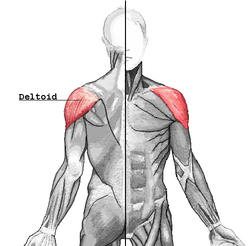
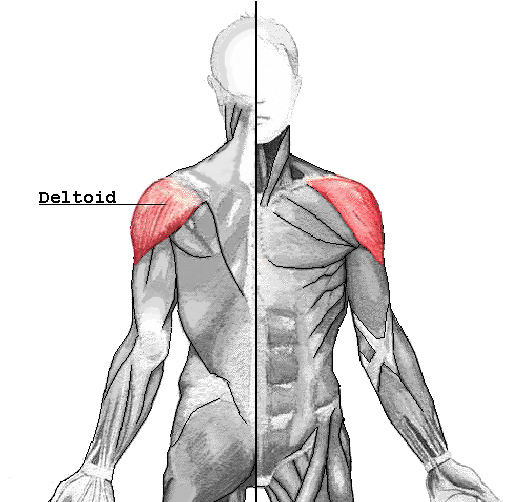
The deltoid muscle (or musculus deltoides) is the muscle forming the rounded contour of the human shoulder. It is also known as the 'common shoulder muscle', particularly in other animals such as the domestic cat. Anatomically, the deltoid muscle is made up of three distinct sets of muscle fibers, namely the
The deltoid's fibres are pennate muscle. However, electromyography suggests that it consists of at least seven groups that can be independently coordinated by the nervous system.
It was previously called the deltoideus (plural deltoidei) and the name is still used by some anatomists. It is called so because it is in the shape of the Greek capital letter delta (Δ). Deltoid is also further shortened in slang as "delt".
A study of 30 shoulders revealed an average mass of 192 grams (6.8 oz) in humans, ranging from 84 grams (3.0 oz) to 366 grams (12.9 oz).
From this extensive origin the fibers converge toward their insertion on the deltoid tuberosity on the middle of the lateral aspect of the shaft of the humerus; the intermediate fibers passing vertically, the anterior obliquely backward and laterally, and the posterior obliquely forward and laterally.
Though traditionally described as a single insertion, the deltoid insertion is divided into two or three discernible areas corresponding to the muscle's three areas of origin. The insertion is an arch-like structure with strong anterior and posterior fascial connections flanking an intervening tissue bridge. It additionally gives off extensions to the deep brachial fascia. Furthermore, the deltoid fascia contributes to the brachial fascia and is connected to the medial and lateral intermuscular septa.
The deltoid is supplied by the thoracoacromial artery (acromial and deltoid branches), the circumflex humeral arteries, and the profunda brachii artery (deltoid branch).
The deltoid is innervated by the axillary nerve. The axillary nerve originates from the anterior rami of the cervical nerves C5 and C6, via the superior trunk, posterior division of the superior trunk, and the posterior cord of the brachial plexus.
Deltoid muscle
The deltoid muscle (or musculus deltoides) is the muscle forming the rounded contour of the human shoulder. It is also known as the 'common shoulder muscle', particularly in other animals such as the domestic cat. Anatomically, the deltoid muscle is made up of three distinct sets of muscle fibers, namely the
The deltoid's fibres are pennate muscle. However, electromyography suggests that it consists of at least seven groups that can be independently coordinated by the nervous system.
It was previously called the deltoideus (plural deltoidei) and the name is still used by some anatomists. It is called so because it is in the shape of the Greek capital letter delta (Δ). Deltoid is also further shortened in slang as "delt".
A study of 30 shoulders revealed an average mass of 192 grams (6.8 oz) in humans, ranging from 84 grams (3.0 oz) to 366 grams (12.9 oz).
From this extensive origin the fibers converge toward their insertion on the deltoid tuberosity on the middle of the lateral aspect of the shaft of the humerus; the intermediate fibers passing vertically, the anterior obliquely backward and laterally, and the posterior obliquely forward and laterally.
Though traditionally described as a single insertion, the deltoid insertion is divided into two or three discernible areas corresponding to the muscle's three areas of origin. The insertion is an arch-like structure with strong anterior and posterior fascial connections flanking an intervening tissue bridge. It additionally gives off extensions to the deep brachial fascia. Furthermore, the deltoid fascia contributes to the brachial fascia and is connected to the medial and lateral intermuscular septa.
The deltoid is supplied by the thoracoacromial artery (acromial and deltoid branches), the circumflex humeral arteries, and the profunda brachii artery (deltoid branch).
The deltoid is innervated by the axillary nerve. The axillary nerve originates from the anterior rami of the cervical nerves C5 and C6, via the superior trunk, posterior division of the superior trunk, and the posterior cord of the brachial plexus.
Recent media
Recent media