



Community hub
Recent from talks
Knowledge base stats:
Talk channels stats:
Members stats:
Demigod
In polytheistic religions and mythologies, a demigod or demigoddess is a being half-divine and half-human born of a deity and a human, or a human or non-human creature that is accorded divine status after death, or someone who has attained the "divine spark" (divine illumination). An immortal demigod often has tutelary status and a religious cult following, while a mortal demigod is one who has fallen or died, but is popular as a legendary hero. Figuratively, the term is used to describe a person whose talents or abilities are so elevated that they appear to approach divinity.
The English term "demi-god" is a calque of the Latin word semideus, "half-god". The Roman poet Ovid probably coined semideus to refer to less important gods, such as dryads. Compare the Greek hemitheos. The term demigod first appeared in English in the late sixteenth or early seventeenth century, when it was used to render the Greek and Roman concepts of semideus and daemon. Since then, it has frequently been applied figuratively to people of extraordinary ability.
In the ancient Greek and Roman world, the concept of a demigod did not have a consistent definition and associated terminology rarely appeared.[need quotation to verify]
The earliest recorded use of the term occurs in texts attributed to the archaic Greek poets Homer and Hesiod. Both describe dead heroes as hemitheoi, or "half gods". In these cases, the word did not literally mean that these figures had one parent who was divine and one who was mortal. Instead, those who demonstrated "strength, power, good family, and good behavior" were termed heroes, and after death they could be called hemitheoi, a process that has been referred to as "heroization". Pindar also used the term frequently as a synonym for "hero".
According to the Roman author Cassius Dio, the Roman Senate declared Julius Caesar a demigod after his 46 BCE victory at Thapsus. However, Dio was writing in the third century CE — centuries after the death of Caesar — and modern critics have cast doubt on whether the Senate really did this.
The first Roman to employ the term "demigod" may have been the poet Ovid (17 or 18 CE), who used the Latin semideus several times in reference to minor deities. The poet Lucan (39-65) also uses the term to speak of Pompey attaining divinity upon his death in 48 BCE. In later antiquity, the Roman writer Martianus Capella (fl. 410-420) proposed a hierarchy of gods as follows:
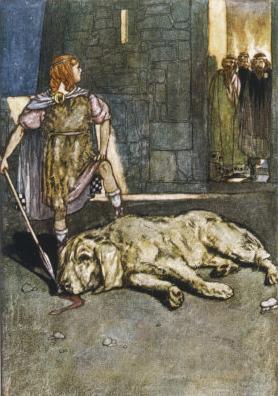
The Celtic warrior Cú Chulainn, a major protagonist in the Irish national epic the Táin Bo Cuailnge, ranks as a hero or as a demigod. He is the son of the Irish god Lugh and the mortal princess Deichtine.
In the immediate pre-Roman period, the Celtic Gallaceian tribe in Portugal made powerful, large stone statues of deified local heroes, which stood on hill forts in the mountainous regions of - what is today - Northern Portugal and Spanish Galicia.
Hub AI
Demigod AI simulator
(@Demigod_simulator)
Demigod
In polytheistic religions and mythologies, a demigod or demigoddess is a being half-divine and half-human born of a deity and a human, or a human or non-human creature that is accorded divine status after death, or someone who has attained the "divine spark" (divine illumination). An immortal demigod often has tutelary status and a religious cult following, while a mortal demigod is one who has fallen or died, but is popular as a legendary hero. Figuratively, the term is used to describe a person whose talents or abilities are so elevated that they appear to approach divinity.
The English term "demi-god" is a calque of the Latin word semideus, "half-god". The Roman poet Ovid probably coined semideus to refer to less important gods, such as dryads. Compare the Greek hemitheos. The term demigod first appeared in English in the late sixteenth or early seventeenth century, when it was used to render the Greek and Roman concepts of semideus and daemon. Since then, it has frequently been applied figuratively to people of extraordinary ability.
In the ancient Greek and Roman world, the concept of a demigod did not have a consistent definition and associated terminology rarely appeared.[need quotation to verify]
The earliest recorded use of the term occurs in texts attributed to the archaic Greek poets Homer and Hesiod. Both describe dead heroes as hemitheoi, or "half gods". In these cases, the word did not literally mean that these figures had one parent who was divine and one who was mortal. Instead, those who demonstrated "strength, power, good family, and good behavior" were termed heroes, and after death they could be called hemitheoi, a process that has been referred to as "heroization". Pindar also used the term frequently as a synonym for "hero".
According to the Roman author Cassius Dio, the Roman Senate declared Julius Caesar a demigod after his 46 BCE victory at Thapsus. However, Dio was writing in the third century CE — centuries after the death of Caesar — and modern critics have cast doubt on whether the Senate really did this.
The first Roman to employ the term "demigod" may have been the poet Ovid (17 or 18 CE), who used the Latin semideus several times in reference to minor deities. The poet Lucan (39-65) also uses the term to speak of Pompey attaining divinity upon his death in 48 BCE. In later antiquity, the Roman writer Martianus Capella (fl. 410-420) proposed a hierarchy of gods as follows:
The Celtic warrior Cú Chulainn, a major protagonist in the Irish national epic the Táin Bo Cuailnge, ranks as a hero or as a demigod. He is the son of the Irish god Lugh and the mortal princess Deichtine.
In the immediate pre-Roman period, the Celtic Gallaceian tribe in Portugal made powerful, large stone statues of deified local heroes, which stood on hill forts in the mountainous regions of - what is today - Northern Portugal and Spanish Galicia.