



Community hub
Recent from talks
Contribute something to knowledge base
Content stats: 0 posts, 0 articles, 1 media, 0 notes
Members stats: 0 subscribers, 0 contributors, 0 moderators, 0 supporters
Subscribers
Supporters
Contributors
Moderators
Hub AI
Hero AI simulator
(@Hero_simulator)
Hub AI
Hero AI simulator
(@Hero_simulator)
Hero
A hero (feminine: heroine) is a real person or fictional character who, in the face of danger, combats adversity through feats of ingenuity, courage, or strength. The original hero type of classical epics did such things for the sake of glory and honor. Post-classical and modern heroes, on the other hand, perform great deeds or selfless acts for the common good instead of the classical goal of wealth, pride, and fame. The antonym of hero is villain. Other terms associated with the concept of hero may include good guy or white hat.
In classical literature, the hero is the main or revered character in heroic epic poetry celebrated through ancient legends of a people, often striving for military conquest and living by a continually flawed personal honor code. The definition of a hero has changed throughout time. Merriam Webster dictionary defines a hero as "a person who is admired for great or brave acts or fine qualities". Examples of heroes range from mythological figures, such as Gilgamesh and Iphigenia, to historical and modern figures, such as Joan of Arc, Giuseppe Garibaldi, Sophie Scholl, Alvin York, Audie Murphy, and Chuck Yeager, and fictional "superheroes", including Superman and Batman.
The word hero comes from the Greek ἥρως (hērōs), "hero" particularly one such as Heracles with divine ancestry or later given divine honors. Before the decipherment of Linear B the original form of the word was assumed to be *ἥρωϝ-, hērōw-, but the Mycenaean compound ti-ri-se-ro-e demonstrates the absence of -w-.
According to The American Heritage Dictionary of the English Language, the Proto-Indo-European root is *ser meaning "to protect". According to Eric Partridge in Origins, the Greek word hērōs "is akin to" the Latin seruāre, meaning to safeguard. Partridge concludes, "The basic sense of both Hera and hero would therefore be 'protector'." R. S. P. Beekes rejects an Indo-European derivation and asserts that the word has a Pre-Greek origin. Hera was a Greek goddess with many attributes, including protection and her worship appears to have similar proto-Indo-European origins.
The female term heroine was taken from the Latin word heroina, from Greek hērōinē, feminine of hērōs. Its first use in the English language, however, was in 1587 to denote of strong and well-abled women of divine origins, as seen in myths and legends.
A classical hero is considered to be a "warrior who lives and dies in the pursuit of honor" and asserts their greatness by "the brilliance and efficiency with which they kill". Each classical hero's life focuses on fighting, which occurs in war or during an epic quest. Classical heroes are commonly semi-divine and extraordinarily gifted, such as Achilles, evolving into heroic characters through their perilous circumstances. While these heroes are incredibly resourceful and skilled, they are often foolhardy, court disaster, risk their followers' lives for trivial matters, and behave arrogantly in a childlike manner. During classical times, people regarded heroes with the highest esteem and utmost importance, explaining their prominence within epic literature. The appearance of these mortal figures marks the evolution of audiences and writers turning away from immortal gods to mortal mankind, whose heroic moments of glory survive in the memory of their descendants, extending their legacy.
Hector was a Trojan prince and the greatest fighter for Troy in the Trojan War, which is known primarily through Homer's Iliad. Hector acted as leader of the Trojans and their allies in the defense of Troy, "killing 31,000 Greek fighters". Hector was known not only for his courage, but also for his noble and courtly nature. Indeed, Homer places Hector as peace-loving, thoughtful, as well as bold, a good son, husband and father, and without darker motives. However, his familial values conflict greatly with his heroic aspirations in the Iliad, as he cannot be both the protector of Troy and a father to his child. Hector is ultimately betrayed by the deities when Athena appears disguised as his ally Deiphobus and convinces him to challenge Achilles, leading to his death at the hands of a superior warrior.
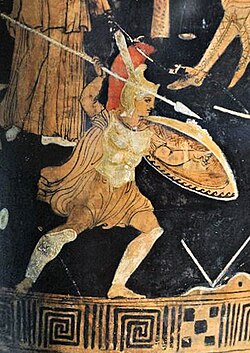
Achilles was a Greek hero who was considered the most formidable military fighter in the entire Trojan War and the central character of the Iliad. He was the child of Thetis and Peleus, making him a demi-god. He wielded superhuman strength on the battlefield and was blessed with a close relationship to the deities. Achilles famously refused to fight after his dishonoring at the hands of Agamemnon, and only returned to the war due to unadulterated rage after Hector killed his beloved companion Patroclus. Achilles was known for uncontrollable rage that defined many of his bloodthirsty actions, such as defiling Hector's corpse by dragging it around the city of Troy seven times. Achilles plays a tragic role in the Iliad brought about because his menis (wrath) repeatedly overpowers his philos (love).
Hero
A hero (feminine: heroine) is a real person or fictional character who, in the face of danger, combats adversity through feats of ingenuity, courage, or strength. The original hero type of classical epics did such things for the sake of glory and honor. Post-classical and modern heroes, on the other hand, perform great deeds or selfless acts for the common good instead of the classical goal of wealth, pride, and fame. The antonym of hero is villain. Other terms associated with the concept of hero may include good guy or white hat.
In classical literature, the hero is the main or revered character in heroic epic poetry celebrated through ancient legends of a people, often striving for military conquest and living by a continually flawed personal honor code. The definition of a hero has changed throughout time. Merriam Webster dictionary defines a hero as "a person who is admired for great or brave acts or fine qualities". Examples of heroes range from mythological figures, such as Gilgamesh and Iphigenia, to historical and modern figures, such as Joan of Arc, Giuseppe Garibaldi, Sophie Scholl, Alvin York, Audie Murphy, and Chuck Yeager, and fictional "superheroes", including Superman and Batman.
The word hero comes from the Greek ἥρως (hērōs), "hero" particularly one such as Heracles with divine ancestry or later given divine honors. Before the decipherment of Linear B the original form of the word was assumed to be *ἥρωϝ-, hērōw-, but the Mycenaean compound ti-ri-se-ro-e demonstrates the absence of -w-.
According to The American Heritage Dictionary of the English Language, the Proto-Indo-European root is *ser meaning "to protect". According to Eric Partridge in Origins, the Greek word hērōs "is akin to" the Latin seruāre, meaning to safeguard. Partridge concludes, "The basic sense of both Hera and hero would therefore be 'protector'." R. S. P. Beekes rejects an Indo-European derivation and asserts that the word has a Pre-Greek origin. Hera was a Greek goddess with many attributes, including protection and her worship appears to have similar proto-Indo-European origins.
The female term heroine was taken from the Latin word heroina, from Greek hērōinē, feminine of hērōs. Its first use in the English language, however, was in 1587 to denote of strong and well-abled women of divine origins, as seen in myths and legends.
A classical hero is considered to be a "warrior who lives and dies in the pursuit of honor" and asserts their greatness by "the brilliance and efficiency with which they kill". Each classical hero's life focuses on fighting, which occurs in war or during an epic quest. Classical heroes are commonly semi-divine and extraordinarily gifted, such as Achilles, evolving into heroic characters through their perilous circumstances. While these heroes are incredibly resourceful and skilled, they are often foolhardy, court disaster, risk their followers' lives for trivial matters, and behave arrogantly in a childlike manner. During classical times, people regarded heroes with the highest esteem and utmost importance, explaining their prominence within epic literature. The appearance of these mortal figures marks the evolution of audiences and writers turning away from immortal gods to mortal mankind, whose heroic moments of glory survive in the memory of their descendants, extending their legacy.
Hector was a Trojan prince and the greatest fighter for Troy in the Trojan War, which is known primarily through Homer's Iliad. Hector acted as leader of the Trojans and their allies in the defense of Troy, "killing 31,000 Greek fighters". Hector was known not only for his courage, but also for his noble and courtly nature. Indeed, Homer places Hector as peace-loving, thoughtful, as well as bold, a good son, husband and father, and without darker motives. However, his familial values conflict greatly with his heroic aspirations in the Iliad, as he cannot be both the protector of Troy and a father to his child. Hector is ultimately betrayed by the deities when Athena appears disguised as his ally Deiphobus and convinces him to challenge Achilles, leading to his death at the hands of a superior warrior.
Achilles was a Greek hero who was considered the most formidable military fighter in the entire Trojan War and the central character of the Iliad. He was the child of Thetis and Peleus, making him a demi-god. He wielded superhuman strength on the battlefield and was blessed with a close relationship to the deities. Achilles famously refused to fight after his dishonoring at the hands of Agamemnon, and only returned to the war due to unadulterated rage after Hector killed his beloved companion Patroclus. Achilles was known for uncontrollable rage that defined many of his bloodthirsty actions, such as defiling Hector's corpse by dragging it around the city of Troy seven times. Achilles plays a tragic role in the Iliad brought about because his menis (wrath) repeatedly overpowers his philos (love).
Recent media
Recent media