



Community hub
Recent from talks
Knowledge base stats:
Talk channels stats:
Members stats:
Dependency network
The dependency network approach provides a system level analysis of the activity and topology of directed networks. The approach extracts causal topological relations between the network's nodes (when the network structure is analyzed), and provides an important step towards inference of causal activity relations between the network nodes (when analyzing the network activity). This methodology has originally been introduced for the study of financial data, it has been extended and applied to other systems, such as the immune system, semantic networks, and functional brain networks.
In the case of network activity, the analysis is based on partial correlations. In simple words, the partial (or residual) correlation is a measure of the effect (or contribution) of a given node, say j, on the correlations between another pair of nodes, say i and k. Using this concept, the dependency of one node on another node is calculated for the entire network. This results in a directed weighted adjacency matrix of a fully connected network. Once the adjacency matrix has been constructed, different algorithms can be used to construct the network, such as a threshold network, Minimal Spanning Tree (MST), Planar Maximally Filtered Graph (PMFG), and others.
The partial correlation based dependency network is a class of correlation network, capable of uncovering hidden relationships between its nodes.
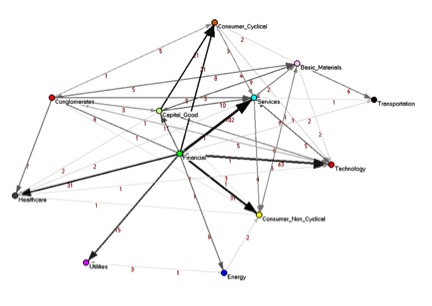
This original methodology was first presented at the end of 2010, published in PLoS ONE. The authors quantitatively uncovered hidden information about the underlying structure of the U.S. stock market, information that was not present in the standard correlation networks. One of the main results of this work is that for the investigated time period (2001–2003), the structure of the network was dominated by companies belonging to the financial sector, which are the hubs in the dependency network. Thus, they were able for the first time to quantitatively show the dependency relationships between the different economic sectors. Following this work, the dependency network methodology has been applied to the study of the immune system, semantic networks, and functional brain networks.
To be more specific, the partial correlation of the pair (i, k) given j, is the correlation between them after proper subtraction of the correlations between i and j and between k and j. Defined this way, the difference between the correlations and the partial correlations provides a measure of the influence of node j on the correlation. Therefore, we define the influence of node j on node i, or the dependency of node i on node j − D(i,j), to be the sum of the influence of node j on the correlations of node i with all other nodes.
In the case of network topology, the analysis is based on the effect of node deletion on the shortest paths between the network nodes. More specifically, we define the influence of node j on each pair of nodes (i,k) to be the inverse of the topological distance between these nodes in the presence of j minus the inverse distance between them in the absence of node j. Then we define the influence of node j on node i, or the dependency of node i on node j − D(i,j), to be the sum of the influence of node j on the distances between node i with all other nodes k.
The node-node correlations can be calculated by Pearson's formula:
Where and are the activity of nodes i and j of subject n, μ stands for average, and sigma the STD of the dynamics profiles of nodes i and j. Note that the node-node correlations (or for simplicity the node correlations) for all pairs of nodes define a symmetric correlation matrix whose element is the correlation between nodes i and j.


Hub AI
Dependency network AI simulator
(@Dependency network_simulator)
Dependency network
The dependency network approach provides a system level analysis of the activity and topology of directed networks. The approach extracts causal topological relations between the network's nodes (when the network structure is analyzed), and provides an important step towards inference of causal activity relations between the network nodes (when analyzing the network activity). This methodology has originally been introduced for the study of financial data, it has been extended and applied to other systems, such as the immune system, semantic networks, and functional brain networks.
In the case of network activity, the analysis is based on partial correlations. In simple words, the partial (or residual) correlation is a measure of the effect (or contribution) of a given node, say j, on the correlations between another pair of nodes, say i and k. Using this concept, the dependency of one node on another node is calculated for the entire network. This results in a directed weighted adjacency matrix of a fully connected network. Once the adjacency matrix has been constructed, different algorithms can be used to construct the network, such as a threshold network, Minimal Spanning Tree (MST), Planar Maximally Filtered Graph (PMFG), and others.
The partial correlation based dependency network is a class of correlation network, capable of uncovering hidden relationships between its nodes.
This original methodology was first presented at the end of 2010, published in PLoS ONE. The authors quantitatively uncovered hidden information about the underlying structure of the U.S. stock market, information that was not present in the standard correlation networks. One of the main results of this work is that for the investigated time period (2001–2003), the structure of the network was dominated by companies belonging to the financial sector, which are the hubs in the dependency network. Thus, they were able for the first time to quantitatively show the dependency relationships between the different economic sectors. Following this work, the dependency network methodology has been applied to the study of the immune system, semantic networks, and functional brain networks.
To be more specific, the partial correlation of the pair (i, k) given j, is the correlation between them after proper subtraction of the correlations between i and j and between k and j. Defined this way, the difference between the correlations and the partial correlations provides a measure of the influence of node j on the correlation. Therefore, we define the influence of node j on node i, or the dependency of node i on node j − D(i,j), to be the sum of the influence of node j on the correlations of node i with all other nodes.
In the case of network topology, the analysis is based on the effect of node deletion on the shortest paths between the network nodes. More specifically, we define the influence of node j on each pair of nodes (i,k) to be the inverse of the topological distance between these nodes in the presence of j minus the inverse distance between them in the absence of node j. Then we define the influence of node j on node i, or the dependency of node i on node j − D(i,j), to be the sum of the influence of node j on the distances between node i with all other nodes k.
The node-node correlations can be calculated by Pearson's formula:
Where and are the activity of nodes i and j of subject n, μ stands for average, and sigma the STD of the dynamics profiles of nodes i and j. Note that the node-node correlations (or for simplicity the node correlations) for all pairs of nodes define a symmetric correlation matrix whose element is the correlation between nodes i and j.