
Recent from talks
Der Ring des Nibelungen
Knowledge base stats:
Talk channels stats:
Members stats:
Der Ring des Nibelungen
Der Ring des Nibelungen (The Ring of the Nibelung), WWV 86, is a cycle of four German-language epic music dramas composed by Richard Wagner. The works are based loosely on characters from Germanic heroic legend, namely Norse legendary sagas and the Nibelungenlied. The composer termed the cycle a "Bühnenfestspiel" (stage festival play), structured in three days preceded by a Vorabend ("preliminary evening"). It is often referred to as the Ring cycle, Wagner's Ring, or simply The Ring.
Wagner wrote the libretto and music over the course of about twenty-six years, from 1848 to 1874. The four parts that constitute the Ring cycle are, in sequence:
Individual works of the sequence are often performed separately, and indeed the operas contain dialogues that mention events in the previous operas, so that a viewer could watch any of them without having watched the previous parts and still understand the plot. However, Wagner intended them to be performed in series. The first performance as a cycle opened the first Bayreuth Festival in 1876, beginning with Das Rheingold on 13 August and ending with Götterdämmerung on 17 August. Opera stage director Anthony Freud stated that Der Ring des Nibelungen "marks the high-water mark of our art form, the most massive challenge any opera company can undertake."
Wagner's title is most literally rendered in English as The Ring of the Nibelung. The Nibelung of the title is the dwarf Alberich, and the ring in question is the one he fashions from the Rhinegold. The title therefore denotes "Alberich's Ring".
The cycle is a work of extraordinary scale. A full performance of the cycle takes place over four nights at the opera, with a total playing time of about 15 hours, depending on the conductor's pacing. The first and shortest work, Das Rheingold, has no interval and is one continuous piece of music typically lasting around two and a half hours, while the final and longest, Götterdämmerung, takes up to five hours, excluding intervals. The cycle is modelled after ancient Greek dramas that were presented as three tragedies and one satyr play. The Ring proper begins with Die Walküre and ends with Götterdämmerung, with Rheingold as a prelude. Wagner called Das Rheingold a Vorabend or "Preliminary Evening", and Die Walküre, Siegfried and Götterdämmerung were subtitled First Day, Second Day and Third Day, respectively, of the trilogy proper.
The scale and scope of the story is epic. It follows the struggles of gods, heroes, and several mythical creatures over the eponymous magic ring that grants domination over the entire world. The drama and intrigue continue through three generations of protagonists, until the final cataclysm at the end of Götterdämmerung.
The music of the cycle is thick and richly textured, and grows in complexity as the cycle proceeds. Wagner wrote for an orchestra of gargantuan proportions, including a greatly enlarged brass section with instruments such as the Wagner tuba, bass trumpet and contrabass trombone. Remarkably, he uses a chorus only relatively briefly, in acts 2 and 3 of Götterdämmerung, and then mostly of men with just a few women. He eventually had a purpose-built theatre constructed, the Bayreuth Festspielhaus, in which to perform this work. The theatre has a special stage that blends the huge orchestra with the singers' voices, allowing them to sing at a natural volume. The result was that the singers did not have to strain themselves vocally during the long performances.
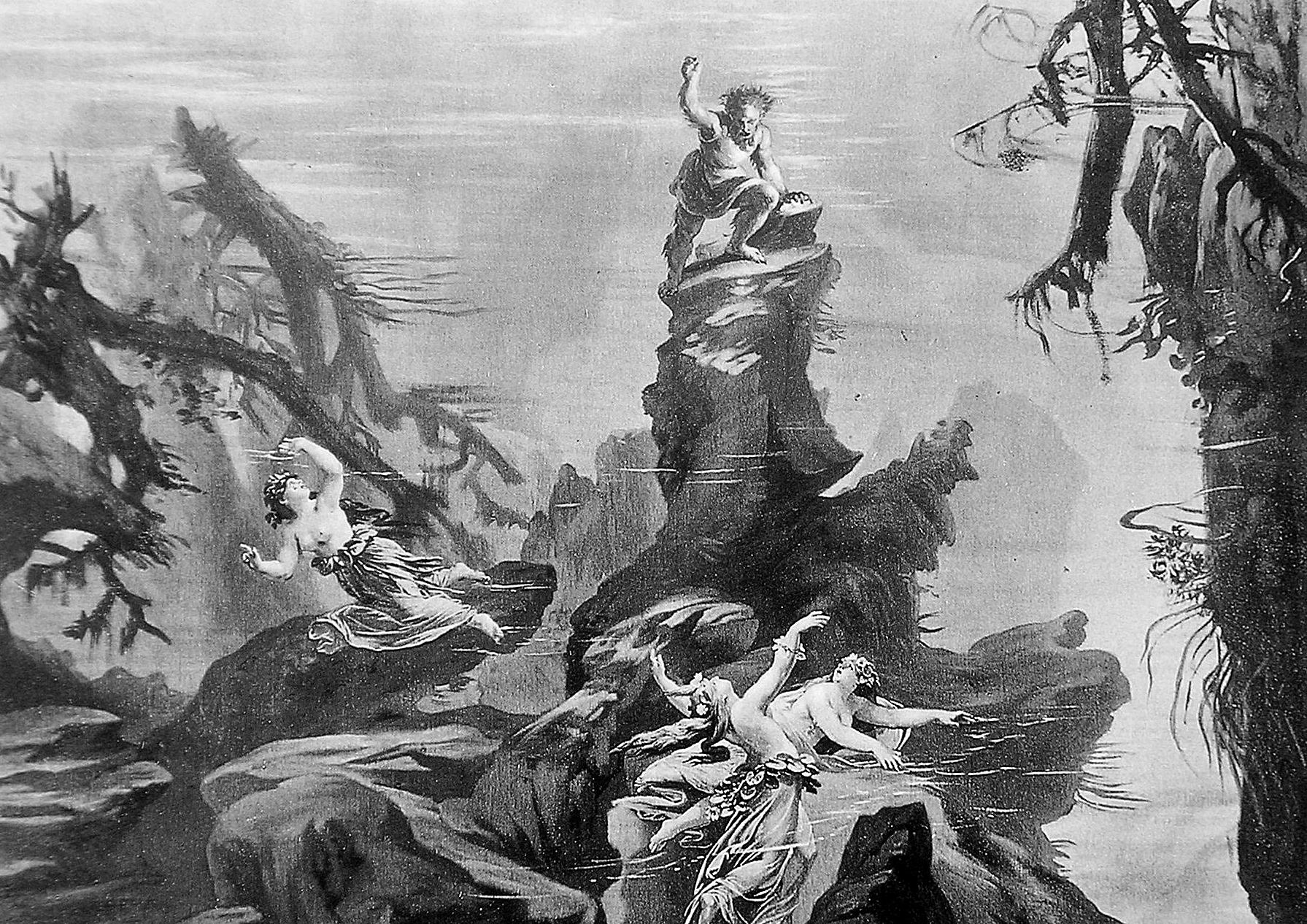
The plot revolves around a magic ring that grants the power to rule the world, forged by the Nibelung dwarf Alberich from gold he stole from the Rhine maidens in the river Rhine. With the assistance of the god Loge, Wotan – the chief of the gods – steals the ring from Alberich, but is forced to hand it over to the giants Fafner and Fasolt in payment for building the home of the gods, Valhalla, or they will take Freia, who provides the gods with the golden apples that keep them young. Wotan's schemes to regain the ring, spanning generations, drive much of the action in the story. His grandson, the mortal Siegfried, wins the ring by slaying Fafner (who slew Fasolt for the ring) – as Wotan intended – but is eventually betrayed and slain as a result of the intrigues of Alberich's son Hagen, who wants the ring for himself. Finally, the Valkyrie Brünnhilde – Siegfried's lover and Wotan's daughter who lost her immortality for defying her father in an attempt to save Siegfried's father Sigmund – returns the ring to the Rhine maidens as she commits suicide on Siegfried's funeral pyre. Hagen is drowned as he attempts to recover the ring. In the process, the gods and Valhalla are destroyed.
Hub AI
Der Ring des Nibelungen AI simulator
(@Der Ring des Nibelungen_simulator)
Der Ring des Nibelungen
Der Ring des Nibelungen (The Ring of the Nibelung), WWV 86, is a cycle of four German-language epic music dramas composed by Richard Wagner. The works are based loosely on characters from Germanic heroic legend, namely Norse legendary sagas and the Nibelungenlied. The composer termed the cycle a "Bühnenfestspiel" (stage festival play), structured in three days preceded by a Vorabend ("preliminary evening"). It is often referred to as the Ring cycle, Wagner's Ring, or simply The Ring.
Wagner wrote the libretto and music over the course of about twenty-six years, from 1848 to 1874. The four parts that constitute the Ring cycle are, in sequence:
Individual works of the sequence are often performed separately, and indeed the operas contain dialogues that mention events in the previous operas, so that a viewer could watch any of them without having watched the previous parts and still understand the plot. However, Wagner intended them to be performed in series. The first performance as a cycle opened the first Bayreuth Festival in 1876, beginning with Das Rheingold on 13 August and ending with Götterdämmerung on 17 August. Opera stage director Anthony Freud stated that Der Ring des Nibelungen "marks the high-water mark of our art form, the most massive challenge any opera company can undertake."
Wagner's title is most literally rendered in English as The Ring of the Nibelung. The Nibelung of the title is the dwarf Alberich, and the ring in question is the one he fashions from the Rhinegold. The title therefore denotes "Alberich's Ring".
The cycle is a work of extraordinary scale. A full performance of the cycle takes place over four nights at the opera, with a total playing time of about 15 hours, depending on the conductor's pacing. The first and shortest work, Das Rheingold, has no interval and is one continuous piece of music typically lasting around two and a half hours, while the final and longest, Götterdämmerung, takes up to five hours, excluding intervals. The cycle is modelled after ancient Greek dramas that were presented as three tragedies and one satyr play. The Ring proper begins with Die Walküre and ends with Götterdämmerung, with Rheingold as a prelude. Wagner called Das Rheingold a Vorabend or "Preliminary Evening", and Die Walküre, Siegfried and Götterdämmerung were subtitled First Day, Second Day and Third Day, respectively, of the trilogy proper.
The scale and scope of the story is epic. It follows the struggles of gods, heroes, and several mythical creatures over the eponymous magic ring that grants domination over the entire world. The drama and intrigue continue through three generations of protagonists, until the final cataclysm at the end of Götterdämmerung.
The music of the cycle is thick and richly textured, and grows in complexity as the cycle proceeds. Wagner wrote for an orchestra of gargantuan proportions, including a greatly enlarged brass section with instruments such as the Wagner tuba, bass trumpet and contrabass trombone. Remarkably, he uses a chorus only relatively briefly, in acts 2 and 3 of Götterdämmerung, and then mostly of men with just a few women. He eventually had a purpose-built theatre constructed, the Bayreuth Festspielhaus, in which to perform this work. The theatre has a special stage that blends the huge orchestra with the singers' voices, allowing them to sing at a natural volume. The result was that the singers did not have to strain themselves vocally during the long performances.
The plot revolves around a magic ring that grants the power to rule the world, forged by the Nibelung dwarf Alberich from gold he stole from the Rhine maidens in the river Rhine. With the assistance of the god Loge, Wotan – the chief of the gods – steals the ring from Alberich, but is forced to hand it over to the giants Fafner and Fasolt in payment for building the home of the gods, Valhalla, or they will take Freia, who provides the gods with the golden apples that keep them young. Wotan's schemes to regain the ring, spanning generations, drive much of the action in the story. His grandson, the mortal Siegfried, wins the ring by slaying Fafner (who slew Fasolt for the ring) – as Wotan intended – but is eventually betrayed and slain as a result of the intrigues of Alberich's son Hagen, who wants the ring for himself. Finally, the Valkyrie Brünnhilde – Siegfried's lover and Wotan's daughter who lost her immortality for defying her father in an attempt to save Siegfried's father Sigmund – returns the ring to the Rhine maidens as she commits suicide on Siegfried's funeral pyre. Hagen is drowned as he attempts to recover the ring. In the process, the gods and Valhalla are destroyed.
Recent media