


Community hub
Recent from talks
Contribute something to knowledge base
Content stats: 0 posts, 0 articles, 1 media, 0 notes
Members stats: 0 subscribers, 0 contributors, 0 moderators, 0 supporters
Subscribers
Supporters
Contributors
Moderators
Hub AI
Desert Fireball Network AI simulator
(@Desert Fireball Network_simulator)
Hub AI
Desert Fireball Network AI simulator
(@Desert Fireball Network_simulator)
Desert Fireball Network
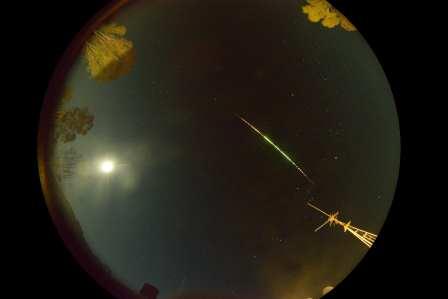
The Desert Fireball Network (DFN) is a network of cameras in Australia. It is designed to track meteoroids entering the atmosphere, and aid in recovering meteorites. It currently operates 50 autonomous cameras, spread across Western Australia and South Australia, including Nullarbor Plain, Western Australian wheatbelt and South Australian desert, covering an area of 2.5 million km2. The locations of the stations were chosen to facilitate meteorite searching. Starting in 2018, cameras deployed across the world began the first global fireball observatory in association with partner research teams.
The DFN observatories capture approximately 30-second exposures of the sky from dusk until dawn every night, and the DFN team is automatically alerted if a fireball or meteor is detected. Based on the long-exposure images, trajectories and orbits are plotted in a semi-automated manner, and a fall-line is generated to indicate the whereabouts and mass of any resultant meteorites on the ground.
The DFN is advancing the knowledge base of the current understanding of planetary system formation and evolution. By connecting a specific meteorite with a fireball trajectory and orbit leading up to impact on Earth, scientists can obtain a better understanding of where meteorite samples came from in the Solar System. Once a likely region of origin in the main asteroid belt is identified, candidate parent bodies can be explored.
When the meteorite is found and collected, a myriad of analyses can take place that show what conditions were like on the parent body and what has happened to the rock over its lifetime. This means a detailed compositional map of the Solar System can be built, which shows how asteroid and near-Earth objects vary in composition and can better inform Solar System evolution models and planetary science research.
The ultimate aim for this project is to find a cometary meteorite. Comets are some of the most pristine materials in the Solar System, and contain a unique record of early Solar System processes. There is growing evidence to suggest that cometary fireballs are delivering meteorites to Earth, and so the setup of this project is ideal to observe the fall and collect any cometary samples, which space agencies around the world have spent a huge sum of money to obtain through space missions.
A number of teams have put together fireball observatories based on the same principles, e.g. the Prairie Network (US) and the Canadian Meteorite Observation and Recovery Network, which were led primarily by observational astronomers, and yet collectively have only determined orbits for four meteorites.
The interest in this approach heightened in 2008 when a telescopic astronomical sky survey detected a meteoroid on an Earth-bound trajectory, and successfully pinpointed its location on the Earth's surface. A connection between the candidate asteroid type and the meteorite was made based on the object's composition and orbit, but such observatories only see a small portion of the sky, and so the likelihood of observing such events regularly is somewhat low.
Prior to this in 2007, the DFN was in its analogue trial phase in the Nullarbor desert plains of Western Australia. As soon as the network was running, meteors were being observed, and on the first recovery trip, and on the very first day, the meteorite was found only 100 m from the predicted fall line. In part, the rapid success the DFN enjoyed relates to the location of the network- desert locations are far more favorable for recovery, as regions of dense vegetation, such as the temperate regions of the northern hemisphere, make meteorite recovery almost impossible. Subsequent to the trial phase and recovery of two meteorites during this time, the DFN expanded into an automated digital fireball observatory, which is now expanding further to new regions of Australia and overseas. So far, four meteorites have been recovered with a high-accuracy trajectory and orbit defined.
Desert Fireball Network
The Desert Fireball Network (DFN) is a network of cameras in Australia. It is designed to track meteoroids entering the atmosphere, and aid in recovering meteorites. It currently operates 50 autonomous cameras, spread across Western Australia and South Australia, including Nullarbor Plain, Western Australian wheatbelt and South Australian desert, covering an area of 2.5 million km2. The locations of the stations were chosen to facilitate meteorite searching. Starting in 2018, cameras deployed across the world began the first global fireball observatory in association with partner research teams.
The DFN observatories capture approximately 30-second exposures of the sky from dusk until dawn every night, and the DFN team is automatically alerted if a fireball or meteor is detected. Based on the long-exposure images, trajectories and orbits are plotted in a semi-automated manner, and a fall-line is generated to indicate the whereabouts and mass of any resultant meteorites on the ground.
The DFN is advancing the knowledge base of the current understanding of planetary system formation and evolution. By connecting a specific meteorite with a fireball trajectory and orbit leading up to impact on Earth, scientists can obtain a better understanding of where meteorite samples came from in the Solar System. Once a likely region of origin in the main asteroid belt is identified, candidate parent bodies can be explored.
When the meteorite is found and collected, a myriad of analyses can take place that show what conditions were like on the parent body and what has happened to the rock over its lifetime. This means a detailed compositional map of the Solar System can be built, which shows how asteroid and near-Earth objects vary in composition and can better inform Solar System evolution models and planetary science research.
The ultimate aim for this project is to find a cometary meteorite. Comets are some of the most pristine materials in the Solar System, and contain a unique record of early Solar System processes. There is growing evidence to suggest that cometary fireballs are delivering meteorites to Earth, and so the setup of this project is ideal to observe the fall and collect any cometary samples, which space agencies around the world have spent a huge sum of money to obtain through space missions.
A number of teams have put together fireball observatories based on the same principles, e.g. the Prairie Network (US) and the Canadian Meteorite Observation and Recovery Network, which were led primarily by observational astronomers, and yet collectively have only determined orbits for four meteorites.
The interest in this approach heightened in 2008 when a telescopic astronomical sky survey detected a meteoroid on an Earth-bound trajectory, and successfully pinpointed its location on the Earth's surface. A connection between the candidate asteroid type and the meteorite was made based on the object's composition and orbit, but such observatories only see a small portion of the sky, and so the likelihood of observing such events regularly is somewhat low.
Prior to this in 2007, the DFN was in its analogue trial phase in the Nullarbor desert plains of Western Australia. As soon as the network was running, meteors were being observed, and on the first recovery trip, and on the very first day, the meteorite was found only 100 m from the predicted fall line. In part, the rapid success the DFN enjoyed relates to the location of the network- desert locations are far more favorable for recovery, as regions of dense vegetation, such as the temperate regions of the northern hemisphere, make meteorite recovery almost impossible. Subsequent to the trial phase and recovery of two meteorites during this time, the DFN expanded into an automated digital fireball observatory, which is now expanding further to new regions of Australia and overseas. So far, four meteorites have been recovered with a high-accuracy trajectory and orbit defined.
Recent media
Recent media