Hubbry Logo
Planetary systemPlanetary systemMain
Open search
Planetary system
Community hub
Planetary system
logo
8 pages, 0 posts
0 subscribers
Be the first to start a discussion here.
Contribute something
Planetary system
Planetary system
from Wikipedia

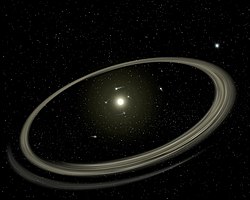
An artist's concept of a planetary system

A planetary system consists of a set of non-stellar bodies which are gravitationally bound to and in orbit of a star or star system. Generally speaking, such systems will include planets, and may include other objects such as dwarf planets, asteroids, natural satellites, meteoroids, comets, planetesimals[1][2], and circumstellar disks. The Solar System is an example of a planetary system, in which Earth, seven other planets, and other celestial objects are bound to and revolve around the Sun.[3][4] The term exoplanetary system is sometimes used in reference to planetary systems other than the Solar System. By convention planetary systems are named after their host, or parent, star, as is the case with the Solar System being named after "Sol" (Latin for sun).

As of 29 July 2025, there are 6,032 confirmed exoplanets in 4,530 planetary systems, with 989 systems having more than one planet.[5] Debris disks are known to be common while other objects are more difficult to observe.

Of particular interest to astrobiology is the habitable zone of planetary systems where planets could have surface liquid water, and thus, the capacity to support Earth-like life.

Definition

[edit]

The International Astronomical Union (IAU) has described a planetary system as the system of planets orbiting one or more stars, brown dwarfs or stellar remnants. The IAU and NASA consider the Solar System a planetary system, including its star the Sun, its planets, and all other bodies orbiting the Sun.[6][7]

Other definitions of planetary system explicitly include all bodies gravitationally bound to one or more stars.[8]

History

[edit]

Heliocentrism

[edit]

Heliocentrism is a planetary model that places the Sun is at the center of the universe, as opposed to geocentrism (placing Earth at the center of the universe).

The idea was first proposed in Western philosophy and Greek astronomy as early as the 3rd century BC by Aristarchus of Samos,[9] but received no support from most other ancient astronomers.

Some also interpret Aryabhatta's writings in Āryabhaṭīya as implicitly heliocentric, although this has also been rebutted.[10]

Discovery of the Solar System

[edit]
Heliocentric model of the Solar System in Copernicus' manuscript

De revolutionibus orbium coelestium by Nicolaus Copernicus, published in 1543, presented the first mathematically predictive heliocentric model of a planetary system. 17th-century successors Galileo Galilei, Johannes Kepler, and Sir Isaac Newton developed an understanding of physics which led to the gradual acceptance of the idea that the Earth moves around the Sun and that the planets are governed by the same physical laws that governed Earth.

Speculation on extrasolar planetary systems

[edit]

In the 16th century the Italian philosopher Giordano Bruno, an early supporter of the Copernican theory that Earth and other planets orbit the Sun, put forward the view that the fixed stars are similar to the Sun and are likewise accompanied by planets. He was burned at the stake for his ideas by the Roman Inquisition.[11]

In the 18th century, the same possibility was mentioned by Sir Isaac Newton in the "General Scholium" that concludes his Principia. Making a comparison to the Sun's planets, he wrote "And if the fixed stars are the centres of similar systems, they will all be constructed according to a similar design and subject to the dominion of One."[12]

His theories gained popularity through the 19th and 20th centuries despite a lack of supporting evidence. Long before their confirmation by astronomers, conjecture on the nature of planetary systems had been a focus of the search for extraterrestrial intelligence and has been a prevalent theme in fiction, particularly science fiction.

Detection of exoplanets

[edit]

The first confirmed detection of an exoplanet was in 1992, with the discovery of several terrestrial-mass planets orbiting the pulsar PSR B1257+12. The first confirmed detection of exoplanets of a main-sequence star was made in 1995, when a giant planet, 51 Pegasi b, was found in a four-day orbit around the nearby G-type star 51 Pegasi. The frequency of detections has increased since then, particularly through advancements in methods of detecting extrasolar planets and dedicated planet-finding programs such as the Kepler mission.

Origin and evolution

[edit]
Illustration of the dynamics of a proplyd

Planetary systems come from protoplanetary disks that form around stars as part of the process of star formation.

During formation of a system, much material is gravitationally-scattered into distant orbits, and some planets are ejected completely from the system, becoming rogue planets.

Evolved systems

[edit]

High-mass stars

[edit]

Planets orbiting pulsars have been discovered. Pulsars are the remnants of the supernova explosions of high-mass stars, but a planetary system that existed before the supernova would likely be mostly destroyed. Planets would either evaporate, be pushed off of their orbits by the masses of gas from the exploding star, or the sudden loss of most of the mass of the central star would see them escape the gravitational hold of the star, or in some cases the supernova would kick the pulsar itself out of the system at high velocity so any planets that had survived the explosion would be left behind as free-floating objects. Planets found around pulsars may have formed as a result of pre-existing stellar companions that were almost entirely evaporated by the supernova blast, leaving behind planet-sized bodies. Alternatively, planets may form in an accretion disk of fallback matter surrounding a pulsar.[13] Fallback disks of matter that failed to escape orbit during a supernova may also form planets around black holes.[14]

Lower-mass stars

[edit]

Many low-mass stars are expected to have rocky planets, with their planetary systems primarily consisting of rock- and ice-based bodies. This is because low-mass stars have less material in their planetary disks, making it unlikely that the planetesimals within will reach the critical mass necessary to form gas giants. The planetary systems of low-mass stars also tend to be compact, as such stars tend to have lower temperatures, resulting in the formation of protoplanets closer to the star.[15]

Protoplanetary discs observed with the Very Large Telescope.[16]

As stars evolve and turn into red giants, asymptotic giant branch stars, and eventually planetary nebulae, they engulf the inner planets, evaporating or partially evaporating them depending on how massive they are.[17][18] As the star loses mass, planets that are not engulfed move further out from the star.

If an evolved star is in a binary or multiple system, then the mass it loses can transfer to another star, forming new protoplanetary disks and second- and third-generation planets which may differ in composition from the original planets, which may also be affected by the mass transfer.

System architectures

[edit]

The Solar System consists of an inner region of small rocky planets and outer region of large giant planets. However, other planetary systems can have quite different architectures. Studies suggest that architectures of planetary systems are dependent on the conditions of their initial formation.[19] Many systems with a hot Jupiter gas giant very close to the star have been found. Theories such as planetary migration or scattering have been proposed for the formation of large planets close to their parent stars.[20] At present,[when?] few systems have been found to be analogous to the Solar System with small terrestrial planets in the inner region, as well as a gas giant with a relatively circular orbit, which suggests that this configuration is uncommon.[21] More commonly, systems consisting of multiple Super-Earths have been detected.[22][23] These super-Earths are usually very close to their star, with orbits smaller than that of Mercury.[24]

Classification

[edit]

Planetary system architectures may be partitioned into four classes based on how the mass of the planets is distributed around the host star:[25][26]

  • Similar: The masses of all planets in a system are similar to each other. This architecture class is the most commonly-observed in our galaxy. Examples include TRAPPIST-1. The planets in these systems are said to be like 'peas in a pod'.[27]
  • Mixed: The masses of planets in a system show large increasing or decreasing variations. Examples of such systems are Gliese 876 and Kepler-89.
  • Anti-Ordered: The massive planets of a system are close to the star and smaller planets are further away from the star. There are currently no known examples of this architecture class.
  • Ordered: The mass of the planets in a system tends to increase with increasing distance from the host star. The Solar System, with small rocky planets in the inner part and giant planets in the outer part, is a type of Ordered system.

Peas in a pod

[edit]

Multiplanetary systems tend to be in a "peas in a pod" configuration meaning they tend to have the following factors:[27]

  • Size: planets within a system tend to be either similar or ordered in size.
  • Mass: planets within a system tend to be either similar or ordered in mass.
  • Spacing: planets within a system tend to be equally spaced apart.
  • Packing: small planets tend to be closely packed together, while large planets tend to have larger spacing.

Components

[edit]

Planets and stars

[edit]
The Morgan-Keenan spectral classification

Most known exoplanets orbit stars roughly similar to the Sun: that is, main-sequence stars of spectral categories F, G, or K. One reason is that planet-search programs have tended to concentrate on such stars. In addition, statistical analyses indicate that lower-mass stars (red dwarfs, of spectral category M) are less likely to have planets massive enough to be detected by the radial-velocity method.[28][29] Nevertheless, several tens of planets around red dwarfs have been discovered by the Kepler space telescope by the transit method, which can detect smaller planets.

Exoplanetary systems may also feature planets extremely different from those in the Solar System, such as Hot Jupiters, Hot Neptunes, and Super-Earths.[30] Hot Jupiters and Hot Neptunes are gas giants, like their namesakes, but orbit close to their stars and have orbital periods on the order of a few days.[31] Super-Earths are planets that have a mass between that of Earth and planets like Neptune and Uranus, and can be made of rock and gas. There is a lot of variety among Super-Earths, with planets ranging from water worlds to mini-Neptunes.[32]

Circumstellar disks and dust structures

[edit]
Debris disks detected in HST archival images of young stars, HD 141943 and HD 191089, using improved imaging processes (April 24, 2014).

After planets, circumstellar disks are one of the most commonly-observed properties of planetary systems, particularly of young stars. The Solar System possesses at least four major circumstellar disks (the asteroid belt, Kuiper belt, scattered disc, and Oort cloud) and clearly-observable disks have been detected around nearby solar analogs including Epsilon Eridani and Tau Ceti. Based on observations of numerous similar disks, they are assumed to be quite common attributes of stars on the main sequence.

Interplanetary dust clouds have been studied in the Solar System and analogs are believed to be present in other planetary systems. Exozodiacal dust, an exoplanetary analog of zodiacal dust, the 1–100 micrometre-sized grains of amorphous carbon and silicate dust that fill the plane of the Solar System[33] has been detected around the 51 Ophiuchi, Fomalhaut,[34][35] Tau Ceti,[35][36] and Vega systems.

Comets

[edit]

As of November 2014 there are 5,253 known Solar System comets[37] and they are thought to be common components of planetary systems. The first exocomets were detected in 1987[38][39] around Beta Pictoris, a very young A-type main-sequence star. There are now a total of 11 stars around which the presence of exocomets have been observed or suspected.[40][41][42][43] All discovered exocometary systems (Beta Pictoris, HR 10,[40] 51 Ophiuchi, HR 2174,[41] 49 Ceti, 5 Vulpeculae, 2 Andromedae, HD 21620, HD 42111, HD 110411,[42][44] and more recently HD 172555[43]) are around very young A-type stars.

Other components

[edit]

Computer modelling of an impact in 2013 detected around the star NGC 2547-ID8 by the Spitzer Space Telescope, and confirmed by ground observations, suggests the involvement of large asteroids or protoplanets similar to the events believed to have led to the formation of terrestrial planets like the Earth.[45]

Based on observations of the Solar System's large collection of natural satellites, they are believed common components of planetary systems; however, the existence of exomoons has not yet been confirmed. The star 1SWASP J140747.93-394542.6, in the constellation Centaurus, is a strong candidate for a natural satellite.[46] Indications suggest that the confirmed extrasolar planet WASP-12b also has at least one satellite.[47]

Orbital configurations

[edit]

Unlike the Solar System, which has orbits that are nearly circular, many of the known planetary systems display much higher orbital eccentricity.[48] An example of such a system is 16 Cygni.

Mutual inclination

[edit]

The mutual inclination between two planets is the angle between their orbital planes. Many compact systems with multiple close-in planets interior to the equivalent orbit of Venus are expected to have very low mutual inclinations, so the system (at least the close-in part) would be even flatter than the Solar System. Captured planets could be captured into any arbitrary angle to the rest of the system. As of 2016 there are only a few systems where mutual inclinations have actually been measured[49] One example is the Upsilon Andromedae system: the planets c and d have a mutual inclination of about 30 degrees.[50][51]

Orbital dynamics

[edit]

Planetary systems can be categorized according to their orbital dynamics as resonant, non-resonant-interacting, hierarchical, or some combination of these. In resonant systems the orbital periods of the planets are in integer ratios. The Kepler-223 system contains four planets in an 8:6:4:3 orbital resonance.[52] Giant planets are found in mean-motion resonances more often than smaller planets.[53] In interacting systems the planets' orbits are close enough together that they perturb the orbital parameters. The Solar System could be described as weakly interacting. In strongly interacting systems Kepler's laws do not hold.[54] In hierarchical systems the planets are arranged so that the system can be gravitationally considered as a nested system of two-bodies, e.g. in a star with a close-in hot Jupiter with another gas giant much further out, the star and hot Jupiter form a pair that appears as a single object to another planet that is far enough out.

Other, as yet unobserved, orbital possibilities include: double planets; various co-orbital planets such as quasi-satellites, trojans and exchange orbits; and interlocking orbits maintained by precessing orbital planes.[55]

Number of planets, relative parameters and spacings

[edit]
The spacings between orbits vary widely amongst the different systems discovered by the Kepler space telescope.

Planet capture

[edit]

Free-floating planets in open clusters have similar velocities to the stars and so can be recaptured. They are typically captured into wide orbits between 100 and 105 AU. The capture efficiency decreases with increasing cluster size, and for a given cluster size it increases with the host/primary[clarification needed] mass. It is almost independent of the planetary mass. Single and multiple planets could be captured into arbitrary unaligned orbits, non-coplanar with each other or with the stellar host spin, or pre-existing planetary system. Some planet–host metallicity correlation may still exist due to the common origin of the stars from the same cluster. Planets would be unlikely to be captured around neutron stars because these are likely to be ejected from the cluster by a pulsar kick when they form. Planets could even be captured around other planets to form free-floating planet binaries. After the cluster has dispersed some of the captured planets with orbits larger than 106 AU would be slowly disrupted by the galactic tide and likely become free-floating again through encounters with other field stars or giant molecular clouds.[56]

Zones

[edit]

Habitable zone

[edit]
Location of habitable zone around different types of stars

The habitable zone around a star is the region where the temperature range allows for liquid water to exist on a planet; that is, not too close to the star for the water to evaporate and not too far away from the star for the water to freeze. The heat produced by stars varies depending on the size and age of the star; this means the habitable zone will also vary accordingly. Also, the atmospheric conditions on the planet influence the planet's ability to retain heat so that the location of the habitable zone is also specific to each type of planet.

Habitable zones have usually been defined in terms of surface temperature; however, over half of Earth's biomass is from subsurface microbes,[57] and temperature increases as depth underground increases, so the subsurface can be conducive for life when the surface is frozen; if this is considered, the habitable zone extends much further from the star.[58]

Studies in 2013 indicate that an estimated 22±8% of Sun-like[a] stars have an Earth-sized[b] planet in the habitable[c] zone.[59][60]

Venus zone

[edit]

The Venus zone is the region around a star where a terrestrial planet would have runaway greenhouse conditions like Venus, but not so near the star that the atmosphere completely escapes. As with the habitable zone, the location of the Venus zone depends on several factors, including the type of star and properties of the planets such as mass, rotation rate, and atmospheric clouds. Studies of the Kepler spacecraft data indicate that 32% of red dwarfs have potentially Venus-like planets based on planet size and distance from star, increasing to 45% for K-type and G-type stars.[d] Several candidates have been identified, but spectroscopic follow-up studies of their atmospheres are required to determine whether they are like Venus.[61][62]

Galactic distribution of planets

[edit]
90% of planets with known distances are within about 2000 light years of Earth, as of July 2014.

The Milky Way is 100,000 light-years across, but 90% of planets with known distances are within about 2000 light years of Earth, as of July 2014. One method that can detect planets much further away is microlensing. The upcoming Nancy Grace Roman Space Telescope could use microlensing to measure the relative frequency of planets in the galactic bulge versus the galactic disk.[63] So far, the indications are that planets are more common in the disk than the bulge.[64] Estimates of the distance of microlensing events is difficult: the first planet considered with high probability of being in the bulge is MOA-2011-BLG-293Lb at a distance of 7.7 kiloparsecs (about 25,000 light years).[65]

Population I, or metal-rich stars, are those young stars whose metallicity is highest. The high metallicity of population I stars makes them more likely to possess planetary systems than older populations, because planets form by the accretion of metals.[citation needed] The Sun is an example of a metal-rich star. These are common in the disks of galaxies.[66] Generally, the youngest stars, the extreme population I, are found farther in and intermediate population I stars are farther out, etc. The Sun is considered an intermediate population I star. Population I stars have regular elliptical orbits around the Galactic Center, with a low relative velocity.[67]

Population II, or metal-poor stars, are those with relatively low metallicity which can have hundreds (e.g. BD +17° 3248) or thousands (e.g. Sneden's Star) times less metallicity than the Sun. These objects formed during an earlier time of the universe.[68] Intermediate population II stars are common in the bulge near the center of the Milky Way,[citation needed] whereas Population II stars found in the galactic halo are older and thus more metal-poor.[citation needed] Globular clusters also contain high numbers of population II stars.[69] In 2014, the first planets around a halo star were announced around Kapteyn's star, the nearest halo star to Earth, around 13 light years away. However, later research suggests that Kapteyn b is just an artefact of stellar activity and that Kapteyn c needs more study to be confirmed.[70] The metallicity of Kapteyn's star is estimated to be about 8[e] times less than the Sun.[71]

Different types of galaxies have different histories of star formation and hence planet formation. Planet formation is affected by the ages, metallicities, and orbits of stellar populations within a galaxy. Distribution of stellar populations within a galaxy varies between the different types of galaxies.[72] Stars in elliptical galaxies are much older than stars in spiral galaxies. Most elliptical galaxies contain mainly low-mass stars, with minimal star-formation activity.[73] The distribution of the different types of galaxies in the universe depends on their location within galaxy clusters, with elliptical galaxies found mostly close to their centers.[74]

See also

[edit]

Notes

[edit]

References

[edit]

Further reading

[edit]
Revisions and contributorsEdit on WikipediaRead on Wikipedia
from Grokipedia
A planetary system consists of a or multiple stars orbited by gravitationally bound non-stellar objects, including , dwarf planets, natural satellites (moons), asteroids, comets, and interplanetary dust and gas. These systems form from the collapse of molecular clouds into protoplanetary disks, where dust grains aggregate into planetesimals and eventually coalesce into larger bodies through processes like accretion and gravitational instability. The most well-studied example is our own Solar System, centered on the Sun and comprising eight —Mercury, , , Mars, , Saturn, , and —along with over 200 moons, five dwarf planets (including , Ceres, Eris, , and ), the , objects, and the distant . Beyond the Solar System, thousands of exoplanetary systems have been discovered since the first confirmed exoplanet in 1992, with NASA's tally of confirmed exoplanets exceeding 6,000 as of 2025, many orbiting in multi-planet configurations around stars of various types, from Sun-like G-type stars to red dwarfs. These systems exhibit remarkable diversity in architecture, including compact arrangements of super-Earths and mini-Neptunes, widely spaced gas giants, and resonant chains like those in the TRAPPIST-1 system, which hosts seven Earth-sized planets. Formation models suggest that environmental factors such as the host star's mass, metallicity, and disk dynamics influence this variety, with some systems retaining protoplanetary disks for millions of years while others evolve rapidly through migration and dynamical instabilities. Planetary systems are key to understanding planetary formation, , and the potential for , as they reveal how conditions conducive to life—such as stable orbits, liquid water zones, and protective magnetic fields—arise across the galaxy. Ongoing missions like NASA's and ESA's planned mission continue to characterize these systems' compositions and atmospheres, probing the origins of life and the prevalence of Earth-like worlds.

Introduction

Definition

A planetary system consists of a host star, or occasionally a binary pair of stars, orbited by a collection of non-stellar bodies including , dwarf planets, moons, asteroids, comets, and circumstellar or debris disks, all formed from the collapse and accretion processes within a shared . These components are gravitationally bound to the central star(s), maintaining orbits over extended timescales, and collectively define the system's . The inclusion of smaller bodies and disks highlights the system's integral structure, where remnants of the formation process contribute to its dynamical stability and evolution. Central to the definition are the criteria for identifying within such systems. A is a sub-stellar body that orbits the host star, possesses sufficient for its composition to achieve and assume a nearly spherical due to its self-gravity, and has gravitationally cleared its orbital zone of other significant bodies through accretion, ejection, or collision. must also fall below the stellar threshold, with masses under approximately 13 masses to avoid deuterium fusion characteristic of . Dwarf planets and minor bodies, while part of the system, do not fully satisfy the clearing criterion and thus represent transitional or residual elements. These standards, adapted from the International Astronomical Union's resolution for Solar System objects, apply analogously to exoplanetary contexts despite the original wording specifying orbit . What distinguishes a planetary system from isolated planets or rogue objects is the emphasis on multi-body gravitational interactions within a bound ensemble around the host star(s). Rogue planets, ejected from their systems or never captured, lack this central binding and do not contribute to a cohesive planetary architecture. In contrast, planetary systems exhibit interconnected dynamics, such as orbital resonances, migrations, and stability influenced by the collective mass distribution of planets and debris. The term "planetary system" traces its origins to 18th-century astronomy, initially used to describe the arrangement of planets around the Sun in models proposed by figures like and , and later generalized to include extrasolar analogs following the confirmation of exoplanets in the . This evolution reflects advancing observations, from heliocentric models to the detection of diverse architectures beyond our Solar System.

Overview of Known Systems

As of November 2025, the Exoplanet Archive catalogs 6,045 confirmed within approximately 4,500 planetary systems, including around 1,020 multiplanetary systems hosting more than one planet. The Solar System remains the foundational archetype, featuring eight planets—Mercury, , , Mars, , Saturn, , and —arranged in a hierarchical structure from terrestrial inner worlds to gas and ice giants in the outer reaches. This census reflects ongoing discoveries primarily from space-based and ground-based observatories, underscoring the ubiquity of planetary systems across the galaxy. Known planetary systems exhibit remarkable diversity in architecture and composition, ranging from compact chains of super-Earths and mini-Neptunes, like those in the system with seven rocky planets, to expansive configurations dominated by hot Jupiters—gas giants orbiting perilously close to their stars, such as . Circumbinary systems, where planets orbit pairs, add further variety, exemplified by the system. However, detection methods introduce biases: the technique, which measures stellar wobble due to planetary gravitational pull, preferentially identifies massive planets in close orbits, while transit photometry favors large planets aligned edge-on with our line of sight. Approximately 70% of confirmed exoplanets have been detected via transits (primarily from missions like Kepler, , and TESS), and about 20% via , with the remainder from microlensing, direct imaging, and other methods. Recent milestones highlight advancing capabilities in exoplanet detection. In 2025, the survey announced BEBOP-3 b, the first confirmed solely through measurements, orbiting a binary F-type pair at a distance of about 390 light-years with a period of 1.5 years and a mass of 0.56 masses. The (JWST) has further expanded insights through direct imaging of young systems, such as the 2025 detection of TWA 7 b—a Saturn-mass around a young 110 light-years away—revealing interactions between protoplanetary disks and forming planets that influence system evolution. These JWST observations, leveraging high-contrast infrared imaging, provide unprecedented views of disk gaps and asymmetries potentially carved by unseen companions.

Historical Development

Early Concepts and Heliocentrism

In ancient astronomy, Babylonian observers from around 1600 BCE systematically recorded the positions and motions of the five visible planets—Mercury, Venus, Mars, Jupiter, and Saturn—treating them as wandering stars distinct from fixed stars due to their irregular paths against the zodiac. These records, preserved on cuneiform tablets, documented planetary cycles, conjunctions, and retrogrades, laying foundational data for later models without proposing a comprehensive system. Greek philosophers like Aristotle (384–322 BCE) developed a geocentric model, positing Earth as the stationary center of the universe with celestial bodies moving in perfect circular paths on concentric spheres to explain uniform motion. Claudius Ptolemy (c. 100–170 CE) refined this in his Almagest, incorporating epicycles—smaller circles on deferent orbits—to account for observed planetary retrogrades and varying speeds, achieving predictive accuracy for the known Solar System planets up to Saturn. During the medieval period, Islamic astronomers built upon Ptolemaic geocentric frameworks, enhancing precision through refined observations and mathematical tools. (c. 858–929 CE), working in , improved epicycle models by accurately measuring the solar year's length and planetary inclinations, compiling extensive tables in his that corrected Ptolemy's obliquity of the and rates. These advancements preserved and transmitted Greek knowledge via translations, while introducing trigonometric methods to better fit epicycles to data for Mercury through Saturn. In 1543, published , proposing a heliocentric model where the Sun occupied the center and and planets orbited in circular paths, simplifying retrograde explanations by attributing them to relative motions and eliminating many Ptolemaic epicycles. Key observational evidence propelled the shift toward in the late 16th and early 17th centuries. (1546–1601) conducted unprecedentedly precise naked-eye measurements of planetary positions, particularly Mars, from his observatory, amassing data that revealed inconsistencies in circular models without relying on geocentrism. (1571–1630), using Brahe's Mars observations, derived his three laws of planetary motion between 1609 and 1619: orbits as ellipses with the Sun at one focus, equal areas swept in equal times, and periods scaling with semi-major axis cubes—fundamentally altering the geometric basis from circles to ellipses. (1564–1642) provided telescopic corroboration in 1610 via , observing Jupiter's moons orbiting a secondary center to demonstrate non-geocentric motion and Venus's phases matching heliocentric predictions rather than Ptolemaic ones. This heliocentric paradigm opened speculative avenues beyond the Solar System. (1548–1600), in his 1584 work De l'infinito, universo e mondi, extended Copernican ideas to hypothesize an infinite universe teeming with innumerable worlds akin to our own, each potentially centered on a sun with orbiting planets, challenging finite geocentric cosmologies.

Discovery of the Solar System

The five planets visible to the —Mercury, , Mars, , and Saturn—were recognized by ancient civilizations across cultures, with records dating back thousands of years in Babylonian, Greek, and . These observations formed the basis of early celestial models, though limited to geocentric interpretations until the adoption of . The advent of the in the early marked a pivotal expansion in Solar System observations. In 1610, used an improved to discover Jupiter's four largest moons—Io, Europa, Ganymede, and Callisto—demonstrating that not all celestial bodies orbited Earth. This instrument, with magnifications up to 33x, also revealed surface features on the and , supporting the heliocentric model. Further telescope advancements enabled the identification of the , beginning with Giuseppe Piazzi's discovery of Ceres on January 1, 1801, using a Ramsden circle while cataloging stars; Ceres was initially classified as a planet before being grouped with subsequent finds in the main belt between Mars and . The outer Solar System's boundaries were pushed dramatically in the late 18th and 19th centuries through telescopic surveys and mathematical predictions. On March 13, 1781, identified as a while scanning the constellation Gemini with a 6.2-inch , initially mistaking it for a due to its slow motion; this was the first planetary discovery since antiquity. followed in 1846, predicted independently by and through calculations of gravitational perturbations in 's orbit, and confirmed observationally by Johann Galle at the Berlin Observatory on September 23. was spotted on February 18, 1930, by at using a blink comparator to compare photographic plates taken with a 13-inch , fulfilling Percival Lowell's earlier search for a perturbing body; it was reclassified as a in 2006 by the due to its failure to clear its orbital neighborhood. The 20th century unveiled the Solar System's small body populations and ring systems, aided by for compositional analysis and space probes for close-up data. The , a of icy bodies beyond , was observationally confirmed in 1992 with the discovery of 1992 QB1 by David Jewitt and using the 2.2-meter telescope at Observatory, revealing a scattered disk of trans-Neptunian objects including dwarf planets like . NASA's Voyager missions in the late 1970s and 1980s revealed intricate ring systems around the outer planets: imaged Jupiter's faint dust ring in 1979, detailed Saturn's thousands of ringlets in 1980, discovered Uranus's nine narrow rings in 1986, and Neptune's clumpy rings and arcs in 1989. Modern robotic explorers, such as NASA's spacecraft, conducted the first close flyby of on July 14, 2015, passing within 7,800 miles and imaging its surface, moons, and thin atmosphere, while continuing to survey the .

Speculation and Detection of Extrasolar Planets

Early speculation about planetary systems beyond the Solar System arose from philosophical and astronomical reasoning that the processes forming our own system could be universal. In 1755, proposed the in his work Allgemeine Naturgeschichte und Theorie des Himmels, suggesting that stars and their planetary systems form from collapsing rotating clouds of gas and dust, implying that such systems might exist around other stars as a natural outcome of cosmic . This idea laid a foundational concept for expecting extrasolar planets, though direct evidence remained elusive for centuries. By the , astronomers began actively searching for signs of unseen planets through their gravitational influence on host stars, focusing on astrometric perturbations—tiny wobbles in a star's position. One notable early claim came in 1855 when suggested planets around based on observed irregularities, but subsequent observations disproved this as instrumental error or data misinterpretation. Similarly, in the early , E.E. Barnard's 1916 discovery of Barnard's Star's high sparked interest, leading to later searches; in the , Peter van de Kamp reported astrometric evidence for planets around it, but these were ultimately attributed to systematic errors in photographic plates, marking one of the first major false positives in hunting. These efforts highlighted the challenges of detecting faint signals amid observational limitations, yet they fueled persistent speculation that planetary systems were common. The first confirmed exoplanets were announced in 1992, when Aleksander Wolszczan and Dale Frail discovered two terrestrial-mass planets orbiting the using the pulsar timing method, though these orbited a rather than a Sun-like star. Further technological advances in the late enabled confirmed detections around main-sequence stars, primarily through the method, which measures a star's spectral line shifts due to the gravitational tug of orbiting planets. In 1995, and announced the discovery of , a Jupiter-mass planet orbiting a Sun-like star every 4.23 days, using high-precision with the ELODIE instrument at Haute-Provence Observatory; this "hot Jupiter" challenged prior theories but confirmed extrasolar planets exist. Building on this, the transit method—detecting periodic dips in a star's as a planet passes in front—gained prominence with space-based observatories. 's Kepler mission, launched in 2009 and operating until 2018, monitored over 150,000 stars, confirming thousands of exoplanets and revealing their prevalence, with a focus on small, Earth-sized worlds in habitable zones. Key detections in the late 1990s and 2000s diversified the methods and showcased varied system architectures. In 1999, the first multiplanetary system around a main-sequence star was identified around using observations from multiple telescopes, revealing three gas giants at distances from 0.06 to 2.5 AU, suggesting dynamical interactions akin to but distinct from the Solar System. Direct imaging, which captures planet directly by blocking stellar glare, achieved a breakthrough in 2008 with the system, where four massive planets (5–13 masses) were photographed orbiting a young A-type star at 24–68 AU using on the Keck and Gemini telescopes. , exploiting a foreground star's to briefly magnify a distant system's , yielded the first cold in 2006: , about 5.5 Earth masses orbiting a low-mass star 21,500 light-years away, detected via the OGLE survey's global network of ground telescopes. Recent advancements, particularly from 2022 to 2025, have refined atmospheric characterization and expanded detections to cooler, more diverse worlds. The (JWST), operational since 2022, has imaged and spectroscopically analyzed atmospheres in the system, a compact chain of seven Earth-sized planets around an ; observations of planets d and e in 2023–2025 revealed thin or absent atmospheres on some, with potential signals on others, using NIRSpec to probe indicators at temperatures around 230–250 K. efforts have continued to yield new finds, such as TOI-6478 b in 2025, a cold Neptune-mass planet (19 Earth masses, equilibrium temperature 204 K) orbiting an M5 dwarf in the galactic , confirmed via TESS transits and ground-based radial velocities from ESPaDOnS and MAROON-X, highlighting underdense, icy compositions. These detection methods exhibit distinct sensitivities and biases that shape our catalog of known systems. favors massive, close-in planets around bright, stable stars but struggles with low-mass worlds due to small velocity amplitudes (e.g., <1 m/s for Earth analogs), introducing biases toward hot Jupiters. The transit method excels at small planets but requires edge-on alignments (probability ~R_star / a), biasing toward short-period orbits and underdetecting long-period ones; Kepler's yield of ~2,600 confirmations underscores this, with completeness dropping for radii <1.5 Earth. Direct imaging targets young, massive planets at wide separations but is limited by contrast ratios (>10^6:1 needed), favoring hot, self-luminous worlds around nearby stars. Microlensing probes distant, low-mass planets unbiased by inclination but is rare and transient, with events like OGLE's revealing cold Earths at ~1–10 AU. Overall, these biases mean current samples overrepresent giant planets near their stars, while Earth-like worlds in habitable zones remain underrepresented, though missions like JWST and future ELTs aim to mitigate this.

Formation and Evolution

Planet Formation Processes

Planetary systems begin to assemble within protoplanetary disks, which form through the of dense cores in molecular clouds. These clouds, typically composed of molecular and at temperatures around 15 , collapse under their own , conserving to produce a central surrounded by a rotating disk. The collapse phase lasts approximately 170,000 years until the combined mass of the star and disk reaches about 1 , after which the disk enters a phase of viscous spreading. Young stars in this stage, known as stars, exhibit accretion from the disk onto the star, with disk-to-star mass ratios around 0.087 after about 2 million years, resembling the minimum mass solar nebula model but delayed by a similar timescale. The core accretion model describes the primary mechanism for forming both rocky planets and gas giants within these disks. In this paradigm, solid cores build up through the aggregation of planetesimals, reaching critical masses of several masses before runaway gas accretion occurs for giants. For rocky planets, growth is limited by the available solid material in the inner disk regions, resulting in terrestrial bodies. Gas giants form when cores exceed about 10 masses, rapidly accreting and envelopes from the disk's gas reservoir, a process that can complete within a few million years. Key stages of planet formation commence with dust , where submicron-sized grains in the disk collide and stick to form larger aggregates up to millimeter- or centimeter-sized pebbles, constrained by barriers such as fragmentation and radial drift. These pebbles concentrate via mechanisms like the , achieving dust-to-gas ratios greater than 1.5 and enabling into kilometer-sized planetesimals with a mass distribution following dN/dMM1.6exp[(M/Mexp)β]dN/dM \propto M^{-1.6} \exp[-(M/M_{\exp})^\beta], where MexpM_{\exp} corresponds to roughly 100 km radius objects. Pebble accretion then drives rapid growth of protoplanets, with accretion rates up to 210 masses per million years in the Hill regime for bodies larger than 10310^{-3} masses, transitioning from for smaller embryos and halting at the pebble isolation mass of about 10 masses, which triggers gas envelope contraction. Alternatively, can directly form massive planets in the outer disk by causing dense regions of gas and to collapse under self-gravity, particularly effective for Jupiter-mass objects beyond 10 AU where cooling times are short. Protoplanetary disks evolve through viscous processes driven by , likely induced by , which transports outward and allows mass to accrete inward onto the star, causing the disk to spread over time while its surface density decreases. Photoevaporation, triggered by high-energy radiation from the central star (FUV, EUV, and X-rays), heats the disk's upper layers and drives mass loss, dispersing the outer disk and forming gaps that limit further growth; for instance, this can reduce final masses in diffusion-limited scenarios to 0.14 Jupiter masses at 28.6 AU. Observational evidence from the Atacama Large Millimeter/submillimeter (ALMA) supports these processes, as seen in the 2014 image of the disk, a 1-million-year-old 450 light-years away, revealing intricate concentric gaps and rings at 1.28 mm —interpreted as signs of forming carving out substructures in the dust distribution. Recent observations from NASA's (), as of 2025, have further characterized protoplanetary disks, identifying and complex organics in forming systems like d203-506, providing insights into early chemistry relevant to formation. Variations in disk structure arise in systems, where the companion star induces asymmetries through tidal torques and uneven illumination, leading to temperature variations up to 25% across the disk and altering distribution and formation efficiency. Recent simulations incorporating magnetohydrodynamic (MHD) effects, such as non-ideal MHD and magnetic braking, model the formation of magnetized disks with sizes of tens of AU and masses around 0.01 solar masses at 10^5 years post-protostellar formation, consistent with observations and highlighting transport via and winds.

Dynamical Evolution

After the initial formation of planets within a , gravitational interactions among the planets, with residual disk material, and occasionally with passing stars drive the dynamical evolution of planetary systems over timescales ranging from millions to billions of years. These interactions can alter planetary orbits, leading to migration, eccentricity changes, and sometimes ejections or collisions, reshaping the system's from its primordial configuration. This evolution is crucial for understanding the diversity of observed exoplanetary systems, as initial compact arrangements often become unstable without such dynamics. One primary mechanism is planet migration, where planets exchange with the surrounding gas disk, causing inward or outward shifts in their semi-major axes. Type I migration affects low-mass planets (typically - to Neptune-sized) that do not carve gaps in the disk; these experience differential torques from density waves excited in the disk, often resulting in rapid inward migration on timescales of 10^5 to 10^6 years for planets at a few AU from their star. In contrast, Type II migration occurs for more massive, gap-opening planets like gas giants, where the planet's motion is coupled to the viscous spreading of the disk, leading to slower migration rates typically directed inward but potentially outward if the disk has low viscosity. During these processes, planets can capture into mean-motion resonances, where their orbital periods align in simple integer ratios, such as the 2:1 resonance observed in systems like GJ 876. The condition for a p:q mean-motion resonance is derived from the commensurability of mean motions n1n_1 and n2n_2 (where n=2π/Pn = 2\pi / P), satisfying pn1qn2p n_1 \approx q n_2, or equivalently P2/P1p/qP_2 / P_1 \approx p / q; for first-order resonances (e.g., 2:1), this leads to of the resonant angle around stable points, stabilizing the configuration against further migration. A notable example is the 2:5 resonance between and Saturn in the early Solar System, which facilitated their outward migration before an instability disrupted it. Dynamical instabilities further sculpt systems through close encounters and events. In the Solar System, the Nice model posits that the giant planets, initially in a compact configuration beyond 5 AU, underwent slow outward migration due to planetesimal scattering until approximately 4 Gyr ago, when Jupiter and Saturn escaped their mutual 2:5 , triggering chaotic among all four giants; this led to Uranus and Neptune's current orbits, excitation of Jupiter's Trojans, and depletion of the outer disk. Secular perturbations, arising from averaged gravitational interactions over long periods, can excite eccentricities without changing semi-major axes, as described by the Laplace-Lagrange theory, where the evolves according to coupled differential equations involving planetary masses and orbital separations, potentially destabilizing close-in systems. In exoplanetary contexts, such instabilities often result from multi-planet interactions in compact architectures. Key outcomes of these dynamics include the formation of hot Jupiters, massive planets orbiting <0.1 AU from their stars, primarily through inward Type II migration halting at disk inner edges or tidal barriers, with observed examples like illustrating semimajor axes reduced from ~5 AU to ~0.05 AU over ~10 Myr. Instabilities can also eject planets from their systems, producing rogue (free-floating) planets; N-body simulations indicate that up to 10-20% of giant planets may be ejected during violent scattering phases in young systems, with estimates suggesting billions of rogues per galaxy. Modern N-body codes like REBOUND have been used to model these processes, revealing that compact multi-planet systems exhibit chaotic behavior on Gyr timescales, where small initial eccentricities amplify via three-body interactions, leading to instabilities in ~1-10% of Kepler-like systems within 5 Gyr; a 2024 study using such simulations showed that resonant overlaps drive rapid ejections in tightly packed configurations, underscoring the ubiquity of chaos in observed architectures.

Evolved Planetary Systems

Planetary systems undergo profound transformations as their host stars evolve beyond the main sequence, influenced by the star's mass and lifetime. For high-mass stars of spectral types O and B, which have masses exceeding 8 solar masses and main-sequence lifetimes of only a few million years, the rapid progression to core-collapse supernovae typically disrupts or engulfs the entire system. The supernova explosion ejects stellar material at high velocities, vaporizing inner planets and scattering outer remnants, leaving behind neutron stars or black holes with potential surviving debris disks or distant planets. In contrast, lower-mass stars like the Sun, with main-sequence phases lasting billions of years, experience more gradual changes, allowing planetary systems to persist longer before significant alterations occur during the red giant branch (RGB) and asymptotic giant branch (AGB) phases. During the RGB phase of lower-mass stars (0.8–2 solar masses), the stellar radius expands dramatically, often exceeding 100 solar radii, leading to the engulfment of inner planets through Roche lobe overflow. This process occurs when the expanded stellar envelope reaches the planet's orbital radius, causing tidal interactions that can lead to orbital decay and inspiral; for a Jupiter-mass planet around a 1 solar mass star, the critical semi-major axis for engulfment is approximately acritR(MMp)1/3a_{\rm crit} \approx R_{\star} \left( \frac{M_{\star}}{M_p} \right)^{1/3}, where planets interior to this distance are disrupted and accreted. Such events enrich the star's atmosphere with planetary material, potentially observable as chemical anomalies, and shift the habitable zone outward by factors of 10–100 as luminosity increases by up to 3000 times. For example, models predict that about 10% of Sun-like stars will engulf a 1–10 Jupiter-mass planet during RGB or AGB evolution. Post-main-sequence evolution leaves planetary remnants around white dwarfs from intermediate-mass progenitors (up to ~8 solar masses) and neutron stars from higher-mass ones. Around white dwarfs, surviving outer planets or planetesimals can be perturbed into close orbits, leading to tidal disruption and accretion that pollutes the stellar atmosphere with metals; a notable case is WD 1145+017, where transiting debris from disintegrating planetesimals was detected in 2015, indicating ongoing impacts from remnant bodies. For neutron stars, rare pulsar planets suggest that some systems retain compact remnants, though most are likely stripped during the supernova. Observations reveal that approximately 25% of white dwarfs show metal lines from such pollution, providing insights into the bulk composition of extrasolar planetesimals. Recent kinematic analyses have refined the dynamics of these evolved systems, showing that polluted white dwarfs often exhibit perturbed orbits consistent with past stellar mass loss and planet scattering.

System Architectures

Classification Schemes

Planetary systems are categorized by their architectural features, which reflect formation histories and dynamical processes. One prominent scheme divides systems into inner and outer regimes based on orbital periods, with inner architectures (planets within ~130 days) further classified by the presence of Jupiter-sized planets and spacing patterns. Compact multiplanet systems, often featuring closely spaced sub-Neptunes or super-Earths with uniform radii and orbital spacings—termed "peas-in-a-pod" patterns—dominate this category, as observed in Kepler multi-planet systems where adjacent planets exhibit radius similarities within ~20% and period ratios near 1.5–2.5. Examples include TRAPPIST-1, a seven-planet system of Earth-sized worlds in near-resonant orbits within 0.06 AU, exemplifying stable, packed configurations without giant planets. In contrast, giant planet-dominated architectures resemble the Solar System, with outer Jupiters (periods 300–3000 days) accompanied by inner low-mass planets or ; these systems often show period gaps (>5 times adjacent ratios) indicating dynamical clearing. systems represent another architecture, characterized by extended dust belts sculpted by unseen planets, typically outer giants that confine planetesimals and produce infrared excesses; such systems, like those around , imply mature architectures with ongoing collisional evolution beyond 10 AU. Compositional classifications link stellar to planetary inventories, with metal-rich host ([Fe/H] > 0) favoring systems rich in giants and diverse architectures, while metal-poor ([Fe/H] < -0.5) predominantly host compact, terrestrial or icy worlds. In metal-rich environments, higher solid disk masses enable giant planet formation via core accretion, correlating with mixed systems containing both low-mass inners and outer gas giants, as seen in population synthesis models yielding four classes: ordered terrestrials/ices (Class I, low ), migrated sub-Neptunes (Class II, moderate), mixed low-mass/giants (Class III, higher), and active giants (Class IV, highest). The peas-in-a-pod pattern, prevalent among sub-Neptunes (1.75–3.5 R⊕) in Kepler data, further highlights compositional uniformity, with systems showing consistent radii and Mg/Si ratios implying shared formation from similar disk materials. Evolutionary schemes distinguish primordial architectures, preserved from disk dispersal with minimal post-formation disruption, from dynamically sculpted ones altered by migrations or instabilities. Primordial systems include compact multiples with regular spacings, reflecting in-situ growth without major scattering. Recent classifications (post-2023) emphasize resonance chains in primordial setups, such as the TOI-178 system, where five of its six planets are in a 18:9:6:4:3 Laplace resonance chain, indicating convergent migration during formation. Conversely, sculpted architectures feature isolated giants or hot Jupiters, resulting from disk-driven inward migration and ejections that disrupt original configurations, often leaving gapped or eccentric orbits. These distinctions are informed by orbital dynamics, where resonant chains stabilize against scattering. Key metrics for classification include planet multiplicity (e.g., >3 for compact systems, comprising ~30% of Kepler multiples) and mass ratios (e.g., inverted ratios >2 in sculpted pairs indicating instabilities). Recent integrations of JWST atmospheric data enhance these schemes by adding compositional subtypes, such as hycean worlds—ocean-bearing sub-Neptunes with H₂-rich envelopes—proposed in 2021 and supported by JWST observations of candidates like K2-18 b (2023) and TOI-270 d (2024), though interpretations remain debated with potential and signatures but no confirmed biosignatures as of 2025.

Key Components

A planetary system comprises various material components orbiting a central star, including planets, smaller bodies, circumstellar disks, and associated debris. These elements arise from the remnants of the star's formation process and interact dynamically over time. Planets form the core of these systems and are classified by composition and size. Terrestrial planets, like Mercury, Venus, Earth, and Mars in our Solar System, are rocky worlds with solid surfaces and thin or no atmospheres, typically under 1.5 Earth radii. Gas giants, such as Jupiter and Saturn, are massive hydrogen- and helium-dominated bodies with deep atmospheres and no solid surface, often exceeding 10 Earth masses. Ice giants, exemplified by Uranus and Neptune, feature substantial mantles of water, ammonia, and methane ices beneath gaseous envelopes, bridging terrestrials and gas giants in mass (around 15-17 Earth masses). In exoplanetary systems, super-Earths—planets 1.5 to 2 times Earth's radius and up to 10 times its mass—represent a common intermediate type, potentially rocky or enveloped in hydrogen, as detected around numerous stars by missions like Kepler. Dwarf planets, such as Eris and in our Solar System, are sub-planetary bodies massive enough for but not dominant in their orbital zones, orbiting within or beyond planetary regions. Rogue planets, ejected from their original systems through gravitational interactions, wander as isolated remnants of disrupted planetary architectures, with estimates suggesting billions exist in the . Circumstellar disks provide reservoirs of gas, , and planetesimals that either form or persist as . Protoplanetary disks, surrounding young , consist of gas and where accrete, as observed around . Debris disks, like the iconic edge-on disk around , arise from collisions among leftover planetesimals after formation, producing fine detectable in wavelengths. Zodiacal dust analogs in exosystems, such as warm inner belts, mirror our Solar System's zodiacal cloud from and vaporization. Comets and asteroids serve as icy and rocky reservoirs, storing volatile and refractory materials that can be perturbed into inner system orbits. Additional components include moons, rings, and distant scattered populations. Moons, or natural satellites, orbit planets and may form from circumplanetary disks or capture, with the candidate exomoon Kepler-1625b-i potentially orbiting a Jupiter-sized at about 7% of the planet's radius. Planetary rings, composed of dust and ice particles, are rare in confirmed exosystems but inferred around some young giants like those in the system. Oort cloud equivalents manifest as outer scattered disks of distant, low-mass objects perturbed from inner regions, analogous to our Solar System's comet reservoir. Interactions among components sustain system evolution, such as dust from collisions contributing to planetary atmospheres through accretion or infall. Recent detections of exocomets via transits in systems like reveal evaporating icy bodies crossing stellar disks, releasing gas and dust observable in , with ongoing TESS observations in 2024-2025 identifying multiple events in debris-rich environments.

Orbital Configurations

In planetary systems, the mutual inclinations of orbits—the angles between orbital planes—are typically small, with most systems exhibiting values less than 5°, often around 1°–2° as observed in Kepler data. This arises from the shared from which planets form, promoting aligned orbits, though systems with more planets tend to have even lower median mutual inclinations. Exceptions include high-inclination configurations, such as the π Mensae system where mutual inclinations reach 34°–140°, and retrograde orbits (inclinations >90°), which may result from dynamical captures or instabilities. Orbital dynamics in planetary systems are governed by stability criteria that prevent close encounters and ejections, with Hill stability providing a key framework for non-crossing orbits. For two orbiting a , Hill stability requires sufficient separation to avoid gravitational perturbations leading to collisions or escapes, typically enforced when the outer 's semi-major axis exceeds a critical value relative to the inner one. This criterion is tied to the Hill radius, RHR_H, which defines the region around a where its dominates over the star's tidal influence. The Hill radius is given by RH=a(mp3M)1/3,R_H = a \left( \frac{m_p}{3 M_\star} \right)^{1/3}, where aa is the planet's semi-major axis, mpm_p its mass, and MM_\star the stellar mass. To derive this, consider a test particle at distance rr from the planet along the line connecting it to the star; stability occurs when the planet's gravitational acceleration GMp/r2GM_p / r^2 equals the difference in the star's tidal acceleration across the planet's orbit, approximated as (3GM/a3)r(3 GM_\star / a^3) r for small rar \ll a. Setting these equal yields ra(mp/3M)1/3r \approx a (m_p / 3 M_\star)^{1/3}, establishing the boundary for stable orbits around the planet. For packing limits, stable multi-planet configurations require separations of at least 5–10 mutual Hill radii between adjacent planets to prevent overlaps, constraining the maximum number of bodies in compact systems. Orbital spacings in planetary systems often follow approximate logarithmic patterns, as exemplified by the Titius-Bode rule in the Solar System, where semi-major axes increase geometrically (e.g., ratios near 1.6–2 between consecutive planets). This spacing reflects dynamical stability, with detected exoplanet systems typically having 2–3 planets in multi-planet configurations from Kepler and TESS surveys. Capture scenarios can alter spacings, such as moons originating from partial captures of asteroids during impacts, as proposed for Mars' moons Phobos and Deimos, where tidal evolution circularizes irregular orbits post-capture. Notable patterns in orbital configurations include the "peas-in-a-pod" uniformity, where planets within a system share similar sizes and spacings, particularly for worlds near mean-motion resonances, reducing diversity compared to inter-system variations. Recent analyses of TESS data reveal eccentricity distributions that are generally low (medians <0.1) for compact multi-planet systems but higher for isolated warm Jupiters, indicating dynamical sculpting influences configurations.

Special Zones

Habitable Zone

The habitable zone (HZ) refers to the orbital distance range around a star where a rocky planet with sufficient atmospheric pressure can sustain liquid water on its surface, a key prerequisite for life as known on . This zone is delimited by stellar flux thresholds that prevent water from boiling away at the inner edge or freezing solid at the outer edge. Conservative HZ estimates, which assume Earth-like atmospheres with CO₂ and H₂O as primary greenhouse gases, place the boundaries for a Sun-like star at approximately 0.95 AU (inner) to 1.67 AU (outer), corresponding to fluxes of about 1.1 times Earth's insolation (inner) and 0.36 times (outer). Optimistic boundaries extend these limits to 0.84–1.77 AU by considering scenarios like recent Venus conditions (inner) or early Mars habitability (outer), allowing for a broader potential range under varied atmospheric compositions. The HZ boundaries depend on stellar luminosity LL_\star, with the effective flux FF at distance dd given by F=L4πd2F = \frac{L_\star}{4 \pi d^2}, scaled such that the inner edge occurs where F1.1F\EarthF \approx 1.1 F_\Earth (runaway greenhouse limit) and the outer at F0.36F\EarthF \approx 0.36 F_\Earth (CO₂ condensation limit). Thus, HZ distances scale as dL/L\sund \propto \sqrt{L_\star / L_\sun}
Add your contribution
Related Hubs
Contribute something
User Avatar
No comments yet.