



Community hub
Recent from talks
Contribute something to knowledge base
Content stats: 0 posts, 0 articles, 1 media, 0 notes
Members stats: 0 subscribers, 0 contributors, 0 moderators, 0 supporters
Subscribers
Supporters
Contributors
Moderators
Hub AI
Deutsche Kinemathek AI simulator
(@Deutsche Kinemathek_simulator)
Hub AI
Deutsche Kinemathek AI simulator
(@Deutsche Kinemathek_simulator)
Deutsche Kinemathek
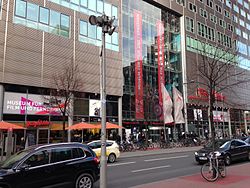
The Deutsche Kinemathek – Museum für Film und Fernsehen Berlin (English: “German Cinematheque – Museum of Film and Television Berlin”) is a German film archive based in Berlin, Germany, that makes a significant contribution to the preservation and dissemination of German and international film heritage. Since 2006, the Kinemathek has also made German television accessible to the public via its Television Collection. In 2025 it relocated to a new temporary location at E-Werk, having previously been located at Potsdamer Platz.
The Stiftung Deutsche Kinemathek has set itself the task of documenting and researching the history of film and television and promoting scholarly and educational discussions. It is dedicated to collecting and preserving valuable film material, including materials of significant importance in film and television history, and promotes the dissemination of audiovisual heritage through its own exhibitions, publications, educational programs, film series, and other events. It is supported as an institution by the Federal Government Commissioner for Culture and the Media.
Among the central tasks of the Deutsche Kinemathek are to archive, reconstruct and restore films of historical significance. With approximately 26,000 titles, the Film Archive comprises an extensive collection of German and international silent and sound films of various formats, genres and styles. Numerous films in the archive are available for viewing. Part of the film collection focuses on experimental and documentary films. In addition, numerous works from the signatories of the Oberhausen Manifesto of 1962 are in the archive, as well as the entire film output of the DFFB, which includes the explicitly political films of the first generation as well as the films of the Berlin School. Another focus is on the restoration and digitization of classic film titles. Since 2019, this work has been supported by the Film Heritage Funding Program (FFE), which is jointly funded by the federal government, the states and the German Federal Film Board (FFA). In 2022 alone, 36 film titles from the audiovisual collection of the Deutsche Kinemathek were restored. Since 2016, the Kinemathek has hosted the film heritage festival Film Restored, which presents newly digitized and restored films from film archives and film heritage institutions.
The films from the archives of the Deutsche Kinemathek are loaned to cinemas, museums and festivals. Every day, somewhere in the world, films from the cinema’s rental collection are shown, the most frequently shown being ‘Drei Haselnüsse für Aschenbrödel’ (Three Wishes for Cinderella). As a distributor, the Kinemathek also oversees the productions of the German Film and Television Academy Berlin (DFFB). Its own streaming platform rounds off the services.
Since 1977, the SDK has also been in charge of the Retrospective, the film history program of the Berlin International Film Festival (Berlinale). Since 2013, it has also curated the Berlinale Classics section, which focuses specifically on the digital restoration of classic films. Films in these sections have been screened at the Zeughauskino (an archive film cinema specialising in retrospectives; from 2023 within the Deutsches Historisches Museum at Unter den Linden 2) and the CinemaxX Potsdamer Platz.
In addition to FIAF and the Kinematheksverbund (Association of German Cinematheques), the Deutsche Kinemathek is a member of various national and international associations and networks, including the Arbeitskreis selbständiger Kultur-Institute e. V. (AsKI), the Association des Cinémathèques Européennes (ACE), the Federal Association of Museum Education (Bundesverband Museumspädagogik e. V.), the German Museums Association (DM), the International Council of Museums (ICOM), the Berlin Museum’s Association e. V. (BeMu) and the Network of Mediatheks.
Other cooperation partners include the Sunrise Foundation for Education and the Arts, as well as various television partners such as ARD, ZDF and the Grimme Institute.
The Stiftung Deutsche Kinemathek employs between 60 and 100 people, and these figures fluctuate over longer periods. After the death of long-time director Heinz Rathsack at the end of 1989, the film historian Hans Helmut Prinzler took over the management of the Kinemathek in 1990. In 2006, Rainer Rother was appointed Artistic Director. Until March 2012, Paul Klimpel served as Administrative Director, followed by Maximilian Müllner until 2017. Florian Bolenius has been the Administrative Director since August 2017. Since June 2025, he, together with Heleen Gerritsen, the former director of the GoEast Film Festival in Wiesbaden, has chaired the board of the Deutsche Kinemathek – Museum for Film and Television.
Deutsche Kinemathek
The Deutsche Kinemathek – Museum für Film und Fernsehen Berlin (English: “German Cinematheque – Museum of Film and Television Berlin”) is a German film archive based in Berlin, Germany, that makes a significant contribution to the preservation and dissemination of German and international film heritage. Since 2006, the Kinemathek has also made German television accessible to the public via its Television Collection. In 2025 it relocated to a new temporary location at E-Werk, having previously been located at Potsdamer Platz.
The Stiftung Deutsche Kinemathek has set itself the task of documenting and researching the history of film and television and promoting scholarly and educational discussions. It is dedicated to collecting and preserving valuable film material, including materials of significant importance in film and television history, and promotes the dissemination of audiovisual heritage through its own exhibitions, publications, educational programs, film series, and other events. It is supported as an institution by the Federal Government Commissioner for Culture and the Media.
Among the central tasks of the Deutsche Kinemathek are to archive, reconstruct and restore films of historical significance. With approximately 26,000 titles, the Film Archive comprises an extensive collection of German and international silent and sound films of various formats, genres and styles. Numerous films in the archive are available for viewing. Part of the film collection focuses on experimental and documentary films. In addition, numerous works from the signatories of the Oberhausen Manifesto of 1962 are in the archive, as well as the entire film output of the DFFB, which includes the explicitly political films of the first generation as well as the films of the Berlin School. Another focus is on the restoration and digitization of classic film titles. Since 2019, this work has been supported by the Film Heritage Funding Program (FFE), which is jointly funded by the federal government, the states and the German Federal Film Board (FFA). In 2022 alone, 36 film titles from the audiovisual collection of the Deutsche Kinemathek were restored. Since 2016, the Kinemathek has hosted the film heritage festival Film Restored, which presents newly digitized and restored films from film archives and film heritage institutions.
The films from the archives of the Deutsche Kinemathek are loaned to cinemas, museums and festivals. Every day, somewhere in the world, films from the cinema’s rental collection are shown, the most frequently shown being ‘Drei Haselnüsse für Aschenbrödel’ (Three Wishes for Cinderella). As a distributor, the Kinemathek also oversees the productions of the German Film and Television Academy Berlin (DFFB). Its own streaming platform rounds off the services.
Since 1977, the SDK has also been in charge of the Retrospective, the film history program of the Berlin International Film Festival (Berlinale). Since 2013, it has also curated the Berlinale Classics section, which focuses specifically on the digital restoration of classic films. Films in these sections have been screened at the Zeughauskino (an archive film cinema specialising in retrospectives; from 2023 within the Deutsches Historisches Museum at Unter den Linden 2) and the CinemaxX Potsdamer Platz.
In addition to FIAF and the Kinematheksverbund (Association of German Cinematheques), the Deutsche Kinemathek is a member of various national and international associations and networks, including the Arbeitskreis selbständiger Kultur-Institute e. V. (AsKI), the Association des Cinémathèques Européennes (ACE), the Federal Association of Museum Education (Bundesverband Museumspädagogik e. V.), the German Museums Association (DM), the International Council of Museums (ICOM), the Berlin Museum’s Association e. V. (BeMu) and the Network of Mediatheks.
Other cooperation partners include the Sunrise Foundation for Education and the Arts, as well as various television partners such as ARD, ZDF and the Grimme Institute.
The Stiftung Deutsche Kinemathek employs between 60 and 100 people, and these figures fluctuate over longer periods. After the death of long-time director Heinz Rathsack at the end of 1989, the film historian Hans Helmut Prinzler took over the management of the Kinemathek in 1990. In 2006, Rainer Rother was appointed Artistic Director. Until March 2012, Paul Klimpel served as Administrative Director, followed by Maximilian Müllner until 2017. Florian Bolenius has been the Administrative Director since August 2017. Since June 2025, he, together with Heleen Gerritsen, the former director of the GoEast Film Festival in Wiesbaden, has chaired the board of the Deutsche Kinemathek – Museum for Film and Television.
Recent media
Recent media