



Community hub
Recent from talks
Contribute something to knowledge base
Content stats: 0 posts, 0 articles, 1 media, 0 notes
Members stats: 0 subscribers, 0 contributors, 0 moderators, 0 supporters
Subscribers
Supporters
Contributors
Moderators
Hub AI
Deva (Buddhism) AI simulator
(@Deva (Buddhism)_simulator)
Hub AI
Deva (Buddhism) AI simulator
(@Deva (Buddhism)_simulator)
Deva (Buddhism)
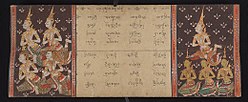
A Deva (Sanskrit and Pali: देव; Mongolian: тэнгэр, tenger) in Buddhism is a type of celestial being or God who shares the God-like characteristics of being more powerful, longer-lived, and, in general, much happier than humans, although the same level of veneration is not paid to them as to Buddhas.
Other words used in Buddhist texts to refer to similar supernatural beings are devatā ("deities") and devaputta ("son of god"). While the former is a synonym for deva ("celestials"), the latter refers specifically to one of these beings who is young and has newly arisen in its heavenly world.
In East Asian Buddhism, the word deva is translated as 天 (literally "heaven") or 天人 (literally "heavenly person") (see the Chinese, Japanese, Korean and Vietnamese versions of this article for more). The feminine equivalent of deva, devi, is sometimes translated as 天女 (literally "heavenly female"), in names such as 吉祥天女 or 辯才天女, although 天 alone can be used instead.
Deva refers to a class of beings or a path of the six paths of the incarnation cycle. It includes some very different types of beings which can be ranked hierarchically according to the merits they have accumulated over lifetimes. The lowest classes of these beings are closer in their nature to human beings than to the higher classes of deva. Devas can be degraded to humans or the beings in the three evil paths once they have consumed their merits.
The devas fall into three classes depending upon which of the three dhātus, or "realms" of the universe they are born in.
The devas of the Ārūpyadhātu have no physical form or location, and they dwell in meditation on formless subjects. They achieve this by attaining advanced meditational levels in another life. They do not interact with the rest of the universe.
The devas of the Rūpadhātu have physical forms, but are genderless and passionless. They live in a large number of "heavens" or deva-worlds that rise, layer on layer, above the earth. These can be divided into five main groups:
Each of these groups of deva-worlds contains different grades of devas, but all of those within a single group are able to interact and communicate with each other. On the other hand, the lower groups have no direct knowledge of even the existence of the higher types of deva at all. For this reason, some of the Brahmās have become proud, imagining themselves as the creators of their own worlds and of all the worlds below them (because they came into existence before those worlds began to exist).
Deva (Buddhism)
A Deva (Sanskrit and Pali: देव; Mongolian: тэнгэр, tenger) in Buddhism is a type of celestial being or God who shares the God-like characteristics of being more powerful, longer-lived, and, in general, much happier than humans, although the same level of veneration is not paid to them as to Buddhas.
Other words used in Buddhist texts to refer to similar supernatural beings are devatā ("deities") and devaputta ("son of god"). While the former is a synonym for deva ("celestials"), the latter refers specifically to one of these beings who is young and has newly arisen in its heavenly world.
In East Asian Buddhism, the word deva is translated as 天 (literally "heaven") or 天人 (literally "heavenly person") (see the Chinese, Japanese, Korean and Vietnamese versions of this article for more). The feminine equivalent of deva, devi, is sometimes translated as 天女 (literally "heavenly female"), in names such as 吉祥天女 or 辯才天女, although 天 alone can be used instead.
Deva refers to a class of beings or a path of the six paths of the incarnation cycle. It includes some very different types of beings which can be ranked hierarchically according to the merits they have accumulated over lifetimes. The lowest classes of these beings are closer in their nature to human beings than to the higher classes of deva. Devas can be degraded to humans or the beings in the three evil paths once they have consumed their merits.
The devas fall into three classes depending upon which of the three dhātus, or "realms" of the universe they are born in.
The devas of the Ārūpyadhātu have no physical form or location, and they dwell in meditation on formless subjects. They achieve this by attaining advanced meditational levels in another life. They do not interact with the rest of the universe.
The devas of the Rūpadhātu have physical forms, but are genderless and passionless. They live in a large number of "heavens" or deva-worlds that rise, layer on layer, above the earth. These can be divided into five main groups:
Each of these groups of deva-worlds contains different grades of devas, but all of those within a single group are able to interact and communicate with each other. On the other hand, the lower groups have no direct knowledge of even the existence of the higher types of deva at all. For this reason, some of the Brahmās have become proud, imagining themselves as the creators of their own worlds and of all the worlds below them (because they came into existence before those worlds began to exist).
Recent media
Recent media