Hubbry Logo
HeavenHeavenMain
Open search
Heaven
Community hub
Heaven
logo
8 pages, 0 posts
0 subscribers
Be the first to start a discussion here.
Contribute something
Heaven
Heaven
from Wikipedia

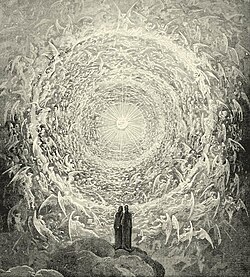
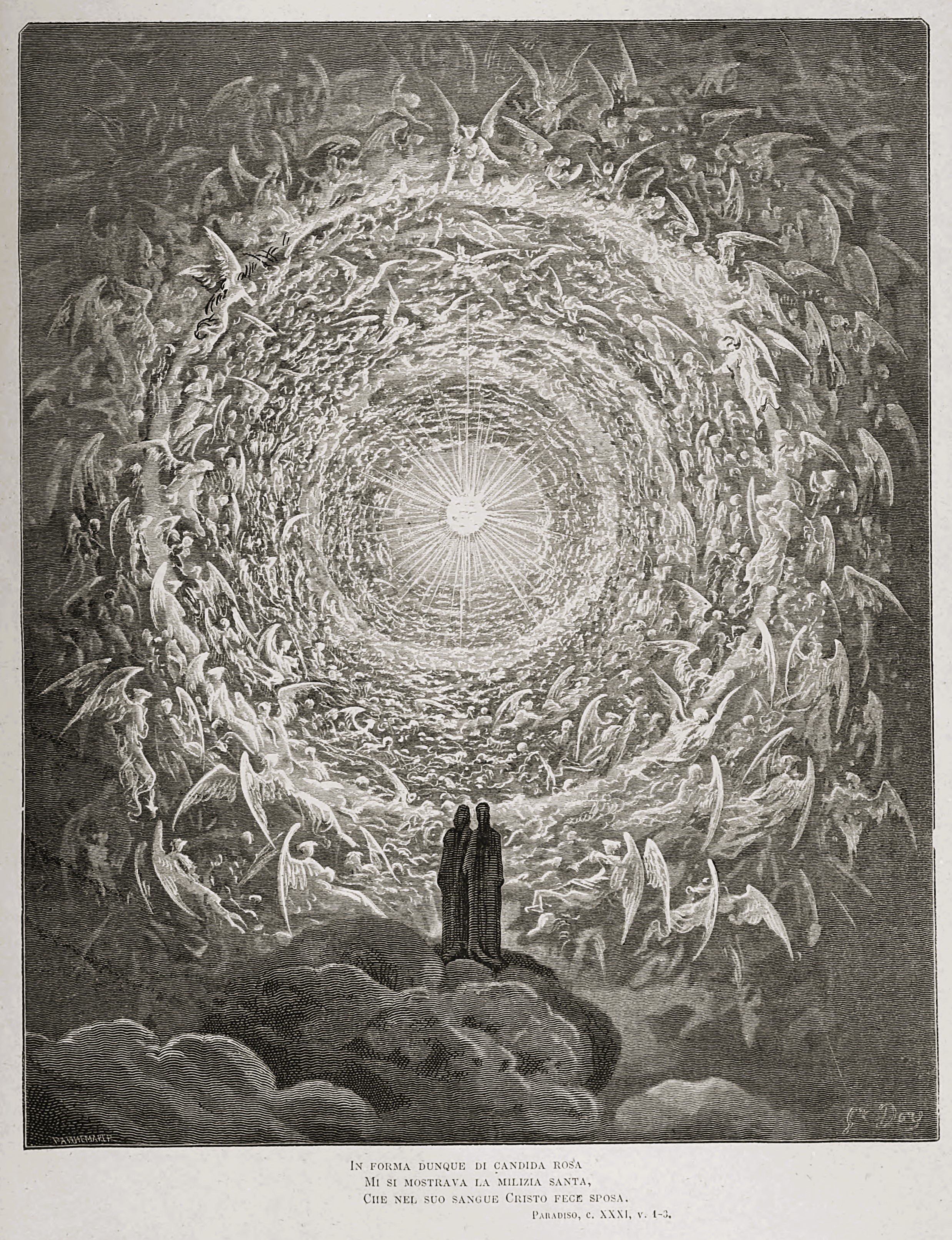
Dante and Beatrice gaze upon the highest heaven; from Gustave Doré's illustrations to the Divine Comedy.

Heaven, or the Heavens, is a common religious cosmological or supernatural place where beings such as deities, angels, souls, saints, or venerated ancestors are said to originate, be enthroned, or reside. According to the beliefs of some religions, heavenly beings can descend to Earth or incarnate and earthly beings can ascend to Heaven in the afterlife or, in exceptional cases, enter Heaven without dying.

Heaven is often described as a "highest place", the holiest place, a paradise, in contrast to Hell or the Underworld or the "low places" and universally or conditionally accessible by earthly beings according to various standards of divinity, goodness, piety, faith, or other virtues or right beliefs or simply divine will. Some believe in the possibility of a heaven on Earth in a world to come.

Another belief is in an axis mundi or world tree which connects the heavens, the terrestrial world, and the underworld. In Indian religions, heaven is considered as Svargaloka,[1] and the soul is again subjected to rebirth in different living forms according to its karma. This cycle can be broken after a soul achieves Moksha or Nirvana. Any place of existence, either of humans, souls or deities, outside the tangible world (Heaven, Hell, or other) is referred to as the otherworld.

In the Abrahamic faiths of Christianity, Islam, and some schools of Judaism, as well as Zoroastrianism, heaven is the realm of afterlife where good actions in the previous life are rewarded for eternity (Hell being the place where bad behavior is punished).

Etymology

[edit]
"heofones", an ancient Anglo-Saxon word for heavens in Beowulf

The modern English word heaven is derived from the earlier (Middle English) heven (attested 1159); this in turn was developed from the previous Old English form heofon. By about 1000, heofon was being used in reference to the Christianized "place where God dwells", but originally, it had signified "sky, firmament"[2] (e.g. in Beowulf, c. 725).

The English term has cognates in the other Germanic languages: Old Saxon heƀan "sky, heaven" (hence also Middle Low German heven "sky"), Old Icelandic himinn, Gothic himins; and those with a variant final -l: Old Frisian himel, himul "sky, heaven", Old Saxon and Old High German himil, Old Saxon and Middle Low German hemmel, Old Dutch and Dutch hemel, and modern German Himmel. All of these have been derived from a reconstructed Proto-Germanic form *hemina-.[3] or *hemō.[4]

The further derivation of this form is uncertain. A connection to Proto-Indo-European *ḱem- "cover, shroud", via a reconstructed *k̑emen- or *k̑ōmen- "stone, heaven", has been proposed.[5]

Others endorse the derivation from a Proto-Indo-European root *h₂éḱmō "stone" and, possibly, "heavenly vault" at the origin of this word, which then would have as cognates ancient Greek ἄκμων (ákmōn "anvil, pestle; meteorite"), Persian آسمان (âsemân, âsmân "stone, sling-stone; sky, heaven") and Sanskrit अश्मन् (aśman "stone, rock, sling-stone; thunderbolt; the firmament").[4] In the latter case English hammer would be another cognate to the word.

Ancient Near East

[edit]

Mesopotamia

[edit]
Ruins of the Ekur temple in Nippur, believed by the ancient Mesopotamians to be the "Dur-an-ki", the "mooring rope" of heaven and earth[6][7]

The ancient Mesopotamians regarded the sky as a series of domes (usually three, but sometimes seven) covering the flat Earth.[8] Each dome was made of a different kind of precious stone.[9] The lowest dome of heaven was made of jasper and was the home of the stars.[10][11] The middle dome of heaven was made of saggilmut stone and was the abode of the Igigi.[10][11] The highest and outermost dome of heaven was made of luludānītu stone and was personified as An, the god of the sky.[12][10][11] The celestial bodies were equated with specific deities as well.[9] The planet Venus was believed to be Inanna, the goddess of sex and war.[13][9] The Sun was her brother Utu, the god of justice, and the Moon was their father Nanna.[9]

In ancient Near Eastern cultures in general and in Mesopotamia in particular, humans had little to no access to the divine realm.[14][15] Heaven and Earth were separated by their very nature;[11] humans could see and be affected by elements of the lower heaven, such as stars and storms,[11] but ordinary mortals could not go to Heaven because it was the abode of the gods alone.[15][16][11] In the Epic of Gilgamesh, Gilgamesh says to Enkidu, "Who can go up to heaven, my friend? Only the gods dwell with Shamash forever."[16] Instead, after a person died, his or her soul went to Kur (later known as Irkalla), a dark shadowy underworld, located deep below the surface of the earth.[15][17]

All souls went to the same afterlife,[15][17] and a person's actions during life had no impact on how they would be treated in the world to come.[15][17] Nonetheless, funerary evidence indicates that some people believed that Inanna had the power to bestow special favors upon her devotees in the afterlife.[17][18] Despite the separation between heaven and earth, humans sought access to the gods through oracles and omens.[6] The gods were believed to live in Heaven,[6][19] but also in their temples, which were seen as the channels of communication between Earth and Heaven, which allowed mortal access to the gods.[6][20] The Ekur temple in Nippur was known as the "Dur-an-ki", the "mooring rope" of heaven and earth.[21] It was widely thought to have been built and established by Enlil himself.[7]

Hurrians and Hittites

[edit]

The ancient Hittites believed that some deities lived in Heaven while others lived in remote places on Earth, such as mountains, where humans had little access.[14] In the Middle Hittite myths, Heaven is the abode of the gods. In the Song of Kumarbi, Alalu was king in Heaven for nine years before giving birth to his son, Anu. Anu was himself overthrown by his son, Kumarbi.[22][23][24][25]

Canaanites

[edit]

Almost nothing is known of Bronze Age (pre-1200 BC) Canaanite views of heaven and the archaeological findings at Ugarit (destroyed c. 1200 BC) have not provided information. The first century Greek author Philo of Byblos may have preserved elements of Iron Age Phoenician religion in his Sanchuniathon.[26]

Zoroastrians

[edit]

Zoroaster, the Zoroastrian prophet who introduced the Gathas, spoke of the existence of Heaven and Hell.[27][28]

Historically, the unique features of Zoroastrianism, such as its conception of heaven, hell, angels, monotheism, belief in free will, and the day of judgement, among other concepts, may have influenced other religious and philosophical systems, including the Abrahamic religions, Gnosticism, Northern Buddhism, and Greek philosophy.[29][28]

Abrahamic and Abrahamic-inspired religions

[edit]

Hebrew Bible

[edit]

As in other ancient Near Eastern cultures, in the Hebrew Bible, the universe is commonly divided into two realms: heaven (šāmayim) and earth ('ereṣ).[6] Sometimes a third realm is added: either "sea",[30] "water under the earth",[31] or sometimes a vague "land of the dead" that is never described in depth.[32][6] The structure of heaven itself is not fully described in the Hebrew Bible,[33] but the fact that the Hebrew word šāmayim is plural has been interpreted by scholars as an indication that the ancient Israelites envisioned the heavens as having multiple layers, much like the ancient Mesopotamians.[33] This reading is also supported by the use of the phrase "heaven of heavens" in verses such as Deuteronomy 10:14,[34] 1 Kings 8:27,[35] and 2 Chronicles 2:6.[36][33]

In line with the typical view of most Near Eastern cultures, the Hebrew Bible depicts Heaven as a place that is inaccessible to humans.[37] Although some prophets are occasionally granted temporary visionary access to heaven, such as in 1 Kings 22:19–23,[38] Job 1:6–12[39] and 2:1–6,[40] and Isaiah 6,[41] they hear only God's deliberations concerning the Earth and learn nothing of what Heaven is like.[33] There is almost no mention in the Hebrew Bible of Heaven as a possible afterlife destination for human beings, who are instead described as "resting" in Sheol.[42][43] The only two possible exceptions to this are Enoch, who is described in Genesis 5:24[44] as having been "taken" by God, and the prophet Elijah, who is described in 2 Kings 2:11[45] as having ascended to Heaven in a chariot of fire.[33] According to Michael B. Hundley, the text in both of these instances is ambiguous regarding the significance of the actions being described[33] and in neither of these cases does the text explain what happened to the subject afterwards.[33]

The God of the Israelites is described as ruling both Heaven and Earth.[46][33] Other passages, such as 1 Kings 8:27[35] state that even the vastness of Heaven cannot contain God's majesty.[33] A number of passages throughout the Hebrew Bible indicate that Heaven and Earth will one day come to an end.[47][33] This view is paralleled in other ancient Near Eastern cultures, which also regarded Heaven and Earth as vulnerable and subject to dissolution.[33] However, the Hebrew Bible differs from other ancient Near Eastern cultures in that it portrays the God of Israel as independent of creation and unthreatened by its potential destruction.[33] Because most of the Hebrew Bible concerns the God of Israel's relationship with his people, most of the events described in it take place on Earth, not in Heaven.[48] The Deuteronomistic source, Deuteronomistic History, and Priestly source all portray the Temple in Jerusalem as the sole channel of communication between Earth and Heaven.[49]

Second Temple Judaism

[edit]

During the period of the Second Temple (c. 515 BC – 70 AD), the Hebrew people lived under the rule of first the Persian Achaemenid Empire, then the Greek kingdoms of the Diadochi, and finally the Roman Empire.[50] Their culture was profoundly influenced by those of the peoples who ruled them.[50] Consequently, their views on existence after death were profoundly shaped by the ideas of the Persians, Greeks, and Romans.[51][52] The idea of the immortality of the soul is derived from Greek philosophy[52] and the idea of the resurrection of the dead is thought to be derived from Persian cosmology,[52] although the later claim has been recently questioned.[53] By the early first century AD, these two seemingly incompatible ideas were often conflated by Hebrew thinkers.[52] The Hebrews also inherited from the Persians, Greeks, and Romans the idea that the human soul originates in the divine realm and seeks to return there.[50] The idea that a human soul belongs in Heaven and that Earth is merely a temporary abode in which the soul is tested to prove its worthiness became increasingly popular during the Hellenistic period (323–31 BC).[43] Gradually, some Hebrews began to adopt the idea of Heaven as the eternal home of the righteous dead.[43]

Christianity

[edit]
The Assumption of the Virgin, 1475–1476, by Francesco Botticini (National Gallery London), shows three hierarchies and nine orders of angels, each with different characteristics.

Descriptions of Heaven in the New Testament are more fully developed than those in the Old Testament, but are still generally vague.[54] As in the Old Testament, in the New Testament God is described as the ruler of Heaven and Earth, but his power over the Earth is challenged by Satan.[43] The Gospels of Mark and Luke speak of the "Kingdom of God" (Ancient Greek: βασιλεία τοῦ θεοῦ; basileía tou theou), while the Gospel of Matthew more commonly uses the term "Kingdom of heaven" (Ancient Greek: βασιλεία τῶν οὐρανῶν; basileía tōn ouranōn).[55][56][57][43] Both phrases are thought to have the same meaning,[58] but the author of the Gospel of Matthew changed the name "Kingdom of God" to "Kingdom of Heaven" in most instances because it was the more acceptable phrase in his own cultural and religious context in the late first century.[59]

Modern scholars agree that the Kingdom of God was an essential part of the teachings of the historical Jesus[60][61] but there is no agreement on what this kingdom was.[62][63] None of the gospels record Jesus as having explained exactly what the phrase "Kingdom of God" means.[61] The most likely explanation for this apparent omission is that the Kingdom of God was a commonly understood concept that required no explanation.[61]

According to Sanders and Casey, Jews in Judea during the early first century believed that God reigns eternally in Heaven,[60][64] but many also believed that God would eventually establish his kingdom on earth as well.[60][65] Because God's Kingdom was believed to be superior to any human kingdom, this meant that God would necessarily drive out the Romans, who ruled Judea, and establish his own direct rule over the Jewish people.[55][65] This belief is referenced in the first petition of the Lord's Prayer, taught by Jesus to his disciples and recorded in Matthew[66] and Luke 11:2:[67] "Your kingdom come, your will be done, on earth as it is in heaven."[68][69]

Other scholars contend that Jesus' teaching of the Kingdom of God was of something that is present but also still yet to come.[70] For instance, Wright points to the synoptic gospels that Jesus' death and resurrection was anticipated as the climax and fulfillment of his "Kingdom of God" messages and that his combined prophecy about the Second Temple's doom, through apocalyptic language, would serve as his vindication.[71] The synoptic gospels and Pauline epistles portray Jesus as believing his death and resurrection would complete the work of inaugurating the Kingdom of God and that his followers who wrote everything down expressed their belief he had done so, using first-century Jewish idioms, and that such events "did with evil and launch the project of new creation".[72]

In the teachings of the historical Jesus, people are expected to prepare for the coming of the Kingdom of God by living moral lives.[73] Jesus's commands for his followers to adopt lifestyles of moral perfectionism are found in many passages throughout the Synoptic Gospels, particularly in the Sermon on the Mount in Matthew 5–7.[74][75] Jesus also taught that, in the Kingdom of Heaven, there would be a reversal of roles in which "the last will be first and the first will be last."[76][77] This teaching recurs throughout the recorded teachings of Jesus, including in the admonition to be like a child,[78] the Parable of the Rich Man and Lazarus in Luke 16,[79] the Parable of the Workers in the Vineyard in Matthew 20,[80] the Parable of the Great Banquet in Matthew 22,[81] and the Parable of the Prodigal Son in Luke 15.[82][83]

Traditionally, Christianity has taught that Heaven is the location of the throne of God as well as the holy angels,[84][85] although this is in varying degrees considered metaphorical. In traditional Christianity, it is considered a state or condition of existence (rather than a particular place somewhere in the cosmos) of the supreme fulfillment of theosis in the beatific vision of the Godhead. In most forms of Christianity, Heaven is also understood as the abode for the redeemed dead in the afterlife, usually a temporary stage before the resurrection of the dead and the saints' return to the New Earth.

The resurrected Jesus is said to have ascended to Heaven where he now sits at the Right Hand of God and will return to Earth in the Second Coming. Various people have been said to have entered Heaven while still alive, including Enoch, Elijah and Jesus, after his resurrection. According to Roman Catholic teaching, Mary, mother of Jesus, is also said to have been assumed into Heaven and is titled the Queen of Heaven.

In the second century AD, Irenaeus of Lyons recorded a belief that, in accordance with John 14,[86] those who in the afterlife see the Saviour are in different mansions, some dwelling in the heavens, others in paradise and others in "the city".[87]

While the word used in all these writings, in particular the New Testament Greek word οὐρανός (ouranos), applies primarily to the sky, it is also used metaphorically of the dwelling place of God and the blessed.[88][89] Similarly, though the English word "heaven" keeps its original physical meaning when used, for instance, in allusions to the stars as "lights shining through from heaven", and in phrases such as heavenly body to mean an astronomical object, the heaven or happiness that Christianity looks forward to is, according to Pope John Paul II, "neither an abstraction nor a physical place in the clouds, but a living, personal relationship with the Holy Trinity. It is our meeting with the Father which takes place in the risen Christ through the communion of the Holy Spirit."[84]

Rabbinical Judaism

[edit]

While the concept of Heaven (malkuth hashamaim מלכות השמים, the Kingdom of Heaven) is much discussed in Christian thought, the Jewish concept of the afterlife, sometimes known as olam haba, the World-to-come, is not discussed as often. The Torah has little to say on the subject of survival after death, but by the time of the rabbis two ideas had made inroads among the Jews: one, which is probably derived from Greek thought,[90] is that of the immortal soul which returns to its creator after death; the other, which is thought to be of Persian origin,[90] is that of resurrection of the dead.

Jewish writings[which?] refer to a "new earth" as the abode of mankind following the resurrection of the dead. Originally, the two ideas of immortality and resurrection were different but in rabbinic thought they are combined: the soul departs from the body at death but is returned to it at the resurrection. This idea is linked to another rabbinic teaching, that men's good and bad actions are rewarded and punished not in this life but after death, whether immediately or at the subsequent resurrection.[90] Around 1 CE, the Pharisees believed in an afterlife but the Sadducees did not.[91]

The Mishnah has many sayings about the World to Come, for example, "Rabbi Yaakov said: This world is like a lobby before the World to Come; prepare yourself in the lobby so that you may enter the banquet hall."[92]

Judaism holds that the righteous of all nations have a share in the World-to-come.[93]

According to Nicholas de Lange, Judaism offers no clear teaching about the destiny which lies in wait for the individual after death and its attitude to life after death has been expressed as follows: "For the future is inscrutable, and the accepted sources of knowledge, whether experience, or reason, or revelation, offer no clear guidance about what is to come. The only certainty is that each man must die – beyond that we can only guess."[90]

Islam

[edit]
19th century Islamic miniature depicting the artist's impression of heaven

Similar to Jewish traditions such as the Talmud, the Qur'an and Hadith frequently mention the existence of seven samāwāt (سماوات), the plural of samāʾ (سماء), meaning 'heaven, sky, celestial sphere', and cognate with Hebrew shamāyim (שמים). Some of the verses in the Qur'an mentioning the samaawat [94] are 41:12, 65:12 and 71:15. Sidrat al-Muntaha, a large enigmatic Lote tree, marks the end of the seventh heaven and the utmost extremity for all of God's creatures and heavenly knowledge.[95]

One interpretation of "heavens" is that all the stars and galaxies (including the Milky Way) are part of the "first heaven", and "beyond that six still bigger worlds are there," which have yet to be discovered by scientists.[96]

According to Shi'ite sources, Ali mentioned the names of the seven heavens as below:[97]

  1. Rafi' (رفیع) the least heaven (سماء الدنیا)
  2. Qaeydum (قیدوم)
  3. Marum (ماروم)
  4. Arfalun (أرفلون)
  5. Hay'oun (هيعون)
  6. Arous (عروس)
  7. Ajma' (عجماء)

Still an afterlife destination of the righteous is conceived in Islam as Jannah (Arabic: جنة "Garden [of Eden]" translated as "paradise"). Regarding Eden or paradise the Quran says, "The description of the Paradise promised to the righteous is that under it rivers flow; eternal is its fruit as well as its shade. That is the ˹ultimate˺ outcome for the righteous. But the outcome for the disbelievers is the Fire!"[98] Islam rejects the concept of original sin, and Muslims believe that all human beings are born pure. Children automatically go to paradise when they die, regardless of the religion of their parents.

Paradise is described primarily in physical terms as a place where every wish is immediately fulfilled when asked. Islamic texts describe immortal life in Jannah as happy, without negative emotions. Those who dwell in Jannah are said to wear costly apparel, partake in exquisite banquets, and recline on couches inlaid with gold or precious stones. Inhabitants will rejoice in the company of their parents, spouses, and children. In Islam if one's good deeds outweigh one's sins then one may gain entrance to paradise only through God's mercy. Conversely, if one's sins outweigh their good deeds they are sent to hell. The more good deeds one has performed the higher the level of Jannah one is directed to.

Mystic Ibn Arabi's (13th century) depiction of Seven Paradises (different from seven heavens). Diagram of Jannat Futuhat al-Makkiyya, ca. 1238 (photo: after Futuhat al-Makkiyya, Cairo edition, 1911).

Quran verses which describe paradise include: 13:15, 18:31, 38:49–54, 35:33–35 and 52:17.[99]

The Quran refers to Jannah with different names: Al-Firdaws, Jannātu-′Adn ("Garden of Eden" or "Everlasting Gardens"), Jannatu-n-Na'īm ("Garden of Delight"), Jannatu-l-Ma'wa ("Garden of Refuge"), Dāru-s-Salām ("Abode of Peace"), Dāru-l-Muqāma ("Abode of Permanent Stay"), al-Muqāmu-l-Amin ("The Secure Station") and Jannātu-l-Khuld ("Garden of Immortality"). In the Hadiths, these are the different regions in paradise.[100]

Ahmadiyya

[edit]

According to the Ahmadiyya view, much of the imagery presented in the Quran regarding Heaven, but also Hell, is metaphorical. They propound the verse which describes, according to them, how the life to come after death is different from the life on Earth. The Quran says: "From bringing in your place others like you, and from developing you into a form which at present you know not."[101] According to Mirza Ghulam Ahmad, the founder of the Ahmadiyya sect in Islam, the soul will give birth to another rarer entity and will resemble the life on earth in the sense that this entity will bear a similar relationship to the soul, as the soul bears relationship with the human existence on earth. On earth, if a person leads a righteous life and submits to the will of God, his or her tastes become attuned to enjoying spiritual pleasures as opposed to carnal desires. With this, an "embryonic soul" begins to take shape. Different tastes are said to be born in which a person given to carnal passions finds no enjoyment. For example, sacrifice of one's own rights over that of other's becomes enjoyable, or that forgiveness becomes second nature. In such a state a person finds contentment and Peace at heart and at this stage, according to Ahmadiyya beliefs, it can be said that a soul within the soul has begun to take shape.[102]

Baháʼí Faith

[edit]

The Baháʼí Faith regards the conventional description of heaven (and hell) as a specific place as symbolic. The Baháʼí writings describe heaven as a "spiritual condition" where closeness to God is defined as heaven; conversely hell is seen as a state of remoteness from God. Bahá'u'lláh, the founder of the Baháʼí Faith, has stated that the nature of the life of the soul in the afterlife is beyond comprehension in the physical plane, but has stated that the soul will retain its consciousness and individuality and remember its physical life; the soul will be able to recognize other souls and communicate with them.[103]

For Baháʼís, entry into the next life has the potential to bring great joy.[103] Bahá'u'lláh likened death to the process of birth. He explains: "The world beyond is as different from this world as this world is different from that of the child while still in the womb of its mother."[104] The analogy to the womb in many ways summarizes the Baháʼí view of earthly existence: just as the womb constitutes an important place for a person's initial physical development, the physical world provides for the development of the individual soul. Accordingly, Baháʼís view life as a preparatory stage, where one can develop and perfect those qualities which will be needed in the next life.[103] The key to spiritual progress is to follow the path outlined by the current Manifestation of God, which Baháʼís believe is currently Bahá'u'lláh. Bahá'u'lláh wrote, "Know thou, of a truth, that if the soul of man hath walked in the ways of God, it will, assuredly return and be gathered to the glory of the Beloved."[105]

The Baháʼí teachings state that there exists a hierarchy of souls in the afterlife, where the merits of each soul determines their place in the hierarchy, and that souls lower in the hierarchy cannot completely understand the station of those above. Each soul can continue to progress in the afterlife, but the soul's development is not entirely dependent on its own conscious efforts, the nature of which we are not aware, but also augmented by the grace of God, the prayers of others, and good deeds performed by others on Earth in the name of that person.[103]

Mandaeism

[edit]

Mandaeans believe in an afterlife or heaven called Alma d-Nhura (World of Light).[106] The World of Light is the primeval, transcendent world from which Tibil and the World of Darkness emerged. The Great Living God (Hayyi Rabbi) and his uthras (angels or guardians) dwell in the World of Light. The World of Light is also the source of Piriawis, the Great Yardena (or Jordan River) of Life.[107]

Gnosticism

[edit]

The cosmological description of the universe in the Gnostic codex On the Origin of the World presents seven heavens created by the lesser god or Demiurge called Yaldabaoth, which are individually ruled over by one of his Archons. Above these realms is the eighth heaven, where the benevolent, higher divinities dwell. During the end of days, the seven heavens of the Archons will collapse on each other. The heaven of Yaldabaoth will split in two and cause the stars in his celestial sphere to fall.[108]

Chinese religions

[edit]
Chinese Zhou dynasty Oracle script for tian, the character for "heaven" or "sky"
Chinese painting of the Jade Emperor and the Heavenly Kings of Taoist cosmology.

In the native Chinese Confucian traditions, heaven (Tian) is an important concept, where the ancestors reside and from which emperors drew their mandate to rule in their dynastic propaganda, for example.

Heaven is a key concept in Chinese mythology, philosophies, and religions, and is on one end of the spectrum a synonym of Shangdi ("Supreme Deity") and on the other naturalistic end, a synonym for nature and the sky. The Chinese term for "heaven", Tian (天), derives from the name of the supreme deity of the Zhou dynasty. After their conquest of the Shang dynasty in 1122 BC, the Zhou people considered their supreme deity Tian to be identical with the Shang supreme deity Shangdi.[109] The Zhou people attributed Heaven with anthropomorphic attributes, evidenced in the etymology of the Chinese character for heaven or sky, which originally depicted a person with a large cranium. Heaven is said to see, hear and watch over all people. Heaven is affected by people's doings, and having personality, is happy and angry with them. Heaven blesses those who please it and sends calamities upon those who offend it.[110] Heaven was also believed to transcend all other spirits and gods, with Confucius asserting, "He who offends against Heaven has none to whom he can pray."[110]

Other philosophers born around the time of Confucius such as Mozi took an even more theistic view of heaven, believing that heaven is the divine ruler, just as the Son of Heaven (the King of Zhou) is the earthly ruler. Mozi believed that spirits and minor gods exist, but their function is merely to carry out the will of heaven, watching for evil-doers and punishing them. Thus they function as angels of heaven and do not detract from its monotheistic government of the world. With such a high monotheism, it is not surprising that Mohism championed a concept called "universal love" (jian'ai, 兼愛), which taught that heaven loves all people equally and that each person should similarly love all human beings without distinguishing between his own relatives and those of others.[111] In Mozi's Will of Heaven (天志), he writes:

"I know Heaven loves men dearly not without reason. Heaven ordered the sun, the moon, and the stars to enlighten and guide them. Heaven ordained the four seasons, Spring, Autumn, Winter, and Summer, to regulate them. Heaven sent down snow, frost, rain, and dew to grow the five grains and flax and silk that so the people could use and enjoy them. Heaven established the hills and rivers, ravines and valleys, and arranged many things to minister to man's good or bring him evil. He appointed the dukes and lords to reward the virtuous and punish the wicked, and to gather metal and wood, birds and beasts, and to engage in cultivating the five grains and flax and silk to provide for the people's food and clothing. This has been so from antiquity to the present."

Original Chinese: 「且吾所以知天之愛民之厚者有矣,曰以磨為日月星辰,以昭道之;制為四時春秋冬夏,以紀綱之;雷降雪霜雨露,以長遂五穀麻絲,使民得而財利之;列為山川谿谷,播賦百事,以臨司民之善否;為王公侯伯,使之賞賢而罰暴;賊金木鳥獸,從事乎五穀麻絲,以為民衣食之財。自古及今,未嘗不有此也。」

Mozi, Will of Heaven, Chapter 27, Paragraph 6, ca. 5th Century BC

Mozi criticized the Confucians of his own time for not following the teachings of Confucius. By the time of the later Han dynasty, however, under the influence of Xunzi, the Chinese concept of heaven and Confucianism itself had become mostly naturalistic, though some Confucians argued that Heaven was where ancestors reside. Worship of heaven in China continued with the erection of shrines, the last and greatest being the Temple of Heaven in Beijing, and the offering of prayers. The ruler of China in every Chinese dynasty would perform annual sacrificial rituals to heaven, usually by slaughtering two healthy bulls as a sacrifice.

Indian religions

[edit]

Buddhism

[edit]
Devas sporting in Heaven; mural in Wat Bowonniwet

In Buddhism there are several heavens, all of which are still part of samsara. Those who accumulate good karma may be reborn[112] in one of them. However, their stay in heaven is not eternal—eventually they will use up their good karma and will undergo rebirth into another realm, as a human, animal or other being. Because heaven is temporary and part of samsara, Buddhists focus more on escaping the cycle of rebirth and achieving bodhi (enlightenment) and realizing the transcendental state of nirvana—which is not a heaven. but a "trans-mundane state".

According to Buddhist cosmology the universe is impermanent and beings transmigrate through several existential "planes" in which this human world is only one "realm" or "path".[113] These are traditionally envisioned as a vertical continuum with the heavens existing above the human realm, and the realms of the animals, hungry ghosts and hell beings existing beneath it. According to Jan Chozen Bays in her book, Jizo: Guardian of Children, Travelers, and Other Voyagers, the realm of the asura is a later refinement of the heavenly realm and was inserted between the human realm and the heavens. One important Buddhist heaven is the Trāyastriṃśa, which resembles Olympus of Greek mythology.

In the Mahayana world view, there are also pure lands which lie outside this continuum and are created by the Buddhas upon attaining enlightenment. Rebirth in the pure land of Amitabha is seen as an assurance of Buddhahood, for once reborn there, beings do not fall back into cyclical existence unless they choose to do so to save other beings, the goal of Buddhism being the obtainment of enlightenment and freeing oneself and others from the birth-death cycle.

The Tibetan word Bardo means literally "intermediate state". In Sanskrit the concept has the name antarabhāva.

The lists below are ordered from highest to lowest of the heavenly worlds.

According to the Aṅguttara Nikāya
[edit]

Brahmāloka

Here the denizens are Brahmās, and the ruler is Mahābrahmā. After developing the four Brahmavihāras, King Makhādeva rebirths here after death. The monk Tissa and Brāhmana Jānussoni were also reborn here.

The lifespan of a Brahmās is not stated but is not eternal.

Parinirmita-vaśavartin (Pali: Paranimmita-vasavatti)

The heaven of devas have "power over (others') creations". These devas do not create pleasing forms that they desire for themselves, but their desires are fulfilled by the acts of other devas who seek their favor. The ruler of this world is called Vaśavartin (Pāli: Vasavatti), who has longer life, greater beauty, more power and happiness and more delightful sense-objects than the other devas of his world. This world is also the home of the devaputra (being of a divine race) called Māra, who endeavors to keep all beings of the Kāmadhātu in the grip of sensual pleasures. Māra is also sometimes called Vaśavartin, but in general these two dwellers in this world are kept distinct. The beings of this world are 3 (1,400 m; 4,500 feet) tall and live for 9,216,000,000 years (Sarvāstivāda tradition).

Nirmāṇarati (Pali: Nimmānaratī)

The world of devas "delighting in their creations". The devas of this world are capable of making any appearance to please themselves. The lord of this world is called Sunirmita (Pāli Sunimmita); his wife is the rebirth of Visākhā, formerly the chief upāsikā (female lay devotee) of the Buddha. The beings of this world are 2+12 (1,140 m; 3,750 feet) tall and live for 2,304,000,000 years (Sarvāstivāda tradition).

Tuṣita (Pali: Tusita)

The world of the "joyful" devas, it is best known for being the world in which a Bodhisattva lives before being reborn in the world of humans. Until a few thousand years ago, the Bodhisattva of this world was Śvetaketu (Pāli: Setaketu), who was reborn as Siddhārtha, who would become the Buddha Śākyamuni; since then the Bodhisattva has been Nātha (or Nāthadeva) who will be reborn as Ajita and will become the Buddha Maitreya (Pāli Metteyya). While this Bodhisattva is the foremost of the dwellers in Tuṣita, the ruler of this world is another deva called Santuṣita (Pāli: Santusita). The beings of this world are 2 (910 m; 3,000 feet) tall and live for 576,000,000 years (Sarvāstivāda tradition). Anāthapindika, a Kosālan householder and benefactor to the Buddha's order was reborn here.

Yāma

The denizens here have a lifespan of 144,000,000 years.

Trāyastriṃśa (Pali: Tāvatimsa)

The ruler of this heaven is Indra or Shakra, and the realm is also called Trayatrimia. Each denizen addresses other denizens with the title "mārisa".

The governing hall of this heaven is called Sudhamma Hall. This heaven has a garden Nandanavana with damsels, as its most magnificent sight.

Ajita, the Licchavi army general, was reborn here. Gopika, the Sākyan girl, was reborn as a male god in this realm.

Any Buddhist reborn in this realm can outshine any of the previously dwelling denizens because of the extra merit acquired for following the Buddha's teachings. The denizens here have a lifespan of 36,000,000 years.

Cātummahārājika

The heaven "of the Four Great Kings", its rulers are the four Great Kings of the name, Virūḍhaka विरुद्धक, Dhṛtarāṣṭra धृतराष्ट्र, Virūpākṣa विरुपाक्ष, and their leader Vaiśravaṇa वैश्यवर्ण. The devas who guide the Sun and Moon are also considered part of this world, as are the retinues of the four kings, composed of Kumbhāṇḍas कुम्भाण्ड (dwarfs), Gandharva गन्धर्वs (fairies), Nāgas नाग (snakes) and Yakṣas यक्ष (goblins). The beings of this world are 230 m (750 feet) tall and live for 9,000,000 years (Sarvāstivāda tradition) or 90,000 years (Vibhajyavāda tradition).

Mahayana

[edit]
According to the Śūraṅgama Sūtra
[edit]
The Form Realm: The First Dhyana, the Second Dhyana, the Third Dhyana and the Fourth Dhyana.
[edit]
  • The Third Dhyana
The Heaven of Pervasive Purity
Those for whom the world, the body, and the mind are all perfectly pure have accomplished the virtue of purity, and a superior level emerges. They return to the bliss of still extinction, and they are among those in the Heaven of Pervasive Purity
The Heaven of Limitless Purity
Those in whom the emptiness of purity manifests are led to discover its boundlessness. Their bodies and minds experience light ease, and they accomplish the bliss of still extinction. They are among those in the Heaven of Limitless Purity.
The Heaven of Lesser Purity
The heavenly beings for whom the perfection of light has become sound and who further open out the sound to disclose its wonder discover a subtler level of practice. They penetrate to the bliss of still extinction and are among those in the Heaven of Lesser Purity.
  • The Second Dhyana
Those who flow to these levels will not be oppressed by worries or vexations. Although they have not developed proper samadhi, their minds are pure to the point that they have subdued their coarser outflows
The Light-Sound Heaven
Those who take in and hold the light to perfection accomplish the substance of the teaching. Creating and transforming the purity into endless responses and functions, they are among those in the Light-Sound Heaven.
The Heaven of Limitless Light
Those whose lights illumine each other in an endless dazzling blaze shine throughout the realms of the ten directions so that everything becomes like crystal. They are among those in the Heaven of Limitless Light.
The Heaven of Lesser Light
Those beyond the Brahma heavens gather in and govern the Brahma beings, for their Brahma conduct is perfect and fulfilled. Unmoving and with settled minds, they produce light in profound stillness, and they are among those in the Heaven of Lesser Light.
  • The First Dhyana
Those who flow to these levels will not be oppressed by any suffering or affliction. Although they have not developed proper samadhi, their minds are pure to the point that they are not moved by outflows.
The Great Brahma Heaven
Those whose bodies and minds are wonderfully perfect, and whose awesome deportment is not in the least deficient, are pure in the prohibitive precepts and have a thorough understanding of them as well. At all times these people can govern the Brahma multitudes as great Brahma lords, and they are among those in the Great Brahma Heaven.
The Heaven of the Ministers of Brahma
Those whose hearts of desire have already been cast aside, the mind apart from desire manifests. They have a fond regard for the rules of discipline and delight in being in accord with them. These people can practice the Brahma virtue at all times, and they are among those in the Heaven of the Ministers of Brahma.
The Heaven of the Multitudes of Brahma
Those in the world who cultivate their minds but do not avail themselves of dhyana and so have no wisdom, can only control their bodies so as to not engage in sexual desire. Whether walking or sitting, or in their thoughts, they are totally devoid of it. Since they do not give rise to defiling love, they do not remain in the realm of desire. These people can, in response to their thoughts, assume the bodies of Brahma beings. They are among those in the Heaven of the Multitudes of Brahma.
The Six Desire Heavens
The cause for birth in the Six Desire Heavens are the ten virtuous actions.

The Heaven of the Comfort from Others' Transformations

Those who have no kind of worldly thoughts while doing what worldly people do, who are lucid and beyond such activity while involved in it, are capable at the end of their lives of entirely transcending states where transformations may be present and may be lacking. They are among those born in the Heaven of the Comfort from Others' Transformations.

The Heaven of Bliss by Transformation

Those who are devoid of desire, but who will engage in it for the sake of their partner, even though the flavor of doing so is like the flavor of chewing wax, are born at the end of their lives in a place of transcending transformations. They are among those born in the Heaven of Bliss by Transformation.

The Tushita Heaven

Those who practice constant silence, but who are not yet able to control their impulses when stimulated by contact, ascend at the end of their lives to a subtle and ethereal place; they will not be drawn into the lower realms. The destruction of the realms of humans and gods and the obliteration of the kalpas by the three disasters will not reach them. They are among those born in the Tushita Heaven.

The Suyama Heaven

Those who become temporarily involved when they meet with desire but who forget about it when it is finished. While in the human realm, one is less active and more quiet, abiding in light and emptiness where the illumination of sun and moon does not reach. By the end of their lives, these beings have their own light. They are among those born in the Suyama Heaven.

The Trayastrimsha Heaven

Those whose sexual love for their wives is slight, but who have not yet obtained the entire flavor of dwelling in purity, transcend the light of the sun and moon at the end of their lives, and reside at the summit of the human realm. They are among those born in the Trayastrimsha Heaven.

The Heaven of the Four Kings

Those with no interest in deviant sexual activity and develop a purity such that one produces light. When their life ends, they draw near to the sun and moon and are among those born in the Heaven of the Four Kings.

Ouyi Zhixu[114] explains that the Shurangama sutra only emphasizes avoidance of deviant sexual desire, but one would naturally need to abide by the 10 good conducts to be born in these heavens.

Tibetan literature classifies the heavenly worlds into 5 major types:

  1. Akanishtha or Ghanavyiiha
    This is the most supreme heaven wherein beings that have achieved Nirvana live for eternity.
  2. Heaven of the Jinas
  3. Heavens of Formless Spirits
    These are 4 in number.
  4. Brahmaloka
    These are 16 in number, and are free from sensuality.
  5. Devaloka
    These are 6 in number, and contain sensuality.

Hinduism

[edit]

Attaining heaven is not the final pursuit in Hinduism as heaven itself is ephemeral and related to physical body. Only being tied by the bhoot-tattvas, heaven cannot be perfect either and is just another name for pleasurable and mundane material life. According to Hindu cosmology, above the earthly plane, are other planes: (1) Bhuva Loka, (2) Swarga Loka, meaning Good Kingdom, is the general name for heaven in Hinduism, a heavenly paradise of pleasure, where most of the Hindu Devatas (Deva) reside along with the king of Devas, Indra, and beatified mortals. Some other planes are Mahar Loka, Jana Loka, Tapa Loka and Satya Loka. Since heavenly abodes are also tied to the cycle of birth and death, any dweller of heaven or hell will again be recycled to a different plane and in a different form per the karma and "maya" i.e. the illusion of Samsara. This cycle is broken only by self-realization by the Jivatma. This self-realization is Moksha (Turiya, Kaivalya).

The concept of moksha is unique to Hinduism. Moksha stands for liberation from the cycle of birth and death and final communion with Brahman. With moksha, a liberated soul attains the stature and oneness with Brahman or Paramatma. Different schools such as Vedanta, Mimansa, Sankhya, Nyaya, Vaisheshika, and Yoga offer subtle differences in the concept of Brahman, obvious Universe, its genesis and regular destruction, Jivatma, Nature (Prakriti) and also the right way in attaining perfect bliss or moksha.

In the Vaishnava traditions the highest heaven is Vaikuntha, which exists above the six heavenly lokas and outside of the mahat-tattva or mundane world. It's where eternally liberated souls who have attained moksha reside in eternal sublime beauty with Lakshmi and Narayana (a manifestation of Vishnu).

In the Nasadiya Sukta, the heavens/sky Vyoman is mentioned as a place from which an overseeing entity surveys what has been created. However, the Nasadiya Sukta questions the omniscience of this overseer.

Jainism

[edit]
Structure of Universe per the Jain Scriptures

The shape of the Universe as described in Jainism is shown at right. Unlike the current convention of using North direction as the top of map, this uses South as the top. The shape is similar to a part of human form standing upright.

The Deva Loka (heavens) are at the symbolic "chest", where all souls enjoying the positive karmic effects reside. The heavenly beings are referred to as devas (masculine form) and devis (feminine form). According to Jainism, there is not one heavenly abode, but several layers to reward appropriately the souls of varying degree of karmic merits. Similarly, beneath the "waist" are the Narka Loka (hell). Human, animal, insect, plant and microscopic life forms reside on the middle.

The pure souls (who reached Siddha status) reside at the very southernmost end (top) of the Universe. They are referred to in Tamil literature as தென்புலத்தார் (Kural 43).

Sikhism

[edit]

Sikhs believe that heaven and hell are also both in this world where everyone reaps the fruit of karma.[115] They refer to good and evil stages of life respectively and can be lived now and here during our life on Earth.[116] Kabir in the Guru Granth Sahib rejects the otherworldly heaven and says that one can experience heaven on this Earth through the company of holy people.

He claims to know the Lord, who is beyond measure and beyond thought; By mere words, he plans to enter heaven. I do not know where heaven is. Everyone claims that he plans to go there. By mere talk, the mind is not appeased. The mind is only appeased, when egotism is conquered. As long as the mind is filled with the desire for heaven, He does not dwell at the Lord's Feet. Says Kabeer, unto whom should I tell this? The Company of the Holy is heaven.

— Kabir, Guru Granth Sahib 325 [117]

Mesoamerican religions

[edit]

The Nahua people such as the Aztecs, Chichimecs and the Toltecs believed that the heavens were constructed and separated into 13 levels. Each level had from one to many Lords living in and ruling these heavens. Most important of these heavens was Omeyocan (Place of Two). The Thirteen Heavens were ruled by Ometeotl, the dual Lord, creator of the Dual-Genesis who, as male, takes the name Ometecuhtli (Two Lord), and as female is named Omecihuatl (Two Lady).

Polynesia

[edit]

In the creation myths of Polynesian mythology are found various concepts of the heavens and the underworld. These differ from one island to another. What they share is the view of the universe as an egg or coconut that is divided between the world of humans (earth), the upper world of heavenly gods, and the underworld. Each of these is subdivided in a manner reminiscent of Dante's Divine Comedy, but the number of divisions and their names differs from one Polynesian culture to another.[118]

Māori

[edit]

In Māori mythology, the heavens are divided into a number of realms. Different tribes number the heaven differently, with as few as two and as many as fourteen levels. One of the more common versions divides heaven thus:

  1. Kiko-rangi, presided over by the gods Toumau
  2. Waka-maru, the heaven of sunshine and rain
  3. Nga-roto, the heaven of lakes where the god Maru rules
  4. Hauora, where the spirits of newborn children originate
  5. Nga-Tauira, home of the servant gods
  6. Nga-atua, which is ruled over by the hero Tawhaki
  7. Autoia, where human souls are created
  8. Aukumea, where spirits live
  9. Wairua, where spirit gods live while waiting on those in
  10. Naherangi or Tuwarea, where the great gods live presided over by Rehua

The Māori believe these heavens are supported by pillars. Other Polynesian peoples see them being supported by gods (as in Hawaii). In one Tahitian legend, heaven is supported by an octopus.

Paumotu, Tuamotus

[edit]
An 1869 illustration by a Tuomatuan chief portraying nine heavens

The Polynesian conception of the universe and its division is illustrated by a drawing made by a Tuomotuan chief in 1869. Here, the nine heavens are further divided into left and right, and each stage is associated with a stage in the evolution of the earth that is portrayed below. The lowest division represents a period when the heavens hung low over the earth, which was inhabited by animals that were not known to the islanders. In the third division is shown the first murder, the first burials, and the first canoes, built by Rata. In the fourth division, the first coconut tree and other significant plants are born.[119]

Theosophy

[edit]

It is believed in Theosophy, founded mainly by Helena Blavatsky, that each religion (including Theosophy) has its own individual heaven in various regions of the upper astral plane that fits the description of that heaven that is given in each religion, to which a soul that has been good in their previous life on Earth will go. The area of the upper astral plane of Earth in the upper atmosphere where the various heavens are located is called Summerland (Theosophists believe hell is located in the lower astral plane of Earth which extends downward from the surface of the earth to its center). However, Theosophists believe that the soul is recalled back to Earth after an average of about 1400 years by the Lords of Karma to incarnate again. The final heaven that souls go to billions of years in the future after they finish their cycle of incarnations is called Devachan.[120]

Neuroscience

[edit]

In Inside the Neolithic Mind (2005), Lewis-Williams and Pearce argue that many cultures around the world and through history neurally perceive a tiered structure of heaven, along with similarly structured circles of hell. The reports match so similarly across time and space that Lewis-Williams and Pearce argue for a neuroscientific explanation, accepting the percepts as real neural activations and subjective percepts during particular altered states of consciousness.

Representations in arts

[edit]

Works of fiction have included numerous conceptions of Heaven and Hell. The two most famous descriptions of Heaven are given in Dante Alighieri's Paradiso (of the Divine Comedy) and John Milton's Paradise Lost.

See also

[edit]

References

[edit]
[edit]
Revisions and contributorsEdit on WikipediaRead on Wikipedia
from Grokipedia
Heaven refers to a transcendent realm or state of eternal bliss and communion with the divine in various religious doctrines, typically conceived as the posthumous destination for the righteous souls, distinct from earthly existence and often contrasted with a realm of punishment for the wicked. Predominantly featured in Abrahamic traditions—Judaism, Christianity, and Islam—heaven is depicted as God's dwelling place, where the faithful experience unending joy, resurrection of the body, and fulfillment of spiritual longings, with Christian theology emphasizing the beatific vision of God, Islamic Jannah promising gardens and rivers, and Judaism's Olam Ha-Ba focusing on messianic restoration and proximity to the divine. Analogous concepts appear across cultures, such as Hinduism's temporary Svarga heavens attained through karma before reincarnation or ancient Egyptian Aaru fields of reeds for the justified dead, underscoring heaven's role in motivating ethical conduct and providing existential comfort amid mortality's finality. Despite these doctrinal elaborations, which have inspired vast theological, artistic, and literary traditions—including Dante's Paradiso and Quranic descriptions—no empirical scientific evidence substantiates heaven's existence, with consensus in neuroscience and biology attributing consciousness to brain function that irreversibly ceases at death, rendering afterlife claims unverifiable and akin to untestable metaphysical assertions. Near-death experiences, sometimes anecdotally linked to heavenly visions, are explained by mainstream science as hallucinations from cerebral hypoxia or neurotransmitter surges rather than proof of survival beyond bodily demise.

Etymology and Core Concepts

Etymology

The English word heaven derives from heofon, denoting both the visible and the abode of , with the earliest attestations appearing before 1150. This form evolved through variants such as heven and hevene, reflecting phonetic shifts in Anglo-Saxon usage. The term traces to Proto-Germanic *himinaz or *hemina-, a root signifying the vaulted or , which underwent in some branches (e.g., from *himin- to *hibin-). Cognates appear across , including himinn (", heaven"), heƀan (""), himil ("heaven, "), heemine, and modern German Himmel (", heaven"), all originally referring to the atmospheric canopy before theological connotations predominated in Christian contexts. The Proto-Indo-European antecedent remains uncertain, with proposed roots including **ḱem- ("to cover" or "vault"), potentially linking to concepts of or arching overhead, as in Latin camara ("vault"); alternatives suggest **(s)kemB- ("bend, "), evoking a bowed , though these reconstructions lack consensus due to sparse direct evidence. In pre-Christian Germanic cosmology, heofon emphasized the physical rather than a post-mortem , a semantic shift accelerating post-Conversion to around the 7th–11th centuries.

Definitions and Variations Across Cultures

Heaven denotes a transcendent domain or condition of eternal or prolonged bliss, typically reserved for the virtuous deceased, where individuals experience union with the divine, freedom from earthly suffering, and fulfillment of desires unattainable in mortal life. This archetype manifests across diverse cultures, often entailing post-mortem judgment determining access, with rewards calibrated to ethical deeds, piety, or ritual adherence. In ancient Egyptian belief, heaven equated to the Elysian Fields (Aaru), a fertile paradise of unending harvests and communal harmony for souls whose hearts proved lighter than the feather of Ma'at during Osiris's judgment, emphasizing moral purity over mere status. portrayed heaven as the multi-tiered Abode of Song (Garodmana) atop , accessible via the to those excelling in good thoughts, words, and actions, featuring radiant maidens and tailored felicities reflective of earthly virtues. Hindu scriptures describe as a celestial realm governed by , offering sensual delights, divine companionship, and feasts to those accruing positive karma, yet impermanent, exhausting merits before or pursuit of . delineates multiple deva-lokas within samsara's desire, form, and formless realms—such as the Trayastrimsa heaven ruled by Sakka—where long-lived deities revel in splendor born of prior merit, but remain ensnared in cyclic existence, subordinate to nirvana's transcendence. Ancient Greek conceptions centered on , an idyllic plain or isle for heroes and the ethically exemplary, granting serene leisure and heroic pursuits free from toil, evolving from Homeric selectivity to broader virtue-based eligibility via Orphic and Pythagorean influences. These variants underscore a shared causal mechanism—deeds shaping destiny—yet diverge in duration (eternal versus transient), locus (stratified skies versus extensions), and (proximate reward versus provisional respite).

Ancient and Pre-Abrahamic Conceptions

Mesopotamian and Near Eastern Views

In ancient Mesopotamian cosmology, the heavens—termed an in Sumerian and šamû in Akkadian—formed the uppermost cosmic layer, abode of supreme deities like , the sky god, and characterized as a vaulted above the earth. This realm, often depicted in seven tiers in later Babylonian texts, was inaccessible to humans and reserved for divine beings, with no provisions for mortal souls to ascend there after death. Human afterlife centered on the underworld, or Kur (Sumerian) and Irkalla (Akkadian), a dusty subterranean domain beneath the earth and above the primordial waters (Apsu), where all deceased resided irrespective of earthly deeds or morality. Described in texts like the Epic of Gilgamesh and Descent of Inanna/Ishtar as a "land of no return" with shades subsisting on clay and brackish water—"the food of the netherworld is bitter and the water is brackish"—it offered no judgment based on ethics but rather a clerical allocation by the Anunnaki deities according to social status and burial provisions. Proper funerary rites, including and offerings, were essential to secure the ghost's (gidim) integration and prevent it from haunting the living as a vengeful spirit; neglect could result in the soul's eternal unrest or annihilation. Ruled initially by and later paired with , the underworld mirrored earthly hierarchies, with kings potentially attended by sacrificed retinues—as evidenced in Ur's royal tombs circa 2600–2500 BCE, containing over 70 attendants—but afforded no paradise or elevation to heavenly bliss for any. Rare exceptions underscored the norm's rigidity: , the flood survivor in the Gilgamesh epic (circa 2100–1200 BCE), received immortality from the gods Enki/Ea and dwelt at the earth's edge in a distant, verdant locale, but this liminal existence bypassed both underworld and heavens, denied to ordinary mortals. In adjacent Near Eastern traditions, such as and Canaanite, the afterlife paralleled this model, with all humans consigned to a dark, grave-like realm under Mot (Death), lacking moral recompense or divine ascent, as seasonal myths of Baal's descent emphasized cyclical finality over personal reward.

Zoroastrian and Persian Influences

Zoroastrianism, originating in ancient Iran around the second millennium BCE, conceives of paradise as garōdmān or garō nmāna-, translated as the "House of Song," the highest realm where Ahura Mazda resides alongside the souls of the righteous. This abode represents eternal joy, light, and union with the divine, attained by those whose good thoughts, words, and deeds outweigh evil during life. In the Avesta, particularly the Gathas attributed to Zoroaster, it is invoked as the ultimate reward, such as in Yasna 50.4 and 51.15, where it symbolizes the pinnacle of truth and good mind (vohu manah). Post-mortem judgment determines entry into this paradise, occurring at the Chinvat Bridge, where deities including Mithra, Rashnu, and Sraosha weigh the soul's merits against its conscience (daēnā), manifested as a beautiful maiden for the virtuous. Successful souls cross effortlessly to garōdmān, experiencing bliss until the final resurrection and world's renovation (frashokereti), when all righteous are granted immortal bodies in a purified cosmos free of death or suffering. This eschatology emphasizes individual accountability and cosmic triumph of good, contrasting with earlier Indo-Iranian views lacking such structured afterlife dualism. Persian Achaemenid rule (c. 559–330 BCE) facilitated transmission of these ideas to neighboring cultures, notably , following the Great's conquest of in 539 BCE and his edict permitting Jewish exiles' return to Judah. Pre-exilic Hebrew texts depict a shadowy for all dead, but (post-539 BCE) incorporates resurrection, final judgment, angelic intermediaries, and heavenly rewards for the pious—parallels to Zoroastrian motifs absent in earlier strata. Scholars attribute this shift to cultural exchange under Persian , where Zoroastrian , including paradise as a luminous, song-filled domain, likely shaped evolving Abrahamic conceptions, though direct textual borrowings remain unproven and debated among historians. These influences persisted indirectly into via Jewish intermediaries, evident in shared imagery of post-judgment bliss and eschatological renewal.

Egyptian and Other Regional Traditions

In , the was conceptualized as an eternal continuation of earthly existence in a paradisiacal realm, rather than a distant celestial heaven, emphasizing resurrection and judgment based on moral conduct during life. The primary destination for the worthy deceased was Sekhet-Aaru (Field of Reeds), depicted as an idyllic landscape mirroring the fertile , with boundless fields of grain, flowing canals, and abundant resources requiring no laborious toil, where inhabitants reaped harvests tenfold greater than sown. This vision, attested from (c. 2686–2181 BCE) onward in funerary texts like the , reflected empirical observations of inundation cycles and agricultural prosperity, positing causal continuity between terrestrial fertility and posthumous abundance under divine oversight. Entry into Aaru hinged on a post-mortem judgment in the Hall of Osiris, where the deceased's heart—embodying ethical deeds—was weighed on a balance scale against the feather of Ma'at (truth, justice, cosmic order) by the god , in the presence of as ruler of the dead and assessor of souls. Spells from the (a New Kingdom compilation, c. 1550–1070 BCE, of earlier Pyramid and ) invoked 42 assessors to negate sins, with success granting eternal life in Aaru; failure resulted in the heart's consumption by , a composite devourer, obliterating the soul from existence. This merit-based system, evidenced in tomb art like the Papyrus of (c. 1275 BCE), prioritized verifiable moral over unearned favor, with mummification and grave goods practically aimed at bodily preservation to enable this judged . Neighboring regional traditions, such as those of (Kush), largely assimilated Egyptian cosmology due to cultural and political integration from the Middle Kingdom (c. 2055–1650 BCE), adopting Aaru-like paradises and Osirian judgment without substantial innovation, as seen in Meroitic temple reliefs paralleling Egyptian motifs. In contrast, Levantine neighbors like Canaanites (c. 2000–1000 BCE) favored shadowy underworlds akin to Hebrew Sheol, lacking Egyptian-style verdant rewards or individualized scales, per emphasizing collective descent over moral paradise. These divergences underscore Egypt's unique emphasis on empirical preparation, influencing but not supplanting sparser regional views.

Abrahamic Traditions

Hebrew Bible and Early Judaism

In the , the primary term for "heaven" is shamayim, which denotes the visible sky, the atmospheric expanse, and the celestial realm serving as the abode of and the stars, rather than a posthumous paradise for human souls. This cosmological framework portrays shamayim as part of the created order, separated from by the (raqia), with enthroned above it, as depicted in visions such as Isaiah 6:1–3 and 1. The term appears over 400 times, emphasizing divine sovereignty over the heavens rather than human access or eternal residence there post-mortem. The Hebrew Bible's conception of the centers on , a shadowy underworld realm to which all deceased individuals descend, irrespective of moral conduct, described as a place of silence, darkness, and separation from . occurs 65 times in the text, often paired with motifs of descent and inescapable gloom (e.g., Psalm 89:48; Job 7:9), functioning as the universal destination for the dead without differentiated rewards or punishments akin to later heavenly paradigms. This view aligns with ancient Near Eastern parallels but lacks the dualistic paradise-hell structure, prioritizing earthly life and progeny over eschatological bliss. Notable exceptions appear in late prophetic texts, reflecting possible Persian-period influences during the Babylonian (circa 586–539 BCE), where emerges as a novel motif. Daniel 12:2, dated to the BCE by critical scholarship, states: "Many of those who sleep in the dust of the shall , some to everlasting life, and some to shame and everlasting contempt," marking the earliest explicit biblical reference to bodily and potential eternal life, though not explicitly tied to shamayim as a locale. Earlier allusions, such as 26:19 ("Your dead shall live; their bodies shall rise"), suggest nascent ideas of revival but remain metaphorical or collective, without a fully developed heavenly reward system. In early , prior to the Second Temple period (post-515 BCE), these concepts remained underdeveloped, with shamayim retaining its role as divine domain inaccessible to humans, and dominating funerary expectations; apocalyptic expansions in texts like Daniel indicate gradual evolution amid Hellenistic pressures, but orthodox views resisted equating heaven with personal paradise until rabbinic elaboration. Scholarly analyses, drawing from textual and archaeological evidence, underscore this restraint, attributing fuller paradise motifs (e.g., Gan Eden as ) to intertestamental literature rather than core doctrine.

Second Temple and Rabbinical Judaism

During the period (516 BCE–70 CE), Jewish conceptions of the evolved significantly beyond the earlier biblical notion of as a shadowy, undifferentiated realm for all deceased, incorporating ideas of , judgment, and paradisiacal reward influenced by encounters with Persian during the Babylonian exile and subsequent Achaemenid rule. This shift is evident in texts like the , composed circa 165 BCE amid Maccabean persecution, which articulates the first explicit biblical reference to bodily : "Many of those who sleep in the dust of the earth shall awake, some to everlasting life, and some to shame and everlasting contempt" (Daniel 12:2), positing a dual outcome of eternal life for the righteous and contempt for the wicked. Apocalyptic literature further developed heavenly paradigms, as seen in the (composed in stages from the 3rd to 1st centuries BCE), which describes Enoch's ascent through multiple heavens, encounters with angels, and visions of a paradisiacal realm akin to a restored Eden reserved for the righteous, complete with trees of life and , contrasting with abyssal punishments. These works, while not canonical in normative , reflect sectarian diversity, including Essene influences evident in the Dead Sea Scrolls (ca. 3rd century BCE–1st century CE), which emphasize immortality of the soul and eschatological tied to fidelity to . , per (ca. 37–100 CE), affirmed and a heavenly abode for souls, while rejected it, adhering to ancestral views of without differentiation. In Rabbinical , emerging post-70 CE destruction of the and codified in the (ca. 200 CE) and (ca. 500 CE), heaven manifests as Gan , a spiritual paradise for righteous souls undergoing purification and eternal , distinct from the physical yet evoking its bliss without sensual excess. , or "World to Come," encompasses both a messianic earthly era of and an eternal spiritual realm of divine proximity, where the righteous experience God's presence () and intellectual ecstasy, as elaborated in texts like 10:1, which states all has a share therein except heretics and sinners. Gehinnom serves as a temporary (up to 12 months) for most, emphasizing moral accountability over eternal torment, with anticipated for the righteous at the end of days per Talmudic discussions in 90b–92b. These rabbinic views prioritize ethical deeds and observance as causal pathways to heavenly reward, synthesizing into a non-physical, theocentric framework resistant to Hellenistic dualism.

Christianity

![Dante's Paradiso Canto 31][float-right] In , heaven constitutes the eternal abode of , angels, and the souls of the redeemed, characterized by perfect fellowship with the divine and absence of earthly afflictions. Scriptural depictions emphasize 's as central, with and pervading the , as seen in 4–5, where heavenly beings continually praise the Creator and the Lamb. The ultimate realization of heaven unfolds in the "new heaven and new earth" of 21:1–4, where , sorrow, and pain cease, and tabernacles directly with humanity, fulfilling prophecies of restoration. ' teachings, such as John 14:2–3, promise prepared dwelling places in the Father's house for believers, underscoring heaven's relational essence over material splendor. The distinguishes an intermediate state post-death from the final eschatological heaven. Believers, upon dying, enter conscious presence with Christ—"absent from the body and at home with the " (2 Corinthians 5:8)—in a disembodied yet aware condition, awaiting bodily . This interim heaven aligns with Luke 23:43, where assures the thief on the of paradise that day, and Hebrews 12:23, referencing spirits of the righteous made perfect. The consummated state, post- and judgment, integrates renewed physicality with spiritual perfection, as in 1 Corinthians 15:42–44, describing imperishable, glorified bodies suited for eternal life. Entry to heaven hinges on through in Christ's atoning death and , granting justification and eternal life (John 3:16; Romans 10:9). Denominational interpretations vary: Roman Catholics affirm heaven's —direct intuitive knowledge of God's essence—preceded potentially by purgatorial purification for venial sins, per the . Eastern Orthodox emphasize theosis, or deification, as progressive union with God's energies, achieved through sacraments and grace, without as a distinct place. Protestants, particularly evangelicals, reject , positing immediate heavenly bliss for the justified, with emphasis on forensic imputed by alone, culminating in the new creation. These views stem from differing of texts like 1 Corinthians 3:13–15, interpreted by Catholics as purgatorial fire, but by Protestants as evaluative rather than expiatory. Theological debates persist on heaven's location and nature—whether a transcendent spiritual dimension or future terrestrial renewal—yet consensus holds it as the of redemption, where redeemed humanity reigns with Christ eternally (:5). Early like Augustine described heaven as the "City of God," a communal beatitude beyond sensory limits, influencing patristic and medieval thought. Empirical verification eludes doctrine, reliant on revelation, though near-death accounts occasionally cited in align variably with biblical motifs without establishing causality.

Islam

In Islamic theology, heaven is designated as Jannah (Arabic: جنة, meaning "garden"), the eternal realm of reward for believers who affirm the oneness of God (tawhid), follow prophetic guidance, and perform righteous deeds weighed on the Day of Judgment. The Quran repeatedly promises Jannah to the muttaqin (God-conscious), depicting it as gardens beneath which rivers flow, with inhabitants reclining on thrones, served fruits and pure spouses, free from toil, fatigue, or worldly imperfections. This abode contrasts sharply with Jahannam (hellfire), reserved for disbelievers and grave sinners, emphasizing causal accountability: actions in life determine posthumous outcomes, with God's mercy ultimately deciding entry beyond meritorious scales. Descriptions in the portray as a multisensory paradise of physical and spiritual fulfillment, including rivers of unspoiled water, milk, wine (non-intoxicating), and honey; abundant fruits akin to earthly but superior; palaces of gold and silver; and silk garments for the blessed. Authentic collections, such as and , elaborate further: inhabitants enjoy (appearing aged 33), immense stature (60 cubits tall), and pleasures like vast tents traversable by riders for centuries under a single tree's shade. Pure companions, termed hur (wide-eyed maidens created by ), await the righteous, alongside reunion with believing family, underscoring 's role as recompense for earthly trials endured in . These accounts derive from Muhammad's reported ascension (Mi'raj), where he witnessed paradise's realities, affirming their veracity over speculative interpretations. Jannah comprises hierarchical levels, numbering one hundred according to a narrated by Abu Sa'id al-Khudri in , with the distance between each akin to that between heavens and earth, elevation granted by deeds' merit—the highest, Jannat al-Firdaws, nearest the . Entry gates, eight in number per some narrations, correspond to pillars of like and , admitting souls post-judgment purification. Ultimate reward for the foremost includes direct vision of , without modality, as stated in 75:22-23, a privilege unattainable in worldly life. Traditional exegeses, drawing from early companions like , maintain these depictions as literal, countering modernist allegorizations that dilute sensory elements despite primary texts' unambiguous language.

Eastern and Indian Religions

Hinduism

In , , also known as Loka or Loka, constitutes one of the seven upper lokas, positioned as the third realm above () and Bhuvarloka (atmosphere). This celestial plane serves as the abode of the devas, presided over by , the king of the gods, and is depicted as a domain of light, joy, and material abundance situated atop . Svarga functions as a temporary reward for souls who accumulate positive karma through virtuous actions, rituals such as yajnas, and adherence to during earthly life. Upon death, the atman undergoes judgment by , potentially ascending to Svarga to partake in pleasures including divine companionship with apsaras, nectar-like soma, and freedom from disease or aging, until the merits are depleted. The explicitly describes this transience: "When they have enjoyed the vast pleasures of heaven, the stock of their merits being exhausted, they return to the earthly plane." Texts like the elaborate on its paradisiacal features, portraying it as a realm of opulent gardens, rivers of milk, and , yet finite in duration. Unlike eternal abodes in other traditions, does not represent ultimate liberation; it remains bound within samsara, the cycle of rebirth. The paramount Hindu aspiration is , the release from karmic bonds and , achievable through jnana (knowledge), (devotion), or , transcending even the highest lokas including . Scriptures emphasize that fixation on heavenly rewards, as in svargaparah pursuits via Vedic rituals alone, diverts from the path to enduring freedom, underscoring 's role as an intermediate state rather than the final destiny.

Buddhism

In , concepts akin to heaven are encompassed within the deva realms (deva-loka), which form part of the 31 planes of existence comprising samsara, the cycle of birth and rebirth driven by karma. These realms are not eternal paradises but temporary abodes of refined sensory pleasures and longevity, attained through virtuous actions in prior lives; devas, or divine beings, experience immense bliss yet remain subject to impermanence, aging, and eventual rebirth into lower realms upon exhaustion of their merit. Unlike Abrahamic heavens, Buddhist deva realms lack a or final , emphasizing instead the causal chain of dependent origination where all conditioned existence entails dukkha () in subtle forms, such as the anxiety of impending demise. Theravada tradition delineates the deva realms primarily within the sensuous sphere (kama-dhatu), comprising six heavens: the Realm of the Four Great Kings (Catumaharajika), the (Tavatimsa), the Realm of Yama's Warriors (), the Contented (Tusita), the Transformed Enjoyers (Nimmanarati), and the Recreators from Others' Thoughts (Paranimmitavasavatti). Higher heavens exist in the form realm (rupa-dhatu) with 16-18 brahma planes corresponding to meditative absorptions (jhanas), and the formless realm (arupa-dhatu) with four infinite attainments, totaling around 26-31 heavenly planes; however, these are progressively more refined states of consciousness rather than literal locales of indulgence. Devas in these realms wield influence over lower beings but are depicted in suttas as fallible, often seeking counsel from enlightened humans like , underscoring the superiority of awakening over divine status. Mahayana and Vajrayana traditions expand on these with pure lands (sukhāvatī or buddha-kṣetra), such as Amitabha Buddha's Western Pure Land, envisioned as realms optimized for rapid progress toward enlightenment through faith and vows rather than karma alone. Rebirth here, facilitated by practices like (recitation of Amitabha's name), offers surroundings free from sensuous distractions, enabling scholastic and meditative cultivation leading to , though still within samsara until full liberation. Across traditions, the ultimate aim transcends heavenly realms entirely: nirvana, the unconditioned cessation of craving and rebirth, represents freedom from all planes, rendering deva existence a felicitous but insufficient diversion from the path to ending .

Jainism and Sikhism

In Jainism, heaven corresponds to the upper world or Urdhva Loka, one of three vertical realms in the eternal, uncreated universe () that also includes the middle human world (Madhya Loka) and lower hellish realms (Adho Loka). This cosmological structure, described in texts like the , positions heavens as finite abodes for souls (jivas) reborn there due to accumulated merit from ethical conduct, non-violence (), and ascetic practices, yet these realms remain subject to the cycle of rebirth (samsara) rather than offering permanent escape. Devas in these heavens enjoy long lifespans—ranging from millions to trillions of years depending on the level—but eventually exhaust their karma and reincarnate, underscoring Jainism's emphasis on karma as the causal mechanism governing all existences without divine intervention. The heavens are hierarchically organized into sixteen deva-lokas, subdivided into four categories: kalpa-vimana (covering heavens for wandering devas), kalpa (sixteen fixed abodes), anuttara (four supreme heavens closest to liberation), and the emancipated realm (siddha-shila) beyond them, where liberated souls reside eternally without form or sensation. Specific lower heavenly levels include Saudharma, Isana, Sanatkumara, and Mahendra, inhabited by devas who aid virtuous humans but possess no omnipotence or salvific power, as Jain doctrine rejects creator deities in favor of self-reliant purification through right knowledge, faith, and conduct (samyak darshana-jnana-charitra). In Sikhism, heaven (swarg or sach khand) is not a permanent geographic paradise but a metaphorical state of spiritual proximity to Waheguru (God), achievable through devotion, truthful living (sat), and remembrance (simran), as articulated in the Guru Granth Sahib, which dismisses ritualistic pursuits of heavenly rewards as illusory distractions from merging with the divine. Gurbani, such as in Guru Nanak's compositions, portrays heaven and hell as transient conditions tied to one's alignment with ethical conduct and ego dissolution rather than post-mortem locales; for instance, verses equate hellish suffering with separation from God via vice and heaven with inner harmony in life, rejecting eternal damnation or reward cycles borrowed from Hindu or Abrahamic traditions. This view aligns with Sikh rejection of reincarnation's perpetuity without divine grace, where ultimate salvation (mukti) entails absorption into the formless Creator, rendering physical heavens secondary to realizing oneness (ekta) here and now. Sikh scriptures acknowledge temporary after-death experiences akin to heavens or hells for the unliberated, where souls may reside briefly before rebirth based on karma, but emphasize that true heaven transcends such impermanence, attained only by the gurmukh (God-oriented person) who eradicates the five vices—lust, anger, greed, attachment, and ego—through the Guru's guidance. Unlike Jainism's detailed celestial hierarchies, minimizes cosmological speculation, prioritizing practical devotion over speculative mapping, as Guru Arjan Dev states that heaven lies in meditating on the divine Name, not in pilgrimages or austerities promising otherworldly pleasures.

Other Global Religious Perspectives

Chinese Religions

In traditional Chinese religious cosmology, Tian (天) functions as the paramount cosmic force and moral authority, embodying the sky, natural patterns, and ethical order that governs human affairs and lesser deities. This concept integrates elements from Confucianism, Taoism, and folk practices, where Tian legitimizes imperial rule via the Mandate of Heaven (Tianming), a doctrine positing that rulers maintain power only through virtuous conduct aligned with celestial will, with dynastic downfall signaling its withdrawal. Confucian interpretations emphasize as an impersonal, rational principle rather than a anthropomorphic , serving as the source of and contingency in human , where alignment with 's patterns ensures societal harmony without reliance on personal divine intervention. In contrast, Taoist frameworks expand into hierarchical celestial realms, including 36 heavens stratified across domains of desire, form, and formlessness, where cultivators achieve (xian) through alchemical and meditative practices to ascend and reside among divine beings in ethereal palaces. Taoist immortals are classified into grades such as celestial, divine, earthly, human, and ghostly, with higher tiers denoting proximity to the purest heavenly abodes. Chinese folk religion portrays Heaven as a vast bureaucratic hierarchy mirroring imperial administration, presided over by the (Yuhuang Dadi), the supreme sovereign who adjudicates cosmic order and human fates from his celestial court. Post-mortem, souls undergo judgment by celestial officials, including the Ten Kings of Hell, with the meritorious granted eternal residence in Heaven's worry-free domains amid deities and immortals, while the wicked face or punishment in subterranean realms. This syncretic view, blending indigenous with Taoist and Buddhist influences, underscores Heaven's role as both administrative enforcer and aspirational paradise for the ethically upright.

Mesoamerican and Polynesian Beliefs

In Mesoamerican cosmology, particularly among the and Maya, the universe was structured in multiple vertical layers, with upper realms designated as ilhuicatl (heavens) inhabited by gods, celestial bodies, and select deceased souls. Aztec sources describe , culminating in Omeyocan, the uppermost dual paradise of Ometeotl, the embodying balance and duality, accessible primarily to or those achieving spiritual purity through ritual sacrifice. Tlalocan, a verdant paradise ruled by the rain god Tlaloc, served as an for those dying by water-related causes—such as drowning or —featuring eternal abundance of , flowers, and streams, distinct from moral judgment and instead tied to the cause of death. Maya beliefs similarly posited layered upper worlds, with concepts like Flower Mountain representing a solar-infused paradise of and regeneration, evoking pre-exilic idylls but integrated into a cyclical where souls might cycle through realms rather than reside eternally in one. These heavenly domains contrasted with the underworld (Mictlan for , for Maya), where most souls journeyed regardless of virtue, enduring trials before potential rest or ; paradise access emphasized efficacy and divine favor over ethical conduct, reflecting a worldview prioritizing cosmic through . Ethnohistoric accounts, such as those compiled post-conquest, indicate variability across city-states, with no unified "heaven" but rather specialized mirroring ecological and divine domains. Polynesian traditions, spanning Māori, Hawaiian, and other archipelagoes, envisioned a stratified originating from the primal separation of (Rangi) and earth mother (Papa), yielding multiple heavenly tiers populated by gods and ancestors. Māori lore delineates twelve heavens, with the supreme Io residing in Tiki-tiki-o-rangi (the highest realm), a transcendent paradise of pure light and knowledge, where select atuas (deities) and purified souls communed in eternal order. , the mythical ancestral homeland invoked in navigation chants and genealogies, functioned as a paradisiacal origin point and potential destination, symbolizing abundance, , and return to primordial unity for warriors or chiefs, though access varied by lineage and ritual prowess rather than universal merit. In Hawaiian variants, upper realms like Leʻaleʻa hosted joyful ancestral spirits amid divine hierarchies, while broader Polynesian emphasized ancestral po (night/) alongside celestial abodes, with souls navigating to paradises via chants, offerings, or heroic deeds that affirmed tapu (sacred power). These beliefs, preserved in oral traditions and post-contact records, underscore a relational tied to and ecology, lacking Abrahamic dualism but prioritizing harmony with cosmic forebears over punitive judgment. Variations across islands reflect proto-Polynesian unity disrupted by migration, with heavens as dynamic realms of influence rather than static rewards.

Indigenous and Folk Traditions

In many indigenous traditions, conceptions of the afterlife diverge from Abrahamic notions of a morally adjudicated heaven, often portraying a spirit realm characterized by continuity with earthly existence rather than reward or punishment. Among North American indigenous peoples, beliefs vary by tribe, but common themes include the spirit's return to nature or a parallel world mirroring physical life, without concepts of eternal bliss contingent on virtue. For instance, some Algonquian groups are associated with the "happy hunting grounds," depicted as an abundant domain for eternal hunting and sustenance, though anthropological analyses suggest this phrase originated from European interpreters and oversimplifies diverse tribal views, with many tribes like the Cree envisioning spirits reintegrating into the natural cycle absent heaven or hell. Pueblo peoples, by contrast, describe post-mortem existence as akin to pre-death life, involving communal continuity in a spiritual domain. Australian Aboriginal traditions emphasize transition to a "" or reintegration into the eternal , where ancestral spirits persist without dichotomous realms of paradise or torment; death marks a return to the timeless creative essence that shaped the world, with the deceased joining forebears in a non-judgmental spiritual continuum. Rituals facilitate this passage, underscoring harmony with and kin rather than individual moral accounting. Sub-Saharan African indigenous beliefs frequently center on ancestor veneration, positing that the departed become spiritual intermediaries dwelling in an unseen realm adjacent to the living world, influencing prosperity and misfortune through ongoing relational bonds rather than segregated heavenly abodes. Among the Igbo of , ancestral spirits maintain direct linkage to the earthly domain, guiding descendants without reference to paradisiacal elevation based on deeds. Zulu traditions similarly view amadlozi (ancestors) as protective entities under a supreme creator, residing in a spiritual plane that demands ritual respect for communal harmony. European folk traditions, particularly Celtic-influenced ones, evoke an Otherworld as a supernatural paradise of perpetual youth, feasting, and abundance—realms like Tír na nÓg or Mag Mell—accessible via portals or heroic quests, blending motifs of immortality with the sidhe (fairy folk) rather than a universal postmortem destination tied to ethics. These narratives, preserved in oral lore and medieval texts, portray the Otherworld as timeless and bountiful, yet perilous for mortals, reflecting pre-Christian Indo-European echoes of an exalted beyond without strict moral bifurcation.

Philosophical and Theological Debates

Arguments Supporting the Reality of Heaven

Philosophical arguments for the reality of heaven typically proceed from premises about , , and the structure of reality, inferring an realm of ultimate fulfillment and as necessary for coherence. These do not constitute empirical proof but aim to show that heaven resolves otherwise intractable problems in reasoning about and . Proponents argue that without such a paradise, core aspects of human experience—like innate longings or demands—remain unexplained or unfulfilled. One foundational argument posits the of the , establishing the possibility of personal continuance beyond bodily death, which heaven presupposes. , in the Phaedo, advances several proofs: the soul's affinity to eternal, unchanging Forms renders it indestructible by physical means; opposites like life and death imply cyclical generation, with the soul as the principle of life unable to admit its opposite (death); and recollection of innate knowledge suggests the soul's pre-existence and thus indestructibility. These contend that the , being simple and non-composite unlike the body, persists eternally, enabling a posthumous state of reward or akin to heaven. Building on soul immortality, the moral argument for an paradise addresses the demand for ultimate . , in his , postulates immortality as necessary for rational moral agents to achieve the —the alignment of with proportionate happiness—which finite earthly life cannot guarantee due to time constraints and empirical contingencies. Without an eternal realm where is perfectly rewarded, moral duty lacks full incentive, rendering incoherent; heaven thus serves as the domain where divine rectifies temporal injustices, ensuring the virtuous attain eternal bliss. This view holds that a just requires posthumous compensation, as unpunished evil and unrewarded good undermine reason's postulate of moral order. Complementing these, C.S. Lewis's argument from desire infers heaven from an innate human yearning for transcendent joy unsatisfied by worldly goods. Lewis contends that every natural desire corresponds to a real object capable of fulfillment—hunger to food, thirst to drink—and the universal "Joy" (a poignant longing beyond mere pleasure) points to its satisfaction in another realm, namely heaven as the "home" for which humans are designed. This , or inconsolable longing, functions analogously to other appetites, implying a paradise where finite experiences find infinite consummation. Critics note potential counterexamples like unfulfilled desires, but proponents counter that this particular longing's object-oriented nature and cross-cultural persistence suggest ontological reality rather than illusion.

Arguments Challenging the Existence of Heaven

Physicalist arguments from assert that the known laws governing everyday phenomena leave no room for non-physical souls or persistent after bodily death. Physicist Sean Carroll has argued that the core theory of quantum fields underlying and everyday life provides a complete description of the world, with no place for immortal souls that could survive without interacting detectably with matter. This view aligns with empirical observations that correlates strictly with brain activity; damage to specific neural structures, such as the hippocampus, disrupts and , implying no separable immaterial essence capable of independent persistence. Neuroscience further challenges heavenly continuity by demonstrating that subjective experience emerges from electrochemical processes in the brain, which cease irreversibly upon . Studies on near-death experiences, often cited as anecdotal support for realms, reveal physiological explanations like oxygen deprivation and surges in neurotransmitters such as DMT, producing vivid hallucinations without requiring intervention. Surveys of leading scientists indicate widespread rejection of afterlife claims, with only 16% affirming belief in compared to 67-82% of the general public, reflecting a consensus grounded in reproducible rather than faith-based assertions. Philosophically, the intensifies scrutiny of heavenly doctrines by questioning why an omnipotent, benevolent permits earthly suffering if paradise is attainable without it. If heaven represents a state of eternal bliss free from pain, an all-powerful creator could instantiate souls directly there, bypassing predation, , and atrocities that claim billions of lives annually—such as the 56 million abortions worldwide in 2019 or the 2.8 million child deaths from preventable causes in 2020—rendering temporal existence superfluous and indicative of either divine indifference or nonexistence. The logical inconsistency arises because heavenly perfection presupposes no inherent necessity for evil-tainted probationary worlds, undermining theodicies that justify suffering as preparatory. Cross-cultural inconsistencies in heavenly conceptions—ranging from the Christian to Islamic houris or Hindu —suggest human invention over objective reality, as mutually exclusive descriptions cannot all obtain empirically. attributes such beliefs to evolved mechanisms like agency detection and , where positing postmortem reward mitigates but lacks independent verification, functioning as an adaptive rather than causal truth. Absent falsifiable predictions or mechanisms bridging material decay to immaterial , these arguments collectively favor naturalistic cessation over unverifiable transcendence.

Empirical Evidence and Scientific Inquiry

Near-Death Experiences and Anecdotal Claims

Near-death experiences (NDEs) involve profound subjective phenomena reported by survivors of , such as , where brain activity is minimal or absent. Common features include out-of-body perceptions, passage through a toward a radiant , life reviews, encounters with deceased relatives or spiritual beings, and immersion in a realm of , vivid colors, and timeless often likened to heaven. These elements appear in 10-20% of cases across studies, transcending cultural backgrounds while varying in detail. A landmark prospective study by Pim van Lommel et al., published in The Lancet in 2001, tracked 344 consecutive cardiac arrest patients in ten Dutch hospitals; 62 (18%) reported NDEs shortly after resuscitation, with no links to duration of unconsciousness, medication, or fear of death. Experiencers described awareness of death (50%), positive emotions (56%), out-of-body experiences (32%), and communication with the deceased (23%), including visions of light (13%) interpreted as gateways to an afterlife domain. Such reports suggest consciousness persists independently of measurable brain function, though the study emphasized NDEs' ineffability and lack of predictive factors. Anecdotal claims frequently portray heavenly realms with crystalline cities, flowing rivers, and divine figures, as in accounts from neurosurgeon Eben Alexander's 2008 coma-induced NDE, where he described a core realm of "" beyond earthly . Compilations in peer-reviewed literature, such as the Journal of Near-Death Studies, document thousands of cases, with experiencers rating these visions as hyper-real compared to . Hellish variants occur rarely (1-3% of reports), involving void-like torment, but positive heavenly motifs predominate. Veridical elements—accurate perceptions unattainable by normal senses—bolster some claims; a of OBE cases found 92% verified as precise upon investigation, including hidden objects or distant events witnessed during verified . For example, van Lommel's cohort included anecdotes like a patient's location correctly identified while comatose. Systematic analyses of 11 veridical NDE cases confirmed mostly visual/auditory details corroborated post-event, challenging reductive models. Yet, these remain retrospective and unblinded, prone to or reconstruction, with no replicated protocol verifying heavenly specifics under controlled conditions. Critics attribute NDEs to cerebral anoxia, neurotransmitter surges (e.g., serotonin, ), or REM intrusion, but veridical accuracies during flat EEGs resist full dismissal. While suggestive of non-local , NDEs offer no empirical falsification of heavenly ontology, serving primarily as phenomenological data rather than proof.

Neuroscience and Psychology of Belief

Functional neuroimaging studies, including (fMRI), have identified neural correlates of religious , showing activation in regions such as the right and during of religious behaviors, based on meta-analyses of 11 studies involving Christian contexts. These findings suggest that religious , including beliefs in divine realms like heaven, engages executive control and spatial networks akin to those used in nonreligious reasoning about agency and . For instance, personalized spiritual experiences, which may encompass visions of paradises, correlate with activity in the , a reward- area, as observed in fMRI scans of participants evoking such feelings. Prayer and meditative practices associated with heavenly aspirations often reduce activity in the parietal lobes, linked to self-other boundaries, fostering a sense of transcendence, according to systematic reviews of neuroimaging data. Broader syntheses indicate that religious and spiritual experiences recruit distributed brain networks involving cognitive control, , and emotional regulation, rather than isolated "God spots," challenging reductionist views of as mere . However, these correlates do not imply that heavenly beliefs are illusory; they reflect adaptive neural mechanisms for , with longitudinal data linking religiosity to lower depression risk via familial and neurobiological pathways. Psychologically, belief in heaven and the serves functions like buffering , as empirical studies demonstrate that such convictions reduce behavioral avoidance of death-related symbols across five experiments with 1,590 participants. surveys of 22 countries reveal sociodemographic predictors of afterlife , including higher prevalence among older adults, women, and those with lower , suggesting it fulfills needs for continuity and justice in uncertain environments. Evolutionary perspectives frame these beliefs as by-products of innate cognitive dispositions, such as and agency detection, which evolved for social cooperation but extend to inferring postmortem persistence, rather than direct adaptations for survival. Additionally, afterlife beliefs promote prosocial behavior; experimental data show that priming such convictions increases altruistic intentions toward strangers, independent of general religiosity, in samples controlling for cultural variance. While psychological benefits like enhanced mental well-being are documented—e.g., positive associations with death acceptance in Islamic contexts—these do not prove ontological reality, as cognitive science attributes persistence of heavenly concepts to stable human dispositions shaped by intuitive theology rather than empirical disconfirmation. Skeptical interpretations in academia, often influenced by materialist assumptions, overemphasize these mechanisms to dismiss belief, yet empirical patterns align with causal roles in motivation and resilience, as seen in reduced anxiety from perceived eternal reward.

Verifiable Evidence and Methodological Limitations

No empirical experiments or repeatable observations have confirmed the existence of heaven as a post-mortem spiritual . Scientific inquiry into claims, including those positing heaven, relies predominantly on subjective reports such as near-death experiences (NDEs), which fail to meet criteria for verifiability due to their non-replicable nature and susceptibility to neurological explanations like hypoxia-induced hallucinations or activity. Parapsychological studies attempting to demonstrate survival of consciousness, such as or apparitional evidence, have not produced consistent, falsifiable results under controlled conditions, with historical efforts like those of yielding inconclusive outcomes despite rigorous intent. Methodological constraints inherent to studying supernatural postulates limit empirical validation of heaven. Claims of heavenly realms are inherently unfalsifiable, as they invoke non-physical dimensions inaccessible to sensory instruments or experimental manipulation, rendering standard scientific methods—requiring , testing, and replication—ineffective. Research on related phenomena, including NDEs and alleged past-life memories, often suffers from small, non-random samples; retrospective self-reporting biased by cultural expectations; and absence of blinding or controls against , as critiqued in reviews of survival studies. Surveys of scientific opinion underscore the evidential deficit: only approximately 16% of leading scientists endorse belief in , contrasting sharply with general rates of 67-82%, reflecting the prioritization of materialist frameworks over unsubstantiated metaphysical assertions in peer-reviewed . Attempts to infer heaven's reality from cosmological fine-tuning or arguments, as proposed by some theologians, do not constitute but philosophical inferences, lacking the causal chains traceable to observable post-mortem states. Mainstream attributes convictions to evolved psychological mechanisms for with mortality, rather than indicative of ontological truth. Thus, while religious texts and personal testimonies proliferate, verifiable remains absent, confined by the boundaries of empirical to the natural domain.

Criticisms and Skeptical Perspectives

Philosophical Materialism and

Philosophical materialism posits that reality consists exclusively of physical matter and energy, with all phenomena, including , arising from material processes without recourse to entities or realms. Under this framework, heaven—as a non-physical domain of eternal reward or spiritual existence—is incompatible, as human identity and awareness depend on the brain's neural activity, which ceases irrevocably at . Evidence from , such as cases where traumatic brain injuries like those from strokes or abolish personality, , and while the body persists, underscores that mental states are not detachable from physical substrates, rendering post-mortem survival implausible. Proponents of , including eliminative materialists like , argue that folk-psychological notions of an immaterial persisting in heaven represent outdated dualistic intuitions refuted by empirical advances in , which demonstrate as a function of electrochemical brain events rather than an independent essence. This perspective invokes parsimony, or , favoring explanations that do not multiply entities beyond observable physical causes, thus dismissing heaven as an unnecessary hypothesis lacking verifiable mechanisms for disembodied continuity. Historical materialists like further critiqued heavenly doctrines as ideological veils obscuring material conditions on earth, prioritizing class struggle over eschatological promises. Nihilism complements materialism by rejecting any inherent purpose or value in existence, including transcendental like heaven, which it views as fabricated narratives to impose artificial meaning on an indifferent . Existential nihilists contend that without objective moral order or cosmic , heavenly rewards offer no genuine resolution to life's absurdities, serving instead as consolatory illusions that stifle authentic engagement with finitude. exemplified this in his proclamation that "God is dead," portraying Christian heaven-centric ethics as life-denying resentiment that devalues terrestrial existence in favor of compensatory fantasies, urging instead a of values grounded in this-worldly affirmation amid meaninglessness.

Societal and Ethical Critiques of Heavenly Doctrines

Critics of heavenly doctrines contend that promises of eternal reward foster societal passivity by consoling individuals for present injustices, thereby impeding for reform. articulated this in his 1844 Introduction to a Contribution to the Critique of Hegel's Philosophy of Right, where he characterized as "the sigh of the oppressed creature" and "the ," arguing that the prospect of heavenly bliss perpetuates alienation by substituting illusory future satisfaction for demands to alleviate earthly through systemic change. This view posits that doctrines emphasizing posthumous equity excuse socioeconomic hierarchies, as seen historically in justifications for or where spiritual recompense was proffered to the subjugated. Philosophers like extended such critiques by portraying heaven-centric beliefs as antithetical to vital human flourishing. In The Antichrist (1888), Nietzsche lambasted Christian paradise as a inverting natural values, rewarding and self-denial while devaluing earthly striving and bodily existence as mere preparation for death-worship. He argued this "slave morality" cultivates resentment toward strength and achievement, prioritizing otherworldly escape over affirmative engagement with life's challenges, which undermines cultural and personal vigor. Ethically, heavenly doctrines face charges of moral arbitrariness, where eternal bliss hinges more on doctrinal adherence than proportional deeds, potentially eroding . Finite lifetimes of variable opportunity yield infinite outcomes, raising proportionality concerns: a deathbed could secure paradise despite prior malfeasance, incentivizing deferred or rather than sustained ethical conduct. This structure, critics assert, commodifies as transactional, diminishing intrinsic value of actions and fostering complacency toward interpersonal harms under the assurance of ultimate rectification. Empirical inquiries reveal mixed societal impacts, with some evidence suggesting heavenly beliefs correlate less robustly with prosocial deterrence than punitive afterlife concepts. A 2012 study by psychologists Azim F. Shariff and Mijke Rhemtulla, analyzing data from 67 countries, found that while hell belief predicts lower national crime rates—likely via fear of retribution—heaven belief shows no such effect or even a slight positive association with wrongdoing, implying doctrines of reward may inadequately constrain self-interested behavior. Further, afterlife convictions, including heavenly ones, have been linked to heightened prejudice against ideological outgroups, as eternal segregation reinforces in-group exclusivity and worldview defense. In extremis, heavenly promises have motivated societal harms, such as martyrdom incentives in conflicts; for instance, interpretations of paradise in have been cited in jihadist rationales for , framing as gateway to sensual rewards, contributing to over 30,000 terrorism deaths annually in peak years like 2014 per analyses. Such dynamics highlight how doctrines, while intending uplift, can causal-realistically enable division or when conjoined with earthly grievances.

Cultural and Societal Impacts

Representations in Art, Literature, and Media

In , representations of heaven emerged prominently during the and , often juxtaposed with to emphasize moral contrasts in scenes. By the period, frescoes commonly depicted heaven as a luminous realm situated in , inhabited by , saints, angels, and the souls of the virtuous, reflecting theological views of eternal reward. Specific works, such as those illustrating divine glory or the Assumption of the Virgin, portray heaven through arrays of celestial figures rather than detailed landscapes, underscoring its transcendent nature over earthly geography. In , paradise is symbolized by enclosed gardens with flowing waters, fruit trees, and peacocks, evoking the Quranic descriptions of as a place of perpetual bliss and abundance, though direct figural depictions of the Prophet's visions remain rare due to aniconic traditions. Literary depictions of heaven draw heavily from religious texts and philosophical explorations. Dante Alighieri's Paradiso (completed circa 1320), the final canticle of , structures heaven as nine concentric corresponding to planetary influences, culminating in , a realm of pure light and divine union, guided by Beatrice to symbolize intellectual ascent toward . John Milton's (1667) presents pre-fall heaven as a harmonious assembly of angels in , emphasizing , , and divine order before Satan's rebellion disrupts it, serving as a theological justification for God's providence. These works prioritize allegorical and moral dimensions over literal geography, influencing subsequent interpretations of heavenly perfection as intellectual and communal flourishing. In modern media, heaven's portrayals vary widely, often adapting religious motifs to narrative or psychological ends. The film What Dreams May Come (1998) visualizes heaven as customizable, vibrant landscapes shaped by individual memories and emotions, allowing deceased souls to construct paradises from personal desires, though hell appears as self-imposed torment. Earlier cinematic efforts, such as Heaven Can Wait (1978), depict heaven through bureaucratic offices and moral reviews, blending whimsy with judgment themes derived from Judeo-Christian eschatology. Television and animation occasionally explore heaven analogously, as in The Good Place (2016–2020), which satirizes afterlife administration but retains core ideas of reward and ethical reckoning, reflecting cultural shifts toward secularized yet optimistic views of posthumous existence. These representations frequently prioritize emotional resonance and visual spectacle over doctrinal fidelity, adapting ancient concepts to contemporary skepticism and individualism.

Influence on Morality, Law, and Social Structures

Belief in heaven as an eternal reward for virtuous conduct has historically motivated adherence to moral norms across religious traditions, positing that earthly actions determine posthumous bliss and thereby fostering prosocial behaviors such as generosity and cooperation. Contemporary global surveys indicate higher belief in an afterlife, often encompassing heaven, in Africa, the Middle East, and parts of Asia, compared to lower rates in Europe and East Asia. Empirical research indicates that priming concepts of afterlife rewards, including heavenly paradise, can enhance charitable giving toward strangers, as demonstrated in experimental studies where participants exposed to moral afterlife beliefs exhibited increased economic generosity compared to controls. However, causal analyses reveal that such reward-oriented beliefs exert a weaker influence on deterring immorality than punitive afterlife concepts like hell; for instance, cross-national data from 2008 World Values Survey responses showed that societies with belief in hell exceeding belief in heaven by a greater margin correlated with 7-10% lower crime rates, suggesting heaven's aspirational role supplements rather than supplants fear-based compliance. In legal systems shaped by Abrahamic doctrines, the heaven paradigm has reinforced principles of and accountability, viewing human laws as provisional reflections of divine order where moral righteousness anticipates eternal vindication. Western legal traditions, particularly from the onward following 's imperial adoption, integrated scriptural emphases on heavenly reward to underpin canon law's focus on equity and restitution, influencing medieval codes like Gratian's Decretum (circa 1140) that prioritized moral rehabilitation over mere penalty to align with eschatological . This framework contributed to the evolution of rule-of-law concepts by 1215's , which echoed Christian equality before —rooted in universal access to heavenly —limiting arbitrary power and promoting as earthly analogs to divine fairness. Social structures have been molded by heaven's hierarchical imagery, from angelic orders in mirroring feudal estates in medieval (circa 9th-15th centuries), where clerical authority invoked celestial precedents to legitimize stratified roles, to Calvinist doctrines in 16th-century Geneva that equated worldly diligence with signs of status for heaven, spurring capitalist work ethics and merit-based hierarchies. In Islamic contexts, paradise () descriptions in the (e.g., 56, circa 615-632 CE) emphasized communal , influencing Ottoman social welfare systems like the vakıf endowments that provided to enforce reciprocity as preparation for divine reward. These influences, while promoting cohesion through shared eschatological incentives, have faced critique for entrenching inequalities when heavenly promises deferred to the , as observed in historical analyses of early Calvinist societies where reinforced class immobility despite rhetoric of spiritual equality.

References

Add your contribution
Related Hubs
Contribute something
User Avatar
No comments yet.