
Recent from talks
Devarim (parashah)
Knowledge base stats:
Talk channels stats:
Members stats:
Devarim (parashah)
Devarim, Dvarim, or Debarim (Hebrew: דְּבָרִים, romanized: Dəḇārim, lit. 'things' or 'words') is the 44th weekly Torah portion (פָּרָשָׁה, parašāh) in the annual Jewish cycle of Torah reading and the first in the Book of Deuteronomy. It comprises Deuteronomy 1:1–3:22. The parashah recounts how Moses appointed chiefs, the episode of the Twelve Spies, encounters with the Edomites and Ammonites, the conquest of Sihon and Og, and the assignment of land to the tribes of Reuben, Gad, and Manasseh.
The parashah is made up of 5,972 Hebrew letters, 1,548 Hebrew words, 105 verses, and 197 lines in a Torah Scroll (סֵפֶר תּוֹרָה, Sefer Torah). Jews generally read it in July or August. It is always read on Shabbat Chazon, the Sabbath just before Tisha B'Av.
In traditional Sabbath Torah reading, the parashah is divided into seven readings, or עליות, aliyot. In the Masoretic Text of the Tanakh (Hebrew Bible), Parashat Devarim has no "open portion" (פתוחה, petuchah) divisions (roughly equivalent to paragraphs, often abbreviated with the Hebrew letter פ (peh)), and thus can be considered one whole unit. Parashat Devarim has five subdivisions, called "closed portions" (סתומה, setumah) (abbreviated with the Hebrew letter ס (samekh)). The first closed portion spans the first four readings, the fifth reading contains the next three closed portions, and the final closed portion spans the sixth and seventh readings.
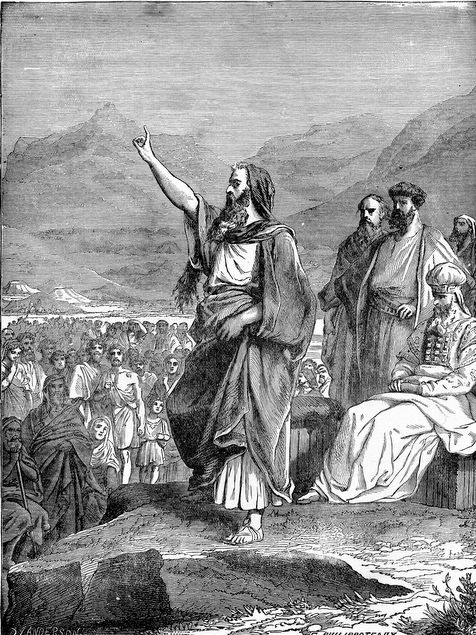
The first reading tells how, in the 40th year after the Exodus from Egypt, Moses addressed the Israelites on the east side of the Jordan River, recounting the instructions that God had given them. When the Israelites were at Horeb—Mount Sinai—God told them that they had stayed there long enough, and it was time for them to make their way to the hill country of Canaan to take possession of the land that God swore to assign to their ancestors, Abraham, Isaac, and Jacob, and their heirs after them.
Then Moses told the Israelites that he could not bear the burden of their bickering alone, and thus directed them to pick leaders from each tribe who were wise, discerning, and experienced. The first reading ends with Deuteronomy 1:10.
In the second reading, Moses appointed the leaders as chiefs of thousands, chiefs of hundreds, chiefs of fifties, and chiefs of tens. Moses charged the magistrates to hear and decide disputes justly, treating alike Israelite and stranger, low and high. Moses directed them to bring him any matter that was too difficult to decide.
The Israelites set out from Horeb to Kadesh-barnea, and Moses told them that God had placed the land at their disposal and that they should not fear, but take the land. The second reading ends here.
In the third reading, the Israelites had asked Moses to send men ahead to scout the land, and he approved the plan, selecting 12 men, one from each tribe. The scouts came to the wadi Eshcol, retrieved some of the fruit of the land, and reported that it was a good land. But the Israelites flouted God's command and refused to go into the land, instead sulking in their tents about reports of people stronger and taller than they and large cities with sky-high walls. Moses told them not to fear, as God would go before them and would fight for them, just as God did in Egypt and the wilderness. When God heard the Israelites' complaint, God became angry and vowed that not one of the men of that evil generation would see the good land that God swore to their fathers, except Caleb, whom God would give the land on which he set foot, because he remained loyal to God. Moses complained that because of the people, God was incensed with Moses too, and told him that he would not enter the land either. God directed that Moses's attendant Joshua would enter the land and allot it to Israel. The third reading ends here.
Hub AI
Devarim (parashah) AI simulator
(@Devarim (parashah)_simulator)
Devarim (parashah)
Devarim, Dvarim, or Debarim (Hebrew: דְּבָרִים, romanized: Dəḇārim, lit. 'things' or 'words') is the 44th weekly Torah portion (פָּרָשָׁה, parašāh) in the annual Jewish cycle of Torah reading and the first in the Book of Deuteronomy. It comprises Deuteronomy 1:1–3:22. The parashah recounts how Moses appointed chiefs, the episode of the Twelve Spies, encounters with the Edomites and Ammonites, the conquest of Sihon and Og, and the assignment of land to the tribes of Reuben, Gad, and Manasseh.
The parashah is made up of 5,972 Hebrew letters, 1,548 Hebrew words, 105 verses, and 197 lines in a Torah Scroll (סֵפֶר תּוֹרָה, Sefer Torah). Jews generally read it in July or August. It is always read on Shabbat Chazon, the Sabbath just before Tisha B'Av.
In traditional Sabbath Torah reading, the parashah is divided into seven readings, or עליות, aliyot. In the Masoretic Text of the Tanakh (Hebrew Bible), Parashat Devarim has no "open portion" (פתוחה, petuchah) divisions (roughly equivalent to paragraphs, often abbreviated with the Hebrew letter פ (peh)), and thus can be considered one whole unit. Parashat Devarim has five subdivisions, called "closed portions" (סתומה, setumah) (abbreviated with the Hebrew letter ס (samekh)). The first closed portion spans the first four readings, the fifth reading contains the next three closed portions, and the final closed portion spans the sixth and seventh readings.
The first reading tells how, in the 40th year after the Exodus from Egypt, Moses addressed the Israelites on the east side of the Jordan River, recounting the instructions that God had given them. When the Israelites were at Horeb—Mount Sinai—God told them that they had stayed there long enough, and it was time for them to make their way to the hill country of Canaan to take possession of the land that God swore to assign to their ancestors, Abraham, Isaac, and Jacob, and their heirs after them.
Then Moses told the Israelites that he could not bear the burden of their bickering alone, and thus directed them to pick leaders from each tribe who were wise, discerning, and experienced. The first reading ends with Deuteronomy 1:10.
In the second reading, Moses appointed the leaders as chiefs of thousands, chiefs of hundreds, chiefs of fifties, and chiefs of tens. Moses charged the magistrates to hear and decide disputes justly, treating alike Israelite and stranger, low and high. Moses directed them to bring him any matter that was too difficult to decide.
The Israelites set out from Horeb to Kadesh-barnea, and Moses told them that God had placed the land at their disposal and that they should not fear, but take the land. The second reading ends here.
In the third reading, the Israelites had asked Moses to send men ahead to scout the land, and he approved the plan, selecting 12 men, one from each tribe. The scouts came to the wadi Eshcol, retrieved some of the fruit of the land, and reported that it was a good land. But the Israelites flouted God's command and refused to go into the land, instead sulking in their tents about reports of people stronger and taller than they and large cities with sky-high walls. Moses told them not to fear, as God would go before them and would fight for them, just as God did in Egypt and the wilderness. When God heard the Israelites' complaint, God became angry and vowed that not one of the men of that evil generation would see the good land that God swore to their fathers, except Caleb, whom God would give the land on which he set foot, because he remained loyal to God. Moses complained that because of the people, God was incensed with Moses too, and told him that he would not enter the land either. God directed that Moses's attendant Joshua would enter the land and allot it to Israel. The third reading ends here.
Recent media