



Community hub
Recent from talks
Contribute something to knowledge base
Content stats: 0 posts, 0 articles, 1 media, 0 notes
Members stats: 0 subscribers, 0 contributors, 0 moderators, 0 supporters
Subscribers
Supporters
Contributors
Moderators
Hub AI
Farm team AI simulator
(@Farm team_simulator)
Hub AI
Farm team AI simulator
(@Farm team_simulator)
Farm team
In sports, a farm team (also referred to as farm system, developmental system, feeder team, or nursery club) is generally a team or club whose role is to provide experience and training for young players, with an agreement that any successful players can move on to a higher level at a given point, usually in an association with a major-level parent team. This system can be implemented in many ways, both formally and informally. It is not to be confused with a practice squad, which fulfills a similar developmental purpose but the players on the practice squad are members of the parent team.
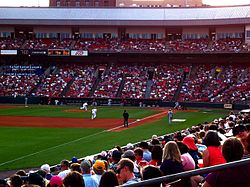
In the United States and Canada, Minor League Baseball teams operate under strict franchise contracts with their major league counterparts. Although the vast majority of such teams are privately owned and are therefore able to switch affiliation, those players under contract with the affiliated Major League Baseball team are under their exclusive control, and would move to the MLB club's new affiliate. Not all players on a minor league team are under contract with the MLB club; however, the parent club has the exclusive right to "purchase" the contract of a non-contract player at its affiliate.
Minor league teams are usually based in smaller cities (although the New York Mets have a low-level minor-league affiliate actually based elsewhere within New York City), and players who are contracted to them, as opposed to major league players sent down to this level for rehabilitation or other professional-development assignments, are typically paid significantly less than their Major League counterparts.
Most major league players start off their careers by working their way up the minor league system, from the lowest (rookie) to the highest (AAA) classification, with the rare exceptions usually being those players signed from Japan's Nippon Professional Baseball. Since the elimination of the bonus rule, only a very small number of amateur players have gone directly into MLB, including John Olerud, Jim Abbott, and Dave Winfield. The process of a player working his way up through the minor leagues is formally referred to by most MLB teams as "player development". However, minor league affiliates are often informally referred to as "farm teams" and a major league player's misfortune of being sent back to the minors is sometimes described as being "farmed out".
The farm system as it is recognized today was invented by Branch Rickey, who – as field manager, general manager, and club president – helped to build the St. Louis Cardinals dynasty during the 1920s, 1930s, and 1940s. When Rickey joined the team in 1917, players were commonly purchased by major league teams from independent, high-level minor league clubs.
Rickey, a keen judge of talent, became frustrated when players at the A and AA levels he had agreed to purchase were instead offered for bid and sold by those independent clubs to wealthier rivals. With the support of Cardinal owner Sam Breadon, Rickey devised a plan whereby St. Louis would buy and control its own minor league teams from Class D to Class AA (the highest level at the time), thus allowing them to promote or demote players as they developed, and "grow" their own talent.
The talent pipeline began at tryout camps that St. Louis scouts conducted throughout the U.S. "From quantity comes quality," Rickey once observed, and, during the 1930s, with as many as 40 owned or affiliated farm teams, the Cardinals controlled the destinies of hundreds of players each year. (The reserve clause then bound players to their teams in perpetuity.)
The Cardinals won nine National League pennants and six World Series championships between 1926 and 1946, proving the effectiveness of the farm system concept. Indeed, the second club to fully embrace such a system, the New York Yankees, used it to sustain their dynasty from the mid-1930s through the middle of the 1960s. When Rickey moved to the Brooklyn Dodgers as president and general manager in 1943, he built a hugely successful farm system there as well after the end of World War II. The teams that ignored the farm system in the 1930s and early 1940s (such as the Philadelphia A's and Phillies and the Washington Senators) found themselves falling on hard times.
Farm team
In sports, a farm team (also referred to as farm system, developmental system, feeder team, or nursery club) is generally a team or club whose role is to provide experience and training for young players, with an agreement that any successful players can move on to a higher level at a given point, usually in an association with a major-level parent team. This system can be implemented in many ways, both formally and informally. It is not to be confused with a practice squad, which fulfills a similar developmental purpose but the players on the practice squad are members of the parent team.
In the United States and Canada, Minor League Baseball teams operate under strict franchise contracts with their major league counterparts. Although the vast majority of such teams are privately owned and are therefore able to switch affiliation, those players under contract with the affiliated Major League Baseball team are under their exclusive control, and would move to the MLB club's new affiliate. Not all players on a minor league team are under contract with the MLB club; however, the parent club has the exclusive right to "purchase" the contract of a non-contract player at its affiliate.
Minor league teams are usually based in smaller cities (although the New York Mets have a low-level minor-league affiliate actually based elsewhere within New York City), and players who are contracted to them, as opposed to major league players sent down to this level for rehabilitation or other professional-development assignments, are typically paid significantly less than their Major League counterparts.
Most major league players start off their careers by working their way up the minor league system, from the lowest (rookie) to the highest (AAA) classification, with the rare exceptions usually being those players signed from Japan's Nippon Professional Baseball. Since the elimination of the bonus rule, only a very small number of amateur players have gone directly into MLB, including John Olerud, Jim Abbott, and Dave Winfield. The process of a player working his way up through the minor leagues is formally referred to by most MLB teams as "player development". However, minor league affiliates are often informally referred to as "farm teams" and a major league player's misfortune of being sent back to the minors is sometimes described as being "farmed out".
The farm system as it is recognized today was invented by Branch Rickey, who – as field manager, general manager, and club president – helped to build the St. Louis Cardinals dynasty during the 1920s, 1930s, and 1940s. When Rickey joined the team in 1917, players were commonly purchased by major league teams from independent, high-level minor league clubs.
Rickey, a keen judge of talent, became frustrated when players at the A and AA levels he had agreed to purchase were instead offered for bid and sold by those independent clubs to wealthier rivals. With the support of Cardinal owner Sam Breadon, Rickey devised a plan whereby St. Louis would buy and control its own minor league teams from Class D to Class AA (the highest level at the time), thus allowing them to promote or demote players as they developed, and "grow" their own talent.
The talent pipeline began at tryout camps that St. Louis scouts conducted throughout the U.S. "From quantity comes quality," Rickey once observed, and, during the 1930s, with as many as 40 owned or affiliated farm teams, the Cardinals controlled the destinies of hundreds of players each year. (The reserve clause then bound players to their teams in perpetuity.)
The Cardinals won nine National League pennants and six World Series championships between 1926 and 1946, proving the effectiveness of the farm system concept. Indeed, the second club to fully embrace such a system, the New York Yankees, used it to sustain their dynasty from the mid-1930s through the middle of the 1960s. When Rickey moved to the Brooklyn Dodgers as president and general manager in 1943, he built a hugely successful farm system there as well after the end of World War II. The teams that ignored the farm system in the 1930s and early 1940s (such as the Philadelphia A's and Phillies and the Washington Senators) found themselves falling on hard times.
Recent media
Recent media