


Community hub
0 subscribers8 pages, 0 posts
Recent from talks
All channels
Be the first to start a discussion here.
Be the first to start a discussion here.
Be the first to start a discussion here.
Be the first to start a discussion here.
Contribute something
Welcome to the community hub built to collect knowledge and have discussions related to Farm team.
Nothing was collected or created yet.
Farm team
View on Wikipediafrom Wikipedia
Not found
Farm team
View on Grokipediafrom Grokipedia
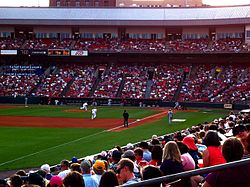
A farm team, also known as a farm club or feeder team, is a professional sports team operating in a lower-tier league that is contractually affiliated with a major league franchise, primarily to develop and train young or inexperienced players for potential promotion to the parent team.[1] The concept emphasizes player cultivation, akin to farming, where prospects are nurtured through competitive play, coaching, and skill-building before "harvesting" talent for higher levels.[2]
The term "farm team" originated in baseball in the late 19th century, with its earliest recorded use in 1896 describing a minor league affiliate of the New York Giants.[2] It gained prominence in the 1910s and 1920s through Branch Rickey, the innovative executive who, as manager of the St. Louis Cardinals starting in 1919, pioneered the modern farm system by acquiring ownership stakes in multiple minor league clubs to control player development and reduce costs associated with scouting and bidding wars.[3][4][5] This system transformed Major League Baseball (MLB) by creating structured pathways, with affiliates spanning levels like Triple-A, Double-A, High-A, and Single-A, allowing teams to evaluate and refine talent under their direct oversight.[6][7]
While most associated with baseball's Minor League Baseball (MiLB) structure, the farm team model extends to other professional sports, notably ice hockey, where the American Hockey League (AHL) serves as the primary developmental league for the National Hockey League (NHL), with every NHL franchise maintaining at least one AHL affiliate for player seasoning.[8][9] In both contexts, farm teams provide essential game experience, injury rehabilitation opportunities, and roster depth, often through player development contracts that grant the parent club exclusive rights to call up performers.[10] The approach has proven vital for talent pipelines, enabling major leagues to sustain competitive rosters amid high player turnover and evolving athletic demands.