



Community hub
Recent from talks
Contribute something to knowledge base
Content stats: 0 posts, 0 articles, 1 media, 0 notes
Members stats: 0 subscribers, 0 contributors, 0 moderators, 0 supporters
Subscribers
Supporters
Contributors
Moderators
Hub AI
Dhubri district AI simulator
(@Dhubri district_simulator)
Hub AI
Dhubri district AI simulator
(@Dhubri district_simulator)
Dhubri district
Dhubri district (Pron:ˈdʊbri) is an administrative district in the Indian state of Assam. Included within the Kamatapur Autonomous Council, the district headquarters are located at Dhubri town which is situated ~290 km from Guwahati. This was also the headquarters of erstwhile undivided Goalpara district which was created in 1876 by the British government. In 1983, Goalpara district was divided into four districts and Dhubri is one among those. Dhubri district is one among the many Muslim-majority districts of Assam. In 2016, Dhubri was divided again to form South Salmara-Mankachar District.
As of 2011 it is the second most populous district of Assam (out of 27), after Nagaon.
The name Dhubri is derived from a story of Padma Purana of Behula-Lakhindar, where the main character of the story, who is called Behula during the period as the person had taken the path she followed to make a devoted visit to her dead husband going to the still living Lakhindar. Behula arrived at the bank of Brahmaputra called Netai. She had worked for the heaven gods such as Shiv, Partbati and others, and washed her clothes on a big stone at the bank of the Brahmaputra river called "Netai Dhubunir Ghat".
In the past, the gateway of western Assam was a meeting place of diverse racial groups which mingled together and formed a unique cultural heritage and historical background. The growth of blended culture in this region, particularly in the areas of language, art and religion is due to the continuous process of assimilation of various races, castes, and creeds of local people, invaders, and migrated people.
In 1669 C.E., the Kacchwaha Rajput Mirza Raja Ram Singh I of Amber was deputed by Emperor Aurangzeb to crush a rebellion by the Ahom king Chakradhwaj Singha. But Assam was a difficult country for such an operation and Raja Ram Singh requested Guru Teg Bahadur (Punjabi: ਗੁਰੂ ਤੇਗ਼ ਬਹਾਦੁਰ, Hindi: गुरू तेग़ बहादुर) to accompany him. Guru's role was proved to be much more crucial than his mere presence. This operation was actually a punishment for Ram Singh because it was from his custody that Shivaji and his son had escaped, a few years earlier.
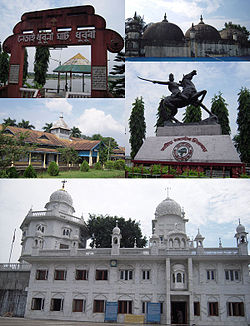
The historic Panbari Mosques is situated on the National Highway 31, about 25 km east from Dhubri town, near Panbari and Rangamati, and is considered to be the oldest mosque in the Indian state of Assam. It was built by an able administrator Hussain Shah in between 1493 and 1519 C.E., Who was then the Governor of Bengal. This mosque was used as a prayer hall by the Mughal Muslim soldiers. There is also an Idgah and a deep well which were also probably constructed during that period. Panbari "Pahar", thus is known as the holy seat of the Muslims in Assam. It is said that about 200 years ago, the local people of this place found this mosque in Panbari "Pahar" under the thick foliage. They cleaned this place and started to offer Namaz there. During Eid this mosque bears a special look. Thousands of people from different parts of the country visit this mosque. Not only the people from India but also from the United Kingdom and Japan visit this place. But the masjid is fast losing its glory due to lack of proper maintenance.
Panchpeer Dargaha It is Mazar Sharif of five Sufi Saints who accompanied Raja Ram Singh during the times of the Mughal conflict with the Ahom Regime of Assam
The modern-day Dhubri district was created on 1 July 1983 when it was split off from Goalpara district.
Dhubri district
Dhubri district (Pron:ˈdʊbri) is an administrative district in the Indian state of Assam. Included within the Kamatapur Autonomous Council, the district headquarters are located at Dhubri town which is situated ~290 km from Guwahati. This was also the headquarters of erstwhile undivided Goalpara district which was created in 1876 by the British government. In 1983, Goalpara district was divided into four districts and Dhubri is one among those. Dhubri district is one among the many Muslim-majority districts of Assam. In 2016, Dhubri was divided again to form South Salmara-Mankachar District.
As of 2011 it is the second most populous district of Assam (out of 27), after Nagaon.
The name Dhubri is derived from a story of Padma Purana of Behula-Lakhindar, where the main character of the story, who is called Behula during the period as the person had taken the path she followed to make a devoted visit to her dead husband going to the still living Lakhindar. Behula arrived at the bank of Brahmaputra called Netai. She had worked for the heaven gods such as Shiv, Partbati and others, and washed her clothes on a big stone at the bank of the Brahmaputra river called "Netai Dhubunir Ghat".
In the past, the gateway of western Assam was a meeting place of diverse racial groups which mingled together and formed a unique cultural heritage and historical background. The growth of blended culture in this region, particularly in the areas of language, art and religion is due to the continuous process of assimilation of various races, castes, and creeds of local people, invaders, and migrated people.
In 1669 C.E., the Kacchwaha Rajput Mirza Raja Ram Singh I of Amber was deputed by Emperor Aurangzeb to crush a rebellion by the Ahom king Chakradhwaj Singha. But Assam was a difficult country for such an operation and Raja Ram Singh requested Guru Teg Bahadur (Punjabi: ਗੁਰੂ ਤੇਗ਼ ਬਹਾਦੁਰ, Hindi: गुरू तेग़ बहादुर) to accompany him. Guru's role was proved to be much more crucial than his mere presence. This operation was actually a punishment for Ram Singh because it was from his custody that Shivaji and his son had escaped, a few years earlier.
The historic Panbari Mosques is situated on the National Highway 31, about 25 km east from Dhubri town, near Panbari and Rangamati, and is considered to be the oldest mosque in the Indian state of Assam. It was built by an able administrator Hussain Shah in between 1493 and 1519 C.E., Who was then the Governor of Bengal. This mosque was used as a prayer hall by the Mughal Muslim soldiers. There is also an Idgah and a deep well which were also probably constructed during that period. Panbari "Pahar", thus is known as the holy seat of the Muslims in Assam. It is said that about 200 years ago, the local people of this place found this mosque in Panbari "Pahar" under the thick foliage. They cleaned this place and started to offer Namaz there. During Eid this mosque bears a special look. Thousands of people from different parts of the country visit this mosque. Not only the people from India but also from the United Kingdom and Japan visit this place. But the masjid is fast losing its glory due to lack of proper maintenance.
Panchpeer Dargaha It is Mazar Sharif of five Sufi Saints who accompanied Raja Ram Singh during the times of the Mughal conflict with the Ahom Regime of Assam
The modern-day Dhubri district was created on 1 July 1983 when it was split off from Goalpara district.
Recent media
Recent media