Hubbry Logo
search
logo

Dice notation

logo
Community Hub0 Subscribers
Read side by side
from Wikipedia

Dice notation (also known as dice algebra, common dice notation, RPG dice notation, and several other titles) is a system to represent different combinations of dice in wargames and tabletop role-playing games using simple algebra-like notation such as d8+2.

Standard notation

[edit]
Probability mass function of a roll of 3d6 and probability density function of the normal distribution with the same mean and standard deviation.

In most tabletop role-playing games, die rolls required by the system are given in the form nds. n and s are variables, separated by the letter d, which stands for die or dice. The letter d is most commonly lower-case, but some forms of notation use upper-case D[1] (non-English texts can use the equivalent form of the first letter of the given language's word for "dice", but also often use the English "d").

  • n is the number of dice to be rolled (if n=1, then the notation is usually simplified to ds)
  • s is the number of faces of each die. The faces are numbered from 1 to s, with the assumption that the die generates a random integer in that range, with uniform probability. A notable exception is the d10, which is labeled from 0 to 9, though the 0 can also be read as a 10.

For example, if a game calls for a roll of d4 or 1d4, it means "roll one 4-sided die."

If the final number is omitted, it is typically assumed to be a d6, but in some contexts, other defaults are used.

3d6 would mean "roll three six-sided dice." Commonly, these dice are added together, but some systems direct the choice of the best result rolled, or some other action.

To this basic notation, an additive modifier can be appended, yielding expressions of the form nds+c. The plus sign is sometimes replaced by a minus sign ("−") to indicate subtraction. c is a number to be added to the sum of the rolls. Therefore, 1d20−10 would indicate a roll of a single 20-sided die with 10 being subtracted from the result. These expressions can also be chained (e.g. 2d6+1d8), though this usage is less common. Additionally, notation such as nds-L is not uncommon. In this case, the "L" is used to represent the lowest result; it is sometimes replaced by an "H" to represent the highest result. For instance, 4d6−L means a roll of 4 six-sided dice, dropping the lowest result. This application skews the probability curve towards the higher numbers, as a result a roll of 3 can only occur when all four dice come up 1 (probability 1/1,296), while a roll of 18 results if any three dice are 6 (probability 21/1,296 = 7/432).

Rolling three or more dice gives a probability distribution that is approximately Gaussian, in accordance with the central limit theorem.

History

[edit]

Miniatures wargamers began using dice in the shape of Platonic solids in the late 1960s and early 1970s, to obtain results that could not easily be produced on a conventional six-sided die. Dungeons & Dragons emerged in this milieu, and was the first game with widespread commercial availability to use such dice.[2][3] In its earliest edition (1974), D&D had no standardized way to call for polyhedral die rolls or to refer to the results of such rolls. In some places the text gives a verbal instruction; in others, it only implies the roll to be made by describing the range of its results. For example, the spell sticks to snakes says, "From 2–16 snakes can be conjured (roll two eight-sided dice)."[4] When only a range is listed, the exact method of rolling can be ambiguous. For example, a typical random wilderness encounter might be a village of "30–300" orcs.[5] A number in that range might be generated by rolling 3d10×10, or alternately by rolling 30d10.

D&D player Ted Johnstone introduced standard dice notation as a way to discuss probability distribution in an article, "Dice as Random Number Generators", in the inaugural issue of fanzine Alarums & Excursions (1975).[3] The notation was also used by another writer, Barry Gold, in the same issue, and quickly spread throughout the fan community.[3] Eventually, standard dice notation became so deeply ingrained in D&D fan culture that Gary Gygax would adopt it as a commonplace in the first edition of Advanced Dungeons & Dragons (1977–1979).[3][6] The close association between D&D fandom and standard dice notation is reflected in the name of the Open Game version of the D&D rules: the "d20 System."

Variations and expansions

[edit]

Multipliers

[edit]

In some games, the above notation is expanded to allow for a multiplier, as in AdX×C or C×dX, where:

  • "×" denotes multiplication, and can be replaced by "/" or "÷" for division.
  • C is a natural number (1 if omitted).

For example,

  • 1d6×5 or 5×d6 means "roll one 6-sided die, and multiply the result by 5."
  • 3d6×10+3 means "roll three 6-sided dice, add them together, multiply the result by 10, and then add 3."

Multiplication can also mean repeating throws of similar setup (usually represented by the letter "x", rather than the multiplication symbol):

  • 3x(2d6+4) means "roll two 6-sided dice adding four to result, repeat the roll 3 times adding the results together."

Percentile dice (d%)

[edit]
A typical pair of percentile dice including a "tens" die

Often, the variable X in the above notation will be 100, alternatively written "%". Although 100-sided dice exist, it is more common to use a combination of two ten-sided dice known as "percentile dice". One die represents units and the other tens; typically these are distinguished by color, but dice marked with multiples of ten are also available for use as the "tens" die. Ten-sided dice intended specifically for use as percentile dice typically have no tens notation (the faces are numbered such that there are two complete sequences of 0 through 9). A roll of 0 on both dice may be interpreted as either 0 or 100, depending on the game rules; however, it is rare for the 0 on the ones die to be read as 10, making a roll of zero on both dice equal to 10 (0 tens, and 10 ones).[7]

The d1000 (using three 10-sided dice) is occasionally also seen, although it is more common in wargames than role-playing games.

Before the introduction of ten-sided dice around 1980, twenty-sided dice were commonly manufactured with two copies of each digit 0 to 9 for use as percentile dice. (Half could be given a distinct color, indicating the addition of ten, for use when randomizing numbers from 1 to 20.) [8]

Selective results

[edit]

A number of notational strategies exist for discarding only certain types of results.

Some games extend the standard notation to or where, in addition to the above, Y is the number of dice kept ("k") from the roll. Whether the dice omitted are the highest, lowest, or the player's choice depends on the game in question; "k" can be replaced with "kh", "kl", or "kc", respectively, to represent this, which also allows for combining them. In this case, , which means "roll A dice with X sides each, keeping the H highest, the L lowest, and C of the player's choice". Just as "B" is normally not shown when it is 0, terms where you would keep all of the dice are normally omitted for ease of reading. While "k" can be replaced with "d" to denote number of dice dropped instead of kept, this will result in two ds in the notation, so care must be kept (in particular, the number of sides can no longer be omitted unambiguously): (here, the Y term is omitted when it is 0, meaning not dropping any dice), such as , which means "roll 4 6-sided dice, dropping the highest and lowest"; this is preferable to keep notation, which has no way to convey keeping middle dice. 7th Sea and Legend of the Five Rings use only 10-sided dice, so it omits the number of sides, using notation of the form , meaning "roll eight ten-sided dice, keep the highest six, and sum them."Although using a roll and keep system, Cortex Plus games all use roll all the dice of different sizes and keep two (normally the two best), although a Plot Point may be spent to keep an additional die, and some abilities let you keep a third automatically.
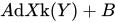

An alternative notation used by the OpenRoleplaying.org die roller uses "L" and "H" to denote the lowest and highest die, respectively, allowing B above to be replaced with this letter rather than a number; when used with a minus, this is equivalent to dropping the lowest or highest die, respectively, while when used with a plus, this lets you add the lowest or highest die to the total again, which is equivalent to doubling the lowest or highest die.[9]

Dice pools

[edit]
Fudge dice

A number of games including the original Ghostbusters role-playing game, the Storyteller system, and Fantasy Flight Games' Star Wars Roleplaying Games use a system where a dice pool consisting of an indicated number of dice are rolled and the total number of dice which meet a fixed condition are recorded as the result. For example, Vampire: The Requiem has players roll a pool of ten-sided dice and note the number that come up as 8 or higher as "successes". Some companies produce custom dice, marked with successes and failures, for use in games which use this mechanic.

The Fudge role-playing system uses a set of dice which are each marked with minus signs, plus signs and blank sides, meaning −1, +1 and 0 respectively. The default is one third of each, usually represented by a six-sided die with two of each, known as dF.2 or just dF. Four of these (4dF) are rolled to determine results from −4 to +4, which is equivalent to 4d3−8. Variants include dF.1, which is a six-sided die with four blanks, one plus and one minus.

6-sided variations

[edit]

Various Games Workshop systems such as Necromunda and Mordheim use an anomalously-named D66 roll, meaning d6×10+d6. This sort of roll originated in the Game Designers' Workshop (no relation) game, Traveller, to roll on various tables and charts, usually involving encounters, but did not use the notation. There are 36 possible results ranging from 11 to 66. The D66 is a base-six variant of the base ten percentile die (d100). The D66 is generally a combination of two six-sided dice, often made distinguishable from each other by color, or simply one die rolled twice. The first die represents the tens digit, and the second die the ones digit. For example, a roll of 1 followed by a roll of 5 will give a total of 15, while a roll of 3 followed by a roll of 6 will give a total of 36. The average result of the D66 is 38.5, and the standard deviation about 17.16.

Blood Bowl, also a Games Workshop product, introduces the block die with special notation Xdb, which is shorthand for (roll the absolute value of X in 6-sided dice and keep 1), where the sign of X specifies whether the attacker (if positive) or defender (if negative) chooses which die to keep; X is usually omitted when 1, and as −1 and 1 are equal, −1 is never used. Common values are 3, 2, 1, −2, or −3. Alternatively, the words "for" and "against" can be used to replace X's sign, where "against" means negative and "for" means positive; the word is placed after the rest of the formula. As an example, is equal to , which both mean "roll 2 6-sided dice, defender chooses from the results rolled".

In Nomine, from Steve Jackson Games, uses a three-dice variation called the d666. However, this is actually a combination of 2d6 (for determining success or failure) and 1d6 (for determining degree of success or failure). The notation of d666 is a reference to the number of the beast.

Planet Mercenary calls its variation d6³, to indicate that in addition to using the conventional sum of 3d6 to check for success or failure, various secondary effects are determined via comparison of the individual numbers rolled. These include whether a specially marked die (called the Mayhem die) has rolled highest, the lowest number rolled, and whether any two dice show the same number.

One other commonly used variant of the 6-sided dice roll is the d3, which is a 6-sided die roll, with the result divided by 2. The average result is 2, and the standard deviation is 0.816.

10-sided variations

[edit]

The Cyborg Commando role-playing game by Gary Gygax uses a dice mechanic called d10x. This is equivalent to d10×d10 and gives a non-linear distribution, with most results concentrated at the lower end of the range. The mean result of d10x is 30.25 and its standard deviation is about 23.82.

Open-ended variations

[edit]

Several games use mechanics that allow one or more dice to be rerolled (often a die that rolls the highest possible number), with each successive roll being added to the total. Terms for this include open-ended rolling, exploding dice, and penetration rolls. Games that use such a system include Feng Shui and Savage Worlds. On Anydice, the function to make dice explode on their highest value is simply called explode. Notational shorthand for exploding dice is to suffix the roll with an exclamation point: AdX! or 6d6!,[10] asterisk AdX*,[11] or the letter ‘X’ AdXX.[12]

The Storyteller system combines exploding dice with a dice pool threshold and target number. Diana: Warrior Princess explodes all successes, and Hackmaster uses a variant called dice penetration by which 1 is subtracted from the total of the rerolled dice.

References

[edit]
Revisions and contributorsEdit on WikipediaRead on Wikipedia
from Grokipedia
Dice notation is a concise algebraic shorthand used primarily in tabletop role-playing games (RPGs) and wargames to specify the number, type, and modifiers for dice rolls, typically expressed as NdS (where N denotes the number of identical dice, d indicates "dice," and S represents the number of sides on each die), such as 2d6 for rolling two six-sided dice and summing the results.[1][2] This notation originated in the mid-1970s within the fan community of early RPGs, particularly around Dungeons & Dragons (D&D), where it first appeared in the fanzine Alarums & Excursions in 1975, proposed by Ted Johnstone as abbreviations like "D4" and "2D6" to streamline descriptions of polyhedral dice rolls.[3] It evolved from earlier wargaming conventions that described rolls verbally or with ranges, but the "d" prefix gained traction through fan publications before being formally adopted by TSR (the publisher of D&D) in the 1978 Players Handbook, marking its standardization in mainstream RPG design.[3] In practice, dice notation facilitates random resolution of game events, such as character actions, combat damage, or random encounters; for instance, in D&D, an attack roll might use 1d20 + 5 (one 20-sided die plus a modifier), while damage could be 1d8 + 3 (one eight-sided die plus a bonus).[1] Common extensions include addition or subtraction modifiers (e.g., 3d6 - 2 (where unmodified 3d6 sums range from 3 to 18, with every integer from 3 to 18 achievable, yielding 16 distinct totals)), percentile rolls via d100 (simulated with two 10-sided dice), and advanced variants like keeping highest/lowest in dice pools (e.g., 4d6kh3 for four six-sided dice, keeping the three highest).[1][2][4] Beyond core RPGs like D&D, the system has influenced board games, video game adaptations, and probabilistic modeling in simulations, with tools like online dice rollers parsing the notation for automated execution.[2] Its simplicity and universality have made it a foundational element of procedural randomness in interactive storytelling and strategy gaming since the late 1970s.[3]

Fundamentals

Definition and Purpose

Dice notation is a symbolic language employing letters and numbers to represent dice rolls, serving as a compact method for expressing probability distributions that determine outcomes in games, such as character attributes or conflict resolutions. This system encapsulates the randomness inherent in physical or virtual dice, allowing game designers and players to specify distributions without detailing each possible result individually. It standardizes the description of stochastic processes central to gameplay mechanics.[5] The primary purpose of dice notation lies in simplifying the articulation of intricate random events within role-playing games (RPGs), wargames, and board games, where it enables efficient generation of diverse results to promote replayability and dynamic decision-making. By abstracting the mechanics of rolling multiple dice or applying modifications, it streamlines rulebooks and session preparation, ensuring that probability-based elements like success thresholds or damage calculations remain accessible yet varied. This notation supports balanced gameplay by integrating chance with player agency, preventing outcomes from becoming overly predictable or deterministic.[6] In practice, dice notation is most prominently utilized in tabletop RPGs like Dungeons & Dragons, where it underpins core systems for action resolution and character development, but extends to broader contexts including probability education, statistical simulations, and software-based randomizers for digital gaming platforms. Its adoption in educational settings aids in teaching concepts like expected value and variance through tangible game examples, while in modeling, it allows precise replication of real-world uncertainties. Beyond gaming, the notation's clarity benefits computational tools that simulate or analyze probabilistic scenarios.[7][8] One key benefit is its capacity to minimize descriptive verbosity relative to natural language, thereby enhancing readability in game materials and enabling rigorous mathematical scrutiny of outcomes, such as computing averages or risk assessments without exhaustive enumeration. This efficiency not only accelerates play but also empowers designers to iterate on balance through probabilistic insights, fostering more engaging and fair experiences.[6]

Common Dice Types

The standard polyhedral dice used in tabletop role-playing games (RPGs) form the foundation of dice notation, consisting of six primary types based on Platonic solids or near-equivalent shapes for fairness in random outcomes. These dice are typically manufactured from acrylic or resin and numbered sequentially starting from 1, except for certain variants of the d10.[9][10] The d4 is a tetrahedral die with four triangular faces, numbered 1 through 4, where the result is read from the upward-facing face or the bottom vertex when it lands point-down.[11] The d6, the familiar cube, features six square faces numbered 1 to 6, with opposite faces summing to 7 for balanced weight distribution.[9] The d8 is an octahedral die with eight triangular faces, numbered 1 to 8, often landing with a vertex up and the result on the adjacent faces.[11] The d10 takes the form of a pentagonal trapezohedron with ten kite-shaped faces; it is commonly numbered 0 to 9, though some versions use 1 to 10, and the 0 is typically interpreted as 10 in single-die contexts.[12][11] The d12 is a dodecahedral die with twelve pentagonal faces, numbered 1 to 12.[9] Finally, the d20 is an icosahedral die with twenty triangular faces, numbered 1 to 20, prized for its high variance in RPG mechanics.[11]
Die TypeShapeFacesNumbering
d4Tetrahedron4 (triangular)1-4
d6Cube6 (square)1-6
d8Octahedron8 (triangular)1-8
d10Pentagonal trapezohedron10 (kite)0-9 or 1-10
d12Dodecahedron12 (pentagonal)1-12
d20Icosahedron20 (triangular)1-20
Non-standard but commonly referenced dice include the d2, often simulated by a coin flip (heads=1, tails=2) for binary outcomes; the d3, typically emulated by rolling a d6 and dividing the result by 2 while rounding up (1-2=1, 3-4=2, 5-6=3); and the d%, which represents a percentile roll (00-99 or 1-100) achieved by combining two d10s—one as tens (00, 10, ..., 90) and one as units (0-9), with 00 often denoting 100.[13][11][14] These dice derive their fairness from the symmetry of Platonic solids (tetrahedron, cube, octahedron, dodecahedron, icosahedron), which ensure equal probability for each face when rolled on a flat surface, though the d10's trapezohedral design approximates this balance.[9] Manufacturers like Chessex and Koplow produce these for RPG use, offering sets in various colors and materials to minimize bias from imperfections such as air bubbles or uneven molding.[15][16] For percentile applications, the d10's 0-9 numbering convention allows seamless integration, distinguishing it from the 1-starting standard of other dice.[12]

Basic Notation

Standard Syntax

Dice notation employs a simple algebraic-like syntax to specify dice rolls, with the core template NdX representing the rolling of N identical dice, each with X sides numbered from 1 to X. The value N indicates the quantity of dice, while X denotes the number of faces on each die; the results of all N dice are typically summed to produce a single outcome unless otherwise specified. This format originated in tabletop role-playing games to concisely describe random outcomes for actions, damage, or other mechanics.[6] When N equals 1, it is conventional to omit the numeral, simplifying the notation to dX for a single die roll. For instance, d20 instructs the rolling of one 20-sided die, yielding a result between 1 and 20, commonly used for attack rolls or ability checks in games like Dungeons & Dragons. In contrast, multiple dice such as 2d8 mean rolling two 8-sided dice and adding their values, producing a range from 2 to 16; this is often applied to damage calculations for weapons. The letter "d" serves as the delimiter between the number of dice and the number of sides, ensuring clarity in written or digital inputs.[17] Standard practice requires explicit specification of X to avoid ambiguity, though in some informal role-playing contexts, d6 may be assumed if no side count is provided; however, formal notation always includes X for precision across different die types. Rolls are evaluated from left to right, with summation as the default aggregation method for multiple dice. Examples include 3d6 for rolling three six-sided dice (summing to 3–18, with every integer from 3 to 18 achievable via various combinations, resulting in 16 distinct possible totals), a staple for generating character attributes.[6][17][18]

Modifiers and Operations

In dice notation, modifiers allow for arithmetic adjustments to the results of basic rolls, extending the standard NdX syntax to incorporate constants or variables that alter the total outcome. Additive modifiers, denoted by +Y, add a value Y to the sum of the dice rolls, while subtractive modifiers use -Y to deduct it; Y can be a fixed number or another roll, such as d6 for variability. For instance, the expression "2d6+3" represents rolling two six-sided dice and adding 3 to their total, commonly used in role-playing games to simulate ability scores with bonuses.[19] Multiplication and division operations, though less common than addition or subtraction, enable scaling of results and follow standard mathematical precedence (PEMDAS/BODMAS), where multiplication and division are performed before addition and subtraction. These are typically applied to the entire roll total, as in "d6*2" to double the result of a single six-sided die roll for amplified effects. Parentheses can be used for grouping to enforce a specific order, such as in "(d20+5)*2", ensuring the addition occurs before multiplication.[19] Basic reroll mechanics simulate discarding and replacing low outcomes, often approximated in notation as rolling extra dice and dropping the lowest values; for example, rerolling 1s once on a single d6 can be expressed as "2d6 drop lowest", and for 2d6 with per-die rerolls it scales to "4d6 drop 2 lowest" to mimic the effect, though this is limited to simple, non-recursive cases without advanced exploding rules.[19] The expected value of a modified roll NdX + Y provides a probabilistic average, given by the formula:
E[NdX+Y]=NX+12+Y E[NdX + Y] = N \cdot \frac{X+1}{2} + Y
This derives from the linearity of expectation: the expected value of a single dX roll, which is uniformly distributed from 1 to X, is the average 1+X2\frac{1 + X}{2}, scaled by the number of dice N, then adjusted by the constant Y. For instance, with N=2, X=6, and Y=3, the expected value is 272+3=102 \cdot \frac{7}{2} + 3 = 10.[20]

Historical Development

Origins in Gaming

The roots of dice notation trace back to pre-1970s wargaming traditions, where descriptive phrases specified dice rolls without symbolic shorthand, laying the groundwork for more compact representations in later systems. Early naval wargames, such as those developed in the 1940s, employed lookup tables to resolve outcomes based on dice results, influencing the need for efficient ways to denote rolls in complex simulations.[3][21] In the 1971 wargame Chainmail by Gary Gygax and Jeff Perren, dice usage was described in full phrases, such as "roll two six-sided dice" to determine combat results like kills in man-to-man melee, where a roll of seven or higher succeeded. This informal verbal notation reflected the era's reliance on explicit instructions for miniature-based battles, without algebraic symbols.[3] The original printed edition of Dungeons & Dragons (1974) by Gygax and Dave Arneson continued to favor descriptive phrases, such as "roll two eight-sided dice," for mechanics like hit points and saving throws. The transition to symbolic notation emerged in fan communities in 1975, first proposed by Ted Johnstone in the fanzine Alarums & Excursions, using abbreviations like "D4" and "2D6" to streamline discussions of polyhedral dice rolls. This fan-driven innovation gained traction through subsequent issues and other publications before commercial adoption.[3] The AD&D Players Handbook (1978) marked TSR's first major publication to employ dice notation liberally, using terms like "d20" and "5d20" without initial explanation, assuming familiarity among players from fan usage. The subsequent Dungeon Masters Guide (1979), authored by Gygax, provided a detailed breakdown of the system for ability scores, combat, and random events, embedding it further in the role-playing game industry.[3][22]

Evolution and Standardization

In the late 1970s and throughout the 1980s, dice notation underwent significant refinement and adoption across major tabletop RPGs, transitioning from informal fan usage to standardized conventions in published rulesets. Advanced Dungeons & Dragons (AD&D), released starting in 1977 with its Players Handbook in 1978, played a pivotal role by liberally employing notations such as "d20" and "5d20" without initial explanation, assuming familiarity among players, while the 1979 Dungeon Masters Guide provided a detailed breakdown of the system.[3] Competitor games further solidified this, with Traveller (1977) introducing "xD+y" formats primarily for six-sided dice rolls like 2d6 + modifiers in character generation and task resolution, and RuneQuest (1978) offering a concise formal description of the notation in its core rules, emphasizing polyhedral dice for skills and combat.[23][3] These developments, building on earlier fan proposals, established NdX+Y as a de facto syntax for summing multiple dice with adjustments, influencing non-TSR publishers and expanding beyond Dungeons & Dragons' ecosystem. The 1990s and 2000s saw broader dissemination through the Open Gaming License (OGL), introduced by Wizards of the Coast in 2000, which enabled third-party creators to incorporate elements of the d20 System—a mechanics framework centered on the d20 roll with modifiers—into their own games without licensing fees for core rules.[24] This license facilitated the proliferation of compatible RPGs, embedding standard dice notation in hundreds of publications and solidifying its role in hit resolution, damage, and checks. Integration into video games further amplified adoption; for instance, Baldur's Gate (1998), an AD&D-licensed title, translated tabletop mechanics including NdX rolls into digital simulations, exposing notation to a wider audience through tooltips and rule summaries. By the early 2000s, the notation had become ubiquitous in the RPG industry, with the d20 System's influence ensuring consistent syntax across print and emerging digital formats. Digital tools reinforced and sometimes enforced dice notation standards from the 1990s onward, as early PC-based RPG aids and later mobile applications parsed inputs like 3d6+2 for automated rolls. Software for simulating tabletop sessions, such as those developed for Windows in the mid-1990s, required adherence to NdX conventions to function, promoting uniformity among users. Post-2010, platforms like online virtual tabletops standardized the syntax in their APIs, making it essential for multiplayer sessions and further entrenching the format. Today, dice notation serves as a de facto industry standard, with Wizards of the Coast's publications—such as the Dungeons & Dragons Player's Handbook—establishing conventions like lowercase "d" and operator precedence, akin to informal ISO guidelines for RPG mechanics. This evolution has ensured interoperability across games, tools, and communities, though debates on extensions persist in professional design discussions.

Variations and Extensions

Multipliers and Selection

In dice notation, multipliers extend basic rolls by scaling the total result through multiplication, typically denoted as "NdX * Y," where the sum of N rolls on an X-sided die is multiplied by the constant Y. This mechanic allows for adjustable outcomes in role-playing games, often representing amplified effects like variable damage or modifiers based on character attributes. For instance, a simple attack roll might be expressed as "1d6 * 2" to double the base damage potential, a notation supported in digital tools for precise simulation.[19] Selection mechanisms in dice notation involve post-roll choices to retain or discard specific results, refining the outcome beyond simple summation. The most common form is keeping the highest k dice from N rolled, abbreviated as "NdXk," which sums only the top k values while ignoring the rest. This increases both the expected value and variance of the result compared to a standard NdX sum, as it favors higher outcomes and reduces the influence of low rolls. Conversely, dropping the lowest (N-k) dice achieves a similar skew toward higher totals, often notated as "NdX drop lowest (N-k)" or "NdXk" in inverse contexts. These selections draw from order statistics in probability, where the expected value of the highest single die (k=1) from N uniform rolls on a dX approximates $ X \frac{N}{N+1} $, shifting the average upward for larger N.[25][26] A prominent example of keeping highest dice appears in the Legend of the Five Rings Roleplaying Game, where players roll a pool of d10s equal to a character's trait plus skill (e.g., 7d10 for Reflexes 3 + Iaijutsu 4) and keep a number equal to the trait (e.g., k3), summing the kept results against a target number. This "roll and keep" system, introduced in the game's first edition in 1997, emphasizes strategic choice in which dice to retain, integrating narrative elements like honor and strife while altering probabilities to reward skilled characters.[27][28] Dropping lowest functions as the inverse, commonly used in aggregate rolls to mitigate poor results; for example, a hypothetical "6d6 drop lowest 3" (equivalent to 6d6k3) might simulate a contested check by discarding underperformers, raising the average from the standard 6d6's 21 to approximately 25.5.[25] The roll-and-keep mechanic originated with the 1997 debut of Legend of the Five Rings Roleplaying Game by Alderac Entertainment Group, designed by John Wick to evoke samurai themes of precision and consequence through selective retention. Subsequent editions by Fantasy Flight Games refined it, blending it with narrative dice for deeper storytelling, while the "NdXk" notation became a de facto standard in RPG tools and communities for its clarity in expressing these selections.[27]

Percentile and Specialized Dice

Percentile dice, commonly notated as d% or 1d100 in dice notation systems, simulate a 100-sided die to produce results ranging from 00 to 99, often mapped to 1-100 for gameplay purposes.[29] These are typically implemented using a pair of ten-sided dice: a standard d10 numbered 0 through 9 for the units digit and a specialized percentile d10 marked 00, 10, 20, up to 90 for the tens digit.[30] The tens die is read first, followed by the units die, forming a two-digit number; for example, 40 on the tens die and 7 on the units die yields 47, while 00 and 0 is conventionally treated as 100 in many rulesets.[31] This combination ensures a uniform probability distribution across the 100 possible outcomes, with each result equally likely at 1%.[32] In role-playing games employing percentile systems, such as those based on Basic Role-Playing (BRP), the d% is frequently used in "roll-under" mechanics for resolving skill checks. Here, a player rolls d% and succeeds if the result is less than or equal to their character's skill rating, expressed as a percentage; higher skill values thus increase success chances linearly.[29] The d00 notation specifically denotes the percentile d10 (00-90), which can be paired with a standard d10 to replicate d% rolls without ambiguity.[33] Specialized dice notations adapt standard polyhedral dice to non-standard ranges, often for games lacking physical odd-sided dice. The d3, simulating a three-sided die (results 1-3), is commonly derived from a d6 where rolls of 1 or 2 count as 1, 3 or 4 as 2, and 5 or 6 as 3.[34] Similarly, the d2 (results 1-2) uses a d6 where rolls of 1-3 count as 1 and 4-6 as 2, providing a fair 50/50 binary outcome.[35] Variations on the ten-sided die include the "d10 tens," which explicitly refers to the 00-90 marked die for generating multiples of 10 in the 10-90 range, sometimes used alone or in custom mechanics.[36] A representative example appears in Call of Cthulhu, where core characteristics like Strength (STR) are generated by rolling 3d6 × 5, transforming the standard 3-18 bell-curve distribution into a 15-90 range scaled to the game's 1-100 percentile framework for consistency with skill ratings. Digital simulators for d%, such as those in virtual tabletops like Roll20 or apps like RPG Simple Dice, generate these rolls using pseudorandom algorithms to ensure perfect uniformity without physical limitations.[37] However, physical d10 pairs for percentile rolls can exhibit fairness issues due to manufacturing variances, such as uneven pips, material density imbalances, or non-isohedral shaping on the tens die, potentially biasing outcomes toward certain numbers; high-quality dice from reputable manufacturers mitigate this, but testing via repeated rolls or weighing is recommended.[38][39]

Exploding and Open-Ended Rolls

Exploding dice, also known as open-ended dice in some systems, introduce a mechanic where rolling the maximum value on a die triggers a reroll of the same die type, with the new result added to the total; this process can repeat indefinitely if the maximum is rolled again.[40] This unbounded extension allows individual rolls to exceed the standard range of the die, adding excitement and variability to outcomes in role-playing games. The mechanic is commonly used in narrative-driven systems to mitigate frustration from low rolls by enabling dramatic successes.[41] In Savage Worlds, all trait rolls and damage dice employ exploding mechanics, termed "Aces," where a maximum result (such as 6 on a d6) prompts an additional roll added to the total, potentially chaining multiple times.[42] Similarly, in Deadlands Classic, trait rolls involve rolling a pool of dice equal to the skill rank (e.g., 3d8 for a rank-3 skill on a d8 attribute), keeping the highest exploding result to determine success against a target number.[43] Open-ended rolls in the Fudge system use four special Fudge dice (4dF), each a six-sided die with faces marked -1, 0, or +1 (typically two of each), summed after canceling pairs to yield results from -4 to +4.[44] An optional variant allows open-ended extension: if all four dice show +1 (total +4) or all -1 (total -4), the player rerolls the full set and adds the new result to the previous total, which can chain on repeated extremes.[45] Variations on six-sided dice often incorporate exploding elements for pooled or escalating rolls. In Earthdawn, the step die system assigns escalating dice pools (e.g., Step 4 is 1d6, Step 7 is d12) to abilities, with all dice exploding on their maximum to produce the total result, allowing steps to range from d4-2 up to complex pools like 6d20 + 2d8.[46] This creates a progression from d4 to d12 and beyond, emphasizing growth in character capabilities through explosive potential on standard d6 components in lower steps. Common notation for exploding rolls appends an exclamation mark, as in "3d8!" to denote three eight-sided dice that explode on 8.[19] Some parsers support "dXeoY" to specify explosion on a custom value Y (e.g., d6eo6 for a d6 exploding only on 6). The probability of an initial explosion is $ \frac{1}{X} $ for an X-sided die, forming an infinite geometric series where the expected number of additional rolls is $ \frac{1}{X-1} $.[40]

Dice Pools and Aggregate Systems

Dice pools represent a core mechanic in many role-playing games, where multiple dice are rolled simultaneously and evaluated individually against a threshold to determine the number of successes, rather than summing their values. This approach, often notated as "NdX ≥ Y" or "NdX count successes > Y," allows for granular assessment of partial outcomes, emphasizing reliability over raw magnitude. For instance, in the World of Darkness system, a roll might be expressed as "10d10 ≥ 8," where each die showing 8, 9, or 10 counts as a success, while 1s may complicate results in cases of zero successes (known as a botch).[47][48] Aggregate systems build on this by pooling successes across the dice to gauge overall achievement, sometimes incorporating modifiers like dropping the lowest roll to mitigate poor results. In games like Exalted, which uses a variant of the Storyteller System, players form a pool based on attributes and abilities (e.g., "8d10 ≥ 7"), count successes meeting or exceeding the difficulty.[49] This aggregation contrasts with simple totals by focusing on binary per-die outcomes, enabling thresholds for degrees of success, such as one success for marginal victory or multiple for exceptional performance.[48] Distinct systems extend dice pools with unique parsing rules. The One-Roll Engine (ORE), used in games like Wild Talents, notates rolls as "Nd10 parse," where players roll the pool and identify matching sets; the "width" is the number of dice in the largest set (indicating speed or penetration), and the "height" is the value shown (indicating quality or damage), such as "3x8" for three eights.[50] Similarly, the Storytelling System, an evolution of earlier White Wolf mechanics, uses pools like "5d10 ≥ 8 again on 10," where successes are counted against a difficulty, and any 10s are rerolled for potential additional successes, sometimes tying into exploding mechanics for heightened variance in pools.[51] Modern indie titles, such as Blades in the Dark (released 2017), adapt pools for narrative context by setting "position" (risk level) and "effect" (potential impact) before rolling a d6 pool based on action ratings, with the highest die determining partial or full success.[52] The probability of successes in these pools follows a binomial distribution, where each die is an independent trial with success probability $ p = \frac{X - Y + 1}{X} $ for a dX needing to meet or exceed Y (e.g., $ p = 0.3 $ for d10 ≥ 8). The expected number of successes is $ np $, but variance $ np(1-p) $ exceeds that of equivalent summed dice, creating swingier results that heighten dramatic tension.[53][48] This structure prioritizes consistent partial successes over rare high totals, influencing design in storytelling-focused RPGs.[54]

References

User Avatar
No comments yet.

