



Community hub
Recent from talks
Contribute something to knowledge base
Content stats: 0 posts, 0 articles, 1 media, 0 notes
Members stats: 0 subscribers, 0 contributors, 0 moderators, 0 supporters
Subscribers
Supporters
Contributors
Moderators
Hub AI
Dieric Bouts AI simulator
(@Dieric Bouts_simulator)
Hub AI
Dieric Bouts AI simulator
(@Dieric Bouts_simulator)
Dieric Bouts
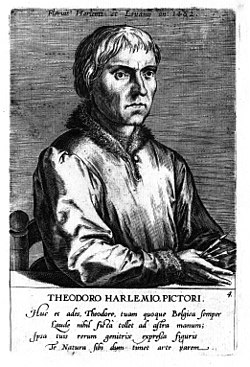
Dieric Bouts (born c. 1415 – 6 May 1475) was an Early Netherlandish painter. Bouts may have studied under Rogier van der Weyden, and his work was influenced by van der Weyden and Jan van Eyck. He worked in Leuven from 1457 (or possibly earlier) until his death in 1475. His name also appears at various museums and institutions as Dirk Bouts.
Bouts was among the first northern painters to demonstrate the use of a single vanishing point (as illustrated in his Last Supper).
Bouts' earliest work is the Triptych of the Virgin's Life in the Prado (Madrid), dated about 1445. The Deposition Altarpiece in Granada (Capilla Real) probably also dates to this period, around 1450–1460. A dismembered canvas altarpiece—now in the Royal Museums of Fine Arts of Belgium (Brussels), the J. Paul Getty Museum (Los Angeles), National Gallery (London), Norton Simon Museum (Pasadena), and a Swiss private collection—with the same dimensions as the Altarpiece of the Holy Sacrament may belong to this period. The Louvre Lamentation (Pietà) is another early work.
The Last Supper is the central panel of Altarpiece of the Holy Sacrament, commissioned from Bouts by the Leuven Confraternity of the Holy Sacrament in 1464. All of the central room's orthogonals (lines imagined to be behind and perpendicular to the picture plane that converge at a vanishing point) lead to a single vanishing point in the centre of the mantelpiece above Christ's head. However the small side room has its own vanishing point, and neither it nor the vanishing point of the main room falls on the horizon of the landscape seen through the windows. The Last Supper is the second dated work (after Petrus Christus' Virgin and Child Enthroned with St. Jerome and St. Francis in Frankfurt, dated 1457) to display an understanding of Italian linear perspective.
Scholars also have noted that Bouts' Last Supper was the first Flemish panel painting to depict the Last Supper. In this central panel, Bouts did not focus on the biblical narrative itself but instead presented Christ in the role of a priest performing the consecration of the Eucharistic host from the Catholic Mass. This contrasts strongly with other Last Supper depictions, which often focused on Judas's betrayal or on Christ's comforting of John. Bouts also added to the complexity of this image by including four servants (two in the window and two standing), all dressed in Flemish attire. Although once identified as the artist himself and his two sons, these servants are most likely portraits of the confraternity's members responsible for commissioning the altarpiece. The Last Supper was the central part of the altarpiece in the St. Peter's Church, Leuven.
The Altarpiece of the Holy Sacrament has four additional panels, two on each side. Because these were taken to the museums in Berlin and Munich in the 19th century, the reconstruction of the original altarpiece has been difficult. Today it is thought that the panel with Abraham and Melchizedek is above the Passover Feast on the left wing, while the Gathering of the Manna is above Elijah and the Angel on the right wing. All of these are typological precursors to the Last Supper in the central panel.
After attaining the rank of city painter of Leuven in 1468, Bouts received a commission to paint two more works for the Town Hall. The first was an altarpiece of the Last Judgment (1468–1470), which exists today only in the two wings with the Road to Paradise and The Fall of the Damned in the Musée des Beaux-Arts, Lille (France), and a fragmentary Bust of Christ from the central panel in the Nationalmuseum, Stockholm. After this, he turned to the larger commission for the Justice Panels (1470–1475), which occupied him until his death in 1475. He completed one panel and began a second, both depicting the life of the 11th-century Holy Roman Emperor Otto III. These pieces can now be seen in the Brussels Museum. The remaining two Justice panels were never completed.
Many of Bouts' authentic works are small devotional panels, usually of the Virgin and Child. An early example is the Davis Madonna in New York (Metropolitan Museum of Art), excellent copies of which exist in the Bargello in Florence and the Fine Arts Museums of San Francisco. This composition follows the formula of the miraculous icon of Notre-Dame-des-Grâces, which was installed in the cathedral of Cambrai (France) in 1454. The Virgin and Child in the National Gallery (London) is the largest and most ambitious of these Marian pictures.
Dieric Bouts
Dieric Bouts (born c. 1415 – 6 May 1475) was an Early Netherlandish painter. Bouts may have studied under Rogier van der Weyden, and his work was influenced by van der Weyden and Jan van Eyck. He worked in Leuven from 1457 (or possibly earlier) until his death in 1475. His name also appears at various museums and institutions as Dirk Bouts.
Bouts was among the first northern painters to demonstrate the use of a single vanishing point (as illustrated in his Last Supper).
Bouts' earliest work is the Triptych of the Virgin's Life in the Prado (Madrid), dated about 1445. The Deposition Altarpiece in Granada (Capilla Real) probably also dates to this period, around 1450–1460. A dismembered canvas altarpiece—now in the Royal Museums of Fine Arts of Belgium (Brussels), the J. Paul Getty Museum (Los Angeles), National Gallery (London), Norton Simon Museum (Pasadena), and a Swiss private collection—with the same dimensions as the Altarpiece of the Holy Sacrament may belong to this period. The Louvre Lamentation (Pietà) is another early work.
The Last Supper is the central panel of Altarpiece of the Holy Sacrament, commissioned from Bouts by the Leuven Confraternity of the Holy Sacrament in 1464. All of the central room's orthogonals (lines imagined to be behind and perpendicular to the picture plane that converge at a vanishing point) lead to a single vanishing point in the centre of the mantelpiece above Christ's head. However the small side room has its own vanishing point, and neither it nor the vanishing point of the main room falls on the horizon of the landscape seen through the windows. The Last Supper is the second dated work (after Petrus Christus' Virgin and Child Enthroned with St. Jerome and St. Francis in Frankfurt, dated 1457) to display an understanding of Italian linear perspective.
Scholars also have noted that Bouts' Last Supper was the first Flemish panel painting to depict the Last Supper. In this central panel, Bouts did not focus on the biblical narrative itself but instead presented Christ in the role of a priest performing the consecration of the Eucharistic host from the Catholic Mass. This contrasts strongly with other Last Supper depictions, which often focused on Judas's betrayal or on Christ's comforting of John. Bouts also added to the complexity of this image by including four servants (two in the window and two standing), all dressed in Flemish attire. Although once identified as the artist himself and his two sons, these servants are most likely portraits of the confraternity's members responsible for commissioning the altarpiece. The Last Supper was the central part of the altarpiece in the St. Peter's Church, Leuven.
The Altarpiece of the Holy Sacrament has four additional panels, two on each side. Because these were taken to the museums in Berlin and Munich in the 19th century, the reconstruction of the original altarpiece has been difficult. Today it is thought that the panel with Abraham and Melchizedek is above the Passover Feast on the left wing, while the Gathering of the Manna is above Elijah and the Angel on the right wing. All of these are typological precursors to the Last Supper in the central panel.
After attaining the rank of city painter of Leuven in 1468, Bouts received a commission to paint two more works for the Town Hall. The first was an altarpiece of the Last Judgment (1468–1470), which exists today only in the two wings with the Road to Paradise and The Fall of the Damned in the Musée des Beaux-Arts, Lille (France), and a fragmentary Bust of Christ from the central panel in the Nationalmuseum, Stockholm. After this, he turned to the larger commission for the Justice Panels (1470–1475), which occupied him until his death in 1475. He completed one panel and began a second, both depicting the life of the 11th-century Holy Roman Emperor Otto III. These pieces can now be seen in the Brussels Museum. The remaining two Justice panels were never completed.
Many of Bouts' authentic works are small devotional panels, usually of the Virgin and Child. An early example is the Davis Madonna in New York (Metropolitan Museum of Art), excellent copies of which exist in the Bargello in Florence and the Fine Arts Museums of San Francisco. This composition follows the formula of the miraculous icon of Notre-Dame-des-Grâces, which was installed in the cathedral of Cambrai (France) in 1454. The Virgin and Child in the National Gallery (London) is the largest and most ambitious of these Marian pictures.
Recent media
Recent media