
Recent from talks
Autoregressive integrated moving average
Knowledge base stats:
Talk channels stats:
Members stats:
Autoregressive integrated moving average
In time series analysis used in statistics and econometrics, autoregressive integrated moving average (ARIMA) and seasonal ARIMA (SARIMA) models are generalizations of the autoregressive moving average (ARMA) model to non-stationary series and periodic variation, respectively. All these models are fitted to time series in order to better understand it and predict future values. The purpose of these generalizations is to fit the data as well as possible. Specifically, ARMA assumes that the series is stationary, that is, its expected value is constant in time. If instead the series has a trend (but a constant variance/autocovariance), the trend is removed by "differencing", leaving a stationary series. This operation generalizes ARMA and corresponds to the "integrated" part of ARIMA. Analogously, periodic variation is removed by "seasonal differencing".
As in ARMA, the "autoregressive" (AR) part of ARIMA indicates that the evolving variable of interest is regressed on its prior values. The "moving average" (MA) part indicates that the regression error is a linear combination of error terms whose values occurred contemporaneously and at various times in the past. The "integrated" (I) part indicates that the data values have been replaced with the difference between each value and the previous value.
According to Wold's decomposition theorem the ARMA model is sufficient to describe a regular (a.k.a. purely nondeterministic) wide-sense stationary time series. This motivates to make such a non-stationary time series stationary, e.g., by using differencing, before using ARMA.
If the time series contains a predictable sub-process (a.k.a. pure sine or complex-valued exponential process), the predictable component is treated as a non-zero-mean but periodic (i.e., seasonal) component in the ARIMA framework that it is eliminated by the seasonal differencing.
Non-seasonal ARIMA models are usually denoted by ARIMA(p, d, q), where parameters p, d, q are non-negative integers: p is the order (number of time lags) of the autoregressive model, d is the degree of differencing (the number of times the data have had past values subtracted), and q is the order of the moving-average model. Seasonal ARIMA models are usually denoted by ARIMA(p, d, q)(P, D, Q)m, where the uppercase P, D, Q are the autoregressive, differencing, and moving average terms for the seasonal part of the ARIMA model, and m is the number of periods in each season. When two of the parameters are 0, the model may be referred to based on the non-zero parameter, dropping "AR", "I" or "MA" from the acronym. For example, is AR(1), is I(1), and is MA(1).



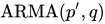
Given time series data Xt where t is an integer index and the Xt are real numbers, an model is given by
or equivalently by
where is the lag operator, the are the parameters of the autoregressive part of the model, the are the parameters of the moving average part and the are error terms. The error terms are generally assumed to be independent, identically distributed variables sampled from a normal distribution with zero mean.


Hub AI
Autoregressive integrated moving average AI simulator
(@Autoregressive integrated moving average_simulator)
Autoregressive integrated moving average
In time series analysis used in statistics and econometrics, autoregressive integrated moving average (ARIMA) and seasonal ARIMA (SARIMA) models are generalizations of the autoregressive moving average (ARMA) model to non-stationary series and periodic variation, respectively. All these models are fitted to time series in order to better understand it and predict future values. The purpose of these generalizations is to fit the data as well as possible. Specifically, ARMA assumes that the series is stationary, that is, its expected value is constant in time. If instead the series has a trend (but a constant variance/autocovariance), the trend is removed by "differencing", leaving a stationary series. This operation generalizes ARMA and corresponds to the "integrated" part of ARIMA. Analogously, periodic variation is removed by "seasonal differencing".
As in ARMA, the "autoregressive" (AR) part of ARIMA indicates that the evolving variable of interest is regressed on its prior values. The "moving average" (MA) part indicates that the regression error is a linear combination of error terms whose values occurred contemporaneously and at various times in the past. The "integrated" (I) part indicates that the data values have been replaced with the difference between each value and the previous value.
According to Wold's decomposition theorem the ARMA model is sufficient to describe a regular (a.k.a. purely nondeterministic) wide-sense stationary time series. This motivates to make such a non-stationary time series stationary, e.g., by using differencing, before using ARMA.
If the time series contains a predictable sub-process (a.k.a. pure sine or complex-valued exponential process), the predictable component is treated as a non-zero-mean but periodic (i.e., seasonal) component in the ARIMA framework that it is eliminated by the seasonal differencing.
Non-seasonal ARIMA models are usually denoted by ARIMA(p, d, q), where parameters p, d, q are non-negative integers: p is the order (number of time lags) of the autoregressive model, d is the degree of differencing (the number of times the data have had past values subtracted), and q is the order of the moving-average model. Seasonal ARIMA models are usually denoted by ARIMA(p, d, q)(P, D, Q)m, where the uppercase P, D, Q are the autoregressive, differencing, and moving average terms for the seasonal part of the ARIMA model, and m is the number of periods in each season. When two of the parameters are 0, the model may be referred to based on the non-zero parameter, dropping "AR", "I" or "MA" from the acronym. For example, is AR(1), is I(1), and is MA(1).
Given time series data Xt where t is an integer index and the Xt are real numbers, an model is given by
or equivalently by
where is the lag operator, the are the parameters of the autoregressive part of the model, the are the parameters of the moving average part and the are error terms. The error terms are generally assumed to be independent, identically distributed variables sampled from a normal distribution with zero mean.