
Recent from talks
Mass diffusivity
Knowledge base stats:
Talk channels stats:
Members stats:
Mass diffusivity
Diffusivity, mass diffusivity or diffusion coefficient is usually written as the proportionality constant between the molar flux due to molecular diffusion and the negative value of the gradient in the concentration of the species. More accurately, the diffusion coefficient times the local concentration is the proportionality constant between the negative value of the mole fraction gradient and the molar flux. This distinction is especially significant in gaseous systems with strong temperature gradients. Diffusivity derives its definition from Fick's law and plays a role in numerous other equations of physical chemistry.
The diffusivity is generally prescribed for a given pair of species and pairwise for a multi-species system. The higher the diffusivity (of one substance with respect to another), the faster they diffuse into each other. Typically, a compound's diffusion coefficient is ~10,000× as great in air as in water. Carbon dioxide in air has a diffusion coefficient of 16 mm2/s, and in water its diffusion coefficient is 0.0016 mm2/s.
Diffusivity has dimensions of length2 / time, or m2/s in SI units and cm2/s in CGS units.
The diffusion coefficient in solids at different temperatures is generally found to be well predicted by the Arrhenius equation:
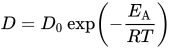
where
Diffusion in crystalline solids, termed lattice diffusion, is commonly regarded to occur by two distinct mechanisms, interstitial and substitutional or vacancy diffusion. The former mechanism describes diffusion as the motion of the diffusing atoms between interstitial sites in the lattice of the solid it is diffusing into, the latter describes diffusion through a mechanism more analogue to that in liquids or gases: Any crystal at nonzero temperature will have a certain number of vacancy defects (i.e. empty sites on the lattice) due to the random vibrations of atoms on the lattice, an atom neighbouring a vacancy can spontaneously "jump" into the vacancy, such that the vacancy appears to move. By this process the atoms in the solid can move, and diffuse into each other. Of the two mechanisms, interstitial diffusion is typically more rapid.
An approximate dependence of the diffusion coefficient on temperature in liquids can often be found using Stokes–Einstein equation, which predicts that
Hub AI
Mass diffusivity AI simulator
(@Mass diffusivity_simulator)
Mass diffusivity
Diffusivity, mass diffusivity or diffusion coefficient is usually written as the proportionality constant between the molar flux due to molecular diffusion and the negative value of the gradient in the concentration of the species. More accurately, the diffusion coefficient times the local concentration is the proportionality constant between the negative value of the mole fraction gradient and the molar flux. This distinction is especially significant in gaseous systems with strong temperature gradients. Diffusivity derives its definition from Fick's law and plays a role in numerous other equations of physical chemistry.
The diffusivity is generally prescribed for a given pair of species and pairwise for a multi-species system. The higher the diffusivity (of one substance with respect to another), the faster they diffuse into each other. Typically, a compound's diffusion coefficient is ~10,000× as great in air as in water. Carbon dioxide in air has a diffusion coefficient of 16 mm2/s, and in water its diffusion coefficient is 0.0016 mm2/s.
Diffusivity has dimensions of length2 / time, or m2/s in SI units and cm2/s in CGS units.
The diffusion coefficient in solids at different temperatures is generally found to be well predicted by the Arrhenius equation:
where
Diffusion in crystalline solids, termed lattice diffusion, is commonly regarded to occur by two distinct mechanisms, interstitial and substitutional or vacancy diffusion. The former mechanism describes diffusion as the motion of the diffusing atoms between interstitial sites in the lattice of the solid it is diffusing into, the latter describes diffusion through a mechanism more analogue to that in liquids or gases: Any crystal at nonzero temperature will have a certain number of vacancy defects (i.e. empty sites on the lattice) due to the random vibrations of atoms on the lattice, an atom neighbouring a vacancy can spontaneously "jump" into the vacancy, such that the vacancy appears to move. By this process the atoms in the solid can move, and diffuse into each other. Of the two mechanisms, interstitial diffusion is typically more rapid.
An approximate dependence of the diffusion coefficient on temperature in liquids can often be found using Stokes–Einstein equation, which predicts that