



Community hub
Recent from talks
Contribute something
Nothing was collected or created yet.
Centimetre–gram–second system of units
View on WikipediaThe centimetre–gram–second system of units (CGS or cgs) is a variant of the metric system based on the centimetre as the unit of length, the gram as the unit of mass, and the second as the unit of time. All CGS mechanical units are unambiguously derived from these three base units, but there are several different ways in which the CGS system was extended to cover electromagnetism.[1][2][3]
The CGS system has mainly been supplanted by the MKS system based on the metre, kilogram, and second, which was in turn extended and replaced by the International System of Units (SI). In many fields of science and engineering, SI is the only system of units in use, but CGS is still prevalent in certain subfields.
In measurements of purely mechanical systems (involving units of length, mass, force, energy, pressure, and so on), the differences between CGS and SI are straightforward: the unit-conversion factors are all powers of 10 as 100 cm = 1 m and 1000 g = 1 kg. For example, the CGS unit of force is the dyne, which is defined as 1 g⋅cm/s2, so the SI unit of force, the newton (1 kg⋅m/s2), is equal to 100000 dynes.
In contrast, converting measurements of electromagnetic quantities — such as electric charge, electric and magnetic fields, and voltage — between CGS and SI systems is considerably more complex. This is because the form of the equations governing electromagnetic phenomena, including Maxwell's equations, depends on the system of units employed; electromagnetic quantities are defined differently in SI and in CGS. Moreover, several distinct versions of the CGS system exist, each defining electromagnetic units differently. These include the electrostatic (ESU), electromagnetic (EMU), Gaussian units, and Heaviside–Lorentz units. Gaussian units are the most widely used in modern scientific literature,[4] and the term “CGS units” is often understood to refer specifically to the CGS–Gaussian system.[5]
History
[edit]The CGS system goes back to a proposal in 1832 by the German mathematician Carl Friedrich Gauss to base a system of absolute units on the three fundamental units of length, mass and time.[6] Gauss chose the units of millimetre, milligram and second.[7] In 1873, a committee of the British Association for the Advancement of Science, including physicists James Clerk Maxwell and William Thomson, 1st Baron Kelvin recommended the general adoption of centimetre, gram and second as fundamental units, and to express all derived electromagnetic units in these fundamental units, using the prefix "C.G.S. unit of ...".[8]
The sizes of many CGS units turned out to be inconvenient for practical purposes. For example, many everyday objects are hundreds or thousands of centimetres long, such as humans, rooms and buildings. Thus the CGS system never gained wide use outside the field of science. Starting in the 1880s, and more significantly by the mid-20th century, CGS was gradually superseded internationally for scientific purposes by the MKS (metre–kilogram–second) system, which in turn developed into the modern SI standard.
Since the international adoption of the MKS standard in the 1940s and the SI standard in the 1960s, the technical use of CGS units has gradually declined worldwide. CGS units have been deprecated in favour of SI units by NIST,[9] as well as organisations such as the American Physical Society[10] and the International Astronomical Union.[11] SI units are predominantly used in engineering applications and physics education, while Gaussian CGS units are still commonly used in theoretical physics, describing microscopic systems, relativistic electrodynamics, and astrophysics.[12][13]
The units gram and centimetre remain useful as noncoherent units within the SI system, as with any other prefixed SI units.
Definition of CGS units in mechanics
[edit]In mechanics, the quantities in the CGS and SI systems are defined identically. The two systems differ only in the scale of the three base units (centimetre versus metre and gram versus kilogram, respectively), with the third unit (second) being the same in both systems.
There is a direct correspondence between the base units of mechanics in CGS and SI. Since the formulae expressing the laws of mechanics are the same in both systems and since both systems are coherent, the definitions of all coherent derived units in terms of the base units are the same in both systems, and there is an unambiguous relationship between derived units:
- (definition of velocity)
- (Newton's second law of motion)
- (energy defined in terms of work)
- (pressure defined as force per unit area)
- (dynamic viscosity defined as shear stress per unit velocity gradient).


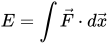


Thus, for example, the CGS unit of pressure, barye, is related to the CGS base units of length, mass, and time in the same way as the SI unit of pressure, pascal, is related to the SI base units of length, mass, and time:
- 1 unit of pressure = 1 unit of force / (1 unit of length)2 = 1 unit of mass / (1 unit of length × (1 unit of time)2)
- 1 Ba = 1 g/(cm⋅s2)
- 1 Pa = 1 kg/(m⋅s2).
Expressing a CGS derived unit in terms of the SI base units, or vice versa, requires combining the scale factors that relate the two systems:
- 1 Ba = 1 g/(cm⋅s2) = 10−3 kg / (10−2 m⋅s2) = 10−1 kg/(m⋅s2) = 10−1 Pa.
Definitions and conversion factors of CGS units in mechanics
[edit]| Quantity | Quantity symbol | CGS unit name | Unit symbol | Unit definition | In SI units |
|---|---|---|---|---|---|
| length, position | L, x | centimetre | cm | 1/100 of metre | 10−2 m |
| mass | m | gram | g | 1/1000 of kilogram | 10−3 kg |
| time | t | second | s | 1 second | 1 s |
| velocity | v | centimetre per second | cm/s | cm/s | 10−2 m/s |
| acceleration | a | gal | Gal | cm/s2 | 10−2 m/s2 |
| force | F | dyne | dyn | g⋅cm/s2 | 10−5 N |
| energy | E | erg | erg | g⋅cm2/s2 | 10−7 J |
| power | P | erg per second | erg/s | g⋅cm2/s3 | 10−7 W |
| pressure | p | barye | Ba | g/(cm⋅s2) | 10−1 Pa |
| dynamic viscosity | μ | poise | P | g/(cm⋅s) | 10−1 Pa⋅s |
| kinematic viscosity | ν | stokes | St | cm2/s | 10−4 m2/s |
| wavenumber | k | kayser | cm−1[14] or K | cm−1 | 100 m−1 |
Derivation of CGS units in electromagnetism
[edit]CGS approach to electromagnetic units
[edit]The conversion factors relating electromagnetic units in the CGS and SI systems are made more complex by the differences in the formulas expressing physical laws of electromagnetism as assumed by each system of units, specifically in the nature of the constants that appear in these formulas. This illustrates the fundamental difference in the ways the two systems are built:
- In SI, the unit of electric current, the ampere (A), was historically defined such that the magnetic force exerted by two infinitely long, thin, parallel wires 1 metre apart and carrying a current of 1 ampere is exactly 2×10⁻⁷ N/m. This definition results in all SI electromagnetic units being numerically consistent (subject to factors of some integer powers of 10) with those of the CGS-EMU system described in further sections. The ampere is a base unit of the SI system, with the same status as the metre, kilogram, and second. Thus the relationship in the definition of the ampere with the metre and newton is disregarded, and the ampere is not treated as dimensionally equivalent to any combination of other base units. As a result, electromagnetic laws in SI require an additional constant of proportionality (see Vacuum permeability) to relate electromagnetic units to kinematic units. (This constant of proportionality is derivable directly from the above definition of the ampere.) All other electric and magnetic units are derived from these four base units using the most basic common definitions: for example, electric charge q is defined as current I multiplied by time t, resulting in the unit of electric charge, the coulomb (C), being defined as 1 C = 1 A⋅s.
- The CGS system variant avoids introducing new base quantities and units, and instead defines all electromagnetic quantities by expressing the physical laws that relate electromagnetic phenomena to mechanics with only dimensionless constants, and hence all units for these quantities are directly derived from the centimetre, gram, and second.

Alternative derivations of CGS units in electromagnetism
[edit]Electromagnetic relationships to length, time and mass may be derived by several equally appealing methods. Two of them rely on the forces observed on charges. Two fundamental laws relate (seemingly independently of each other) the electric charge or its rate of change (electric current) to a mechanical quantity such as force. They can be written[12] in system-independent form as follows:
- The first is Coulomb's law, , which describes the electrostatic force F between electric charges and , separated by distance d. Here is a constant which depends on how exactly the unit of charge is derived from the base units.
- The second is Ampère's force law, , which describes the magnetic force F per unit length L between currents I and I′ flowing in two straight parallel wires of infinite length, separated by a distance d that is much greater than the wire diameters. Since and , the constant also depends on how the unit of charge is derived from the base units.


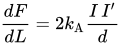


Maxwell's theory of electromagnetism relates these two laws to each other. It states that the ratio of the proportionality constants and must obey , where c is the speed of light in vacuum. Therefore, if one derives the unit of charge from Coulomb's law by setting then Ampère's force law will contain a factor . Alternatively, deriving the unit of current, and therefore the unit of charge, from Ampère's force law by setting or , will lead to a constant factor in Coulomb's law.


Indeed, both of these mutually exclusive approaches have been practiced by users of the CGS system, leading to the two independent and mutually exclusive branches of CGS, described in the subsections below. However, the freedom of choice in deriving electromagnetic units from the units of length, mass, and time is not limited to the definition of charge. While the electric field can be related to the work performed by it on a moving electric charge, the magnetic force is always perpendicular to the velocity of the moving charge, and thus the work performed by the magnetic field on any charge is always zero. This leads to a choice between two laws of magnetism, each relating magnetic field to mechanical quantities and electric charge:
- The first law describes the Lorentz force produced by a magnetic field B on a charge q moving with velocity v:
- The second describes the creation of a static magnetic field B by an electric current I of finite length dl at a point displaced by a vector r, known as the Biot–Savart law: where r and are the length and the unit vector in the direction of vector r respectively.

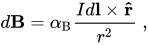

These two laws can be used to derive Ampère's force law above, resulting in the relationship: . Therefore, if the unit of charge is based on Ampère's force law such that , it is natural to derive the unit of magnetic field by setting . However, if it is not the case, a choice has to be made as to which of the two laws above is a more convenient basis for deriving the unit of magnetic field.


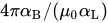
Furthermore, if we wish to describe the electric displacement field D and the magnetic field H in a medium other than vacuum, we need to also define the constants ε0 and μ0, which are the vacuum permittivity and permeability, respectively. Then we have[12] (generally) and , where P and M are polarisation density and magnetisation vectors. The units of P and M are usually so chosen that the factors 𝜆 and 𝜆′ are equal to the "rationalisation constants" and , respectively. If the rationalisation constants are equal, then . If they are equal to one, then the system is said to be "rationalised":[15] the laws for systems of spherical geometry contain factors of 4π (for example, point charges), those of cylindrical geometry factors of 2π (for example, wires), and those of planar geometry contain no factors of π (for example, parallel-plate capacitors). However, the original CGS system used 𝜆 = 𝜆′ = 4π, or, equivalently, . Therefore, Gaussian, ESU, and EMU subsystems of CGS (described below) are not rationalised.




Various extensions of the CGS system to electromagnetism
[edit]The table below shows the values of the above constants used in some common CGS subsystems:
| System | ||||||||
|---|---|---|---|---|---|---|---|---|
| Electrostatic[12] CGS (ESU, esu, or stat-) |
1 | c−2 | 1 | c−2 | c−2 | 1 | 4π | 4π |
| Electromagnetic[12] CGS (EMU, emu, or ab-) |
c2 | 1 | c−2 | 1 | 1 | 1 | 4π | 4π |
| Gaussian[12] CGS | 1 | c−1 | 1 | 1 | c−2 | c−1 | 4π | 4π |
| Heaviside–Lorentz[12] CGS | 1 | 1 | c−1 | 1 | 1 | |||
| SI | 1 | 1 | 1 |


In the CGS systems c = 2.9979 × 1010 cm/s, and in the SI system c = 2.9979 × 10⁸ m/s and b ≈ 107 A2/N = 107 m/H.
In each of these systems the quantities called "charge" etc. may be a different quantity; they are distinguished here by a superscript. The corresponding quantities of each system are related through a proportionality constant.
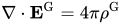
Maxwell's equations can be written in each of these systems as:[12][16]
| System | Gauss's law | Ampère–Maxwell law | Gauss's law for magnetism | Faraday's law |
|---|---|---|---|---|
| CGS-ESU | ||||
| CGS-EMU | ||||
| CGS-Gaussian | ||||
| CGS-Heaviside–Lorentz | ||||
| SI |










Electrostatic units (ESU)
[edit]In the electrostatic units variant of the CGS system, (CGS-ESU), charge is defined as the quantity that obeys a form of Coulomb's law without a multiplying constant (and current is then defined as charge per unit time):
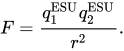
The ESU unit of charge, franklin (Fr), also known as statcoulomb or esu charge, is therefore defined as follows:[17]
two equal point charges spaced 1 centimetre apart are said to be of 1 franklin each if the electrostatic force between them is 1 dyne.
Therefore, in CGS-ESU, a franklin is equal to a centimetre times square root of dyne:

The unit of current is defined as:

In the CGS-ESU system, charge q therefore has the dimension of M1/2L3/2T−1.
Other units in the CGS-ESU system include the statampere (1 statC/s) and statvolt (1 erg/statC).
In CGS-ESU, all electric and magnetic quantities are dimensionally expressible in terms of length, mass, and time, and none has an independent dimension. Such a system of units of electromagnetism, in which the dimensions of all electric and magnetic quantities are expressible in terms of the mechanical dimensions of mass, length, and time, is traditionally called an 'absolute system'.[18]:3
ESU notation
[edit]All electromagnetic units in the CGS-ESU system that do not have proper names are denoted by a corresponding SI name with an attached prefix "stat" or with a separate abbreviation "esu".[17] The franklin was introduced as a fourth ESU base unit; it is not strictly identical with the statcoulomb. (The unit of permittivity is also sometimes used as a fourth base unit.)
Electromagnetic units (EMU)
[edit]In another variant of the CGS system, electromagnetic units (EMU), current is defined via the force existing between two thin, parallel, infinitely long wires carrying it, and charge is then defined as current multiplied by time. (This approach was eventually used to define the SI unit of ampere as well).
The EMU unit of current, biot (Bi), also known as abampere or emu current, is therefore defined as follows:[17]
The biot is that constant current which, if maintained in two straight parallel conductors of infinite length, of negligible circular cross-section, and placed one centimetre apart in vacuum, would produce between these conductors a force equal to two dynes per centimetre of length.
Therefore, in electromagnetic CGS units, a biot is equal to a square root of dyne:

The unit of charge in CGS EMU is:

Dimensionally in the CGS-EMU system, charge q is therefore equivalent to M1/2L1/2. Hence, neither charge nor current is an independent physical quantity in the CGS-EMU system.
EMU notation
[edit]All electromagnetic units in the CGS-EMU system that do not have proper names are denoted by a corresponding SI name with an attached prefix "ab" or with a separate abbreviation "emu".[17] The biot was introduced as a fourth EMU base unit; it is not strictly identical with the abampere. (The unit of permeability is also sometimes used as a fourth base unit.) EMU magnetic unit names formed from abampere, biot, or abvolt should not be used for Gaussian units; other names should be used instead, e.g., oersted, gilbert, erg per gauss, and maxwell (abtesla and abweber are rarely used even with EMU).
Practical CGS units
[edit]The practical CGS system is a hybrid system that uses the volt and the ampere as the units of voltage and current respectively. Doing this avoids the inconveniently large and small electrical units that arise in the esu and emu systems. This system was at one time widely used by electrical engineers because the volt and ampere had been adopted as international standard units by the International Electrical Congress of 1881.[19] As well as the volt and ampere, the farad (capacitance), ohm (resistance), coulomb (electric charge), and henry (inductance) are consequently also used in the practical system and are the same as the SI units. The magnetic units are those of the emu system.[20]
The electrical units, other than the volt and ampere, are determined by the requirement that any equation involving only electrical and kinematical quantities that is valid in SI should also be valid in the system. For example, since electric field strength is voltage per unit length, its unit is the volt per centimetre, which is one hundred times the SI unit.
The system is electrically rationalised and magnetically unrationalised; i.e., 𝜆 = 1 and 𝜆′ = 4π, but the above formula for 𝜆 is invalid. A closely related system is the International System of Electric and Magnetic Units,[21] which has a different unit of mass so that the formula for 𝜆′ is invalid. The unit of mass was chosen to remove powers of ten from contexts in which they were considered to be objectionable (e.g., P = VI and F = qE). Inevitably, the powers of ten reappeared in other contexts, but the effect was to make the familiar joule and watt the units of work and power respectively.
The ampere-turn system is constructed in a similar way by considering magnetomotive force and magnetic field strength to be electrical quantities and rationalising the system by dividing the units of magnetic pole strength and magnetisation by 4π. The units of the first two quantities are the ampere and the ampere per centimetre respectively. The unit of magnetic permeability is that of the emu system, and the magnetic constitutive equations are B = (4π/10)μH and B = (4π/10)μ0H + μ0M. Magnetic reluctance is given a hybrid unit to ensure the validity of Ohm's law for magnetic circuits.
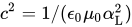
In all the practical systems ε0 = 8.8542 × 10⁻¹⁴ A⋅s/(V⋅cm), μ0 = 1 V⋅s/(A⋅cm), and c2 = 1/(4π × 10−9 ε0μ0). Maxwell's equations in free space are also the same in all the systems.
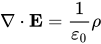
| Name | All systems in vacuum |
Gilbert systems in matter |
Ampere-turn systems in matter |
|---|---|---|---|
| Gauss's law | |||
| Gauss's law for magnetism | |||
| Faraday's law of induction | |||
| Ampère–Maxwell equation |


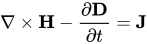
In the practical systems inductance is considered to be an electrical quantity and is defined by L = 10−8 NΦB/I.[23]
Other variants
[edit]There were at various points in time about half a dozen systems of electromagnetic units in use, most based on the CGS system.[24] These include the Gaussian units and the Heaviside–Lorentz units.
Electromagnetic units in various CGS systems
[edit]| Quantity | Symbol | SI unit | ESU unit | Gaussian unit | EMU unit |
|---|---|---|---|---|---|
| electric charge | q | 1 C | ≘ (10−1 c) statC (Fr) | ≘ (10−1) abC | |
| electric current | I | 1 A | ≘ (10−1 c) statA (Fr/s) | ≘ (10−1) abA (Bi) | |
| electric potential / voltage | φ / V, E | 1 V | ≘ (108 c−1) statV (erg/Fr) | ≘ (108) abV | |
| electric field | E | 1 V/m | ≘ (106 c−1) statV/cm (dyn/Fr) | ≘ (106) abV/cm | |
| electric displacement field | D | 1 C/m2 | ≘ (4π × 10−5 c) statC/cm2 | ≘ (4π × 10−5) abC/cm2 | |
| electric dipole moment | p | 1 C⋅m | ≘ (10 c) statC⋅cm | ≘ (10) abC⋅cm | |
| electric flux | Φe | 1 C | ≘ (4π × 10−1 c) statC | ≘ (4π × 10−1) abC | |
| permittivity | ε | 1 F/m | ≘ (4π × 10−11 c2) cm/cm | ≘ (4π × 10−11) s2/cm2 | |
| resistance | R | 1 Ω | ≘ (109 c−2) statΩ (s/cm) | ≘ (109) abΩ | |
| resistivity | ρ | 1 Ω⋅m | ≘ (1011 c−2) statΩ⋅cm (s) | ≘ (1011) abΩ⋅cm | |
| capacitance | C | 1 F | ≘ (10−9 c2) statF (cm) | ≘ (10−9) abF | |
| inductance | L | 1 H | ≘ (109 c−2) statH (s2/cm) | ≘ (109) abH | |
| magnetic B field | B | 1 T | ≘ (104 c−1) statT | ≘ (104) G | |
| magnetic H field | H | 1 A/m | ≘ (4π × 10−3 c) statA/cm | ≘ (4π × 10−3) Oe | |
| magnetic dipole moment | μ | 1 A⋅m2 | ≘ (103 c) statA⋅cm2 | ≘ (103) erg/G | |
| magnetic flux | Φm | 1 Wb | ≘ (108 c−1) statWb | ≘ (108) Mx | |
| permeability | μ | 1 H/m | ≘ ((4π)−1 × 10⁷ c−2) s2/cm2 | ≘ ((4π)−1 × 10⁷) cm/cm | |
| magnetomotive force | 1 A | ≘ (4π × 10−1 c) statA | ≘ (4π × 10−1) Gi | ||
| magnetic reluctance | 1 H−1 | ≘ (4π × 10−9 c2) statH−1 | ≘ (4π × 10−9) Gi/Mx | ||


In this table, c = 29979245800 is the numeric value of the speed of light in vacuum when expressed in units of centimetres per second. The symbol "≘" is used instead of "=" as a reminder that the units are corresponding but not equal. For example, according to the capacitance row of the table, if a capacitor has a capacitance of 1 F in SI, then it has a capacitance of (10−9 c2) cm in ESU; but it is incorrect to replace "1 F" with "(10−9 c2) cm" within an equation or formula. (This warning is a special aspect of electromagnetism units. By contrast it is always correct to replace, e.g., "1 m" with "100 cm" within an equation or formula.)
Physical constants in CGS units
[edit]| Constant | Symbol | Value |
|---|---|---|
| atomic mass constant | mu | 1.660539069×10⁻²⁴ g |
| Bohr magneton | μB | 9.274010066×10⁻²¹ erg/G (EMU, Gaussian) |
| 2.780278273×10⁻¹⁰ statA⋅cm2 (ESU) | ||
| Bohr radius | a0 | 5.291772105×10⁻⁹ cm |
| Boltzmann constant | k | 1.380649×10⁻¹⁶ erg/K |
| electron mass | me | 9.10938371×10⁻²⁸ g |
| elementary charge | e | 4.80320471×10⁻¹⁰ Fr (ESU, Gaussian) |
| 1.602176634×10⁻²⁰ abC (EMU) | ||
| fine-structure constant | α | 0.007297352564 |
| Newtonian constant of gravitation | G | 6.6743×10⁻⁸ dyn⋅cm2/g2 |
| Planck constant | h | 6.62607015×10⁻²⁷ erg⋅s |
| reduced Planck constant | ħ | 1.054571817×10⁻²⁷ erg⋅s |
| speed of light | c | 2.99792458×1010 cm/s |
Advantages and disadvantages
[edit] |
Lack of unique unit names leads to potential confusion: "15 emu" may mean either 15 abvolts, or 15 emu units of electric dipole moment, or 15 emu units of magnetic susceptibility, sometimes (but not always) per gram, or per mole. With its system of uniquely named units, the SI removes any confusion in usage: 1 ampere is a fixed value of a specified quantity, and so are 1 henry, 1 ohm, and 1 volt.
In the CGS-Gaussian system, electric and magnetic fields have the same units, 4πε0 is replaced by 1, and the only dimensional constant appearing in the Maxwell equations is c, the speed of light. The Heaviside–Lorentz system has these properties as well (with ε0 equaling 1).
In SI, and other rationalised systems (for example, Heaviside–Lorentz), the unit of current was chosen such that electromagnetic equations concerning charged spheres contain 4π, those concerning coils of current and straight wires contain 2π and those dealing with charged surfaces lack π entirely, which was the most convenient choice for applications in electrical engineering and relates directly to the geometric symmetry of the system being described by the equation.
Specialised unit systems are used to simplify formulas further than either SI or CGS do, by eliminating constants through a convention of normalising quantities with respect to some system of natural units. For example, in particle physics a system is in use where every quantity is expressed by only one unit of energy, the electronvolt, with lengths, times, and so on all converted into units of energy by inserting factors of speed of light c and the reduced Planck constant ħ. This unit system is convenient for calculations in particle physics, but is impractical in other contexts.
See also
[edit]References and notes
[edit]- ^ "Centimetre-gram-second system | physics". Encyclopedia Britannica. Retrieved 2018-03-27.[failed verification]
- ^ "The Centimeter-Gram-Second (CGS) System of Units – Maple Programming Help". www.maplesoft.com. Retrieved 2018-03-27.
- ^ Carron, Neal J. (21 May 2015). "Babel of units: The evolution of units systems in classical electromagnetism". arXiv:1506.01951 [physics.hist-ph].
- ^ Jackson, J. D. Classical Electrodynamics, 3rd ed. Wiley, 1999.
- ^ Mohr, Peter J.; Newell, David B.; Taylor, Barry N. “CODATA Recommended Values of the Fundamental Physical Constants: 2014.” Rev. Mod. Phys. 88 (3), 035009 (2016).
- ^ Gauss, C. F. (1832), "Intensitas vis magneticae terrestris ad mensuram absolutam revocata", Commentationes Societatis Regiae Scientiarum Gottingensis Recentiores, 8: 3–44. English translation
- ^ Hallock, William; Wade, Herbert Treadwell (1906). Outlines of the evolution of weights and measures and the metric system. New York: The Macmillan Co. p. 200.
- ^ Thomson, Sir W; Foster, Professor GC; Maxwell, Professor JC; Stoney, Mr GJ; Jenkin, Professor Fleeming; Siemens, Dr; Bramwell, Mr FJ (September 1873). Everett, Professor (ed.). First Report of the Committee for the Selection and Nomenclature of Dynamical and Electrical Units. Forty-third Meeting of the British Association for the Advancement of Science. Bradford: John Murray. p. 223. Retrieved 2012-04-08.
- ^ Thompson, Ambler; Taylor, Barry N. (March 2008). Guide for the Use of the International System of Units (SI) (PDF) (Report). p. 10. Retrieved March 3, 2024.
- ^ Waldron, Anne; Judd, Peggy; Miller, Valerie (February 1993), Physical Review Style and Notation Guide (PDF), American Physical Society, p. 15, retrieved March 3, 2024
- ^ Wilkins, George A. (1989), The IAU Style Manual (PDF), International Astronomical Union, p. 20, retrieved March 3, 2024
- ^ a b c d e f g h Jackson, John David (1999). Classical Electrodynamics (3rd ed.). New York: Wiley. pp. 775–784. ISBN 0-471-30932-X.
- ^ Weisstein, Eric W. "cgs". Eric Weisstein's World of Physics.
- ^ "Atomic Spectroscopy". Atomic Spectroscopy. NIST. Retrieved 25 October 2015.
- ^ Cardarelli, F. (2004). Encyclopaedia of Scientific Units, Weights and Measures: Their SI Equivalences and Origins (2nd ed.). Springer. p. 20. ISBN 1-85233-682-X.
- ^ Leung, P. T. (2004). "A note on the 'system-free' expressions of Maxwell's equations". European Journal of Physics. 25 (2): N1 – N4. Bibcode:2004EJPh...25N...1L. doi:10.1088/0143-0807/25/2/N01. S2CID 43177051.
- ^ a b c d e Cardarelli, F. (2004). Encyclopaedia of Scientific Units, Weights and Measures: Their SI Equivalences and Origins (2nd ed.). Springer. pp. 20–25. ISBN 1-85233-682-X.
- ^ Fenna, Donald (2002). A Dictionary of Weights, Measures, and Units. Oxford University Press. ISBN 978-0-19-107898-9.
- ^ Tunbridge, Paul (1992). Lord Kelvin: His Influence on Electrical Measurements and Units. IET. pp. 34–40. ISBN 0-86341-237-8.
- ^ Knoepfel, Heinz E. (2000). Magnetic Fields: A Comprehensive Theoretical Treatise for Practical Use. Wiley. p. 543. ISBN 3-527-61742-6.
- ^ Dellinger, John Howard (1916). International System of Electric and Magnetic Units. Washington, D.C.: U.S. Government Printing Office.
- ^ Knoepfel, p. 542.
- ^ Dellinger, p. 625.
- ^ Bennett, L. H.; Page, C. H.; Swartzendruber, L. J. (1978). "Comments on units in magnetism". Journal of Research of the National Bureau of Standards. 83 (1): 9–12. doi:10.6028/jres.083.002. PMC 6752159. PMID 34565970.
- ^ Gray, Truman S. (1954). Applied Electronics. New York: John Wiley & Sons, Inc. pp. 830–831, Appendix B.
- ^ A.P. French; Edwind F. Taylor (1978). An Introduction to Quantum Physics. W.W. Norton & Company.
General literature
[edit]- Griffiths, David J. (1999). "Appendix C: Units". Introduction to Electrodynamics (3rd ed.). Prentice Hall. ISBN 0-13-805326-X.
- Jackson, John D. (1999). "Appendix on Units and Dimensions". Classical Electrodynamics (3rd ed.). Wiley. ISBN 0-471-30932-X.
- Kent, William (1900). "Electrical Engineering. Standards of Measurement page 1024". The Mechanical Engineer's Pocket-book (5th ed.). Wiley.
- Littlejohn, Robert (Fall 2017). "Gaussian, SI and Other Systems of Units in Electromagnetic Theory" (PDF). Physics 221A, University of California, Berkeley lecture notes. Archived (PDF) from the original on 2015-12-11. Retrieved 2017-12-15.
Centimetre–gram–second system of units
View on GrokipediaOverview and Principles
Core Components and Base Units
The centimetre–gram–second (CGS) system of units establishes a coherent metric framework for mechanical measurements using three fundamental base units: the centimetre (cm) for length, the gram (g) for mass, and the second (s) for time. These units were selected by the British Association for the Advancement of Science (BAAS) in 1874 to form a three-dimensional system compatible with the emerging metric standards, emphasizing decimal scalability and practicality for laboratory-scale experiments where smaller magnitudes are common.[9] The centimetre derives from the French centimètre, combining Latin centum ("hundred") with mètre (from Greek metron, "measure"), defined as one-hundredth of the metre to facilitate precise measurements of modest distances.[10] The gram, originally the mass of one cubic centimetre of water at 4 °C, stems etymologically from Greek gramma ("small weight" or "letter"), providing a reproducible mass standard tied to volume.[11] The second, retained from earlier astronomical conventions as 1/86,400 of the mean solar day, originates from Latin secundus ("following" or "second"), denoting the second sexagesimal division of the hour after the minute.[12][13] This trio of base units enables the derivation of all mechanical quantities through algebraic combinations, eliminating the need for additional bases like temperature or luminous intensity required in more expansive systems. For instance, velocity emerges as cm/s, acceleration as cm/s², and density as g/cm³, ensuring dimensional consistency across kinematics, dynamics, and statics. The system's metric foundation—rooted in decimal prefixes like centi- for 10^{-2}—promotes ease of scaling, while the gram's linkage to water's density underscores a natural, reproducible basis for mass, historically proposed by the French Academy of Sciences in 1795 and adapted into CGS for broader scientific utility.[9][14] Key derived units exemplify this coherence in mechanical contexts. The dyne (dyn), unit of force, is defined as the force imparting an acceleration of 1 cm/s² to a 1 g mass, expressed as[13] The erg (erg), unit of energy or work, represents the work done by 1 dyne over 1 cm, or
This unit derives directly from the base quantities, highlighting CGS's emphasis on absolute, non-empirical definitions for energy in gravitational and kinetic forms.[13] For fluid dynamics, the poise (P), unit of dynamic viscosity, quantifies the shear stress in a fluid as 1 dyne per square centimetre for a 1 cm/s velocity gradient across 1 cm, or
Named after Jean Léonard Marie Poiseuille for his foundational work on laminar flow, the poise integrates force, time, and area to capture viscous resistance without invoking extraneous constants.[13]
Relation to Other Unit Systems
The centimetre–gram–second (CGS) system is a variant of the metric system, employing the centimetre for length, gram for mass, and second for time as its base units, in contrast to the meter-kilogram-second (MKS) system that underpins the International System of Units (SI) with larger base magnitudes.[1] This difference in scale makes CGS particularly suited for describing phenomena at microscopic levels, such as in atomic physics, where the smaller units yield numerical values closer to unity for fundamental constants and quantities, facilitating theoretical calculations without excessive powers of ten.[15] CGS qualifies as an absolute and coherent unit system, wherein derived units like force (dyne) and energy (erg) emerge directly as products or quotients of the base units, without arbitrary scaling factors or defined multiples, unlike some practical systems that introduce such conventions for convenience.[16] The SI, while also coherent, extends the MKS framework into a four-dimensional system by incorporating an ampere base unit for electromagnetism, creating a unified structure that CGS approaches differently through its mechanical focus.[1] In handling electromagnetism, CGS diverges notably from rationalized systems like SI, employing an unrationalized framework—often Gaussian units—where constants such as the speed of light appear explicitly in equations and factors of reside in Maxwell's equations rather than in force laws, promoting symmetry between electric and magnetic fields but complicating some practical applications.[17] This approach contrasts with SI's rationalization, which distributes to simplify integral forms and integrates permeability and permittivity constants ( and ) to enhance coherence across electrical engineering contexts.[7]Historical Context
Origins and Early Development
The centimetre–gram–second (CGS) system of units emerged in the 19th century amid growing demands for a coherent, absolute measurement framework in physics, particularly to unify mechanical and electromagnetic phenomena without relying on arbitrary constants or non-metric units. This need arose from the limitations of earlier systems, such as the foot-pound-second (FPS) units prevalent in Britain, which complicated calculations in emerging fields like electromagnetism. Influenced by the French metric system established in the 1790s—based on natural standards like the metre for length and gram for mass—scientists sought a decimal-compatible alternative that prioritized simplicity and universality for theoretical work.[14] The foundational proposal for CGS traces to 1832, when German mathematician Carl Friedrich Gauss introduced an absolute system for magnetic measurements using the centimetre, gram, and second as base units, enabling direct expression of magnetic intensity without additional scaling factors. Gauss's approach, developed during his geomagnetic research at Göttingen University, emphasized units derived solely from mechanical principles to ensure consistency across physical domains. Wilhelm Weber, Gauss's collaborator, extended this in the 1830s and 1840s by defining electrical units within the same framework, laying the groundwork for a comprehensive CGS electromagnetic system that integrated current, charge, and potential. These German innovations addressed the practical challenges of precise instrumentation in early electrical experiments, promoting adoption among continental European physicists.[18][14] By the 1870s, the British Association for the Advancement of Science (BAAS) played a pivotal role in formalizing CGS for broader scientific use. A BAAS committee, including James Clerk Maxwell and William Thomson (Lord Kelvin), recommended in 1873 the adoption of centimetre, gram, and second as base units, building on the metric-inspired absolute system to standardize electrical resistance and other quantities. Maxwell, in his 1873 treatise A Treatise on Electricity and Magnetism, explicitly employed CGS units to articulate his unified theory of electromagnetism, demonstrating how the system facilitated elegant formulations of electric and magnetic fields without dimensional inconsistencies. This work highlighted CGS's suitability for theoretical physics, influencing its rapid uptake in French and German academic communities during the late 1800s, where it became the preferred framework for laboratory and theoretical research in mechanics and electromagnetism.[14][19] The system's international momentum grew with its inclusion in discussions at the 1881 International Electrical Congress in Paris, where delegates endorsed BAAS's CGS-based definitions for key electrical units like the ohm and ampere, marking a key step toward global coherence despite ongoing debates over practical versus absolute measurements. This event, hosted under French auspices, underscored CGS's alignment with metric principles and its value for cross-border scientific collaboration, solidifying early adoption in European physics circles before broader standardization efforts in the 20th century.[14][20]Standardization and Key Milestones
The standardization of the centimetre–gram–second (CGS) system gained momentum through international scientific bodies in the late 19th and early 20th centuries, building on James Clerk Maxwell's work for a coherent metric framework in electromagnetism. These bodies recognized CGS variants as foundational for absolute measurements, particularly in addressing the integration of electrical units into the metric framework to ensure consistency across scientific disciplines.[14] The development of electrostatic units (ESU) and electromagnetic units (EMU) within the CGS framework occurred primarily in the late 19th century but saw formal refinements in the early 1900s to accommodate advancing electromagnetic theory. At the first International Electrical Congress in Paris in 1881, delegates adopted the CGS-EMU as the international standard for practical electrical measurements, with ESU defined analogously for electrostatic phenomena, establishing these as complementary subsystems to the mechanical CGS base units.[21] Key milestones in CGS evolution include the 1888 introduction by Heinrich Hertz of Gaussian units—a hybrid of ESU and EMU that simplifies Maxwell's equations by setting the speed of light to unity in vacuum—widely adopted by American physicists for theoretical work in electromagnetism. Post-World War II, CGS persisted prominently in Soviet and U.S. physics literature, appearing in textbooks and research on theoretical physics due to its convenience in handling Gaussian formulations, even as practical engineering shifted toward other systems.[22] The promotion of the International System of Units (SI) by the 11th General Conference on Weights and Measures in 1960 marked the beginning of CGS's decline, as SI's metre-kilogram-second base with rationalized electrical units offered greater coherence for international standardization and technology. Despite this, CGS, particularly the Gaussian variant, retained niche applications in fields like astrophysics, where its use facilitates compact expressions for phenomena involving vast scales and electromagnetic processes in stellar and cosmic contexts.[23][24]Mechanical Units
Definitions of Base and Derived Units
The centimetre–gram–second (CGS) system employs three base units for mechanical quantities: the centimetre (cm) for length, the gram (g) for mass, and the second (s) for time.[16] These units form the foundation for all derived mechanical units, ensuring a coherent system where physical equations, such as Newton's second law , hold without additional scaling factors.[16] Velocity in the CGS system is defined as the rate of change of displacement with respect to time, yielding the unit centimetre per second (cm/s). Acceleration, the rate of change of velocity, is thus expressed in centimetres per second squared (cm/s²). Force, derived from , is the product of mass and acceleration, resulting in the dyne (dyn), defined as the force required to accelerate one gram by one centimetre per second squared, or .[13] Momentum, the product of mass and velocity, has the unit gram-centimetre per second (g·cm/s).[13] Energy, or work, in CGS is the product of force and distance, defining the erg as the work done by one dyne over one centimetre, equivalently . Power, the rate of energy transfer, is then energy per unit time, giving the unit erg per second (erg/s). Pressure is force per unit area, leading to the barye (Ba), defined as one dyne per square centimetre, or . Kinematic viscosity, area per unit time, uses the stokes (St), equivalent to one square centimetre per second (cm²/s).[13][25]Conversion Factors and Examples
The centimetre–gram–second (CGS) mechanical units relate to their International System of Units (SI) counterparts through simple power-of-ten factors, enabling direct conversions without complex multipliers. The base mass unit in CGS is the gram (g), defined as exactly kilograms (kg). The derived force unit, the dyne (dyn), equals the force needed to accelerate 1 g by 1 cm/s², corresponding to newtons (N). Similarly, the energy unit, the erg, represents 1 dyn·cm and converts to joules (J). These relations stem from the definitions of the centimetre as m and the gram as kg, preserving coherence within the system.[13][26] Practical examples highlight the scale of CGS units in everyday mechanics. The standard acceleration due to gravity near Earth's surface is 980.665 cm/s² in CGS, equivalent to 9.80665 m/s² in SI. Thus, the gravitational force on a 1 g mass—such as a small paperclip—is approximately 981 dynes, demonstrating how CGS suits microscale or laboratory measurements where forces are modest. For a human-scale scenario, lifting a 1 kg mass (1000 g) against gravity demands about 981,000 dynes, or roughly 9.81 N, underscoring the need for prefixes to manage larger values intuitively.[27][27] CGS accommodates scalability through standard metric prefixes, identical to those in SI, applied to base and derived units for expressing extreme ranges without altering the system's structure. For instance, a microgram (μg = g) quantifies minuscule masses like dust particles, while a megadyne (Mdyne = dyn) handles substantial forces, such as those in mechanical engineering tests. This prefix system ensures consistency, as 1 kilodyne (kdyne = dyn) equals N, maintaining easy traceability to SI equivalents. Users of CGS, especially when consulting older textbooks, often encounter pitfalls from inadvertently mixing units across systems, resulting in errors scaled by powers of 10. For example, treating a gram as equivalent to a kilogram in force calculations can overestimate results by a factor of 1000, a frequent issue in legacy scientific literature before widespread SI adoption. Careful verification of unit consistency, as emphasized in metrology guides, mitigates such risks.[13]Electromagnetic Units
Fundamental Approach to EM in CGS
The centimetre–gram–second (CGS) system treats electromagnetism by deriving all electrical and magnetic quantities directly from its mechanical base units of length (centimetre), mass (gram), and time (second), avoiding the introduction of independent base units for charge or current as required in the SI system. This approach ensures a seamless integration of mechanical and electromagnetic phenomena, where the speed of light arises naturally as a conversion factor between electric and magnetic units, reflecting the fundamental linkage between electrostatic and magnetostatic interactions. In the Gaussian variant of CGS units, the vacuum permittivity and permeability are both set to unity, simplifying the structure of Maxwell's equations by absorbing these constants into the definitions of fields and sources, thereby emphasizing the relativistic symmetry of electromagnetism.[28][29] A key distinction from the SI system lies in the absence of extraneous constants like or in the core laws of electromagnetism. For instance, in the CGS electrostatic units (ESU), the force between two point charges and separated by distance is given simply by where is in dynes, charges in statcoulombs, and in centimetres, eliminating the need for an explicit Coulomb constant and facilitating cleaner theoretical derivations. This contrasts with SI, where the force law includes , introducing geometric factors that can complicate symbolic manipulations in advanced calculations.[30][31] The CGS electromagnetic framework is organized into three main subsystems to handle different aspects of the theory: the ESU system, which prioritizes electrostatic interactions by defining charge from Coulomb's law; the electromagnetic units (EMU) system, which bases magnetic quantities on the force between steady currents; and the Gaussian system, a hybrid that merges ESU for electric fields with EMU for magnetic fields, adjusted by factors of to ensure dimensional consistency and symmetry between and in Maxwell's equations. This structure allows flexibility for specialized applications while maintaining coherence with mechanical units.[32][33] Historically, the derivation of electromagnetic equations in CGS traces back to James Clerk Maxwell's 1860s formulations, originally expressed in a non-metric system resembling EMU, where the displacement current term introduced implicitly through empirical relations. The shift to CGS bases occurred in the late 19th century to align with the emerging metric standards for mechanics, with the Gaussian variant formalized around 1900 by Oliver Heaviside and others to rationalize the equations for emerging theories like relativity, where 's explicit presence underscores the unity of electric and magnetic phenomena.[34][17]Electrostatic Units (ESU)
The electrostatic units (ESU) subsystem within the centimetre–gram–second (CGS) system provides a framework for measuring electrostatic quantities by deriving them directly from the mechanical base units of length (centimetre), mass (gram), and time (second), with a focus on charge and its interactions. This approach ensures that electrostatic forces are expressed in terms of mechanical force (dyne), emphasizing the unity between electrostatics and mechanics without introducing additional fundamental constants for permittivity.[17] The foundational unit in ESU is the statcoulomb (statC), the unit of electric charge, defined such that two point charges of one statcoulomb each, separated by one centimetre in vacuum, repel each other with a force of exactly one dyne.[35] This definition implies that the charge has dimensions of , where is force and is length.[24] Consequently, Coulomb's law in ESU simplifies to where is in dynes, and are in statcoulombs, and is in centimetres; notably, the factor from SI units is absent, as the system's structure absorbs it into the unit definitions.[36] Historically, the statcoulomb was also denoted simply as "esu" for charge.[31] Derived units in ESU build on the statcoulomb to quantify related quantities. The statvolt (statV), the unit of electric potential, is the potential difference across which one statcoulomb of charge experiences a work of one erg (equivalent to one dyne-centimetre); dimensionally, this yields , or equivalently .[37] The unit of electric field strength is then one statvolt per centimetre (statV/cm), which corresponds to the force of one dyne exerted on a charge of one statcoulomb, giving dimensions of . For capacitance, the statfarad (statF) is defined as the capacitance that stores one statcoulomb at a potential difference of one statvolt, resulting in dimensions of one centimetre, as . These derivations highlight the ESU's emphasis on geometric simplicity, where capacitance aligns directly with length scales in electrostatic configurations.Electromagnetic Units (EMU)
The electromagnetic units (EMU) subsystem within the centimetre–gram–second (CGS) system defines electromagnetic quantities primarily through mechanical interactions, such as the force between current-carrying conductors, emphasizing magnetic and current-based measurements. This approach derives units from the base mechanical units of centimetre for length, gram for mass, and second for time, ensuring consistency with Newtonian mechanics while incorporating electromagnetic phenomena via empirical laws like Ampère's. Unlike the electrostatic units (ESU), which prioritize charge-based definitions, EMU focuses on current and magnetic fields, making it particularly suited for magnetostatics and early electrical engineering applications. The base unit of electric current in EMU is the abampere (symbol: abA or Bi), defined as the steady current that, maintained in two straight, parallel, infinitely long conductors spaced 1 cm apart in vacuum, produces a force of 2 dynes per centimetre of length between them. This definition aligns with Ampère's force law, where the force per unit length between such conductors carrying currents and separated by distance is given by . One abampere equals 10 amperes in the International System of Units (SI). The unit of electromotive force is the abvolt (abV), defined as the potential difference required to drive 1 abampere through a resistance of 1 abohm; it equals volts in SI. The maxwell (Mx) serves as the base unit of magnetic flux, representing the flux that, when linking a single-turn coil of 1 cm² area and changing at a rate of 1 maxwell per second, induces an electromotive force of 1 abvolt; 1 maxwell equals webers in SI.[38] Derived units in EMU build upon these bases to quantify magnetic fields and related properties. The oersted (Oe) is the unit of magnetic field strength , defined as the field intensity exerting a force of 1 dyne on a unit magnetic pole in vacuum; it corresponds to approximately 79.58 amperes per metre in SI. The gauss (G) is the unit of magnetic flux density , equivalent to 1 maxwell per square centimetre, and equals teslas in SI. Resistance is measured in abohms (abΩ), where 1 abohm is the resistance carrying 1 abampere under 1 abvolt; it equals ohms in SI. In EMU notation, the "ab-" prefix denotes electromagnetic-derived units, such as the abfarad (abF) for capacitance, which equals farads in SI, highlighting the scale differences from SI due to the mechanical base. These units facilitate calculations in magnetostatics, where, for instance, Ampère's circuital law takes the form for enclosed current in abamperes, without additional constants in vacuum.[38]Gaussian and Heaviside-Lorentz Variants
The Gaussian units represent a hybrid variant of the CGS electromagnetic system that integrates elements from both the electrostatic (ESU) and electromagnetic (EMU) subsystems, achieving symmetry in Maxwell's equations by explicitly incorporating the speed of light into key formulas.[17] In this system, the unit of electric charge is defined such that Coulomb's law takes the simple form dynes, mirroring the ESU convention, while magnetic interactions are scaled to blend with EMU through the relation where the emu unit of charge (biot or abcoulomb) equals times the esu unit of charge (statcoulomb), where is the speed of light in cm/s.[28] A hallmark is the Lorentz force law, expressed as , where cm/s ensures dimensional consistency between electric and magnetic contributions.[39] For magnetism, the system employs the concept of a unit pole, defined such that the force between two unit magnetic poles separated by 1 cm is 1 dyne, leading to the unit of magnetic field strength and induction as the gauss. In Gaussian units, 1 gauss has dimensions of statcoulomb per (centimetre squared times centimetre per second), reflecting relations from the Biot-Savart law.[40] The Heaviside-Lorentz units constitute a rationalized extension of the Gaussian system, designed to eliminate extraneous factors of for enhanced symmetry in relativistic and quantum contexts.[41] Proposed by Oliver Heaviside in 1885 and refined by Hendrik Lorentz, this variant modifies Gauss's approach by redefining units such that Gauss's law becomes instead of , with corresponding adjustments to Ampère's law and other equations to remove the in source terms.[42] The Lorentz force retains the form , as in Gaussian units, with the rationalization affecting field and source scalings instead; magnetic fields are scaled by .[16] This rationalization simplifies calculations in particle physics by aligning more closely with natural units where .[41] Conversions between these variants and the base CGS systems highlight their interconnections; for instance, the dimensional relation for the gauss as described above reflects the scaling by . To convert from Gaussian to Heaviside-Lorentz, electric and magnetic fields are multiplied by , charges by , ensuring Maxwell's equations retain their form without adjustment.[39] These transformations preserve the underlying physics while adapting to the variant's conventions. Gaussian units predominate in theoretical physics literature due to their natural emergence in derivations involving relativity and quantum field theory, as seen in standard texts like Jackson's Classical Electrodynamics.[43] Heaviside-Lorentz units, conversely, find favor in high-energy particle physics for their streamlined handling of symmetries, exemplified in works like Peskin and Schroeder's An Introduction to Quantum Field Theory, where they facilitate compact expressions for interactions.[41]Practical and Specialized Applications
Everyday and Engineering Units
In the centimetre–gram–second (CGS) system, practical units were developed to address the often inconvenient magnitudes of absolute CGS units in engineering and everyday applications, incorporating scaling factors such as powers of 10 to align better with human-scale measurements.[13] These units maintain the core CGS base quantities but adjust derived units for practicality, such as in mechanics and electromagnetism, without altering the fundamental definitions of length, mass, and time. A prominent example in mechanical engineering and geodesy is the gal (Gal), defined as an acceleration of 1 cm/s², which provides a convenient scale for measuring gravitational variations on Earth, where typical values range from 976 to 983 Gal at the surface.[44][13] Similarly, the barye (Ba) serves as the practical CGS unit of pressure, equivalent to 1 dyne per square centimetre (dyn/cm²), and is applied in fluid dynamics to quantify pressures in low-viscosity flows or acoustic waves, where it equals 0.1 pascals for easier comparison with SI metrics.[45] For power, the erg per second (erg/s) represents the rate of energy transfer in absolute CGS terms, but it found use in early 20th-century engineering contexts, such as rating the output of industrial machines, where 10^7 erg/s defines the watt to bridge CGS calculations with practical machinery performance.[46] In photometry, the stilb (sb) acts as a practical unit of luminance, defined as 1 candela per square centimetre (cd/cm²), facilitating measurements of surface brightness in lighting engineering for non-self-luminous objects, equivalent to 10^4 nits.[47] Electromagnetic practical units include the biot (Bi), a unit of current synonymous with the abampere and equal to 10 amperes, which simplifies calculations in electrical engineering by avoiding small numerical values in wire current flows.[48] The gilbert (Gb), meanwhile, measures magnetomotive force in CGS-EMU, defined as 10/(4π) ampere-turns or approximately 0.7958 ampere-turns, and was adopted for convenience in magnetic circuit design, such as in early electromagnets, to eliminate awkward factors of 4π from absolute units.[49][50] These practical units relate to absolute CGS by introducing decimal scaling (powers of 10) or rationalizing factors like 4π to enhance computational ease in engineering without compromising the system's metric foundation, though they sometimes required conversion tables for interoperability.[13]Usage in Specific Scientific Fields
In astrophysics, the CGS system is widely adopted for quantifying stellar energy outputs and magnetic fields due to its convenience in handling large-scale electromagnetic phenomena. The erg serves as the primary unit for energy, including the total luminosity of stars, where the Sun's output is approximately ergs per second, facilitating calculations of radiative transfer and energy densities in stellar interiors, often expressed as erg/cm³.[51] Similarly, the gauss is the standard unit for magnetic field strength in stellar and interstellar contexts, with typical values for galactic fields around 10 microgauss and extreme stellar fields reaching gauss in compact objects like white dwarfs, enabling straightforward integration with Gaussian electromagnetic units.[52][53] In optics, CGS units provide a coherent framework for lens properties and photometric measurements, particularly in historical and specialized contexts. In the CGS system, optical power is measured in cm⁻¹, where 1 diopter (defined as m⁻¹) corresponds to 0.01 cm⁻¹, aligning with centimeter-based length scales in optical design and aberration analysis.[54] For brightness, the stilb (sb) measures luminance in the CGS system, equivalent to 1 candela per square centimeter or cd/m², and remains relevant in surface photometry for non-self-luminous objects like diffusers or screens.[55] Thermodynamics leverages CGS for energy and fluid property calculations, emphasizing mechanical consistency. Heat transfer is quantified in ergs, the base energy unit, as in convective heat fluxes or internal energy changes, where 1 erg represents the work done by 1 dyne over 1 cm, directly linking thermal processes to mechanical equivalents without additional conversion factors.[56] In rheology, a subfield of thermodynamics dealing with fluid deformation, the poise (P) defines dynamic viscosity, with 1 poise equaling the viscosity of a fluid requiring 1 dyne to move a 1 cm² layer at 1 cm/s relative to another, commonly applied in analyzing non-Newtonian behaviors in polymers and biological fluids.[57] The legacy of CGS persists in quantum mechanics, where atomic units are often scaled to its electrostatic (ESU) variant for theoretical computations. In this framework, the hartree energy, the atomic unit of energy, equates to approximately 27.2 eV or ergs, derived from with the electron charge in esu ( esu), simplifying Schrödinger equation solutions for hydrogen-like atoms and molecular potentials.[58] Modern computational physics software continues to utilize CGS in simulations, particularly for astrophysical and plasma dynamics, to maintain compatibility with legacy codes and electromagnetic formulations. Packages like FLASH, an adaptive mesh hydrodynamics code for nuclear astrophysics, and Enzo, for cosmological structure formation, default to CGS units for variables such as density (g/cm³), velocity (cm/s), and magnetic fields (gauss), enabling efficient parallel processing of multi-physics scenarios like supernova remnants or galaxy clusters.[59][60]Physical Constants
Numerical Values in CGS
In the centimetre–gram–second (CGS) system, fundamental physical constants take on numerical values that reflect the smaller scale of the base units compared to the International System of Units (SI), often resulting in larger magnitudes for quantities involving length and mass. For instance, the speed of light in vacuum, , is exactly cm/s, derived directly from its defined SI value of 299792458 m/s by unit conversion.[61] Similarly, the gravitational constant is cm³ g⁻¹ s⁻², obtained by converting the CODATA-recommended SI value of m³ kg⁻¹ s⁻², accounting for 1 m³ = 10⁶ cm³ and 1 kg = 10³ g.[62] Planck's constant is exactly erg·s in CGS, where the erg is the unit of energy (1 erg = 1 dyne·cm = 10^{-7} J), converted from the SI value of J·s.[63] These mechanical constants highlight the compact scale of CGS units, where everyday energies and forces yield manageable numbers without large powers of 10. In the electromagnetic context, particularly the Gaussian variant of CGS units, the vacuum permittivity is defined as 1 (dimensionless), eliminating the need for an explicit factor in Coulomb's law, which simplifies to .[64] The fine-structure constant , a dimensionless measure of electromagnetic interaction strength, is approximately , expressed as using Gaussian units for charge , reduced Planck's constant , and speed of light .[65] Electromagnetic quantities in CGS exhibit notably larger numerical values due to the unit scales; for example, the elementary charge is approximately statcoulombs (esu), calculated from the exact SI value of C via the conversion factor C statC.[66][67]| Constant | Symbol | CGS Value | Units | Notes |
|---|---|---|---|---|
| Speed of light | cm/s | Exact | ||
| Gravitational constant | cm³ g⁻¹ s⁻² | Relative uncertainty 2.2 × 10^{-5} | ||
| Planck's constant | erg·s | Exact | ||
| Vacuum permittivity (Gaussian) | 1 | dimensionless | By definition | |
| Fine-structure constant | ≈ 7.297 × 10^{-3} (or 1/137.036) | dimensionless | Relative uncertainty 1.5 × 10^{-10} | |
| Elementary charge | ≈ 4.803 × 10^{-10} | statC | Exact in SI base, converted |