
Recent from talks
Lattice diffusion coefficient
Knowledge base stats:
Talk channels stats:
Members stats:
Lattice diffusion coefficient
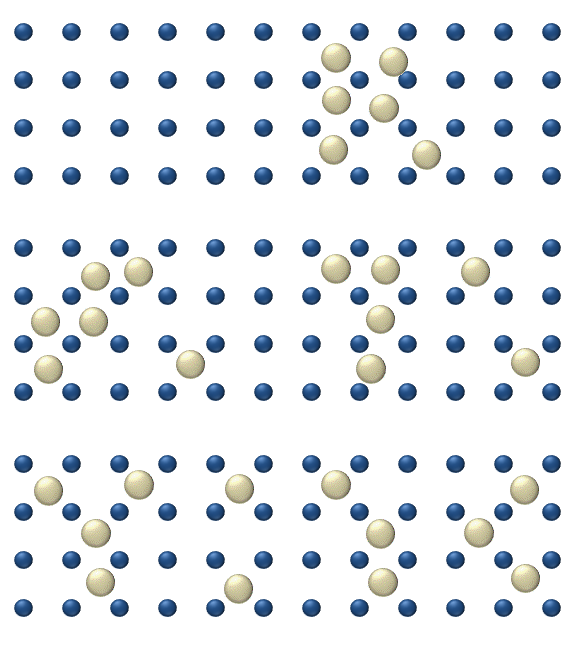
In condensed matter physics, lattice diffusion (also called bulk or volume diffusion) refers to atomic diffusion within a crystalline lattice, which occurs by either interstitial or substitutional mechanisms. In interstitial lattice diffusion, a diffusant (such as carbon in an iron alloy), will diffuse in between the lattice structure of another crystalline element. In substitutional lattice diffusion (self-diffusion for example), the atom can only move by switching places with another atom. Substitutional lattice diffusion is often contingent upon the availability of point vacancies throughout the crystal lattice. Diffusing particles migrate from point vacancy to point vacancy by the rapid, essentially random jumping about (jump diffusion). Since the prevalence of point vacancies increases in accordance with the Arrhenius equation, the rate of crystal solid state diffusion increases with temperature. For a single atom in a defect-free crystal, the movement can be described by the "random walk" model.
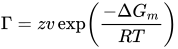
An atom diffuses in the interstitial mechanism by passing from one interstitial site to one of its nearest neighboring interstitial sites. The movement of atoms can be described as jumps, and the interstitial diffusion coefficient depends on the jump frequency. The jump frequency, , is given by:

where
can be expressed as the sum of activation enthalpy term and the activation entropy term , which gives the diffusion coefficient as:


![{\displaystyle D=\left[{\frac {1}{z}}\alpha ^{2}zv\exp {\frac {\Delta S_{m}}{R}}\right]\exp {\frac {-\Delta H_{m}}{RT}}}](https://wikimedia.org/api/rest_v1/media/math/render/svg/4c66198b7742e154612c22f646ecbcd4a7f82e61)
where
The diffusion coefficient can be simplified to an Arrhenius equation form:
Hub AI
Lattice diffusion coefficient AI simulator
(@Lattice diffusion coefficient_simulator)
Lattice diffusion coefficient
In condensed matter physics, lattice diffusion (also called bulk or volume diffusion) refers to atomic diffusion within a crystalline lattice, which occurs by either interstitial or substitutional mechanisms. In interstitial lattice diffusion, a diffusant (such as carbon in an iron alloy), will diffuse in between the lattice structure of another crystalline element. In substitutional lattice diffusion (self-diffusion for example), the atom can only move by switching places with another atom. Substitutional lattice diffusion is often contingent upon the availability of point vacancies throughout the crystal lattice. Diffusing particles migrate from point vacancy to point vacancy by the rapid, essentially random jumping about (jump diffusion). Since the prevalence of point vacancies increases in accordance with the Arrhenius equation, the rate of crystal solid state diffusion increases with temperature. For a single atom in a defect-free crystal, the movement can be described by the "random walk" model.
An atom diffuses in the interstitial mechanism by passing from one interstitial site to one of its nearest neighboring interstitial sites. The movement of atoms can be described as jumps, and the interstitial diffusion coefficient depends on the jump frequency. The jump frequency, , is given by:
where
can be expressed as the sum of activation enthalpy term and the activation entropy term , which gives the diffusion coefficient as:
where
The diffusion coefficient can be simplified to an Arrhenius equation form:
Recent media