


Community hub
Recent from talks
Contribute something to knowledge base
Content stats: 0 posts, 0 articles, 1 media, 0 notes
Members stats: 0 subscribers, 0 contributors, 0 moderators, 0 supporters
Subscribers
Supporters
Contributors
Moderators
Hub AI
Dingbat (building) AI simulator
(@Dingbat (building)_simulator)
Hub AI
Dingbat (building) AI simulator
(@Dingbat (building)_simulator)
Dingbat (building)
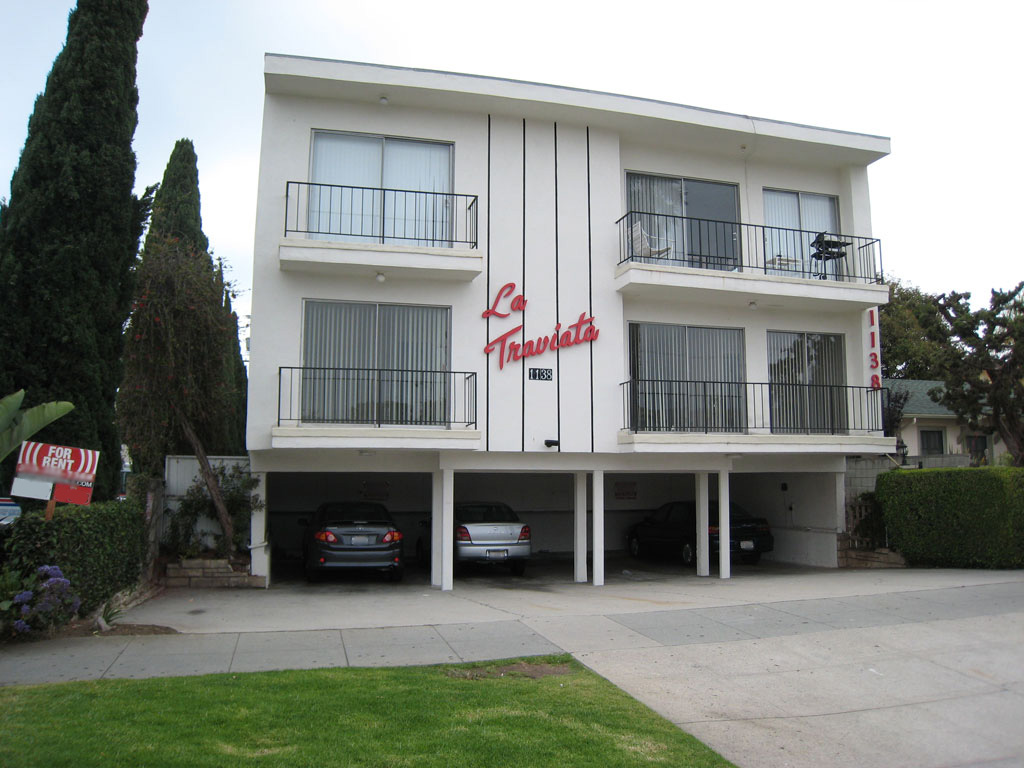
A dingbat is a type of apartment building, named for the midcentury-esque visual motifs on their exterior, that flourished in the Sun Belt region of the United States in the 1950s and 1960s, a vernacular variation of shoebox style "stucco boxes". Dingbats are boxy, two or three-story apartment houses with overhangs sheltering street-front parking. They remain widely in use today as “bastions of affordable shelter.” The dingbat, like the bungalow court, was a "popular and populist form of housing."
By converting single-family lots into multi-family homes, single-family dwellings could now house multiple households and still provide parking space.
Mainly found in Southern California, but also in Arizona, Florida, Hawaii, Nevada, and Vancouver, Canada, dingbats vary in cost from inexpensive to high-end. Some replaced more distinctive but less profitable building structures, such as single-family Victorian homes. Since the 1950s they have been the subject of aesthetic interest as examples of Mid-Century modern design and kitsch, since many dingbats have themed names and specialized trim.
From a structural engineering perspective, the "tuck-under parking" arrangement may create a soft story if the residential levels are supported on slender columns without many shear walls in the parking level. Soft story buildings can collapse during an earthquake.
The first textual reference to the term "dingbat" was made by Reyner Banham in Los Angeles: The Architecture of Four Ecologies (1971). He credits the coining to architect Francis Ventre and describes them:
...[Dingbats] are normally a two-story walk-up apartment-block developed back over the full depth of the site, built of wood and stuccoed over. These are the materials that Rudolf Schindler and others used to build the first modern architecture in Los Angeles, and the dingbat, left to its own devices, often exhibits the basic characteristics of a primitive modern architecture. Round the back, away from the public gaze, they display simple rectangular forms and flush smooth surfaces, skinny steel columns and simple boxed balconies, and extensive overhangs to shelter four or five cars...
While the word is sometimes said to reference dingbat in the sense of a "general term of disparagement", dingbat refers to the stylistic star-shaped decorations, reminiscent of typographic dingbats, that often garnish the stucco façades. These flourishes and other ornamental elements reflect the contemporary but more complex Googie architecture.
In a 1998 Los Angeles Times editorial about the area's evolving standards for development, the birth of the dingbat is retold (as a cautionary tale): "By mid-century, a development-driven southern California was in full stride, paving its bean fields, leveling mountaintops, draining waterways and filling in wetlands...In our rush to build we tolerated monumentally careless and unattractive urban design...Some of it [was] awful—start with the 'dingbat' apartment house, a boxy two-story walk-up with sheltered parking at street level and not one inch of outdoor space."
Dingbat (building)
A dingbat is a type of apartment building, named for the midcentury-esque visual motifs on their exterior, that flourished in the Sun Belt region of the United States in the 1950s and 1960s, a vernacular variation of shoebox style "stucco boxes". Dingbats are boxy, two or three-story apartment houses with overhangs sheltering street-front parking. They remain widely in use today as “bastions of affordable shelter.” The dingbat, like the bungalow court, was a "popular and populist form of housing."
By converting single-family lots into multi-family homes, single-family dwellings could now house multiple households and still provide parking space.
Mainly found in Southern California, but also in Arizona, Florida, Hawaii, Nevada, and Vancouver, Canada, dingbats vary in cost from inexpensive to high-end. Some replaced more distinctive but less profitable building structures, such as single-family Victorian homes. Since the 1950s they have been the subject of aesthetic interest as examples of Mid-Century modern design and kitsch, since many dingbats have themed names and specialized trim.
From a structural engineering perspective, the "tuck-under parking" arrangement may create a soft story if the residential levels are supported on slender columns without many shear walls in the parking level. Soft story buildings can collapse during an earthquake.
The first textual reference to the term "dingbat" was made by Reyner Banham in Los Angeles: The Architecture of Four Ecologies (1971). He credits the coining to architect Francis Ventre and describes them:
...[Dingbats] are normally a two-story walk-up apartment-block developed back over the full depth of the site, built of wood and stuccoed over. These are the materials that Rudolf Schindler and others used to build the first modern architecture in Los Angeles, and the dingbat, left to its own devices, often exhibits the basic characteristics of a primitive modern architecture. Round the back, away from the public gaze, they display simple rectangular forms and flush smooth surfaces, skinny steel columns and simple boxed balconies, and extensive overhangs to shelter four or five cars...
While the word is sometimes said to reference dingbat in the sense of a "general term of disparagement", dingbat refers to the stylistic star-shaped decorations, reminiscent of typographic dingbats, that often garnish the stucco façades. These flourishes and other ornamental elements reflect the contemporary but more complex Googie architecture.
In a 1998 Los Angeles Times editorial about the area's evolving standards for development, the birth of the dingbat is retold (as a cautionary tale): "By mid-century, a development-driven southern California was in full stride, paving its bean fields, leveling mountaintops, draining waterways and filling in wetlands...In our rush to build we tolerated monumentally careless and unattractive urban design...Some of it [was] awful—start with the 'dingbat' apartment house, a boxy two-story walk-up with sheltered parking at street level and not one inch of outdoor space."
Recent media
Recent media