


Community hub
Recent from talks
Contribute something to knowledge base
Content stats: 0 posts, 0 articles, 1 media, 0 notes
Members stats: 0 subscribers, 0 contributors, 0 moderators, 0 supporters
Subscribers
Supporters
Contributors
Moderators
Hub AI
Cautionary tale AI simulator
(@Cautionary tale_simulator)
Hub AI
Cautionary tale AI simulator
(@Cautionary tale_simulator)
Cautionary tale
A cautionary tale or moral tale is a tale told in folklore to warn its listener of a danger. There are three essential parts to a cautionary tale, though they can be introduced in a large variety of ways. First, a taboo or prohibition is stated: some act, location, or thing is said to be dangerous.[citation needed] Then, the narrative itself is told: someone disregarded the warning and performed the forbidden act. Finally, the violator comes to an unpleasant fate, which is frequently related in expansive and grisly detail.
Cautionary tales are ubiquitous in popular culture; many urban legends are framed as cautionary tales: from the lover's lane haunted by a hook-handed murderer to the tale of a man who shot a cactus for fun only to die when the plant toppled onto him. Like horror fiction, generally the cautionary tale exhibits an ambivalent attitude towards social taboos. The narrator of a cautionary tale is momentarily excused from the ordinary demands of etiquette that discourages the use of gruesome or disgusting imagery because the tale serves to reinforce some other social taboo.
Cautionary tales are also frequently utilized to spread awareness of moral issues. For this reason, they are often told to children to make them conform to rules that either protect them or are for their own safety.
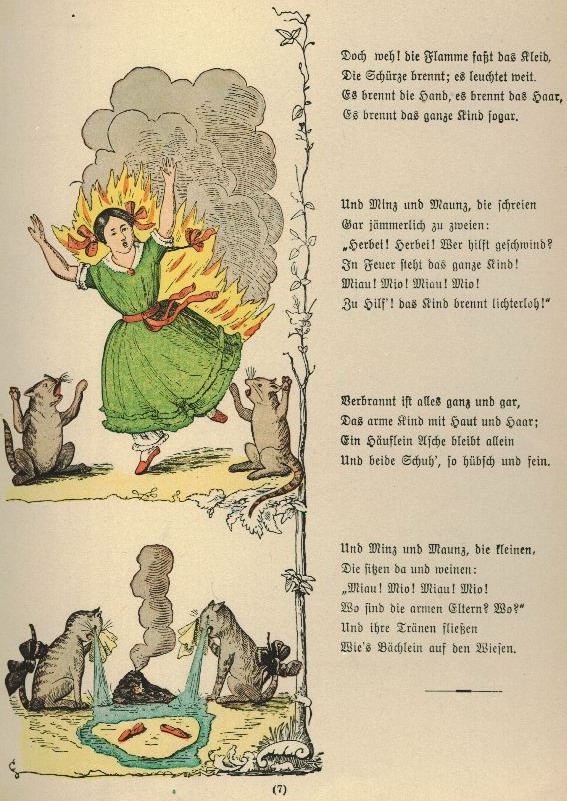
Those whose job it is to enforce conformity therefore frequently resort to cautionary tales. The German language anthology, Struwwelpeter, contains tales such as "Die gar traurige Geschichte mit dem Feuerzeug" (The Dreadful Story of Pauline and the Matches); it is fairly easy to deduce the ending from the title. Social guidance films such as Boys Beware or Reefer Madness are deliberately patterned after traditional cautionary tales, as were the notorious driver's education films (Red Asphalt, Signal 30) of the 1960s, or military films about syphilis and other sexually transmitted diseases. The framework of the cautionary tale became a cliché in the slasher films of the 1980s, in which adolescents who had sex, drank alcoholic beverages, or smoked marijuana inevitably ended up as the victims of the serial killer villain.
On the other hand, in the adolescent culture of the United States, for more than a hundred years the traditional cautionary tale gave rise to the phenomenon of legend tripping, in which a cautionary tale is turned into the basis of a dare that invites the hearer to test the taboo by breaking it.
The cautionary tale has survived to the present day in another form, especially with the rise of modern mass media such as film and television; many public service announcements and public information films frame themselves as cautionary tales regarding both societal issues and common dangers in modern life, pushing conformity by warning viewers of the danger and directing them towards avoiding the causes, or simply not doing actions that result in such dangers.
The genre of the cautionary tale has been satirized by several writers. Hilaire Belloc in his Cautionary Tales for Children presented such moral examples as "Jim, Who ran away from his Nurse, and was eaten by a Lion", and "Matilda, Who told lies, and was Burned to Death". Lewis Carroll, in Alice's Adventures in Wonderland, says that Alice:
... had read several nice little histories about children who had got burnt, and eaten up by wild beasts and other unpleasant things, all because they would not remember the simple rules their friends had taught them: such as, that a red-hot poker will burn you if you hold it too long; and that if you cut your finger very deeply with a knife, it usually bleeds; and she had never forgotten that, if you drink much from a bottle marked "poison", it is almost certain to disagree with you, sooner or later.
Cautionary tale
A cautionary tale or moral tale is a tale told in folklore to warn its listener of a danger. There are three essential parts to a cautionary tale, though they can be introduced in a large variety of ways. First, a taboo or prohibition is stated: some act, location, or thing is said to be dangerous.[citation needed] Then, the narrative itself is told: someone disregarded the warning and performed the forbidden act. Finally, the violator comes to an unpleasant fate, which is frequently related in expansive and grisly detail.
Cautionary tales are ubiquitous in popular culture; many urban legends are framed as cautionary tales: from the lover's lane haunted by a hook-handed murderer to the tale of a man who shot a cactus for fun only to die when the plant toppled onto him. Like horror fiction, generally the cautionary tale exhibits an ambivalent attitude towards social taboos. The narrator of a cautionary tale is momentarily excused from the ordinary demands of etiquette that discourages the use of gruesome or disgusting imagery because the tale serves to reinforce some other social taboo.
Cautionary tales are also frequently utilized to spread awareness of moral issues. For this reason, they are often told to children to make them conform to rules that either protect them or are for their own safety.
Those whose job it is to enforce conformity therefore frequently resort to cautionary tales. The German language anthology, Struwwelpeter, contains tales such as "Die gar traurige Geschichte mit dem Feuerzeug" (The Dreadful Story of Pauline and the Matches); it is fairly easy to deduce the ending from the title. Social guidance films such as Boys Beware or Reefer Madness are deliberately patterned after traditional cautionary tales, as were the notorious driver's education films (Red Asphalt, Signal 30) of the 1960s, or military films about syphilis and other sexually transmitted diseases. The framework of the cautionary tale became a cliché in the slasher films of the 1980s, in which adolescents who had sex, drank alcoholic beverages, or smoked marijuana inevitably ended up as the victims of the serial killer villain.
On the other hand, in the adolescent culture of the United States, for more than a hundred years the traditional cautionary tale gave rise to the phenomenon of legend tripping, in which a cautionary tale is turned into the basis of a dare that invites the hearer to test the taboo by breaking it.
The cautionary tale has survived to the present day in another form, especially with the rise of modern mass media such as film and television; many public service announcements and public information films frame themselves as cautionary tales regarding both societal issues and common dangers in modern life, pushing conformity by warning viewers of the danger and directing them towards avoiding the causes, or simply not doing actions that result in such dangers.
The genre of the cautionary tale has been satirized by several writers. Hilaire Belloc in his Cautionary Tales for Children presented such moral examples as "Jim, Who ran away from his Nurse, and was eaten by a Lion", and "Matilda, Who told lies, and was Burned to Death". Lewis Carroll, in Alice's Adventures in Wonderland, says that Alice:
... had read several nice little histories about children who had got burnt, and eaten up by wild beasts and other unpleasant things, all because they would not remember the simple rules their friends had taught them: such as, that a red-hot poker will burn you if you hold it too long; and that if you cut your finger very deeply with a knife, it usually bleeds; and she had never forgotten that, if you drink much from a bottle marked "poison", it is almost certain to disagree with you, sooner or later.
Recent media
Recent media