Hubbry Logo
Direct image functorDirect image functorMain
Open search
Direct image functor
Community hub
Direct image functor
logo
7 pages, 0 posts
0 subscribers
Be the first to start a discussion here.
Direct image functor
from Wikipedia

In mathematics, the direct image functor describes how structured data assigned to one space can be systematically transferred to another space using a continuous map between them. More precisely, if we have a sheaf—an object that encodes data like functions or sections over open regions—defined on a space X, and a continuous map from X to another space Y, then the direct image functor produces a corresponding sheaf on Y. This construction is a central tool in sheaf theory and is widely used in topology and algebraic geometry to relate local data across spaces.

More formally, given a sheaf F defined on a topological space X and a continuous map f: XY, we can define a new sheaf fF on Y, called the direct image sheaf or the pushforward sheaf of F along f, such that the global sections of fF is given by the global sections of F. This assignment gives rise to a functor f from the category of sheaves on X to the category of sheaves on Y, which is known as the direct image functor. Similar constructions exist in many other algebraic and geometric contexts, including that of quasi-coherent sheaves and étale sheaves on a scheme.

Definition

[edit]

Let f: XY be a continuous map of topological spaces, and let Sh(–) denote the category of sheaves of abelian groups on a topological space. The direct image functor

sends a sheaf F on X to its direct image presheaf fF on Y, defined on open subsets U of Y by

This turns out to be a sheaf on Y, and is called the direct image sheaf or pushforward sheaf of F along f.

Since a morphism of sheaves φ: FG on X gives rise to a morphism of sheaves f(φ): f(F) → f(G) on Y in an obvious way, we indeed have that f is a functor.

Example

[edit]

If Y is a point, and f: XY the unique continuous map, then Sh(Y) is the category Ab of abelian groups, and the direct image functor f: Sh(X) → Ab equals the global sections functor.

Variants

[edit]

If dealing with sheaves of sets instead of sheaves of abelian groups, the same definition applies. Similarly, if f: (X, OX) → (Y, OY) is a morphism of ringed spaces, we obtain a direct image functor f: Sh(X,OX) → Sh(Y,OY) from the category of sheaves of OX-modules to the category of sheaves of OY-modules. Moreover, if f is now a morphism of quasi-compact and quasi-separated schemes, then f preserves the property of being quasi-coherent, so we obtain the direct image functor between categories of quasi-coherent sheaves.[1]

A similar definition applies to sheaves on topoi, such as étale sheaves. There, instead of the above preimage f−1(U), one uses the fiber product of U and X over Y.

Properties

[edit]
  • Forming sheaf categories and direct image functors itself defines a functor from the category of topological spaces to the category of categories: given continuous maps f: XY and g: YZ, we have (gf)=gf.
  • The direct image functor is right adjoint to the inverse image functor, which means that for any continuous and sheaves respectively on X, Y, there is a natural isomorphism:
.
  • If f is the inclusion of a closed subspace XY then f is exact. Actually, in this case f is an equivalence between the category of sheaves on X and the category of sheaves on Y supported on X. This follows from the fact that the stalk of is if and zero otherwise (here the closedness of X in Y is used).
  • If f is the morphism of affine schemes determined by a ring homomorphism , then the direct image functor f on quasi-coherent sheaves identifies with the restriction of scalars functor along φ.

Higher direct images

[edit]

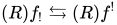
The direct image functor is left exact, but usually not right exact. Hence one can consider the right derived functors of the direct image. They are called higher direct images and denoted Rq f.

One can show that there is a similar expression as above for higher direct images: for a sheaf F on X, the sheaf Rq f(F) is the sheaf associated to the presheaf

,

where Hq denotes sheaf cohomology.

In the context of algebraic geometry and a morphism of quasi-compact and quasi-separated schemes, one likewise has the right derived functor

as a functor between the (unbounded) derived categories of quasi-coherent sheaves. In this situation, always admits a right adjoint .[2] This is closely related, but not generally equivalent to, the exceptional inverse image functor , unless is also proper.

See also

[edit]

References

[edit]
Revisions and contributorsEdit on WikipediaRead on Wikipedia
from Grokipedia
In mathematics, particularly within the framework of sheaf theory on topological spaces or schemes, the direct image functor (also known as the pushforward functor), denoted ff_*, is a covariant functor that arises from a continuous morphism f:XYf: X \to Y. For any sheaf F\mathcal{F} of sets, abelian groups, or modules on XX, it constructs the sheaf fFf_* \mathcal{F} on YY by defining (fF)(V)=F(X×YV)(f_* \mathcal{F})(V) = \mathcal{F}(X \times_Y V) for étale (or open) subsets VV of YY, which in the classical topological case simplifies to (fF)(U)=F(f1(U))(f_* \mathcal{F})(U) = \mathcal{F}(f^{-1}(U)) for open UYU \subseteq Y. This assignment preserves the sheaf axiom, ensuring fFf_* \mathcal{F} is indeed a sheaf whenever F\mathcal{F} is, and the construction is functorial with respect to both morphisms of sheaves on XX and varying the base morphism ff. The direct image functor ff_* exhibits several key structural properties that underpin its utility in algebraic topology and geometry. It is left exact, meaning that for any short exact sequence of sheaves 0FFF00 \to \mathcal{F}' \to \mathcal{F} \to \mathcal{F}'' \to 0 on XX, the induced sequence 0fFfFfF0 \to f_* \mathcal{F}' \to f_* \mathcal{F} \to f_* \mathcal{F}'' remains exact on YY. Consequently, ff_* admits right derived functors RifR^i f_* (for i0i \geq 0), with R0ffR^0 f_* \cong f_*, which measure the failure of exactness and are central to sheaf cohomology computations; for instance, the higher direct images Rif(F)R^i f_*(\mathcal{F}) can be represented as the sheafification of the presheaf UHi(f1U,F)U \mapsto H^i(f^{-1}U, \mathcal{F}). In the context of ringed spaces, such as schemes in algebraic geometry, Rif(F)R^i f_*(\mathcal{F}) inherits a natural module structure over the structure sheaf of YY, preserving quasi-coherence under suitable hypotheses like noetherian schemes and affine targets. Notable applications of the direct image functor include its role in Grothendieck's six functor formalism, where it interacts with inverse image functors like f1f^{-1} and ff^* via adjunctions—specifically, f1f^{-1} is left to ff_*—and in the study of proper or projective morphisms, for which higher direct images often vanish in positive degrees, enabling finite-dimensional . For closed embeddings, ff_* is exact, implying Rif=0R^i f_* = 0 for i>0i > 0, which simplifies global section computations. These features make the direct image functor indispensable for transferring local data from XX to YY, facilitating proofs of finiteness theorems and the computation of invariants in diverse geometric settings.

Definition and Examples

Formal Definition

In sheaf theory, a sheaf of sets on a topological space XX is a contravariant F:Op(X)opSet\mathcal{F}: \operatorname{Op}(X)^{\mathrm{op}} \to \mathbf{Set} from the category of open subsets of XX (with inclusions as morphisms) to the , satisfying the sheaf axioms: for any open set UXU \subseteq X and any open cover {Ui}iI\{U_i\}_{i \in I} of UU, the natural F(U)Eq(iF(Ui)i,jF(UiUj))\mathcal{F}(U) \to \operatorname{Eq}(\prod_i \mathcal{F}(U_i) \rightrightarrows \prod_{i,j} \mathcal{F}(U_i \cap U_j)) is an , ensuring unique gluing of compatible local sections and identity on restrictions. The category Sh(X)\operatorname{Sh}(X) has these sheaves as objects and natural transformations between them (as presheaves) that commute with restriction s as morphisms. Given topological spaces XX and YY and a continuous f:XYf: X \to Y, the direct image f:Sh(X)Sh(Y)f_*: \operatorname{Sh}(X) \to \operatorname{Sh}(Y) sends a sheaf F\mathcal{F} on XX to the sheaf fFf_* \mathcal{F} on YY defined on open sets by (fF)(U)=F(f1(U))(f_* \mathcal{F})(U) = \mathcal{F}(f^{-1}(U)) for UYU \subseteq Y open, with restriction maps (fF)UV=Ff1(U)f1(V)(f_* \mathcal{F})_{U \subseteq V} = \mathcal{F}_{f^{-1}(U) \subseteq f^{-1}(V)} induced by those of F\mathcal{F}. This construction yields a sheaf because the preimage Uf1(U)U \mapsto f^{-1}(U) preserves open covers and intersections, so the sheaf axioms for F\mathcal{F} transfer to fFf_* \mathcal{F}. To verify functoriality, consider a morphism of sheaves ϕ:FG\phi: \mathcal{F} \to \mathcal{G} on XX, which consists of maps ϕV:F(V)G(V)\phi_V: \mathcal{F}(V) \to \mathcal{G}(V) for open VXV \subseteq X compatible with restrictions. Then fϕ:fFfGf_* \phi: f_* \mathcal{F} \to f_* \mathcal{G} is defined componentwise by (fϕ)U=ϕf1(U):F(f1(U))G(f1(U))(f_* \phi)_U = \phi_{f^{-1}(U)}: \mathcal{F}(f^{-1}(U)) \to \mathcal{G}(f^{-1}(U)) for open UYU \subseteq Y, which respects restrictions since ϕ\phi does. The assignment preserves identities, as f(idF)=idfFf_*(\mathrm{id}_{\mathcal{F}}) = \mathrm{id}_{f_* \mathcal{F}}, and is covariant under composition of continuous maps: if g:YZg: Y \to Z is another continuous map, then (gf)=gf(g \circ f)_* = g_* \circ f_*, because ((gf)F)(W)=F((gf)1(W))=F(f1(g1(W)))=(g(fF))(W)((g \circ f)_* \mathcal{F})(W) = \mathcal{F}((g \circ f)^{-1}(W)) = \mathcal{F}(f^{-1}(g^{-1}(W))) = (g_* (f_* \mathcal{F}))(W) for open WZW \subseteq Z. The direct image functor ff_* has a left adjoint, the inverse image functor ff^*, which provides the companion pullback operation.

Basic Example

A fundamental illustration of the direct image functor arises when the codomain YY is a singleton space, denoted Y={}Y = \{ \ast \}, equipped with the discrete topology. In this case, the morphism f:XYf: X \to Y is the unique continuous map sending every point of the topological space XX to the single point \ast. For any sheaf of sets F\mathcal{F} on XX, the direct image sheaf fFf_* \mathcal{F} on YY is defined such that its sections over the open set U=Y={}U = Y = \{ \ast \} are given by (fF)(Y)=F(f1(Y))=F(X)(f_* \mathcal{F})(Y) = \mathcal{F}(f^{-1}(Y)) = \mathcal{F}(X), the space of global sections of F\mathcal{F} over XX. This construction demonstrates how the direct image functor "globalizes" the sheaf F\mathcal{F} by associating to it the constant sheaf on YY whose value is precisely Γ(X,F)\Gamma(X, \mathcal{F}), effectively collapsing all local data into a single global object. To see this in action, consider the open cover of YY consisting only of the empty set and YY itself; the sheaf condition for fFf_* \mathcal{F} holds trivially since there are no nontrivial gluings required on YY. Thus, fFf_* \mathcal{F} is the constant sheaf with stalk Γ(X,F)\Gamma(X, \mathcal{F}) at \ast, illustrating the functor's role in extracting invariant global information from F\mathcal{F}. A particularly simple application occurs when F\mathcal{F} is the constant sheaf A\underline{A} on XX with value the set AA (assuming XX is connected, so Γ(X,A)=A\Gamma(X, \underline{A}) = A). Here, fAf_* \underline{A} is the constant sheaf on YY with value AA, matching the stalk of A\underline{A} at any point of XX. This example highlights how the direct image preserves the constant structure under the projection to a point, yielding a sheaf whose sections are constant functions to AA.

Variants and Generalizations

For Sheaves of Modules

In the context of ringed spaces, the direct image functor extends naturally to sheaves of modules. Consider a morphism f:(X,OX)(Y,OY)f: (X, \mathcal{O}_X) \to (Y, \mathcal{O}_Y) of ringed spaces and an OX\mathcal{O}_X-module sheaf F\mathcal{F}. The direct image fFf_* \mathcal{F} is defined by assigning to each open set UYU \subset Y the sections (fF)(U)=F(f1(U))(f_* \mathcal{F})(U) = \mathcal{F}(f^{-1}(U)), making fFf_* \mathcal{F} a sheaf on YY. This construction equips fFf_* \mathcal{F} with a natural OY\mathcal{O}_Y-module structure via the canonical map f#:OYfOXf^\#: \mathcal{O}_Y \to f_* \mathcal{O}_X, which acts on sections by sσ=f#(s)σs \cdot \sigma = f^\#(s) \cdot \sigma for sOY(U)s \in \mathcal{O}_Y(U) and σF(f1(U))\sigma \in \mathcal{F}(f^{-1}(U)). The compatibility of this action with restrictions ensures that the module structure is preserved, as the sheaf axioms for F\mathcal{F} and the ring homomorphism f#f^\# align the operations across open covers. This extension participates in an adjunction between the f+f^+ (the extension of scalars) and ff_*. Specifically, f+f^+ is left to ff_*, i.e., HomX(f+G,F)HomY(G,fF)\text{Hom}_X(f^+ \mathcal{G}, \mathcal{F}) \cong \text{Hom}_Y(\mathcal{G}, f_* \mathcal{F}) for an OY\mathcal{O}_Y-module G\mathcal{G}, with the map η:Gf(f+G)\eta: \mathcal{G} \to f_* (f^+ \mathcal{G}) arising from the universal property, defined on sections over UYU \subset Y by the canonical action of OY(U)\mathcal{O}_Y(U) on f+G(f1(U))=G(U)OY(U)OX(f1(U))f^+ \mathcal{G}(f^{-1}(U)) = \mathcal{G}(U) \otimes_{\mathcal{O}_Y(U)} \mathcal{O}_X(f^{-1}(U)). This unit map encodes the compatibility of the module structures under the adjunction, ensuring that morphisms respect the ring actions induced by ff. Regarding quasi-coherent sheaves, the direct image functor ff_* maps quasi-coherent OX\mathcal{O}_X-modules to quasi-coherent OY\mathcal{O}_Y-modules when ff is an affine morphism of ringed spaces, as the sections over affine opens in YY correspond to modules over the respective rings via the structure sheaf. More generally, for quasi-compact and quasi-separated , the higher direct images RifFR^i f_* \mathcal{F} also remain quasi-coherent for quasi-coherent F\mathcal{F}, preserving the local presentation properties essential to the definition.

In Scheme Theory

In the category of schemes, the direct image functor associated to a morphism f:XYf: X \to Y is defined on the category of quasi-coherent sheaves as f:\QCoh(X)\QCoh(Y)f_*: \QCoh(X) \to \QCoh(Y), where for a quasi-coherent sheaf F\mathcal{F} on XX and an open subset UYU \subset Y, the sections are given by (fF)(U)=F(f1U)(f_* \mathcal{F})(U) = \mathcal{F}(f^{-1}U). This construction endows fFf_* \mathcal{F} with a natural OY\mathcal{O}_Y-module structure via the adjunction with the , ensuring compatibility with the structure sheaves. When ff is quasi-compact and quasi-separated, ff_* preserves quasi-coherence, mapping quasi-coherent sheaves on XX to those on YY. For morphisms between affine schemes, the direct image functor admits a concrete description in terms of modules. Consider f:\SpecA\SpecBf: \Spec A \to \Spec B induced by a ring homomorphism ϕ:BA\phi: B \to A. The quasi-coherent sheaf M~\tilde{M} on \SpecA\Spec A associated to an AA-module MM is pushed forward to fM~=MB~f_* \tilde{M} = \widetilde{M_B}
Add your contribution
Related Hubs
User Avatar
No comments yet.