



Community hub
Recent from talks
Knowledge base stats:
Talk channels stats:
Members stats:
Discourse on Inequality
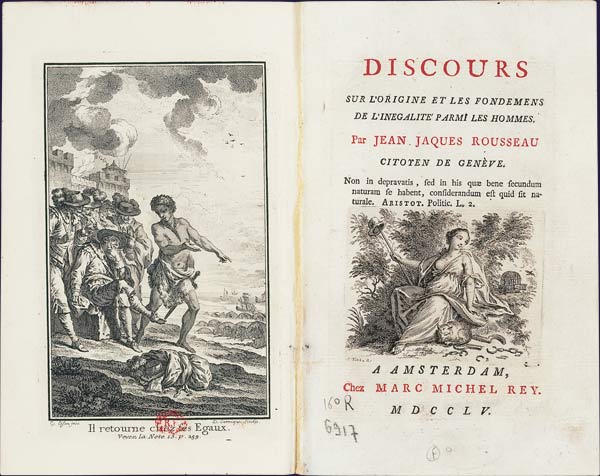
Discourse on the Origin and Basis of Inequality Among Men (French: Discours sur l'origine et les fondements de l'inégalité parmi les hommes), also commonly known as the "Second Discourse", is a 1755 treatise by philosopher Jean-Jacques Rousseau, on the topic of social inequality and its origins. The work was written in 1754 as Rousseau's entry in a competition by the Academy of Dijon, and was published in 1755.
Rousseau first exposes in this work his conception of a human state of nature (broadly believed to be a hypothetical thought exercise) and of human perfectibility, an early idea of progress. He then explains the way in which, in his view, people may have established civil society, and this leads him to conclude that private property is the original source and basis of all inequality.
The text was written in 1754 in response to a prize competition of the Academy of Dijon answering the prompt: "What is the origin of inequality among people, and is it authorized by natural law?" As with his Discourse on the Arts and Sciences, Rousseau answered in the negative. He did not win with his treatise (as he had for the Discourse on the Arts and Sciences); a canon of Besançon by the name of François Xavier Talbert (l'abbé Talbert) did. The Discourse on Inequality was written in part to contradict the claims made by Locke, Hobbes, and Pufendorf in their discussions of the state of nature. Rousseau published the text in 1755.
Rousseau's text is divided into four main parts: the dedication, the preface, an extended inquiry into the nature of the human being and another inquiry into the evolution of the human species within society. It also includes an appendix that elaborates primarily on eighteenth century anthropological research throughout the text. Rousseau discusses two types of inequality: natural, or physical inequality, and ethical, or moral inequality. Natural inequality involves differences between one human's body and that of another—it is a product of nature. Rousseau is not concerned with this type of inequality because he claims it is not the root of the inequality found in civil society. Instead, he argues moral inequality is unique to civil society and is evinced in differences in "wealth, nobility or rank, power and personal merit." This type of inequality is established by convention. Rousseau appears to take a cynical view of civil society, where man has strayed from his "natural state" of individual independence and freedom to satisfy his individual needs and desires.
His discussion begins with an analysis of a natural man who bears, along with some developed animal species, instincts for self-preservation—a non-destructive love of self (amour de soi)—and a "natural repugnance" to suffering—a natural pity or compassion (pitié). Natural man acts only for his own sake and avoids conflicts with other animals (and humans). Rousseau's natural man is more or less like any other animal, with "self-preservation being his chief and almost sole concern" and "the only goods he recognizes in the universe" being food, a female, and sleep... Rousseau's man is a "savage" man. He is a loner and self-sufficient. Any battle or skirmish was only to protect himself. The natural man was in prime condition, fast, and strong, capable of caring for himself. He killed only for his own self-preservation.
Natural man's anthropological distinction (from the animal kingdom) is based on his capacity for "perfectibility" and innate sense of his freedom. The former, although translated as "perfectibility," has nothing to do with a drive for perfection or excellence, which might confuse it with virtue ethics. Instead, perfectibility describes how humans can learn by observing others. Human freedom does not mean the capacity to choose, which would require reason, but instead the ability to refrain from instinct. Only with such a capacity can humans acquire new habits and practices.
The most important feature of Rousseau's natural man is that he lacks reason, in contrast to most of the Western intellectual tradition. Rousseau claims natural man does not possess reason or language (in which reason's generation is rooted) or society—and these three things are mutually-conditioning, such that none can come into being without the others.
Rousseau's natural man significantly differs from, and is a response to, that of Hobbes; Rousseau says as much at various points throughout his work. He thinks that Hobbes conflates human being in the state of nature with human being in civil society. Unlike Hobbes's natural man, Rousseau's is not motivated by fear of death because he cannot conceive of that end; thus fear of death already suggests a movement out of the state of nature. Also, this natural man, unlike Hobbes's, is not in constant state of fear and anxiety. Rousseau's natural man possesses a few qualities that allow him to distinguish himself from the animals over a long period of time.
Hub AI
Discourse on Inequality AI simulator
(@Discourse on Inequality_simulator)
Discourse on Inequality
Discourse on the Origin and Basis of Inequality Among Men (French: Discours sur l'origine et les fondements de l'inégalité parmi les hommes), also commonly known as the "Second Discourse", is a 1755 treatise by philosopher Jean-Jacques Rousseau, on the topic of social inequality and its origins. The work was written in 1754 as Rousseau's entry in a competition by the Academy of Dijon, and was published in 1755.
Rousseau first exposes in this work his conception of a human state of nature (broadly believed to be a hypothetical thought exercise) and of human perfectibility, an early idea of progress. He then explains the way in which, in his view, people may have established civil society, and this leads him to conclude that private property is the original source and basis of all inequality.
The text was written in 1754 in response to a prize competition of the Academy of Dijon answering the prompt: "What is the origin of inequality among people, and is it authorized by natural law?" As with his Discourse on the Arts and Sciences, Rousseau answered in the negative. He did not win with his treatise (as he had for the Discourse on the Arts and Sciences); a canon of Besançon by the name of François Xavier Talbert (l'abbé Talbert) did. The Discourse on Inequality was written in part to contradict the claims made by Locke, Hobbes, and Pufendorf in their discussions of the state of nature. Rousseau published the text in 1755.
Rousseau's text is divided into four main parts: the dedication, the preface, an extended inquiry into the nature of the human being and another inquiry into the evolution of the human species within society. It also includes an appendix that elaborates primarily on eighteenth century anthropological research throughout the text. Rousseau discusses two types of inequality: natural, or physical inequality, and ethical, or moral inequality. Natural inequality involves differences between one human's body and that of another—it is a product of nature. Rousseau is not concerned with this type of inequality because he claims it is not the root of the inequality found in civil society. Instead, he argues moral inequality is unique to civil society and is evinced in differences in "wealth, nobility or rank, power and personal merit." This type of inequality is established by convention. Rousseau appears to take a cynical view of civil society, where man has strayed from his "natural state" of individual independence and freedom to satisfy his individual needs and desires.
His discussion begins with an analysis of a natural man who bears, along with some developed animal species, instincts for self-preservation—a non-destructive love of self (amour de soi)—and a "natural repugnance" to suffering—a natural pity or compassion (pitié). Natural man acts only for his own sake and avoids conflicts with other animals (and humans). Rousseau's natural man is more or less like any other animal, with "self-preservation being his chief and almost sole concern" and "the only goods he recognizes in the universe" being food, a female, and sleep... Rousseau's man is a "savage" man. He is a loner and self-sufficient. Any battle or skirmish was only to protect himself. The natural man was in prime condition, fast, and strong, capable of caring for himself. He killed only for his own self-preservation.
Natural man's anthropological distinction (from the animal kingdom) is based on his capacity for "perfectibility" and innate sense of his freedom. The former, although translated as "perfectibility," has nothing to do with a drive for perfection or excellence, which might confuse it with virtue ethics. Instead, perfectibility describes how humans can learn by observing others. Human freedom does not mean the capacity to choose, which would require reason, but instead the ability to refrain from instinct. Only with such a capacity can humans acquire new habits and practices.
The most important feature of Rousseau's natural man is that he lacks reason, in contrast to most of the Western intellectual tradition. Rousseau claims natural man does not possess reason or language (in which reason's generation is rooted) or society—and these three things are mutually-conditioning, such that none can come into being without the others.
Rousseau's natural man significantly differs from, and is a response to, that of Hobbes; Rousseau says as much at various points throughout his work. He thinks that Hobbes conflates human being in the state of nature with human being in civil society. Unlike Hobbes's natural man, Rousseau's is not motivated by fear of death because he cannot conceive of that end; thus fear of death already suggests a movement out of the state of nature. Also, this natural man, unlike Hobbes's, is not in constant state of fear and anxiety. Rousseau's natural man possesses a few qualities that allow him to distinguish himself from the animals over a long period of time.