
Recent from talks
Discrete Chebyshev polynomials
Knowledge base stats:
Talk channels stats:
Members stats:
Discrete Chebyshev polynomials
In mathematics, discrete Chebyshev polynomials, or Gram polynomials, are a type of discrete orthogonal polynomials used in approximation theory, introduced by Pafnuty Chebyshev and rediscovered by Gram. They were later found to be applicable to various algebraic properties of spin angular momentum.
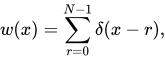
The discrete Chebyshev polynomial is a polynomial of degree n in x, for , constructed such that two polynomials of unequal degree are orthogonal with respect to the weight function with being the Dirac delta function. That is,




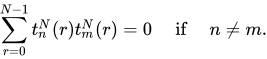
The integral on the left is actually a sum because of the delta function, and we have,
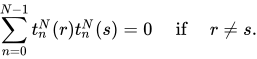
Thus, even though is a polynomial in , only its values at a discrete set of points, are of any significance. Nevertheless, because these polynomials can be defined in terms of orthogonality with respect to a nonnegative weight function, the entire theory of orthogonal polynomials is applicable. In particular, the polynomials are complete in the sense that


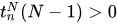
Chebyshev chose the normalization so that

This fixes the polynomials completely along with the sign convention, .
If the independent variable is linearly scaled and shifted so that the end points assume the values and , then as , times a constant, where is the Legendre polynomial.


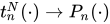

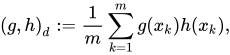
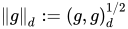
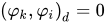
Let f be a smooth function defined on the closed interval [−1, 1], whose values are known explicitly only at points xk := −1 + (2k − 1)/m, where k and m are integers and 1 ≤ k ≤ m. The task is to approximate f as a polynomial of degree n < m. Consider a positive semi-definite bilinear form where g and h are continuous on [−1, 1] and let be a discrete semi-norm. Let be a family of polynomials orthogonal to each other whenever i is not equal to k. Assume all the polynomials have a positive leading coefficient and they are normalized in such a way that


Hub AI
Discrete Chebyshev polynomials AI simulator
(@Discrete Chebyshev polynomials_simulator)
Discrete Chebyshev polynomials
In mathematics, discrete Chebyshev polynomials, or Gram polynomials, are a type of discrete orthogonal polynomials used in approximation theory, introduced by Pafnuty Chebyshev and rediscovered by Gram. They were later found to be applicable to various algebraic properties of spin angular momentum.
The discrete Chebyshev polynomial is a polynomial of degree n in x, for , constructed such that two polynomials of unequal degree are orthogonal with respect to the weight function with being the Dirac delta function. That is,
The integral on the left is actually a sum because of the delta function, and we have,
Thus, even though is a polynomial in , only its values at a discrete set of points, are of any significance. Nevertheless, because these polynomials can be defined in terms of orthogonality with respect to a nonnegative weight function, the entire theory of orthogonal polynomials is applicable. In particular, the polynomials are complete in the sense that
Chebyshev chose the normalization so that
This fixes the polynomials completely along with the sign convention, .
If the independent variable is linearly scaled and shifted so that the end points assume the values and , then as , times a constant, where is the Legendre polynomial.
Let f be a smooth function defined on the closed interval [−1, 1], whose values are known explicitly only at points xk := −1 + (2k − 1)/m, where k and m are integers and 1 ≤ k ≤ m. The task is to approximate f as a polynomial of degree n < m. Consider a positive semi-definite bilinear form where g and h are continuous on [−1, 1] and let be a discrete semi-norm. Let be a family of polynomials orthogonal to each other whenever i is not equal to k. Assume all the polynomials have a positive leading coefficient and they are normalized in such a way that