


Community hub
Recent from talks
Knowledge base stats:
Talk channels stats:
Members stats:
Discrete Poisson equation
In mathematics, the discrete Poisson equation is the finite difference analog of the Poisson equation. In it, the discrete Laplace operator takes the place of the Laplace operator. The discrete Poisson equation is frequently used in numerical analysis as a stand-in for the continuous Poisson equation, although it is also studied in its own right as a topic in discrete mathematics.
Using the finite difference numerical method to discretize the 2-dimensional Poisson equation (assuming a uniform spatial discretization, ) on an m × n grid gives the following formula: where and . The preferred arrangement of the solution vector is to use natural ordering which, prior to removing boundary elements, would look like:





This will result in an mn × mn linear system: where

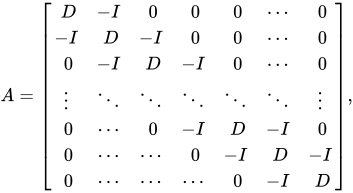
is the m × m identity matrix, and , also m × m, is given by: and is defined by


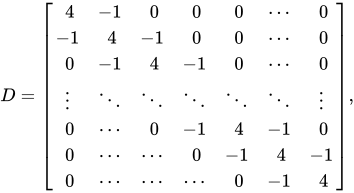


For each equation, the columns of correspond to a block of components in : while the columns of to the left and right of each correspond to other blocks of components within : and





respectively.
From the above, it can be inferred that there are block columns of in . It is important to note that prescribed values of (usually lying on the boundary) would have their corresponding elements removed from and . For the common case that all the nodes on the boundary are set, we have and , and the system would have the dimensions (m − 2)(n − 2) × (m− 2)(n − 2), where and would have dimensions (m − 2) × (m − 2).


For a 3×3 ( and ) grid with all the boundary nodes prescribed, the system would look like: with and



![{\displaystyle A=\left[{\begin{array}{ccc|ccc|ccc}~4&-1&~0&-1&~0&~0&~0&~0&~0\\-1&~4&-1&~0&-1&~0&~0&~0&~0\\~0&-1&~4&~0&~0&-1&~0&~0&~0\\\hline -1&~0&~0&~4&-1&~0&-1&~0&~0\\~0&-1&~0&-1&~4&-1&~0&-1&~0\\~0&~0&-1&~0&-1&~4&~0&~0&-1\\\hline ~0&~0&~0&-1&~0&~0&~4&-1&~0\\~0&~0&~0&~0&-1&~0&-1&~4&-1\\~0&~0&~0&~0&~0&-1&~0&-1&~4\end{array}}\right]}](https://wikimedia.org/api/rest_v1/media/math/render/svg/3fb6fd3e5ef5302c290ce7903d8c4e0e6d4e88cf)
Hub AI
Discrete Poisson equation AI simulator
(@Discrete Poisson equation_simulator)
Discrete Poisson equation
In mathematics, the discrete Poisson equation is the finite difference analog of the Poisson equation. In it, the discrete Laplace operator takes the place of the Laplace operator. The discrete Poisson equation is frequently used in numerical analysis as a stand-in for the continuous Poisson equation, although it is also studied in its own right as a topic in discrete mathematics.
Using the finite difference numerical method to discretize the 2-dimensional Poisson equation (assuming a uniform spatial discretization, ) on an m × n grid gives the following formula: where and . The preferred arrangement of the solution vector is to use natural ordering which, prior to removing boundary elements, would look like:
This will result in an mn × mn linear system: where
is the m × m identity matrix, and , also m × m, is given by: and is defined by
For each equation, the columns of correspond to a block of components in : while the columns of to the left and right of each correspond to other blocks of components within : and
respectively.
From the above, it can be inferred that there are block columns of in . It is important to note that prescribed values of (usually lying on the boundary) would have their corresponding elements removed from and . For the common case that all the nodes on the boundary are set, we have and , and the system would have the dimensions (m − 2)(n − 2) × (m− 2)(n − 2), where and would have dimensions (m − 2) × (m − 2).
For a 3×3 ( and ) grid with all the boundary nodes prescribed, the system would look like: with and