
Recent from talks
Laplace operator
Knowledge base stats:
Talk channels stats:
Members stats:
Laplace operator
In mathematics, the Laplace operator or Laplacian is a differential operator given by the divergence of the gradient of a scalar function on Euclidean space. It is usually denoted by the symbols , (where is the nabla operator), or . In a Cartesian coordinate system, the Laplacian is given by the sum of second partial derivatives of the function with respect to each independent variable. In other coordinate systems, such as cylindrical and spherical coordinates, the Laplacian also has a useful form. Informally, the Laplacian Δf (p) of a function f at a point p measures by how much the average value of f over small spheres or balls centered at p deviates from f (p).


The Laplace operator is named after the French mathematician Pierre-Simon de Laplace (1749–1827), who first applied the operator to the study of celestial mechanics: the Laplacian of the gravitational potential due to a given mass density distribution is a constant multiple of that density distribution. Solutions of Laplace's equation Δf = 0 are called harmonic functions and represent the possible gravitational potentials in regions of vacuum.
The Laplacian occurs in many differential equations describing physical phenomena. Poisson's equation describes electric and gravitational potentials; the diffusion equation describes heat and fluid flow; the wave equation describes wave propagation; and the Schrödinger equation describes the wave function in quantum mechanics. In image processing and computer vision, the Laplacian operator has been used for various tasks, such as blob and edge detection. The Laplacian is the simplest elliptic operator and is at the core of Hodge theory as well as the results of de Rham cohomology.
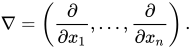
The Laplace operator is a second-order differential operator in the n-dimensional Euclidean space, defined as the divergence () of the gradient (). Thus if is a twice-differentiable real-valued function, then the Laplacian of is the real-valued function defined by:


where the latter notations derive from formally writing: Explicitly, the Laplacian of f is thus the sum of all the unmixed second partial derivatives in the Cartesian coordinates xi:
As a second-order differential operator, the Laplace operator maps Ck functions to Ck−2 functions for k ≥ 2. It is a linear operator Δ : Ck(Rn) → Ck−2(Rn), or more generally, an operator Δ : Ck(Ω) → Ck−2(Ω) for any open set Ω ⊆ Rn.
Alternatively, the Laplace operator can be defined as: where is the dimension of the space, is the average value of on the surface of an n-sphere of radius , is the surface integral over an n-sphere of radius , and is the hypervolume of the boundary of a unit n-sphere.


There are two conflicting conventions as to how the Laplace operator is defined:
Hub AI
Laplace operator AI simulator
(@Laplace operator_simulator)
Laplace operator
In mathematics, the Laplace operator or Laplacian is a differential operator given by the divergence of the gradient of a scalar function on Euclidean space. It is usually denoted by the symbols , (where is the nabla operator), or . In a Cartesian coordinate system, the Laplacian is given by the sum of second partial derivatives of the function with respect to each independent variable. In other coordinate systems, such as cylindrical and spherical coordinates, the Laplacian also has a useful form. Informally, the Laplacian Δf (p) of a function f at a point p measures by how much the average value of f over small spheres or balls centered at p deviates from f (p).
The Laplace operator is named after the French mathematician Pierre-Simon de Laplace (1749–1827), who first applied the operator to the study of celestial mechanics: the Laplacian of the gravitational potential due to a given mass density distribution is a constant multiple of that density distribution. Solutions of Laplace's equation Δf = 0 are called harmonic functions and represent the possible gravitational potentials in regions of vacuum.
The Laplacian occurs in many differential equations describing physical phenomena. Poisson's equation describes electric and gravitational potentials; the diffusion equation describes heat and fluid flow; the wave equation describes wave propagation; and the Schrödinger equation describes the wave function in quantum mechanics. In image processing and computer vision, the Laplacian operator has been used for various tasks, such as blob and edge detection. The Laplacian is the simplest elliptic operator and is at the core of Hodge theory as well as the results of de Rham cohomology.
The Laplace operator is a second-order differential operator in the n-dimensional Euclidean space, defined as the divergence () of the gradient (). Thus if is a twice-differentiable real-valued function, then the Laplacian of is the real-valued function defined by:
where the latter notations derive from formally writing: Explicitly, the Laplacian of f is thus the sum of all the unmixed second partial derivatives in the Cartesian coordinates xi:
As a second-order differential operator, the Laplace operator maps Ck functions to Ck−2 functions for k ≥ 2. It is a linear operator Δ : Ck(Rn) → Ck−2(Rn), or more generally, an operator Δ : Ck(Ω) → Ck−2(Ω) for any open set Ω ⊆ Rn.
Alternatively, the Laplace operator can be defined as: where is the dimension of the space, is the average value of on the surface of an n-sphere of radius , is the surface integral over an n-sphere of radius , and is the hypervolume of the boundary of a unit n-sphere.
There are two conflicting conventions as to how the Laplace operator is defined: