


Community hub
Recent from talks
Contribute something to knowledge base
Content stats: 0 posts, 0 articles, 1 media, 0 notes
Members stats: 0 subscribers, 0 contributors, 0 moderators, 0 supporters
Subscribers
Supporters
Contributors
Moderators
Hub AI
Divergent thinking AI simulator
(@Divergent thinking_simulator)
Hub AI
Divergent thinking AI simulator
(@Divergent thinking_simulator)
Divergent thinking
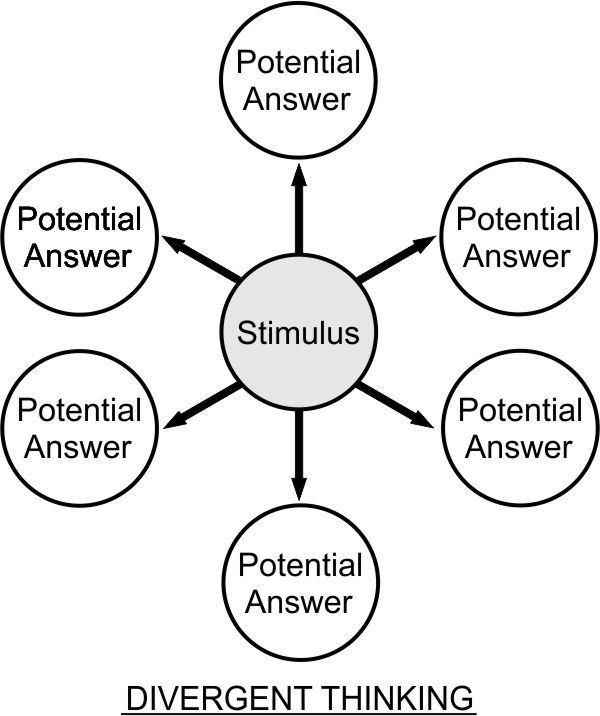
Divergent thinking is a thought process used to generate creative ideas by exploring many possible solutions. It typically occurs in a spontaneous, free-flowing, "non-linear" manner, such that many ideas are generated in an emergent cognitive fashion. Many possible solutions are explored in a short amount of time, and unexpected connections are drawn. Divergent thinking is often contrasted with convergent thinking. Convergent thinking is the opposite of divergent thinking as it organizes and structures ideas and information, which follows a particular set of logical steps to arrive at one solution, which in some cases is a "correct" solution.
The psychologist J. P. Guilford first coined the terms convergent thinking and divergent thinking in 1956.[citation needed]
Activities which promote divergent thinking include creating lists of questions, setting aside time for thinking and meditation, brainstorming, subject mapping, bubble mapping, keeping a journal, playing tabletop role-playing games, creating artwork, and free writing.
Convergent thinking is the process of finding one solution. Divergent thinking involves more creativity, and is typically regarded as spontaneous. In other words, convergent thinking involves more logical thinking with the aim of finding the most efficient solution. Divergent thinking is more useful for brainstorming to explore multiple potential solutions, with less focus on immediate practicality.
Benefits of convergent thinking:
Benefits of divergent thinking:
Parallels have been drawn between playfulness in kindergarten-aged children and divergent thinking. Pier-Luc Chantal, Emilie Gagnon-St-Pierre, and Henry Markovits of Université du Quebec à Montréal conducted a study on preschool-aged children in which the relationship between divergent thinking and deductive reasoning were observed.
Guila Fusi, Sara Lavolpe, Nara Crepaldi, and Maria Lusia Rusconi conducted a systematic review on the effect of age on divergent thinking. They found that the relationship between age and DT abilities is not at all linear, but "complex and multidimensional."
Divergent thinking
Divergent thinking is a thought process used to generate creative ideas by exploring many possible solutions. It typically occurs in a spontaneous, free-flowing, "non-linear" manner, such that many ideas are generated in an emergent cognitive fashion. Many possible solutions are explored in a short amount of time, and unexpected connections are drawn. Divergent thinking is often contrasted with convergent thinking. Convergent thinking is the opposite of divergent thinking as it organizes and structures ideas and information, which follows a particular set of logical steps to arrive at one solution, which in some cases is a "correct" solution.
The psychologist J. P. Guilford first coined the terms convergent thinking and divergent thinking in 1956.[citation needed]
Activities which promote divergent thinking include creating lists of questions, setting aside time for thinking and meditation, brainstorming, subject mapping, bubble mapping, keeping a journal, playing tabletop role-playing games, creating artwork, and free writing.
Convergent thinking is the process of finding one solution. Divergent thinking involves more creativity, and is typically regarded as spontaneous. In other words, convergent thinking involves more logical thinking with the aim of finding the most efficient solution. Divergent thinking is more useful for brainstorming to explore multiple potential solutions, with less focus on immediate practicality.
Benefits of convergent thinking:
Benefits of divergent thinking:
Parallels have been drawn between playfulness in kindergarten-aged children and divergent thinking. Pier-Luc Chantal, Emilie Gagnon-St-Pierre, and Henry Markovits of Université du Quebec à Montréal conducted a study on preschool-aged children in which the relationship between divergent thinking and deductive reasoning were observed.
Guila Fusi, Sara Lavolpe, Nara Crepaldi, and Maria Lusia Rusconi conducted a systematic review on the effect of age on divergent thinking. They found that the relationship between age and DT abilities is not at all linear, but "complex and multidimensional."
Recent media
Recent media